Modern Pool Heating · Owner/operator Henry Manna, Florida Certified Pool/Spa Contractor CPC1460367
Updated October 16, 2026
Short answer
For many Florida pools, yes. Solar is one of Florida's lowest-operating-cost methods for extending the swim season when the home has suitable roof orientation and sun exposure, because its only running cost is the pool pump. It is not worth it on a heavily shaded lot, on a roof too small to hold collectors equal to most of the pool's surface area, or for an owner who needs guaranteed heat on a schedule, which solar alone cannot promise.
What we usually recommend
If you have an unshaded roof plane facing south, west or east that can hold collectors equal to roughly 75 to 100 percent of your pool's surface area, and you mostly swim from spring through fall, we'd usually recommend solar with a pool cover. If you want the water at a set temperature on a set date all winter, we'd pair solar with a heat pump rather than rely on solar alone. If the roof is shaded, too small or due for replacement soon, we'd sort that out first or look at a heat pump instead.
- No fuel cost: two extra pump hours a day on a 1 kW pump is about 60 kWh a month, roughly $9 at Florida's average electricity rate.
- Sizing decides results: DOE says a 15 by 30 foot Florida pool typically needs collectors equal to 100% of its surface, about 450 square feet, for year-round use.
- Winter works, with less output: a panel delivers far less heat when the pool is warmer than the air, and a cover at night is essential.
- Lifespan: DOE says a maintained system runs 10-20 years and typically outlasts gas and heat pump pool heaters.
When solar pays off, and when it doesn't
A solar pool heater is the simplest heating system on a pool pad. The pool pump pushes filtered water up to collectors on the roof, the sun warms it, and it comes back to the pool a few degrees warmer. The Department of Energy lists the parts as the collector, the filter, the pump and a flow control valve, and on automatic systems a pair of sensors sends water to the roof only when the collectors are warmer than the pool. Nothing burns and there is no compressor, so the only running cost is the pump.
That is why solar is one of Florida's lowest-operating-cost methods for extending the swim season when the home has suitable roof orientation and sun exposure. The second half of that sentence is the whole decision. Solar only delivers heat while sun is on the collectors, and only in proportion to how much collector area the roof can hold. An undersized or shaded system will run exactly as designed and still leave the water cooler than you hoped.
Whether it is worth it comes down to what the heat would otherwise cost you. Our cost guide scales DOE's Miami estimates to a 450 square foot pool held at 80°F all year on current Florida energy prices: roughly $1,060 a year on a heat pump with the pool uncovered, about $215 with a cover, and roughly $3,900 a year on natural gas uncovered. Those are every-day, year-round figures, so a part-year swimmer's real bill is lower, but the ratios hold.
Solar's running cost is extra pump time. Two extra hours a day on a 1 kW pump is 60 kWh a month (1 kW x 2 hours x 30 days), about $9 at Florida's average residential rate of 15.36 cents per kWh. Against the figures above, solar pays back fastest when it replaces expensive heat, such as gas, propane, an uncovered pool or a long season, and slowest when it competes with a covered pool already on an efficient heat pump. The installed price comes from a site visit; the operating side you can work out today.
How warm can solar heating make my pool?
Solar does not heat to a number on command the way a heater does. It adds heat whenever there is sun and the pool is below the setpoint on the controller, and how far the water climbs depends on collector area relative to the pool, the season, wind, shade, screening and, above all, whether the pool is covered at night.
Expect the water coming back from the roof to be only a few degrees warmer than the pool. That is by design. Heliocol's installation manual says return water on a sunny day should be about 3-5°F warmer than the pool, and that in cooler months or on partly cloudy days the rise through the panels may be only 2-3°F. The Florida Solar Energy Center explains why a small rise is right: the heat delivered is the flow multiplied by the temperature rise, and collectors running close to pool temperature lose less heat to the air, so lots of water warmed slightly delivers more heat than a little water warmed a lot.
For a realistic target, FSEC's Florida sizing publication treats roughly 78-80°F as comfortable in spring and fall and 76°F in winter, and sizes collector area to reach those temperatures in average weather on a covered pool. That is the honest expectation for a properly sized solar system: comfortable swimming through most of the year, not spa-warm water in January.
The cover is not optional if you want those numbers. FSEC attributes about 70 percent of a pool's heat loss to evaporation and says a cover retains more than two-thirds of the collected heat, and its sizing table calls for 2.1 to 2.9 times as much collector area on an uncovered pool as on a covered one, depending on how many months you swim. Screen enclosures matter too: FSEC measured screens cutting the sunlight that reaches the water by as much as 30-40 percent on a clear day, which is why a screened pool needs more collector to reach the same temperature.
Does solar pool heating work during winter?
Yes, on the Gulf Coast it keeps working through the winter, but it delivers less. Days are shorter, the sun is lower and the pool is often warmer than the air, which costs a collector efficiency. Heliocol's published ratings show how big that effect is: with the same moderate sunshine (1,500 BTU per square foot per day), one of its 4 by 12.5 foot HC-50 panels is rated at 77,170 BTU a day when the pool is 9°F cooler than the air and 28,940 BTU a day when the pool is 9°F warmer. Same panel, same sun, more than 60 percent less heat. FSEC adds that cool winds above 5 mph substantially reduce the efficiency of unglazed collectors, the type most often used on Florida pools.
That is why DOE's guidance for a Florida pool used year-round is collector area equal to 100 percent of the pool's surface, 450 square feet for a 15 by 30 foot pool, and why the manufacturers lean so hard on covers. Heliocol's manual calls a pool blanket at night essential in the cooler months, because a cold night can pull out more heat than the panels put back the next day, and Techno-Solis recommends a solar cover whenever nighttime temperatures drop below 60°F.
Where solar alone falls short is a cloudy week or the days after a cold front. If the collectors are not warmer than the pool, the controller simply sends the water past them, and the pool drifts down with the weather. If you want the water held at a set temperature through those weeks, the answer is a backup heater, usually a heat pump, with solar still carrying every sunny day.
Freezes deserve a plan even here. Water left to freeze inside collectors damages them, and Heliocol states plainly that its collectors are not warrantied against water freezing inside them. Systems are built to drain back to the pool when the pump stops, and many controllers add recirculation freeze protection, which Hayward's GL-235 manual warns leaves the system unprotected in a power failure. Heliocol's homeowner manual recommends two redundant means of freeze protection, so ask which two your system has.
How long do pool solar panels last?
Longer than the heaters they compete with, on the published evidence. The Department of Energy says a properly maintained solar pool heating system will run smoothly for 10-20 years and that solar pool heaters typically last longer than gas and heat pump pool heaters. FSEC notes that several collector plastics have withstood pool chemicals and sunlight for at least 20 years and that some plastic collectors are expected to last 25 years, and Heliocol's installation manual puts functional lifespans past 15 years in many cases.
What shortens that life is mostly predictable. Ultraviolet light breaks down most plastics over time, which is why manufacturers blend stabilizers and UV inhibitors into the collector material. Riser tubes that rub on the roof wear through, and Heliocol's troubleshooting table also lists birds and squirrels. Freeze damage, storm debris and the joints between panels round out the list. Many of these are repairable, which our solar repair article covers.
Warranty terms differ more than the brochures suggest, so read the document for the collector you are quoted. As published: Heliocol advertises a twelve year limited warranty including freeze protection, although its installation manual, as noted above, says the collectors are not warrantied against water freezing inside them, so ask what the freeze term actually covers. SunStar's brochure describes a twelve year limited warranty covering panels, labor, parts and freeze protection when installed to the manufacturer's manual. Techno-Solis publishes 10 years, followed by a limited lifetime period in which a defective panel is replaced at 50 percent of list price, with labor and storm damage excluded and installation and service by an authorized dealer required. We cite these three because their documents are public, not as a statement of which collectors we install.
Is your house a good candidate?
Most of the answer is on the roof. DOE says a site with unshaded areas that generally faces south is a good candidate, and that collectors can face up to 45 degrees east or west of true south without significantly decreasing performance. The manufacturer manuals we cite accept east and west roofs, typically with extra collector area, and none of them accept north. Our sizing article works through how direction and shading change the panel count.
Size is the other half. Heliocol's manual warns that roof areas often look larger than they really are, and the array has to fit with setbacks from ridges, valleys, edges and vents plus room for the plumbing. If no single plane is big enough, the array can be split across two, which is exactly what our Largo and Lakewood Ranch installs did.
Then the practical checks: roof type and age (shingle is the simplest; tile and metal are covered in our roof article), whether the pool is screened (FSEC and Techno-Solis both call for more collector on a screened pool), and whether the pool pump can lift water to the roof while still filtering properly. DOE notes that a solar conversion can need a larger pump or a separate smaller pump to move water through the collectors.
A homeowners association cannot simply say no. Florida Statutes section 163.04 bars deed restrictions and covenants from prohibiting solar collectors, though an association may decide where on the roof they go, within south to 45 degrees east or west of due south, provided that does not impair their effective operation. Our roof article summarizes the statute in more detail. This is a summary of the statute, not legal advice.
What our recent solar installs show
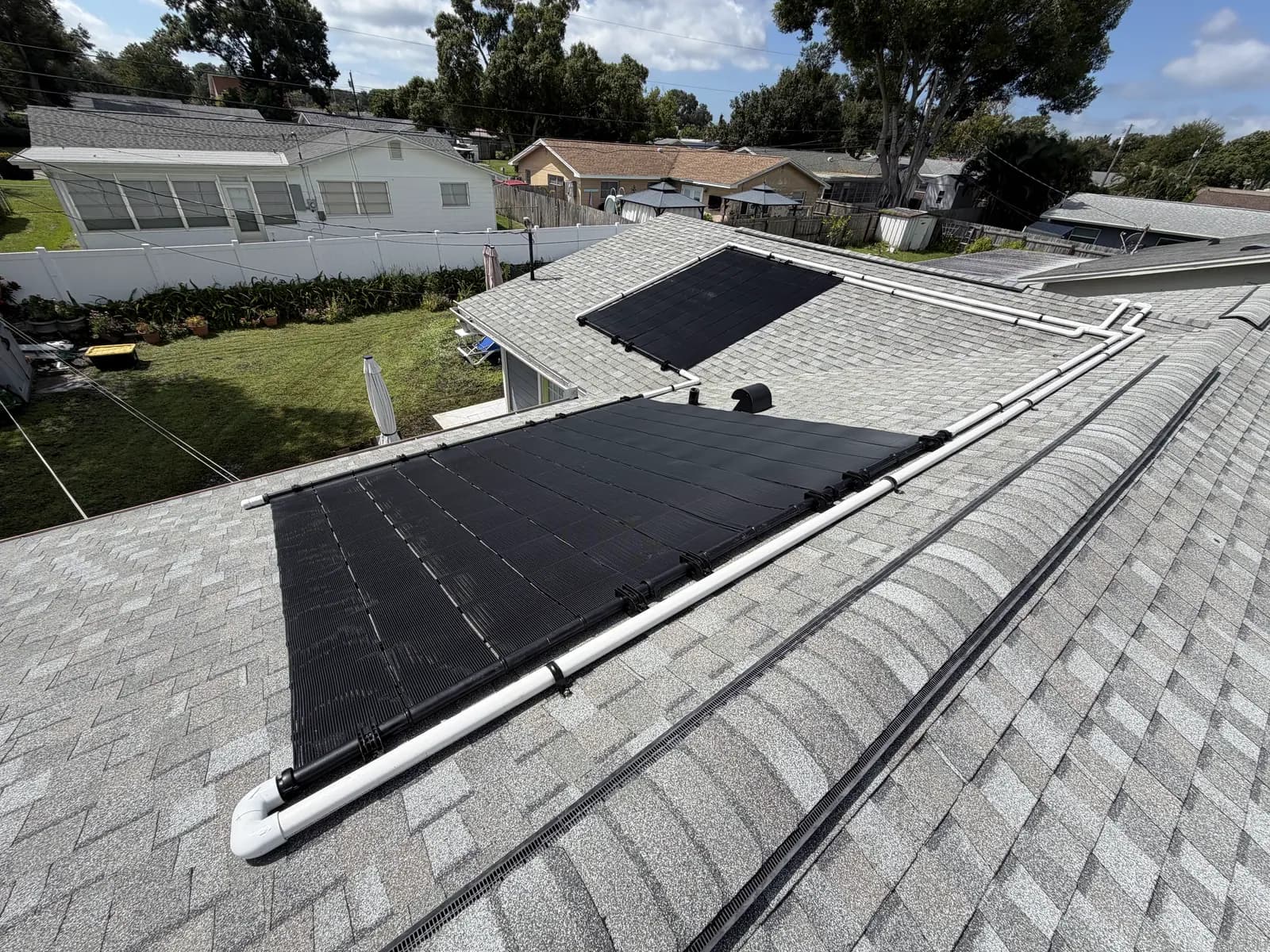
Three recent jobs show the range on ordinary shingle roofs. In Largo, in Pinellas County, the collectors went up as two separate arrays on two roof planes, with white PVC supply and return lines run across the roof and tied into one loop. Splitting the array is a common way to reach the collector area a pool needs when no single plane is big enough.
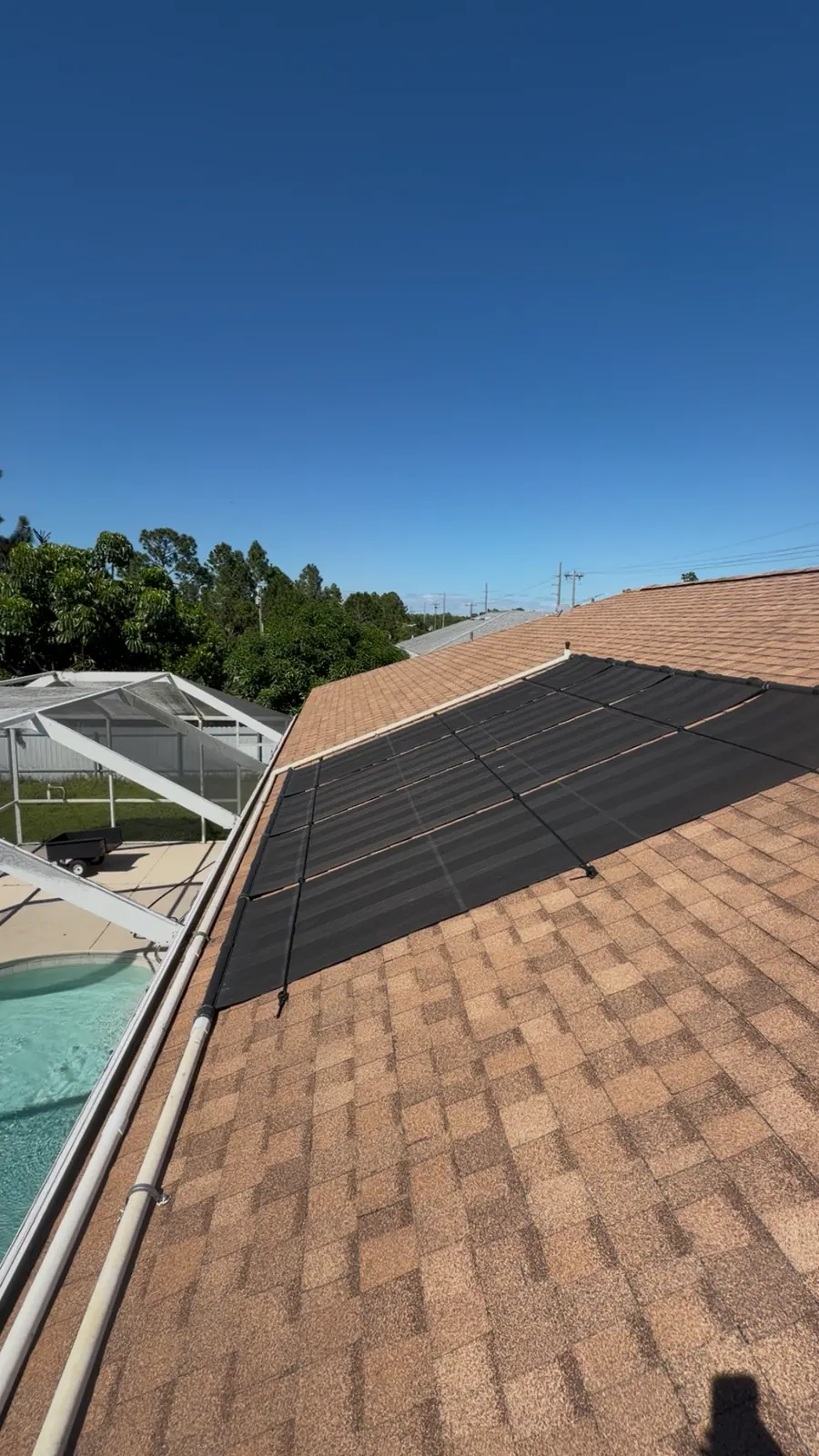
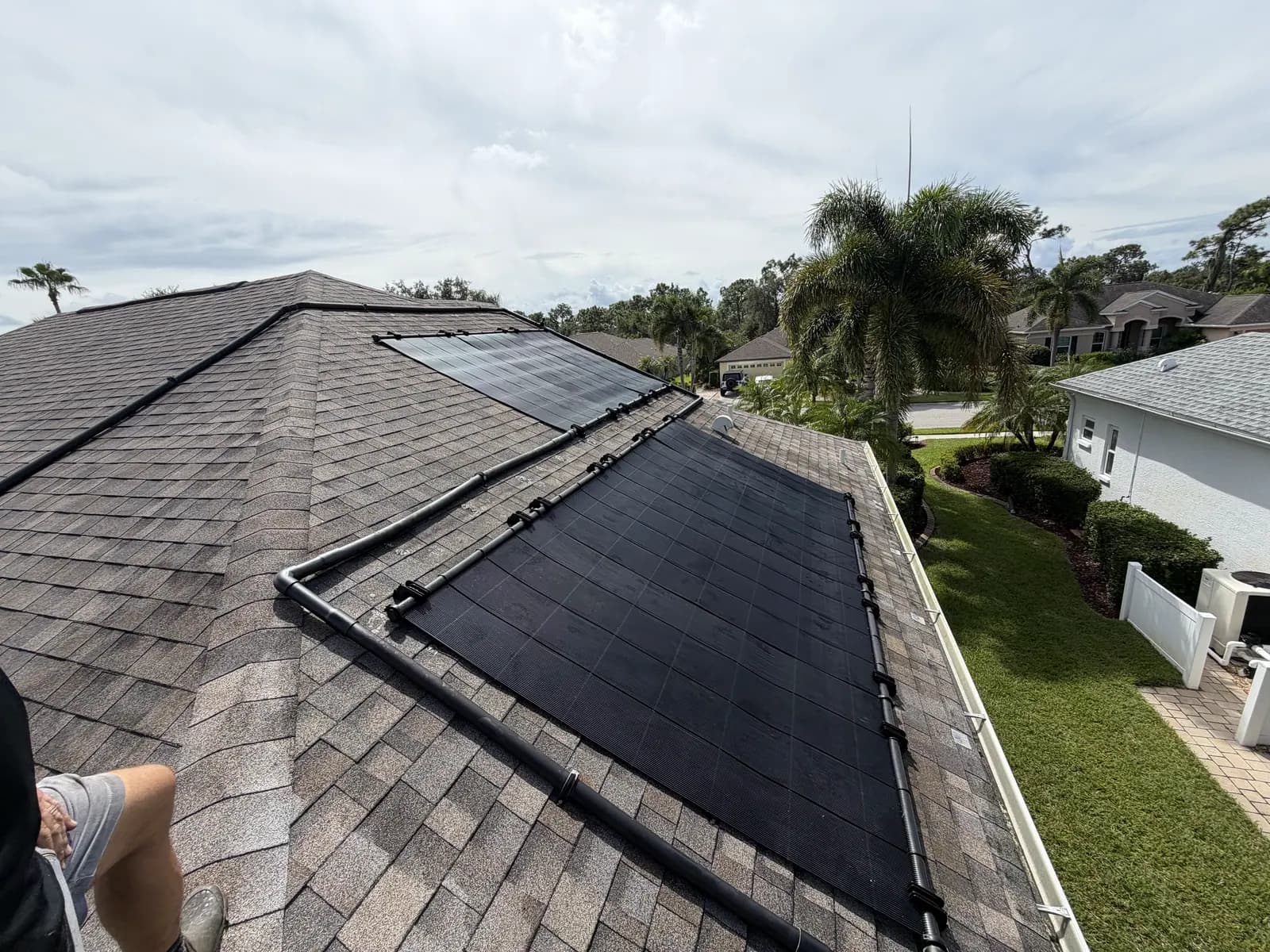
In Lakewood Ranch, the two arrays sit on adjoining planes of a hip roof, and the supply and return lines are dark rather than white so the plumbing reads as part of the roof from the street. In Lehigh Acres, the array sits on the roof plane directly above a screened pool, which keeps the plumbing run back down to the equipment short.
None of these is a showpiece. They are what pool solar looks like when it is sized to the pool and fitted to the roof the house actually has, and each project page has the photos, plus an install clip for Lehigh Acres.
Is it right for you?
Good fit if
- An unshaded roof plane facing south, west or east with room for collectors equal to most of the pool's surface area
- You swim mostly spring through fall, or year-round with a cover and a backup heater
- You want the lowest possible operating cost and can live with heat that follows the weather
- The roof is in good condition and not due for replacement in the next few years
Look elsewhere if
- Heavy shade from trees or neighboring buildings over the usable roof
- Only a north-facing roof, or roof planes too small for a meaningful array
- You need guaranteed heat on demand, such as a spa or a set temperature for a specific date
- The roof needs replacing soon: re-roof first, then add solar
Real installations
Recent jobs from our installation library that relate to this topic.