Modern Pool Heating · Owner/operator Henry Manna, Florida Certified Pool/Spa Contractor CPC1460367
Updated October 16, 2026
Short answer
Plan on solar collector area equal to 50 to 100 percent of your pool's surface area; the Department of Energy says a 15 by 30 foot pool in Florida typically needs 100 percent, about 450 square feet, for year-round use. With common 4 by 12 foot panels of roughly 48 square feet each, that is about nine or ten panels. Screened or shaded pools, east- or west-facing roofs and longer swim seasons push the number up; a pool cover pulls it down.
What we usually recommend
If you swim year-round or the pool is screened, we'd size close to 100 percent of the surface area and pair it with a cover. If you mostly swim spring through fall on an open pool with a good south-facing roof, something nearer 75 percent can do the job. If no single roof plane holds the area, we'd split the array across two planes rather than shrink the system.
- DOE's rule: collector area equal to 50-100% of the pool's surface area, about 100% for year-round use in Florida.
- Heliocol's manual puts the optimum at 75-100% and above 100% for heavily shaded pools.
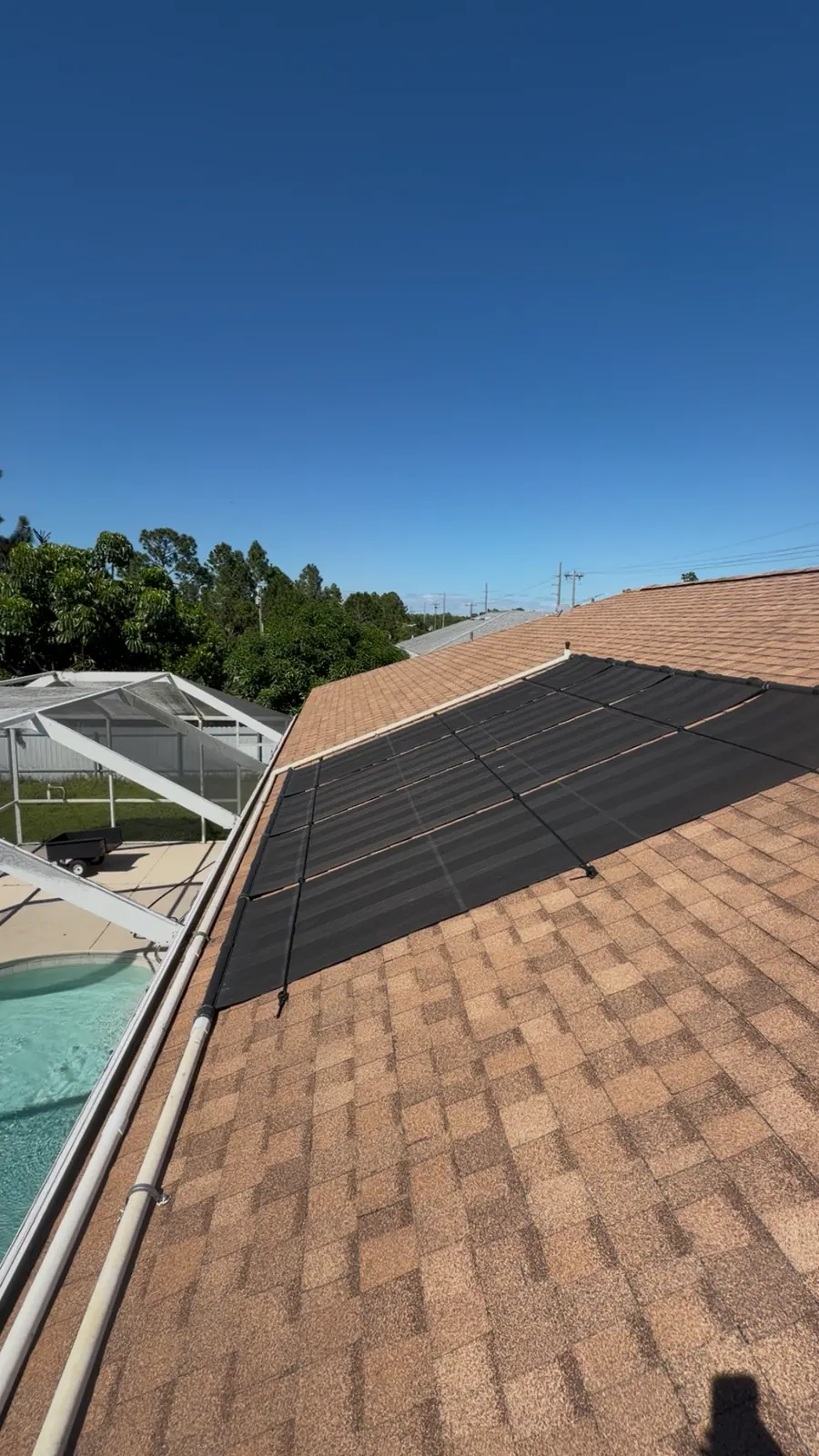
- South-facing roofs are best; DOE says collectors can face up to 45° east or west of south without significant loss, and no manufacturer accepts north.
- A cover cuts the area needed: FSEC's table calls for 2.1-2.9 times as much collector on an uncovered pool.
Start with the pool's surface area, not its gallons
Solar sizing is driven by the pool's surface area, because that is where the heat goes. FSEC's sizing publication puts it simply: most of a pool's heat loss happens at the water's surface, and the amount of solar heat put back depends on how much collector you install. Measure length times width for a rectangle; for a freeform pool, a sketch broken into rectangles gets close enough.
The Department of Energy's rule of thumb is that collector area should equal 50 to 100 percent of the pool's surface area, more in cooler and cloudier areas, and that adding collector lengthens the swimming season. Its Florida example is specific: a 15 by 30 foot outdoor pool typically needs collectors equal to 100 percent of its area, 450 square feet, to accommodate year-round use. DOE also notes that a pool cover usually lets you reduce the collector area in any climate.
Manufacturers land in the same place. Heliocol's installation manual says the optimal system for most pools is 75 to 100 percent of the surface area, that heavily shaded or indoor pools may need more than 100 percent, and that a system under 75 percent will still add heat but may not perform as well as one closer to the size of the pool. The available roof and the pump's flow are the two limits it tells installers to balance that against.
Common panel sizes
Pool collectors are sold as panels about 4 feet wide in several lengths, and the length is what changes the area. Heliocol publishes its HC-30, HC-38, HC-40 and HC-50 at nominal 4 by 8, 4 by 9.5, 4 by 10.5 and 4 by 12.5 feet, with aperture areas of 29.15, 36.68, 40.68 and 48.23 square feet. Techno-Solis sells 4 by 8, 4 by 10 and 4 by 12 foot panels and uses 32, 40 and 48 square feet for them in its sizing worksheet, and its manual recommends larger panels where possible to lower the cost per square foot.
Width matters for fitting the roof. Techno-Solis allows 51 inches per panel across the row (a 48 inch panel plus a 3 inch mounting gap), so seven of its 4 by 10 panels take up about 357 by 120 inches, and it wants at least 3 inches more on every side of a row for the feed and return plumbing. Heliocol's 4 foot panels measure 46.56 inches wide. Your installer should measure the actual roof plane, not estimate from the ground.
Worked examples by pool size
The table below applies DOE's range to common residential pool sizes, with the panel count worked at 48 square feet per 4 by 12 foot panel. Treat it as a starting point: the shading, roof-direction and cover adjustments in the next sections can move the answer by several panels either way.
One manufacturer's worksheet shows how those adjustments stack. Techno-Solis multiplies the pool's area by a shading factor (1.0 open, 1.1 screened, 1.15 shaded, 1.25 screened and shaded) and a roof factor (0.75 south, 0.85 west, 0.95 east), then divides by the panel area. For a 15 by 30 foot pool and 4 by 12 panels that gives about 7 panels for an open pool on a south roof (450 x 1.0 x 0.75 / 48), about 9 for a screened pool on a west roof (450 x 1.1 x 0.85 / 48) and about 11 for a screened, shaded pool on an east roof (450 x 1.25 x 0.95 / 48). Note that this worksheet's south-roof answer is smaller than DOE's year-round Florida figure, so it is best read as a guide to the adjustments rather than the final number.
| Pool (feet) | Surface area | 75% of surface | 100% of surface | 4x12 panels at 75% | 4x12 panels at 100% |
|---|---|---|---|---|---|
| 12 x 24 | 288 sq ft | 216 sq ft | 288 sq ft | 4-5 | 6 |
| 14 x 28 | 392 sq ft | 294 sq ft | 392 sq ft | 6 | 8 |
| 15 x 30 | 450 sq ft | 338 sq ft | 450 sq ft | 7 | 9-10 |
| 16 x 32 | 512 sq ft | 384 sq ft | 512 sq ft | 8 | 11 |
| 18 x 36 | 648 sq ft | 486 sq ft | 648 sq ft | 10 | 13-14 |
| 20 x 40 | 800 sq ft | 600 sq ft | 800 sq ft | 12-13 | 17 |
Screens, season length and the cover
The Florida Solar Energy Center's sizing publication gives collector-to-pool ratios by region of the state, by swim season and by whether the pool is screened, and every one of them assumes the pool is covered. For year-round swimming on a covered pool, FSEC's ratio is 0.75 in central Florida and 0.60 in south Florida for an unscreened pool, rising to 1.05 and 0.83 for a screened one. Shorter seasons need much less: a covered, unscreened south Florida pool swum nine months a year is at 0.25. The publication was last revised in 1984 and is still posted on UCF's publications site.
The cover is the biggest single lever. FSEC says that if the pool will not be covered, the ratio has to be multiplied by 2.9 for a nine-month season and 2.1 for a twelve-month season, which more than doubles the collector needed for a year-round pool. Screening pushes the other way, too: FSEC measured screen enclosures cutting the sunlight reaching the water by as much as 30-40 percent on a clear day, and Techno-Solis says a screened or shaded pool needs roughly 15-25 percent more solar heating than an open one.
| Pool setup | Central Florida | South Florida |
|---|---|---|
| Covered, unscreened | 0.75 = about 338 sq ft | 0.60 = about 270 sq ft |
| Covered, screened | 1.05 = about 473 sq ft | 0.83 = about 374 sq ft |
| Uncovered, unscreened | 1.58 = about 709 sq ft | 1.26 = about 567 sq ft |
| Uncovered, screened | 2.21 = about 992 sq ft | 1.74 = about 784 sq ft |
What roof direction is best for pool solar in Florida?
South is best, and the window around it is wider than most people think. DOE says the optimum orientation in the northern hemisphere is true south, but that depending on location and tilt a collector can face up to 45 degrees east or west of true south without significantly decreasing its performance. FSEC's manual says the same in installer terms: if roof space facing within 45 degrees of south is available, mount the collectors directly on it, accept the small penalty for modest deviations, and occasionally add collector area to compensate.
Beyond that window, east and west roofs still work with more collector. Heliocol's manual calls west and east orientations acceptable, with east-facing systems producing more in the morning and west-facing systems more in the afternoon. Techno-Solis ranks orientations in order of efficiency as south, flat, then west or east, and its worksheet factors imply a west roof needs about 13 percent more collector than a south roof and an east roof about 27 percent more (0.85 and 0.95 against 0.75). Both manufacturers say collectors should never face north.
Florida law backs the south-facing window. Under Florida Statutes section 163.04, an association with architectural control may decide where on the roof solar collectors go, but only within an orientation to the south or within 45 degrees east or west of due south, and only if that decision does not impair the collectors' effective operation. This is a summary of the statute, not legal advice.
Tilt and shading
On tilt, DOE says year-round collectors would ideally be tilted at an angle equal to the site's latitude and summer-only collectors at latitude minus 10 to 15 degrees, but that studies show a collector not at the optimum angle loses little, so collectors can usually be mounted flat on the roof. The roof angle is then accounted for in sizing. FSEC adds that racks built to hold collectors at the ideal angle are generally too costly except in new construction. Techno-Solis asks for at least 15 degrees of pitch so the panels drain, and allows flat roofs in subtropical climates only with freeze circulation.
Shade is less forgiving than tilt. DOE's test for a good site starts with unshaded areas, FSEC tells installers to lay out collectors avoiding as much as possible any area shaded by trees, the building or other obstructions, and its manual reminds them to plan for longer winter shadows as the sun's path changes. Heliocol says heavily shaded pools may need more than 100 percent collector area, and Techno-Solis lists shade on the panels as a cause of inadequate heating, with the fix being to remove the obstruction or run the pump only when the panels are in sun. A tree that only shades the roof in December can still matter, because December is when you want the heat.
Splitting the array across roof planes
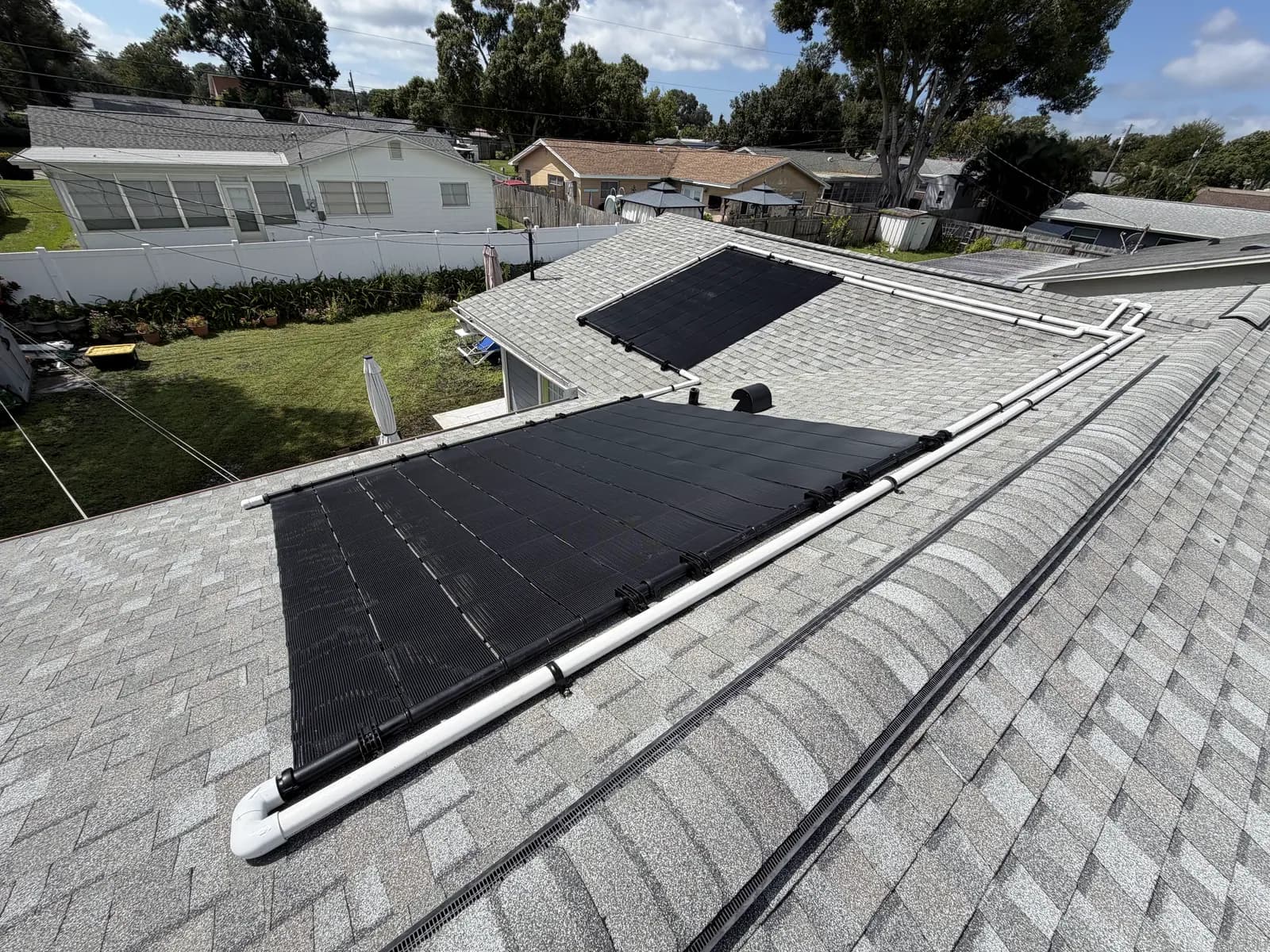
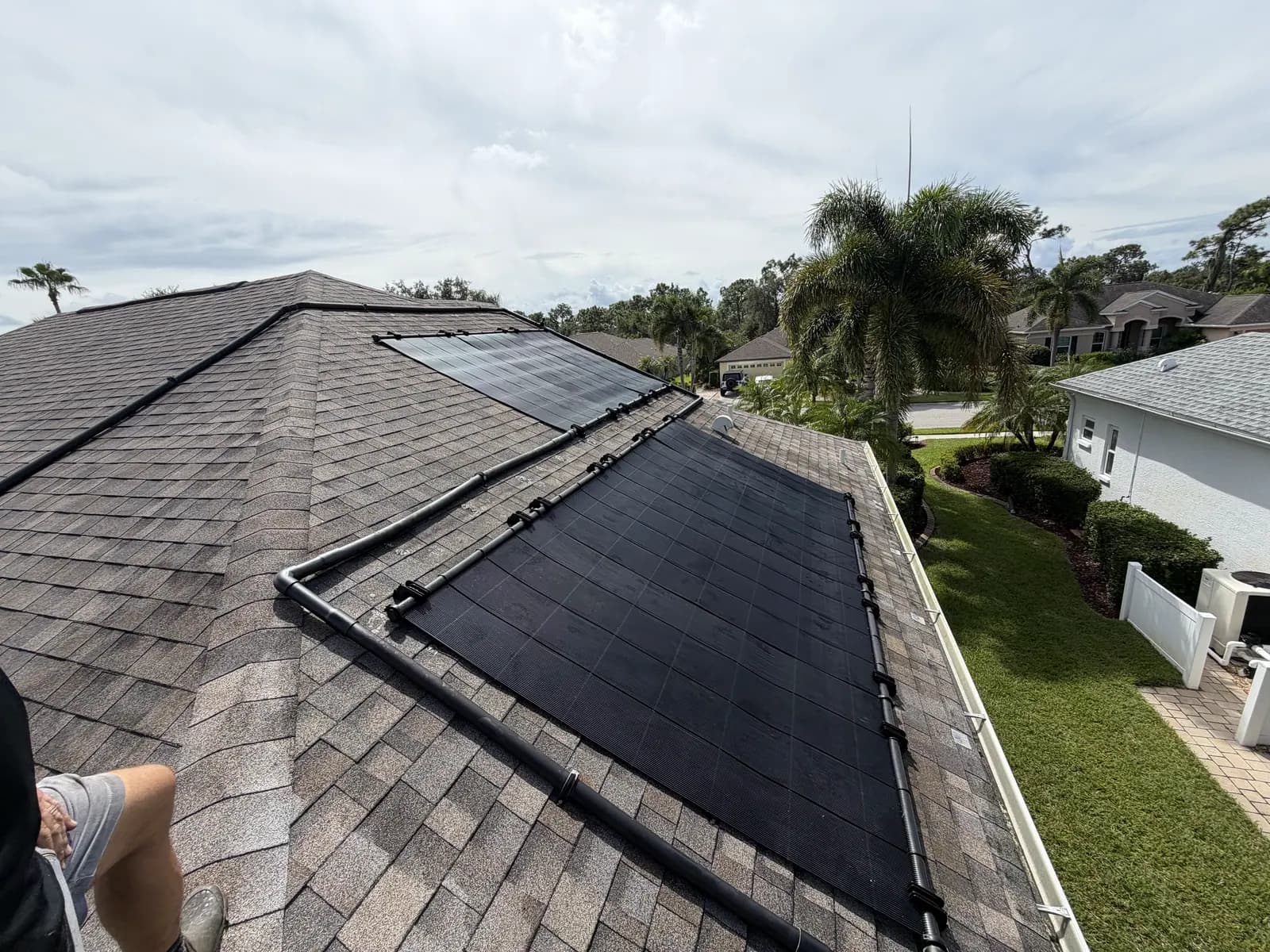
When no single roof plane can take the collector area, the array is split. Our Largo install is two separate arrays on two roof planes tied into one loop with PVC supply and return lines, and our Lakewood Ranch install is two arrays on adjoining planes of a hip roof sharing one loop. Splitting is normal practice, and the manuals cover it in detail.
Each bank has a size limit for even flow. Heliocol bases its limits on a maximum of about 40 GPM to any bank, which works out to 8 of its HC-50 panels, 10 of the HC-40 or HC-38, or 12 of the HC-30 per bank, and it supplies a row spacer kit for joining collectors on different roof levels or facing different directions. Techno-Solis allows no more than 12 panels in a row, uses a split kit for each break, and requires the return lines from multiple rows to meet at the highest point of the system.
The plumbing between banks is where split systems succeed or fail. FSEC's manual says pool collectors are almost always connected in parallel, that the feed and return paths to each collector should be about the same length, and that groups at different heights should all be fed from the lowest point and returned from the highest. Where the layout cannot balance itself, balancing valves are set until the outlet temperatures of the groups are within a few degrees of each other. Feeding each bank at a bottom corner and returning from the opposite top corner is the arrangement both manufacturers specify.
Flow and the pool pump
More panels need more water. Heliocol bases flow on 0.1 GPM per square foot of collector, with a typical 5-7 GPM through each HC-50, and Techno-Solis puts the ideal at 3-5 GPM per panel with 3-8 GPM acceptable. Ten 48 square foot panels at Heliocol's figure is about 48 GPM, which Heliocol's pipe table puts at the top of the range for 2 inch Schedule 40 PVC; above 50 GPM it calls for 2-1/2 inch.
That flow has to come from a pump that is still filtering the pool. Heliocol says the solar flow should be equal to or less than the pool's current filtration flow and that the pump must keep the turnover required for health and safety; DOE notes that switching to solar can require a larger pump or a separate, smaller pump to move water to and through the collectors. FSEC's manual describes that booster pump going in the solar feed line, where it runs only when solar heat is wanted. Techno-Solis adds a simple field check: on a sunny day the panels should feel cool to the touch, because the water is carrying the heat away.
Real installations
Recent jobs from our installation library that relate to this topic.