Modern Pool Heating · Owner/operator Henry Manna, Florida Certified Pool/Spa Contractor CPC1460367
Updated October 16, 2026
Short answer
Solar costs almost nothing to run but only delivers heat while the sun is on the collectors; an electric heat pump costs more to run but holds a set temperature day or night through most of a Gulf Coast winter. Solar suits a home with a good roof whose owners swim mostly spring through fall, and a heat pump suits owners who want a set temperature on a schedule. You can also combine them: solar does the work whenever it can and the heat pump makes up the difference, so it runs fewer hours.
What we usually recommend
If you have a suitable, unshaded roof and mainly swim from spring into late fall, we'd usually start with solar and a cover. If the roof won't work or you want the water at a set temperature on a set day, we'd go with a heat pump. If you swim year-round, have the roof for it and want the lowest running cost without giving up a dependable temperature, we'd pair them, with solar first and the heat pump as the backstop.
- Running cost: about $9 of electricity per million BTU from a heat pump at COP 5.0, against about $9 a month of extra pump time for solar.
- A heat pump gives heat on demand and needs pad space, airflow and a 240-volt circuit; solar gives free heat on sunny days and needs roof area.
- Combined systems: GulfStream's manual plumbs pool pump, filter, heat pump, solar, then the chlorinator.
- Control: solar first, with the heat pump running only when solar cannot hold the temperature.
The short version
Solar and a heat pump solve the same problem in opposite ways. A solar system uses the pool pump to send water through roof collectors whenever the sun can warm it; the heat is free, but it only arrives when the weather provides it. A heat pump uses electricity to move heat from the outdoor air into the water; you pay for every degree, but you choose the temperature and it keeps working at night and on cloudy days.
That gives each a clear role. Solar is one of Florida's lowest-operating-cost methods for extending the swim season when the home has suitable roof orientation and sun exposure. An electric heat pump is one of the lowest-cost powered methods of heating a pool, and our buyer's guide calls it the default answer for most Florida pools that get used regularly.
This page goes deeper on the two-way choice and on running both together. For gas, spas and the full three-way comparison, see our solar vs heat pump vs gas buyer's guide rather than a repeat of it here.
Operating cost, worked out
A heat pump's running cost is the electricity it uses divided by its efficiency. One million BTU of heat is 293 kWh (at 3,412 BTU per kWh), and at a coefficient of performance (COP) of 5.0 the compressor draws about 58.6 kWh to deliver it: about $9.00 at Florida's average residential rate of 15.36 cents per kWh. At the COP of about 4.0 that manufacturers publish for 50°F air, the same heat costs about $11.25.
Scaled to a pool, our cost guide takes DOE's Miami heat pump estimates down to a 450 square foot pool held at 80°F all year at today's Florida rate: roughly $1,060 a year uncovered, about $88 a month averaged over the year, and about $215 a year, roughly $18 a month, with a cover. Most owners heat for part of the year, so a real bill is usually lower. Solar's running cost is pump time; the cost guide uses two extra hours a day on a 1 kW pump, 60 kWh a month, which is about $9 at the same rate, and less if the pump already runs in daylight for filtration.
What the solar heat is worth depends on how much the array collects. As an example only, Heliocol rates its 4 by 12.5 foot HC-50 panel at 28,940 BTU a day with 1,500 BTU per square foot of sunshine when the pool is 9°F warmer than the air, a common winter condition here, since FSEC notes that desired pool temperatures sit only slightly above the winter daytime mean in most of Florida. Ten panels at that rating is about 289,000 BTU a day, or roughly 8.7 million BTU over 30 such days: heat that would cost about $78 to make with a heat pump at COP 5.0, or about $98 at COP 4.0.
When the pool is cooler than the air, Heliocol's rating for the same sunshine is about 2.7 times higher. Real days vary, and solar heat only counts while the pool is below its setpoint, but the arithmetic shows why a well-sized array can carry much of the load in sunny weeks and why the heat pump still matters in cloudy ones.
Heat on demand vs free heat
A heat pump holds a temperature you choose. Heat pumps warm a swimming pool gradually over many hours. Actual heating speed depends on pool volume, heater output, starting water temperature, outdoor air temperature, humidity, wind conditions and whether the pool is covered. Proper heater sizing and the use of a pool cover can significantly affect recovery time. GulfStream's manual gives its own benchmark: a properly sized unit in ideal conditions (80°F air, 80% relative humidity, 80°F water) should raise the water an average of about 1°F per hour, and it describes heat pumps as best used to maintain a set temperature, not for fast heating like a gas heater.
A heat pump also has a weather floor. GulfStream's HE Series enters a defrost cycle below 48°F air and will not run below 35°F, so the coldest nights of a Florida winter are when its output is lowest.
Solar delivers heat only while the sun is on the collectors and the pool is below the setpoint. Heliocol's manual puts the return water about 3-5°F above the pool on a sunny day and only 2-3°F in cooler months, and when the collectors are no warmer than the pool, the controller simply bypasses them. After a cold front, solar alone recovers over a run of sunny days rather than overnight.
Neither one heats a spa quickly. If a hot spa on short notice matters, that is a job for gas, which the buyer's guide covers.
Roof needs vs pad space
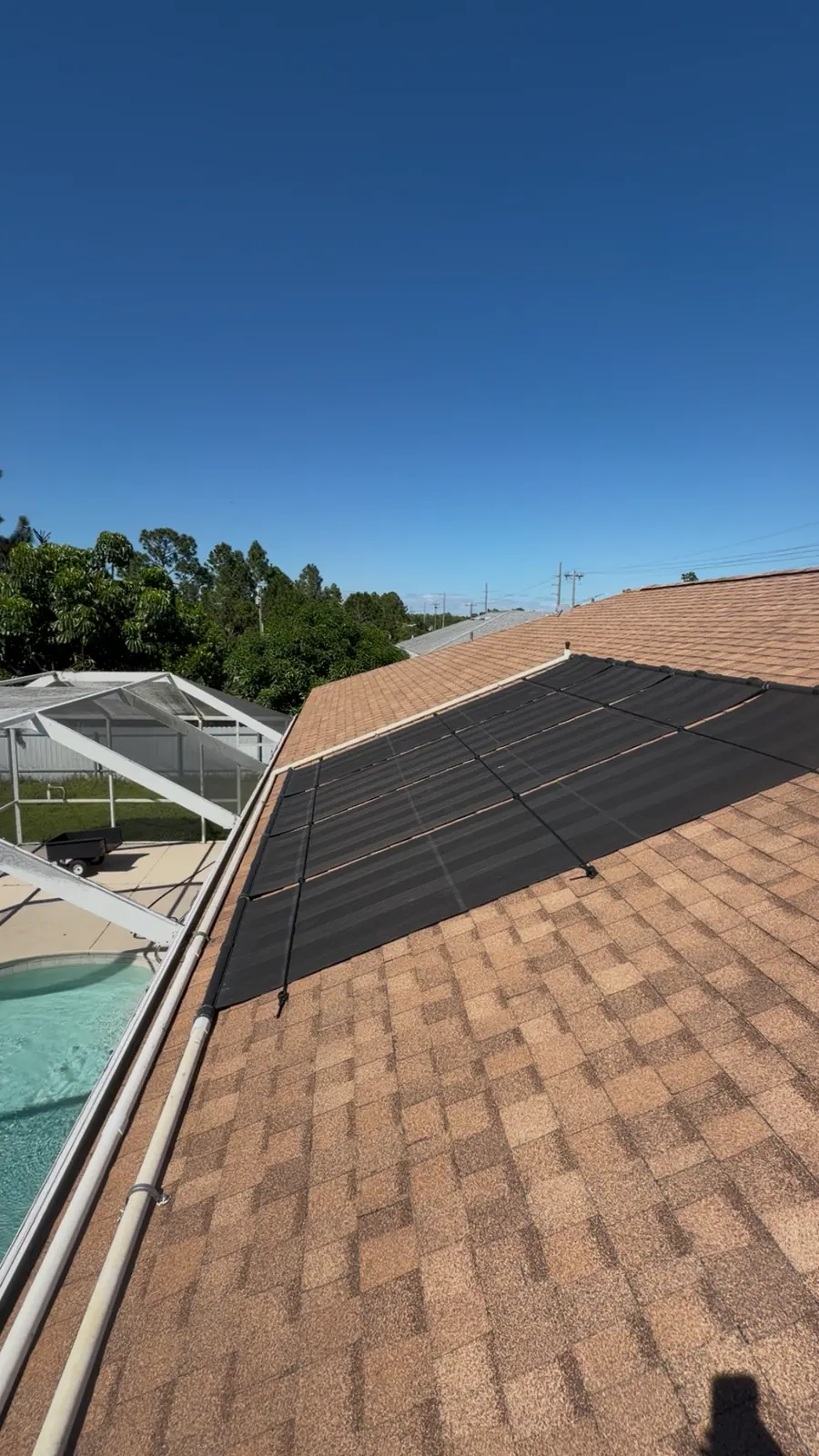
Solar needs roof. DOE's rule is collector area equal to 50-100 percent of the pool's surface area, and about 100 percent for year-round use in Florida: 450 square feet of collector for a 15 by 30 foot pool, ideally facing south or within 45 degrees of it, unshaded, on a roof the collectors can be properly attached to. It also needs the pool pump to lift water to the roof during daylight, which DOE notes can mean a larger pump or a separate booster pump. Our sizing and roof articles cover the details.
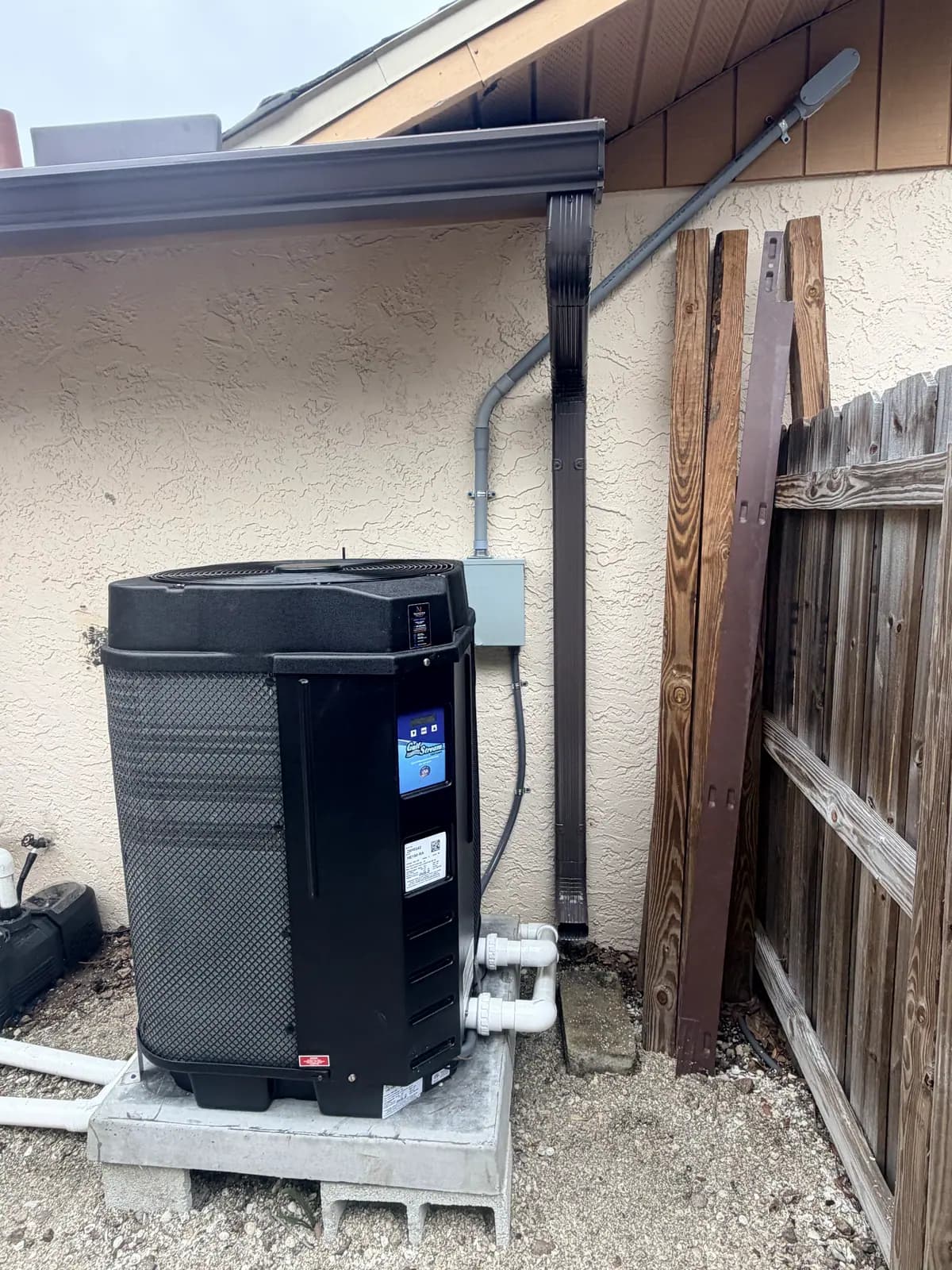
A heat pump needs ground and wiring. Take GulfStream's HE150-RA, the unit on our Dunedin, Tampa, Siesta Key and Treasure Island installs: it is rated at 138,000 BTU/hr at 80°F air, 80°F water and 80% relative humidity, measures 31 by 31 by 46 inches, weighs 239 pounds, and runs on 208-230 volts with 37 minimum circuit amps on a 50 amp maximum breaker. GulfStream calls for 12 inches of clearance on each side and four feet above, outdoors only, and 30-70 GPM of water flow.
So the property often settles it. A shaded lot or a small, broken-up roof points to a heat pump. A tight side yard with no room for the clearances, or an electrical panel with no capacity left, points toward solar.
Can I combine solar pool heating with a heat pump? How it's plumbed
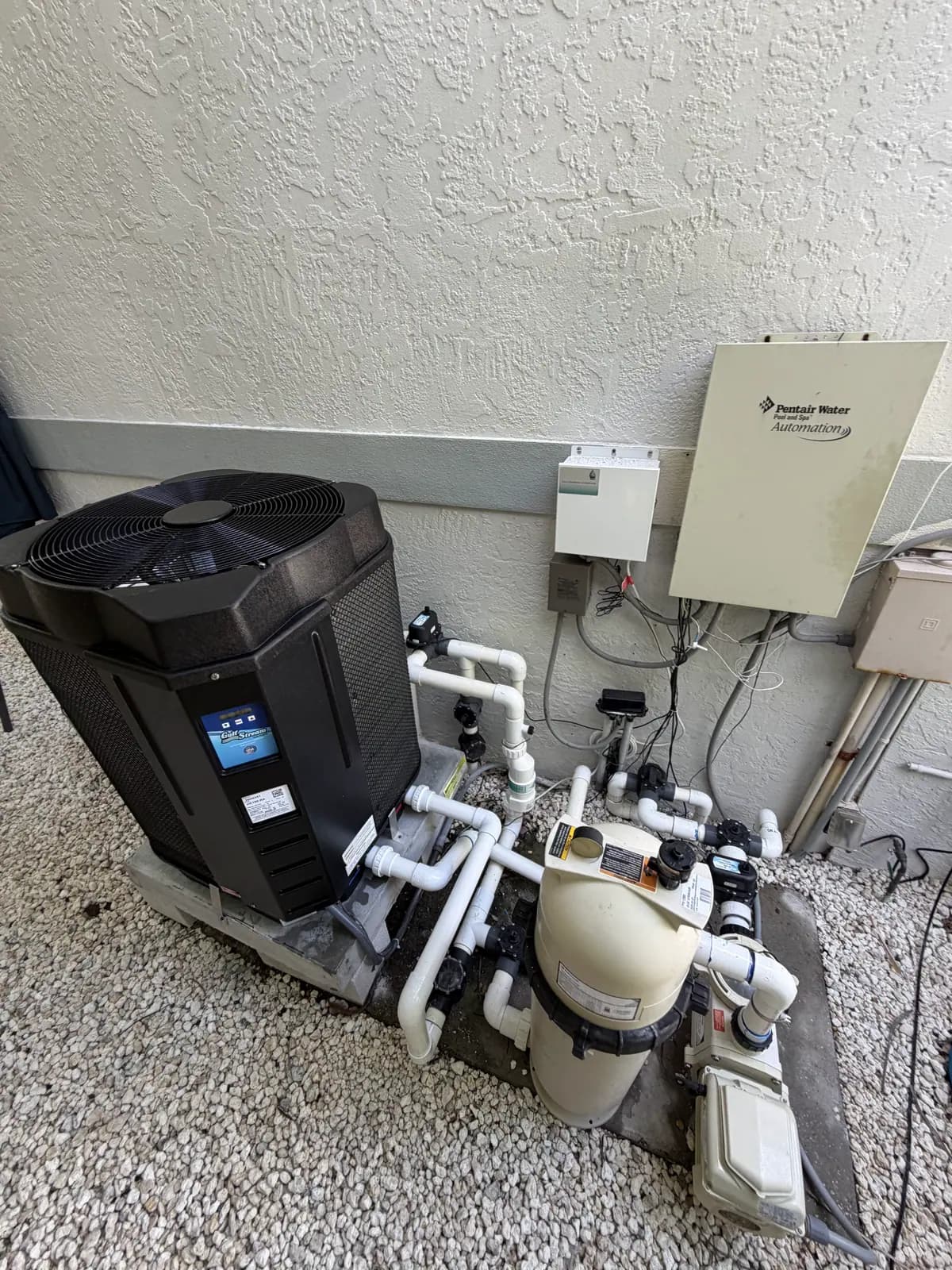
Yes, and the plumbing order matters. GulfStream's installation guide publishes the sequence: pool pump, filter, heat pump, solar, then the chlorinating system, then the pool. It also says in-line chlorinators and salt chlorine generators must be on the return side of the heat pump, and that a check valve can be installed between the chlorinator and the heat pump to prevent backflow. On a GulfStream install, that is the order to follow.
Solar collector manuals draw the connection from the solar side. Heliocol's places the solar tie-in right after the filter and ahead of other equipment such as heaters and chemical feeders, and Techno-Solis puts auxiliary heaters and chlorine feeders on the return line after the solar tee. The rule every document agrees on is that the chlorinator or salt cell comes last. Where the heat pump's own manual specifies its position, as GulfStream's does, follow the heat pump manual for the heat pump.
Flow has to suit both. GulfStream asks for 30-70 GPM through its heat pumps, 45-50 GPM optimal, with no external bypass needed up to 70 GPM, while Heliocol sizes solar flow at about 0.1 GPM per square foot of collector, so ten 48 square foot panels want about 48 GPM. The pool pump has to deliver that up to the roof while still turning the pool over.
One detail catches installations out. GulfStream notes that with some solar heaters the heat pump's water pressure switch must be adjusted or an external flow switch added, because head pressure can make the switch falsely sense flow, and that water flowing back from the solar loop when the circulation pump stops can activate the pressure switch and lead to a water-flow lockout.
How a combined system is controlled
The goal is solar first, with the heat pump doing only what solar cannot. A solar controller already behaves that way on its own side: Hayward's GL-235, for example, sends water to the roof when the collectors are at least 4°F warmer than the pool and the pool is below its setpoint, and stops when the difference drops to 1.5°F or the setpoint is reached.
With separate controls, the heat pump runs on its own thermostat. Giving the heat pump a setpoint a little below the solar setpoint lets the sun do the work on good days, with the heat pump starting only when the pool falls below its lower setting. The pump schedule has to cover both: daylight hours for solar (Heliocol suggests roughly 10 a.m. to 4 p.m., Techno-Solis 9 a.m. to 5 p.m.) and whatever hours the heat pump needs to hold its setpoint.
Automation can do the coordinating. Pool automation systems can run the solar valve and call for a heater from one set of temperatures; Pentair's SunTouch guide, for instance, describes a Solar Preferred setting, written for solar combined with a gas heater, that uses solar when it is most effective and switches to the heater when solar heat is not available. How a given system handles a heat pump in that role varies, so check its manual. GulfStream heat pumps connect to automation through dry-contact remote thermostat terminals, and the manual states they cannot be connected over RS-485.
We have built this kind of pairing. One equipment rebuild in our gallery, completed in 2024, combined new plumbing and valves, a new electric heater and automation with pool solar to help hold the heat and lower the electric heater's operating cost. The published price for that whole job was $11,500-$12,500; it is one specific project, not a typical quote.
Who should choose which
Whichever you choose, price a cover first. DOE calls covering a pool when it is not in use the single most effective way to reduce pool heating costs, with savings of 50-70 percent possible, and it makes every option on this list cheaper to run.
Beyond that, use these as a starting point. Our buyer's guide covers gas and the full three-way decision, and a site visit settles what the roof, the pad and the electrical panel will actually allow:
- Solar alone: a suitable, unshaded roof facing south, west or east, a pool used mostly spring through fall, and an owner who wants the lowest running cost and accepts heat that follows the weather.
- Heat pump alone: a shaded lot or unusable roof, a pool used most weeks of the year at a set temperature, and room for the unit's clearances and a 240-volt circuit.
- Both: year-round swimmers with a good roof who want a low running cost without giving up a dependable temperature, and larger or exposed pools where a heat pump alone would run long hours.
- Gas in the mix: an attached spa you want hot on short notice, or a pool used only a few weekends a year. See the buyer's guide.
Pros and cons
Solar pool heating
Pros
- Essentially no fuel cost: about $9 a month of extra pump time in our example
- No compressor or combustion, and DOE says solar heaters typically outlast gas and heat pump heaters
- Running cost barely moves when electricity prices do
Cons
- Heat only while the sun is on the collectors
- Needs unshaded roof area equal to most of the pool's surface
- Recovers slowly after cold fronts and cloudy weeks
Electric heat pump
Pros
- Holds a set temperature day or night
- One of the lowest-cost powered methods: about $9 of electricity per million BTU at COP 5.0
- Works regardless of roof direction or shade
Cons
- You pay for every degree
- Needs pad space, clearances and a 240-volt circuit
- Output falls as the air cools; GulfStream's HE units defrost below 48°F and stop below 35°F
Solar plus heat pump
Pros
- Solar carries the sunny days, so the heat pump runs fewer hours
- A dependable temperature at a lower running cost than a heat pump alone
Cons
- Two systems to buy and maintain
- Plumbing order, flow and controls have to be set up correctly
What this costs
We give a written, itemized price after we have seen your equipment pad. The pad, the plumbing, the electrical service and the gas supply decide most of the cost, so a number given before anyone has looked at them is a guess.
What moves the price
- Roof type (solar): shingle, tile and metal roofs each mount differently.
- Number and size of solar collectors: driven by pool surface area and how much heat you want.
- Electrical service: whether the panel has room and capacity for a new 240-volt circuit.
- Equipment pad: whether there is a level pad in the right spot or one has to be poured or built.
- Existing plumbing: whether the current lines can be reused or need re-piping to reach the new equipment.
- Automation: tying the heater into an existing controller, or adding one.
What recent jobs cost
These are the actual price ranges for specific past jobs shown in our gallery, not quotes or averages. Your price depends on your pad, plumbing and electrical.
Pool Equipment Rebuild
$11,500-$12,500A full rebuild of the pool's plumbing with new valves, a new electric heater and automation, plus pool solar to help hold the heat and lower the operating cost of the electric heater. Completed in 2024.
See it in the gallery: Pool Equipment RebuildReal installations
Recent jobs from our installation library that relate to this topic.