Modern Pool Heating · Owner/operator Henry Manna, Florida Certified Pool/Spa Contractor CPC1460367
Updated October 16, 2026
Short answer
A typical 110,000 to 140,000 BTU/hr pool heat pump draws roughly 5 to 8 kilowatts while its compressor runs, which works out to about 80 cents to $1.20 an hour at Florida's average residential rate of 15.36 cents per kWh. What you pay in a month depends on how many hours it runs, and that depends on the temperature you keep, the weather and, above all, whether the pool is covered. As a yardstick, a million BTU of pool heat costs about $7.50 at a COP of 6.0 and about $11.25 when cold air pulls the COP down to 4.0.
What we usually recommend
If you want a smaller bill, put a cover on the pool before you think about equipment, and keep the setpoint where you actually enjoy swimming rather than a few degrees above it. Let the heat pump do most of its work in the warmest hours of the day, when it runs most efficiently. If you are choosing between heat pumps, compare COP at both the 80°F and 50°F test points, but expect the cover and the setpoint to move your bill far more than the brand does.
- Electrical input is roughly heating capacity divided by (COP x 3,412). A GulfStream HE150-RA works out to about 6.7 kW at the 80/80/80 test point.
- At a COP of 4.0, the 50°F-air test point, the same heat takes 50% more electricity than at COP 6.0.
- Monthly cost = kilowatts x hours per day x days x your rate. The hours are the variable, and a cover cuts them more than anything else.
- The data plate's breaker and circuit amps are for sizing wire, not for estimating your bill.
The formula: how much electricity a pool heat pump draws
A heat pump does not make heat, it moves it, and its COP (coefficient of performance) tells you how much heat it moves for each unit of electricity. The Department of Energy describes COPs of 3.0 to 7.0, meaning 3 to 7 units of heat out for every unit of electricity it takes to run the compressor. Since one kilowatt-hour is 3,412 BTU, the electricity a heat pump draws while it runs is approximately its heating capacity divided by (COP x 3,412).
Worked through for the units on our own recent jobs: the GulfStream HE150-RA is rated 138,000 BTU/hr at a COP of 6.0 at 80°F air, 80°F water and 80% humidity, so 138,000 / (6.0 x 3,412) = 138,000 / 20,472, or about 6.7 kW. The HE110-RA, at 110,000 BTU/hr and a COP of 6.1, works out to about 5.3 kW. Where manufacturers publish the input power at the rating point, the arithmetic lands on it: AquaCal lists 5.9 kW for the SQ140R (114,000 / (5.7 x 3,412) is about 5.9), and Jandy's brochure lists 7.95 kW for the JRT4001R (160,000 / (5.9 x 3,412) is about 7.95).
One thing not to do is estimate a bill from the electrical panel. The minimum circuit amps and maximum breaker printed on the data plate are for sizing the wire and the breaker safely; a heat pump on a 50 amp breaker is not drawing 50 amps all the time.
| Model | Heating capacity | COP | Electrical input | Cost per running hour |
|---|---|---|---|---|
| GulfStream HE110-RA | 110,000 BTU/hr (80/80/80) | 6.1 | About 5.3 kW (calculated) | About $0.81 |
| GulfStream HE125-RA | 118,000 BTU/hr (80/80/80) | 6.0 | About 5.8 kW (calculated) | About $0.89 |
| GulfStream HE150-RA | 138,000 BTU/hr (80/80/80) | 6.0 | About 6.7 kW (calculated) | About $1.03 |
| AquaCal SQ140R | 114,000 BTU/hr (80/80/80) | 5.7 | 5.9 kW (published) | About $0.91 |
| Hayward HP21405T | 138,000 BTU/hr (80/80/80) | 5.7 | About 7.1 kW (calculated) | About $1.09 |
| Hayward HP21405T at 50°F air | 82,000 BTU/hr (50/63/80) | 4.0 | About 6.0 kW (calculated) | About $0.92 |
| Raypak Crosswind V 8550EHC | 137,000 BTU/hr (80/80/80) | 5.8 | 6.7 kW (published input) | About $1.03 |
| Jandy VersaTemp JRT4001R | 160,000 BTU/hr (80/80/80) | 5.9 | 7.85 kW (manual) to 7.95 kW (brochure) | About $1.21 to $1.22 |
| Moov Inverter MI900 | 82,000 BTU/hr (published) | Not published at a test point | 0.6 to 3.9 kW (published range at 80°F air and water) | About $0.09 to $0.60 |
What happens when the air gets cold
A heat pump's efficiency falls as the air cools, because there is less heat in the air to move. The Department of Energy puts it simply: heat pump pool heaters work efficiently as long as the outside temperature remains above the 45°F to 50°F range, and the cooler the air they draw in, the less efficient they are, which means higher energy bills. GulfStream states that every HE model meets or exceeds a COP of 4.0 at the AHRI low test point of 50°F air, 63% humidity and 80°F water.
Here is what that does to the arithmetic. At a COP of 6.0, each kWh moves 20,472 BTU into the pool; at a COP of 4.0 it moves 13,648. The same heat therefore takes 50% more electricity on a 50°F morning than on an 80°F afternoon. Per million BTU, that is about 48.8 kWh ($7.50) at COP 6.0 against about 73.3 kWh ($11.25) at COP 4.0, at 15.36 cents per kWh.
The power draw itself does not climb; the output falls. Hayward publishes both points for the HP21405T: 138,000 BTU/hr at COP 5.7 (about 7.1 kW) at 80/80/80, and 82,000 BTU/hr at COP 4.0 (about 6.0 kW) at 50°F air. In the cold it draws a little less power but makes about 40% less heat, so it has to run longer to do the same job. GulfStream publishes no capacity at 50°F, only the COP floor, so we cannot do the same sum for the HE150-RA. Its manual adds the practical advice: run the heat pump during the warmer daylight hours, because it keeps working as the temperature drops at night but its efficiency decreases.
From hourly cost to a monthly bill: worked illustrations
Monthly cost is kilowatts x compressor hours per day x days x your electricity rate. The table below runs that sum for two GulfStream models at their 80/80/80 draw and the EIA's Florida residential average of 15.36 cents per kWh. These are illustrations of the arithmetic, not predictions for your pool: we do not know how many hours your heat pump will run, and nobody else does either until they know the pool, the cover, the setpoint and the weather.
Read the two columns with care. They are not two different pools. For the same pool on the same day, the HE150-RA would run fewer hours than the HE110-RA, because it makes about 25% more heat per hour; per BTU delivered, the two cost almost exactly the same. The columns show what a given number of compressor hours costs on each unit.
Two more caveats. The draw shifts with conditions, so a heat pump working through a cool, damp week will not sit exactly at its 80/80/80 figure. And the filter pump has to run whenever the heat pump runs; its electricity is separate from the figures here. A variable-speed pump set just high enough to satisfy the heat pump's minimum flow keeps that side of the bill down.
| Average compressor run time | HE110-RA (about 5.3 kW) | HE150-RA (about 6.7 kW) |
|---|---|---|
| 2 hours a day | 318 kWh, about $49 | 402 kWh, about $62 |
| 4 hours a day | 636 kWh, about $98 | 804 kWh, about $123 |
| 6 hours a day | 954 kWh, about $147 | 1,206 kWh, about $185 |
| 8 hours a day | 1,272 kWh, about $195 | 1,608 kWh, about $247 |
Another way to estimate: start from the heat your pool needs
Run hours are really just a consequence of how much heat the pool needs, so it can be easier to start there. A million BTU is roughly what it takes to raise a 15,000 gallon pool by 8°F, before counting the heat the pool loses while you warm it. At 15.36 cents per kWh, a million BTU of heat costs about $7.50 at a COP of 6.0, about $9.00 at a COP of 5.0 and about $11.25 at a COP of 4.0. Our cost-to-heat guide puts that figure beside natural gas and propane.
The heat a pool needs over a month is dominated by losses, mostly evaporation, and that is where published seasonal numbers help. The Department of Energy's heat pump table for Miami, based on a 1,000 square foot uncovered pool heated year round at an average COP of 5.0 and 13.01 cents per kWh, shows $1,499 a year at 78°F, $1,989 at 80°F and $2,514 at 82°F. Our cost guide scales the 80°F figure to a 450 square foot pool and today's Florida rate and lands at roughly $88 a month averaged across the year uncovered, and roughly $18 a month with a cover.
Those are year-round figures for a pool held at 80°F every day. Most Gulf Coast owners heat for part of the year, so a real bill is usually a fraction of that annual total, concentrated in the cooler months. The calculator on this page lets you put in your own pool size, electricity rate and heat pump COP, and switch between a covered and an uncovered pool; it holds the pool at 80°F.
The cover effect
If there is one line on this page to act on, it is this one. The Department of Energy says evaporation is the largest source of heat loss from a pool and that covering a pool when it is not in use is the single most effective way to cut pool heating costs, with savings of 50-70% possible. In DOE's own Miami heat pump table, the covered figure at 80°F is $409 a year against $1,989 uncovered, about a fifth of the cost.
In the terms of the table above, a cover moves you up the rows. If it halves the heat the pool loses overnight, it roughly halves the compressor hours, and a pool that needed six hours a day may need three. No equipment upgrade we can sell you does that. GulfStream's own troubleshooting section makes the same point: a pool blanket greatly cuts the heat the pool loses.
The setpoint is the second lever. In the same DOE table, moving a year-round Miami pool from 78°F to 82°F raises the annual heat pump cost from $1,499 to $2,514, about two thirds more for four degrees. A screen enclosure or a windbreak helps too, by cutting the wind that drives evaporation.
What else moves the bill
After the cover and the setpoint, these are the things we look at when an owner tells us the heat pump costs more to run than they expected.
None of them needs new equipment, and most cost nothing to fix. Several are installation details, which is why we check clearances, flow and the pump schedule on the day a heat pump goes in rather than waiting for the first winter bill.
- Your real electricity rate. Divide your bill's total by the kWh used to get your all-in rate, and swap it for the 15.36 cent state average used here.
- When it runs. GulfStream's manual says the unit operates most efficiently in the warmest hours of the day; a schedule that heats mostly overnight pays the cold-air penalty every night.
- Airflow. A heat pump that recirculates its own cold discharge air under an overhang or against a wall behaves like a smaller, less efficient unit, and GulfStream warns it will push the unit into defrost.
- A dirty coil or filter. GulfStream lists good airflow through the evaporator and proper drainage as the two main maintenance tasks, and low water flow from a dirty filter as a cause of slow heating.
- Water flow. The heat pump only works when water moves through it at a flow inside its published window, so the pump schedule and the heater schedule have to overlap.
- Cooling. On a heat-and-cool unit, chilling runs the same compressor, so a summer of cooling shows up on the bill too.
When the bill does not add up
If the heat pump seems to run constantly and the pool still will not hold temperature, the cause is usually one of the items above rather than the heat pump itself: an uncovered pool on a windy week, a filter that needs cleaning, a pump schedule that leaves the heater short of flow, or a unit breathing its own cold air. GulfStream's troubleshooting guide lists low flow, air leaks, short pump run times and strong wind as the usual causes of slow heating, and suggests checking for roughly 40 to 50 GPM through the unit.
A quick check you can do yourself: with the heat pump running, hold a hand above the top grille. GulfStream's manual says you should feel cool air coming out after the start-up delay, the water returning to the pool should be a few degrees warmer than the water going in, and condensation should start draining from the base after about 15 minutes. If those three things are happening, the unit is moving heat, and the bill is telling you about the pool rather than the heater. If they are not, our troubleshooting article is the next step.
Comparing heat pumps on running cost
Published COP is the right way to compare efficiency, but keep the differences in proportion. The GulfStream HE150-RA's COP of 6.0 and the Hayward HP21405T's 5.7 differ by about 5%. As an illustration, a pool that needed 20 million BTU of heat over a winter would use about 977 kWh at COP 6.0 and about 1,028 kWh at COP 5.7, roughly $150 against $158 at 15.36 cents. A cover can change the same bill by half.
The 50°F figure is the more useful comparison for Florida winters, because that is when the heat pump works hardest. Hayward, AquaCal, Built Right, Jandy, Raypak and Thermeau publish capacity and COP at that point; most land at a COP of about 4.0. Inverter units such as Moov's run at part load for long periods, and Moov publishes an average COP across its speed range rather than a test-point figure, so its claim cannot be compared like for like.
Against other ways of heating, the ordering is not close on current Florida prices: our cost guide works a million BTU out at about $9 on a heat pump at COP 5.0 against about $29 on natural gas at 84% efficiency at the state average gas price, and more on propane. That is why we describe a heat pump as one of the lowest-cost powered ways to heat a pool in Florida; solar costs less again to run where the roof suits it.
Florida pool heating cost calculator
Change any number to match your pool and your utility bill. The defaults are Florida residential energy prices from the U.S. Energy Information Administration and a 15 by 30 foot pool.
Estimated year-round cost: heat pump $1,057 a year, natural gas $3,753 a year.
Estimated cost to hold 450 sq ft at 80°F all year, uncovered
| Method | Per year | Per month |
|---|---|---|
| Electric heat pump | $1,057 | $88 |
| Natural gas heater | $3,753 | $313 |
| Propane heater | $5,959 | $497 |
| Solar (pump electricity only) | $111 | $9 |
These are year-round estimates for a pool held at 80°F every single day. Most Florida owners heat for part of the year, so a real bill is usually a fraction of these figures. Solar shows only the extra pump electricity; whether solar alone can hold 80°F depends on collector area, roof orientation and the weather.
Cost per million BTU of heat delivered
About what it takes to raise a 15,000 gallon pool by 8°F.
| Method | Per million BTU |
|---|---|
| Electric heat pump · COP 5.0 | $9.00 |
| Natural gas heater · 84% efficient | $29.29 |
| Propane heater · 84% efficient | $46.50 |
| Electric resistance · for context | $45.02 |
How these numbers are worked out
Cost per million BTU: a heat pump uses 293.07 kWh ÷ COP for each million BTU it delivers; natural gas needs 10 therms ÷ thermal efficiency; propane needs 1,000,000 ÷ efficiency ÷ 91,452 BTU per gallon. Electric resistance has no multiplier: 293.07 kWh at your rate.
Year-round cost starts from the Department of Energy’s Miami estimates for a 1,000 sq ft pool held at 80°F: $1,989 a year uncovered and $409 covered for a heat pump at COP 5.0 and 13.01¢/kWh; $3,880 uncovered and $796 covered for an 80% efficient gas heater at $1.09 a therm. Each figure is scaled by your surface area (the load follows surface area), your energy price and your equipment’s efficiency. Propane uses the gas figure with your propane price converted at 0.91452 therms per gallon (currently $3.91 a therm).
Solar has no fuel cost: the figure is the extra pump time, two hours a day of a 1 kW pump, about 60 kWh a month at your electricity rate.
DOE’s heat pump and gas tables make slightly different cover assumptions, so they are not perfectly parallel. What the comparison shows reliably is the ratio between methods, and how much a cover changes everything. The full working is in What It Costs to Heat a Pool in Florida.
Sources
- U.S. Department of Energy, Energy Saver: Heat Pump Swimming Pool Heaters (archived)
- U.S. Department of Energy, Energy Saver: Gas Pool Heaters (archived)
- U.S. Department of Energy, Energy Saver: Swimming Pool Covers (archived)
- U.S. Department of Energy, Energy Saver: Solar Swimming Pool Heaters (archived)
- U.S. Energy Information Administration: average price of electricity by state (Table 5.6.B)
- U.S. Energy Information Administration: natural gas prices by state
- U.S. Energy Information Administration: residential propane prices
- U.S. Energy Information Administration: British thermal units and conversions
Real installations
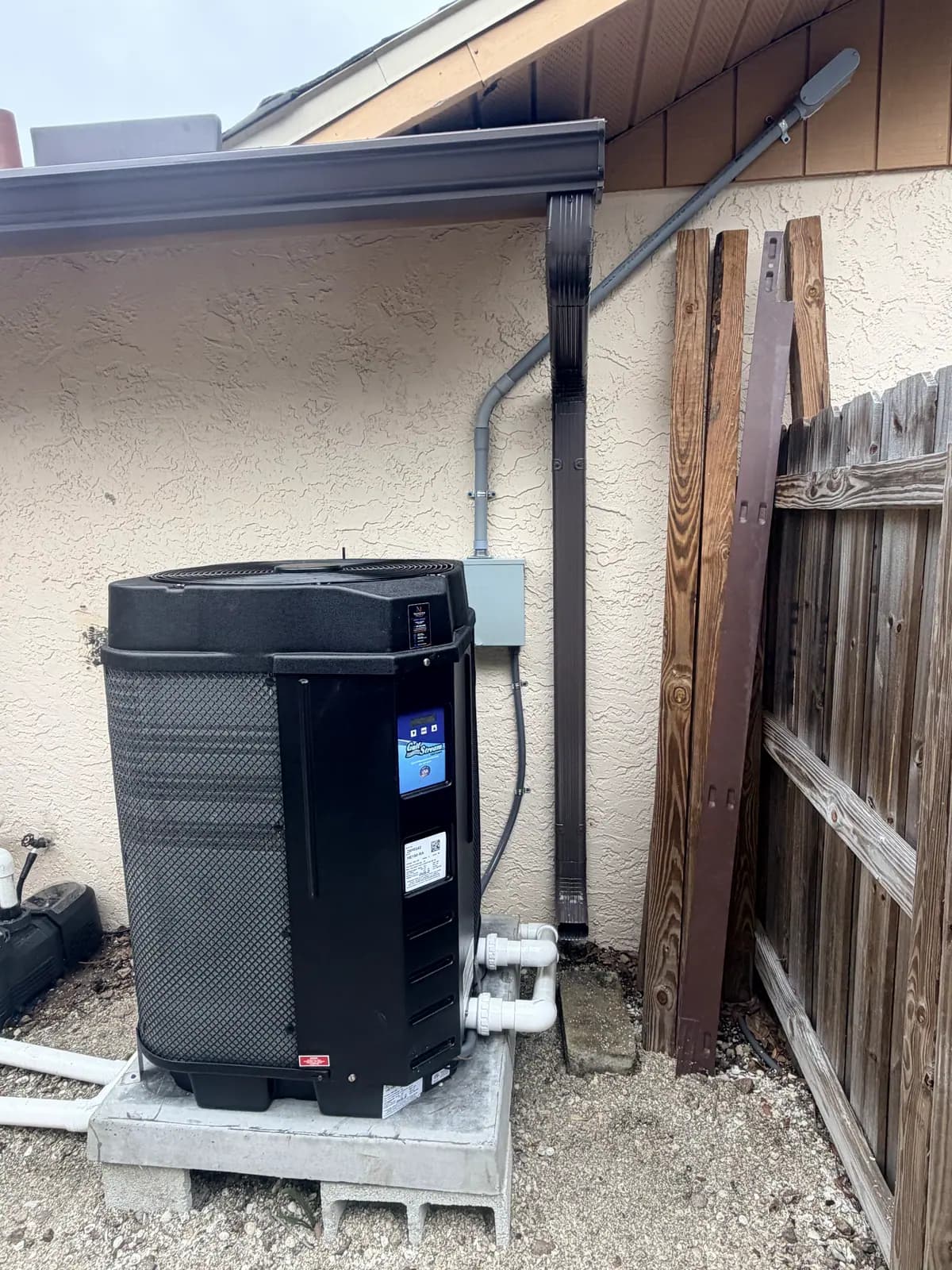
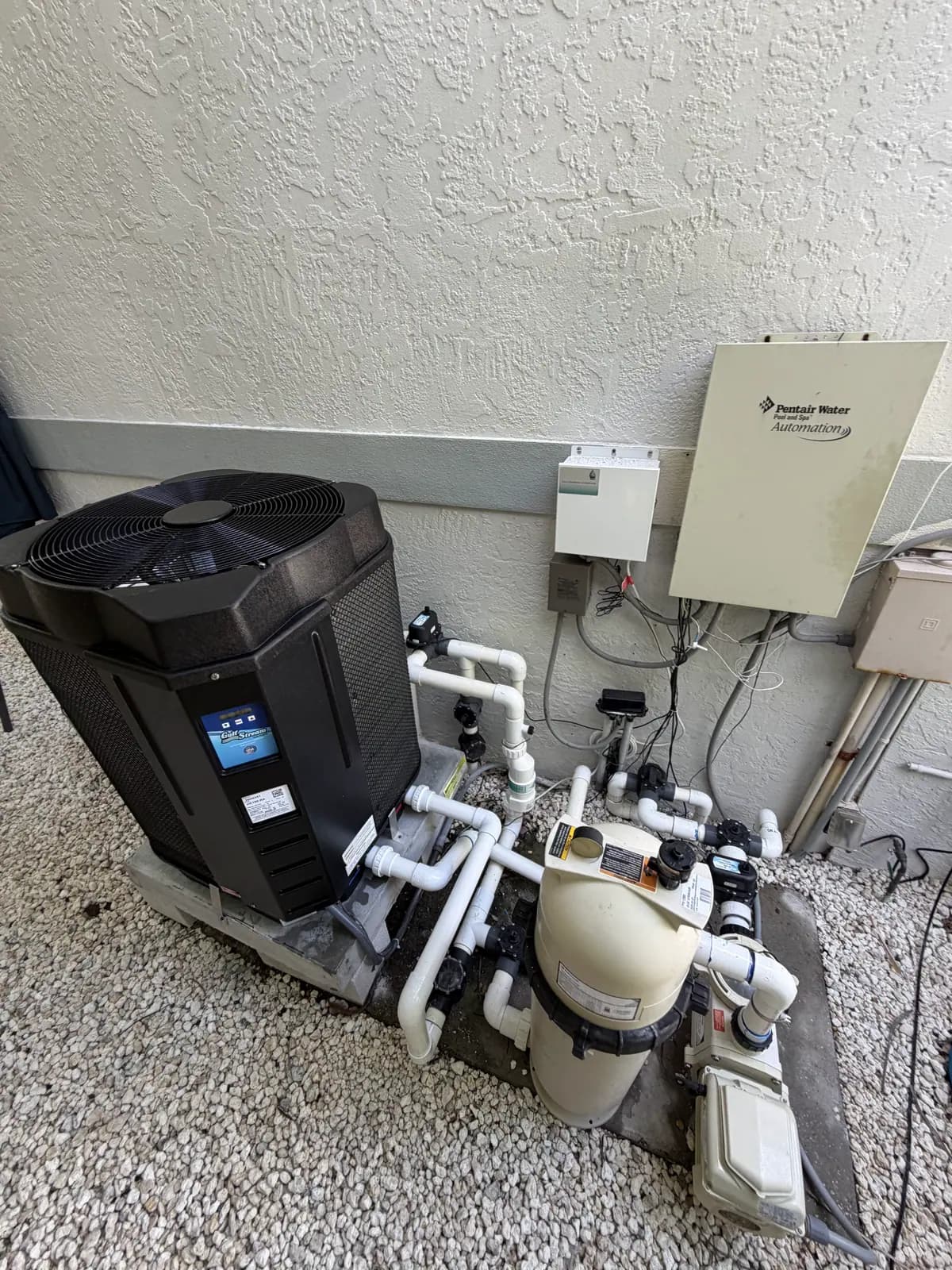
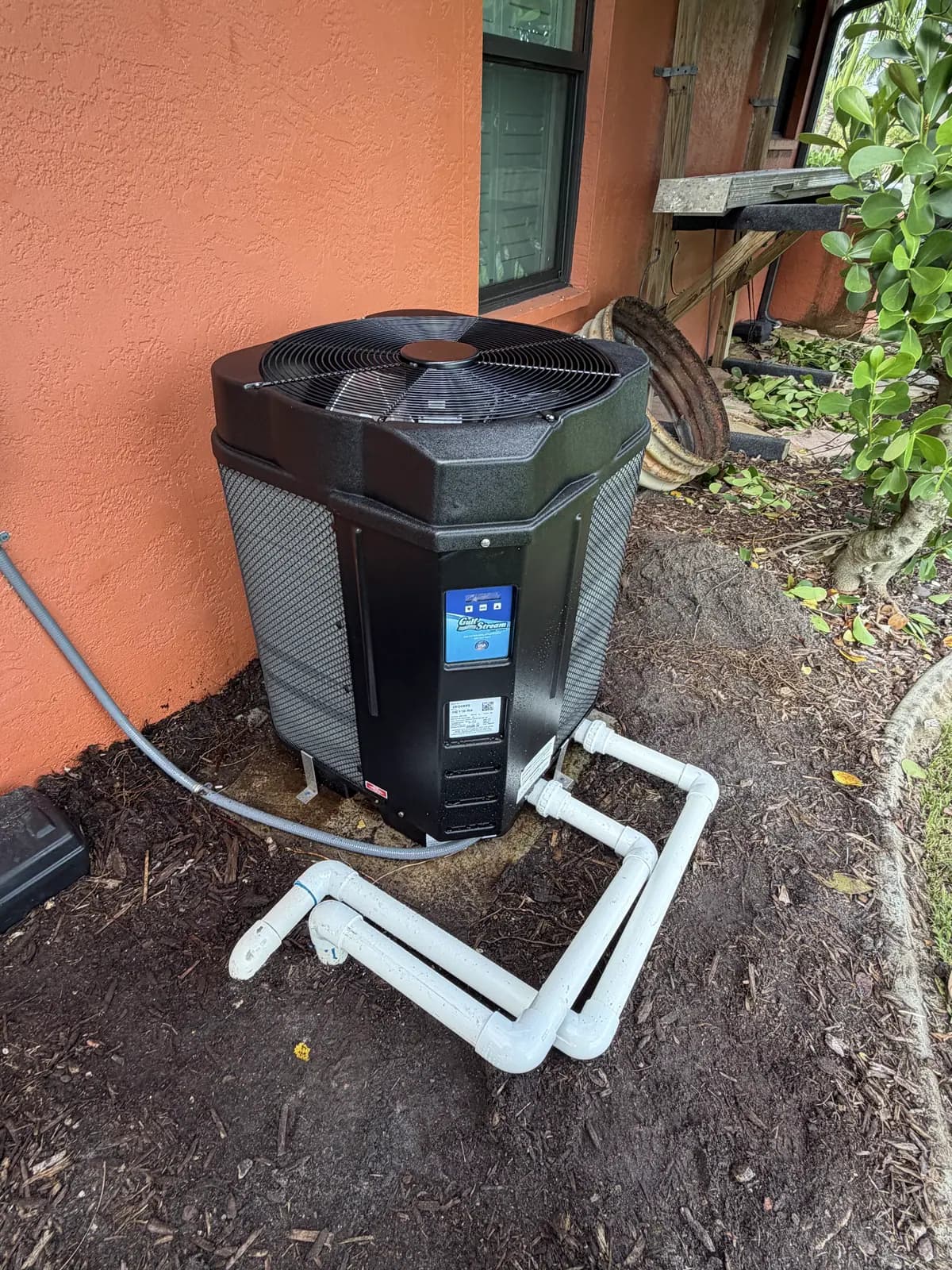
Recent jobs from our installation library that relate to this topic.