Modern Pool Heating · Owner/operator Henry Manna, Florida Certified Pool/Spa Contractor CPC1460367
Updated October 16, 2026
Short answer
Enter your pool's surface area and, if you have them, your own electricity, natural gas or propane prices, and the calculator works out what a million BTU of pool heat costs on each fuel and what holding the pool at 80°F year-round would cost, scaled from the Department of Energy's Miami tables. At current EIA Florida averages, a million BTU of heat costs about $9.00 from a heat pump at COP 5, about $29 from natural gas, about $46.50 from propane at the East Coast price and about $45 from electric resistance heating. Solar's cost is the extra pump electricity, about $9 a month for two extra hours a day on a 1 kW pump. These are operating costs only; the heater and its installation are separate.
What we usually recommend
If you're choosing between a heat pump and gas for a pool you'll heat most of the winter, run the calculator with your own rates: on Florida's average prices a heat pump costs roughly a third as much per unit of heat as natural gas, and gas wins on speed rather than running cost. If you only heat for the odd weekend or for a spa, the year-round figures overstate what you'll spend, so weigh heat-up time more heavily than the annual number. And look at the gap between the uncovered and covered results for your pool; a cover is the cheapest upgrade on the list.
- Cost per million BTU at default prices: heat pump about $9.00 (COP 5), natural gas about $29.29, propane about $46.50, electric resistance about $45.02.
- A 450 sq ft pool held at 80°F all year: roughly $1,057 a year on a heat pump uncovered, $217 covered.
- The same pool on natural gas with an 84% efficient heater: roughly $3,753 uncovered and $770 covered; propane runs about 1.6 times the gas figure.
- Use your own bill rates if you can; Florida's average gas price can overstate what a heavy gas user pays.
- The figures are year-round, every-day estimates. Partial-season heating costs less, though not proportionally less.
Florida pool heating cost calculator
Change any number to match your pool and your utility bill. The defaults are Florida residential energy prices from the U.S. Energy Information Administration and a 15 by 30 foot pool.
Estimated year-round cost: heat pump $1,057 a year, natural gas $3,753 a year.
Estimated cost to hold 450 sq ft at 80°F all year, uncovered
| Method | Per year | Per month |
|---|---|---|
| Electric heat pump | $1,057 | $88 |
| Natural gas heater | $3,753 | $313 |
| Propane heater | $5,959 | $497 |
| Solar (pump electricity only) | $111 | $9 |
These are year-round estimates for a pool held at 80°F every single day. Most Florida owners heat for part of the year, so a real bill is usually a fraction of these figures. Solar shows only the extra pump electricity; whether solar alone can hold 80°F depends on collector area, roof orientation and the weather.
Cost per million BTU of heat delivered
About what it takes to raise a 15,000 gallon pool by 8°F.
| Method | Per million BTU |
|---|---|
| Electric heat pump · COP 5.0 | $9.00 |
| Natural gas heater · 84% efficient | $29.29 |
| Propane heater · 84% efficient | $46.50 |
| Electric resistance · for context | $45.02 |
How these numbers are worked out
Cost per million BTU: a heat pump uses 293.07 kWh ÷ COP for each million BTU it delivers; natural gas needs 10 therms ÷ thermal efficiency; propane needs 1,000,000 ÷ efficiency ÷ 91,452 BTU per gallon. Electric resistance has no multiplier: 293.07 kWh at your rate.
Year-round cost starts from the Department of Energy’s Miami estimates for a 1,000 sq ft pool held at 80°F: $1,989 a year uncovered and $409 covered for a heat pump at COP 5.0 and 13.01¢/kWh; $3,880 uncovered and $796 covered for an 80% efficient gas heater at $1.09 a therm. Each figure is scaled by your surface area (the load follows surface area), your energy price and your equipment’s efficiency. Propane uses the gas figure with your propane price converted at 0.91452 therms per gallon (currently $3.91 a therm).
Solar has no fuel cost: the figure is the extra pump time, two hours a day of a 1 kW pump, about 60 kWh a month at your electricity rate.
DOE’s heat pump and gas tables make slightly different cover assumptions, so they are not perfectly parallel. What the comparison shows reliably is the ratio between methods, and how much a cover changes everything. The full working is in What It Costs to Heat a Pool in Florida.
Sources
- U.S. Department of Energy, Energy Saver: Heat Pump Swimming Pool Heaters (archived)
- U.S. Department of Energy, Energy Saver: Gas Pool Heaters (archived)
- U.S. Department of Energy, Energy Saver: Swimming Pool Covers (archived)
- U.S. Department of Energy, Energy Saver: Solar Swimming Pool Heaters (archived)
- U.S. Energy Information Administration: average price of electricity by state (Table 5.6.B)
- U.S. Energy Information Administration: natural gas prices by state
- U.S. Energy Information Administration: residential propane prices
- U.S. Energy Information Administration: British thermal units and conversions
How to use the calculator
The calculator needs your pool's surface area and, optionally, your own energy prices. Surface area matters because a pool loses most of its heat from the surface, so the heating load follows square feet rather than gallons. For a rectangular pool, multiply length by width; a 15 by 30 foot pool is 450 square feet. For an oval, length times width times 0.785 is a good estimate. For a freeform pool, estimate the real water area rather than multiplying the longest length by the widest width, which overstates it. You can type the surface area in directly or enter length and width, and a switch tells the calculator whether the pool is covered when it isn't in use.
If you leave the prices alone, the calculator uses the same EIA figures as our cost guide: 15.36 cents per kWh for Florida residential electricity (year-to-date through June 2026), $2.46 a therm for Florida residential natural gas (EIA's 2025 average of $25.48 per thousand cubic feet, divided by 10.36 therms), and $3.572 a gallon for East Coast residential propane (March 2026). It also assumes a heat pump COP of 5.0, DOE's average, and a gas heater thermal efficiency of 84%; both can be changed. Swap in your own rates and equipment and the results update. The next section shows where to find the prices on your bills.
The output has two parts. The first is the cost of one million BTU of pool heat on each fuel, which puts every option on the same footing; a million BTU is roughly what it takes to raise a 15,000 gallon pool by 8°F. The second is an annual and average monthly estimate for holding the pool at 80°F every day of the year, uncovered or, with the cover switch on, covered, scaled from DOE's Miami tables. Solar appears in that annual table as the pump electricity it uses, because it has no fuel cost: about $111 a year, or about $9 a month, at the default electric rate.
Finding your inputs on your utility bills
Electricity: your bill lists the kilowatt-hours you used and the charges that go with them. Dividing the total bill by the kWh gives an all-in average, which slightly overstates the cost of extra kWh because it spreads the fixed monthly customer charge across your usage. The per-kWh charges alone (energy, fuel and any per-kWh riders and taxes) give a closer figure for what a heat pump adds. If your utility charges a higher rate above a monthly usage threshold, use the higher rate, because pool heating is likely what pushes you over it.
Natural gas: gas bills are in therms. Add up the per-therm charges, typically a gas supply or commodity charge and a delivery or distribution charge, and leave out the fixed monthly customer charge. The calculator asks for a price per therm. If your bill is in thousand cubic feet instead, divide that price by 10.36, since a thousand cubic feet of natural gas carries about 10.36 therms. Florida's $25.48 average works out to about $2.46 a therm.
Propane: use the delivered price per gallon on your last delivery ticket, without any annual tank rental, which you pay whether or not you heat. Propane is a retail price that varies by supplier and contract, so your own number beats any average.
Pump power, for solar: the calculator assumes a 1 kW pump running two extra hours a day. Your pump's label lists its watts, or its amps and volts (watts are roughly amps times volts), and many variable-speed pumps display their wattage. If yours draws more or less than 1,000 watts at the speed it runs for solar, scale the solar figure by the same ratio.
The method behind the numbers
Every figure comes from one idea: heat needed, divided by the heater's efficiency, times the price of the energy. EIA's conversion factors do the rest: 1 kWh is 3,412 BTU, a cubic foot of natural gas is 1,036 BTU, a therm is 100,000 BTU, and a gallon of propane is 91,452 BTU.
Heat pump: one million BTU is 293.1 kWh (1,000,000 divided by 3,412). A heat pump at COP 5 delivers that heat using 58.6 kWh, and 58.6 kWh at 15.36 cents is $9.00. Gas: an 84% efficient heater needs 1.19 million BTU of gas to deliver one million (1,000,000 divided by 0.84). That's 11.9 therms of natural gas (10 therms divided by 0.84), $29.29 at the default $2.46 a therm ($29.28 if you work from EIA's unrounded $25.48 per thousand cubic feet), or 13.02 gallons of propane, $46.50 at $3.572. Electric resistance: 293.1 kWh with no multiplier, $45.02. Solar: two extra hours a day of a 1 kW pump is about 60 kWh a month, $9.22.
For the annual figure, the calculator starts from DOE's tables for a 1,000 square foot pool in Miami held at 80°F year-round. The heat pump table, which assumes an average COP of 5.0 and electricity at 13.01 cents, lists $1,989 a year uncovered and $409 covered. The gas table, which assumes an 80% efficient heater and gas at $1.09 a therm, lists $3,880 uncovered and $796 covered. Each figure is multiplied by your pool area divided by 1,000, then by your price divided by DOE's price, then by DOE's equipment assumption divided by yours (5.0 divided by your COP for the heat pump, 80 divided by your heater's efficiency for gas). For propane, the gallon price is first converted to a per-therm equivalent by dividing by 0.91452, because a gallon of propane holds 0.91452 therms.
| Heating method | Energy needed | Price used | Cost per million BTU |
|---|---|---|---|
| Heat pump, COP 5.0 | 58.6 kWh (293.1 kWh ÷ 5) | 15.36¢/kWh | $9.00 |
| Heat pump, COP 6.0 (warm, humid air) | 48.8 kWh | 15.36¢/kWh | $7.50 |
| Heat pump, COP 4.0 (50°F air) | 73.3 kWh | 15.36¢/kWh | $11.25 |
| Natural gas heater, 84% efficient | 11.9 therms (10 ÷ 0.84) | $2.46 a therm | $29.29 |
| Propane heater, 84% efficient | 13.02 gallons | $3.572/gal (East Coast) | $46.50 |
| Propane heater, 84% efficient | 13.02 gallons | $2.668/gal (U.S. average) | $34.73 |
| Electric resistance heater | 293.1 kWh | 15.36¢/kWh | $45.02 |
| Solar | No fuel; about 60 kWh a month of extra pump time | 15.36¢/kWh | About $9.22 a month |
What a year-round pool costs at default prices
Here is the annual method worked for a 15 by 30 foot pool (450 square feet) at the default prices. Heat pump, uncovered: $1,989 times 0.45 times 15.36 divided by 13.01 is about $1,057 a year, about $88 a month averaged over the year. Covered: $409 times the same factors is about $217 a year, about $18 a month.
Natural gas, uncovered: $3,880 times 0.45 times 2.46 divided by 1.09, times 80 divided by 84 for an 84% efficient heater, is about $3,753 a year, about $313 a month. Covered: about $770 a year, about $64 a month. Propane at $3.572 a gallon is about $3.91 per therm-equivalent, which makes it about 1.59 times the natural gas figure: roughly $5,959 a year uncovered and $1,222 covered.
The ratio is the reliable part. On Florida's average prices, the annual natural gas figure comes out at roughly three and a half times the heat pump figure, and propane at about five and a half times; per million BTU the gap is a little smaller, about three and a quarter and five times, because DOE's heat pump and gas tables aren't perfectly parallel. The cover changes every number by a similar factor, which is why it's worth more than any equipment upgrade.
| Heating method | Uncovered, per year | Uncovered, per month (average) | Covered, per year | Covered, per month (average) |
|---|---|---|---|---|
| Heat pump (COP 5.0) | About $1,057 | About $88 | About $217 | About $18 |
| Natural gas (84% efficient heater) | About $3,753 | About $313 | About $770 | About $64 |
| Propane (84% heater, East Coast price) | About $5,959 | About $497 | About $1,222 | About $102 |
Where the assumptions break
The calculator is a sound starting point and an imperfect forecast. These are the places where your real bill will differ, roughly in order of how much they matter.
- Partial-season heating. The annual figures assume the pool is held at 80°F every day of the year. Most owners heat for part of the year, so a real bill is usually lower, but not in proportion to the months, because most of a year-round figure is spent in the cool months when the heater actually runs. FSEC's Florida table, for example, counts about 90 days of heater operation for a nine-month swimming season in South Florida and about 180 days for twelve months.
- Climate. DOE's Miami table is the closest Gulf Coast proxy it offers, and Miami is warmer in winter than Sarasota, Bradenton or Punta Gorda. FSEC counts about 210 days of heater operation for a year-round pool in Central Florida against 180 in South Florida, so a pool here can need more heating than the Miami-based figure suggests.
- Wind. Evaporation is the largest source of heat loss, and DOE notes it rises with wind speed. An open waterfront lot costs more to heat than a sheltered one, and a windbreak that doesn't shade the pool helps.
- Screened vs open pools. A screen enclosure cuts wind, which reduces evaporation and the heating load, but it also shades the water. The calculator doesn't distinguish the two. For solar the shading matters: FSEC's tables call for noticeably more collector area on a screened pool.
- Target temperature. The calculator uses 80°F. In DOE's Miami heat pump table, moving from 78°F to 82°F takes the annual cost from $1,499 to $2,514 for a 1,000 square foot pool, a 68% increase for four degrees.
- Heat pump efficiency in cold air. DOE's table uses an average COP of 5.0. Manufacturers publish about 4.0 at 50°F air, so the most expensive heat is what you buy during a cold front.
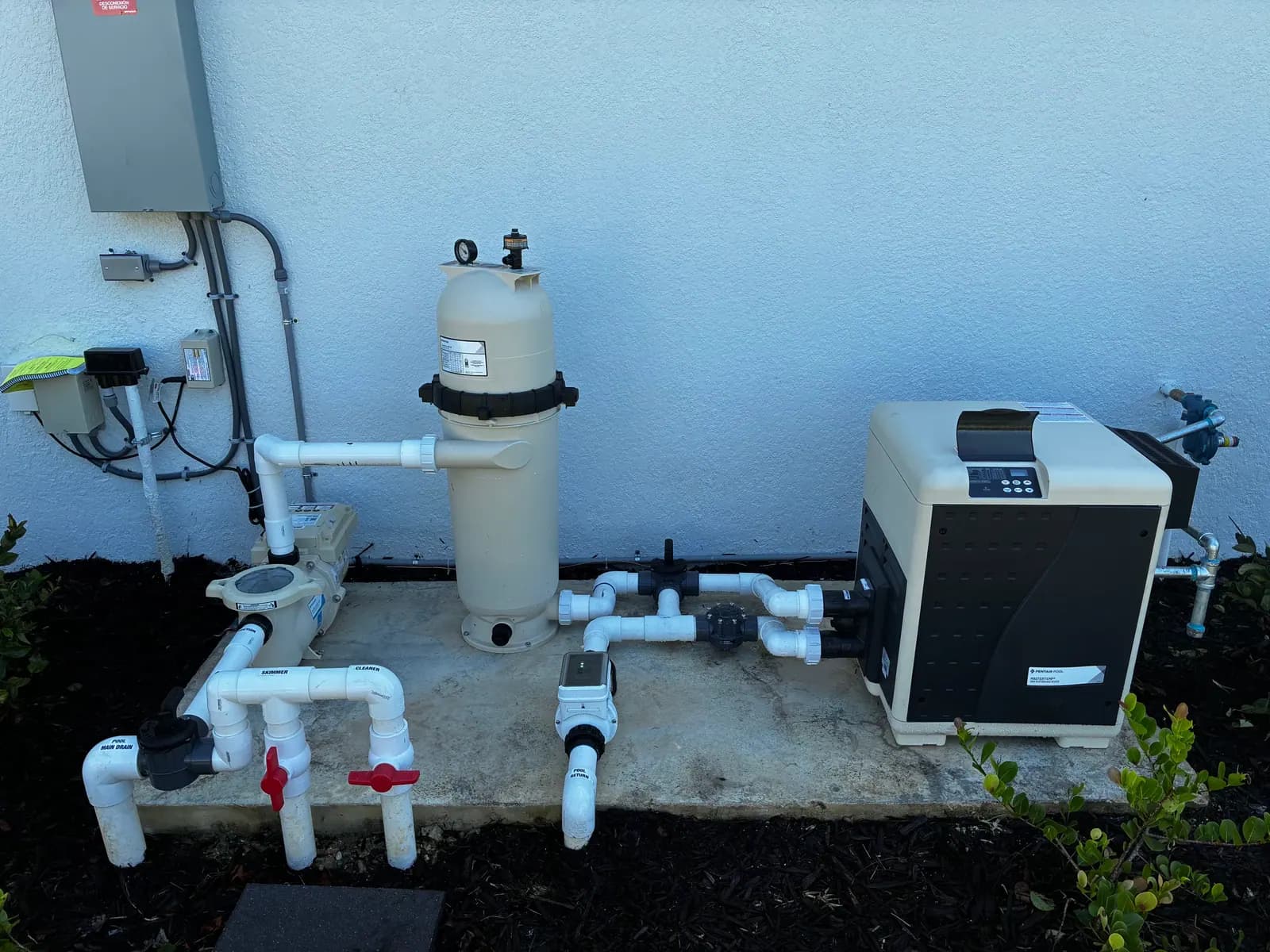
- Gas heater efficiency. DOE's gas table assumes an 80% efficient heater, and current models run from the low 80s into the mid 90s. The calculator adjusts for this automatically by multiplying DOE's gas figures by 80 divided by the efficiency you enter: about 0.95 for an 84% heater such as a MasterTemp 400.
- Your gas rate. Florida's average residential gas price is high partly because most households here use very little gas, so fixed charges are spread over few therms. A pool-heating household's effective rate is usually lower; use your own per-therm charges.
- Covers. DOE says covering a pool when it isn't in use can save 50-70%. Its heat pump and gas tables make slightly different cover assumptions, so the covered figures aren't perfectly parallel.
Solar vs heat pump vs gas: the cost comparison
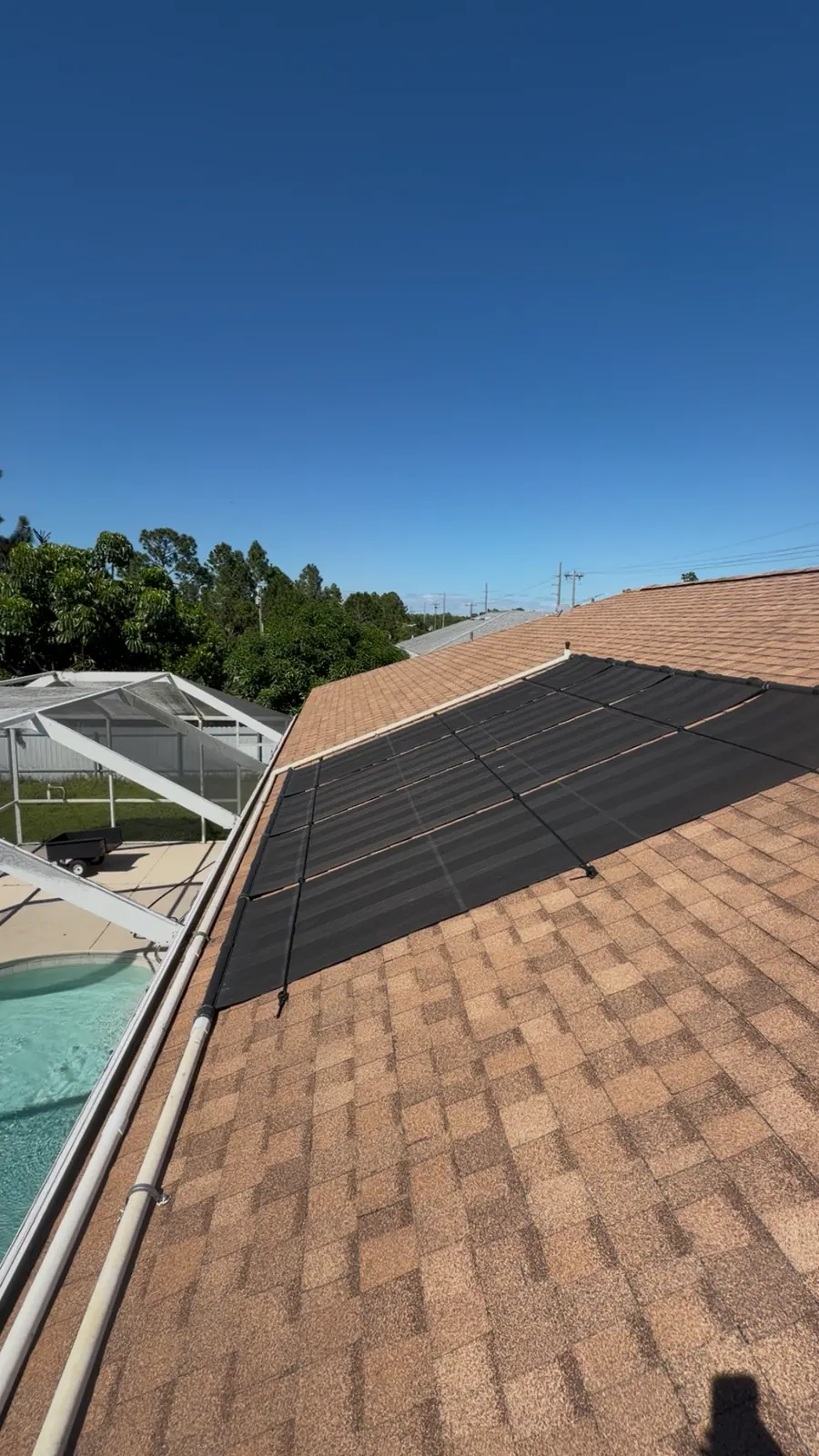
On running cost the order is clear at Florida's average prices. Solar can be one of Florida's lowest-operating-cost methods for heating a pool when the home has suitable roof orientation and sun exposure, because it uses only pump electricity. A heat pump is one of the lowest-cost powered methods, at about $9 per million BTU. Natural gas costs about three times as much per unit of heat, and propane about five times as much.
Installed cost runs on different drivers for each: collector area and the roof for solar, the electrical circuit and pad for a heat pump, and the gas supply and line sizing for gas. Our cost articles for each method explain those drivers and show what our recent priced jobs included.
Speed is the other half of the decision. Gas heats quickly and on demand. Heat pumps warm a swimming pool gradually over many hours. Actual heating speed depends on pool volume, heater output, starting water temperature, outdoor air temperature, humidity, wind conditions and whether the pool is covered. Proper heater sizing and the use of a pool cover can significantly affect recovery time. Solar adds heat whenever the sun is out and can't be called on during a cloudy cold snap, which is why it's often paired with a heat pump.
| Solar | Heat pump | Natural gas | Propane | |
|---|---|---|---|---|
| What you pay to run it | Extra pool pump electricity | Electricity for the compressor and fan | Natural gas, 84% efficient heater | Propane, 84% efficient heater |
| Cost per million BTU of heat | No fuel cost; about $9.22 a month of pump time | About $9.00 at COP 5 | About $29.29 | About $46.50 |
| Year-round 80°F, uncovered | Depends on collector area | About $1,057 a year | About $3,753 a year | About $5,959 a year |
| Year-round 80°F, covered | Cover cuts the collector area needed by more than half | About $217 a year | About $770 a year | About $1,222 a year |
| Main installed-price drivers | Collector area, roof type, plumbing run | Electrical circuit, pad, plumbing | Gas supply, line sizing, pad, clearances | Tank and line, pad, clearances |
Turning the numbers into a decision
Use the calculator to rank your options, not to predict your bill to the dollar. If the ranking holds with your own rates, and on Florida prices it usually does, the decision comes down to how you use the pool. Owners who keep the pool warm all winter tend to save the most with a heat pump, solar or both. Owners who want an attached spa hot quickly, or heat only for weekends and guests, often find gas worth its running cost.
When you're ready for real numbers on equipment and installation, our cost articles for heat pumps, solar and gas heaters explain what moves the installed price, and our cost guide shows the full working behind every figure on this page. If your pool is in Sarasota, Manatee, Charlotte & Pinellas County, call (941) 323-6559 and we'll run these numbers against your actual pool, cover, enclosure and utility rates.
Pros and cons
Solar
Pros
- No fuel cost; running cost is extra pump time only.
- Running cost doesn't move with gas or propane prices.
Cons
- Up-front cost scales with collector area, which follows pool area, season and enclosure.
- Can't deliver heat on demand during a cold, cloudy week.
Heat pump
Pros
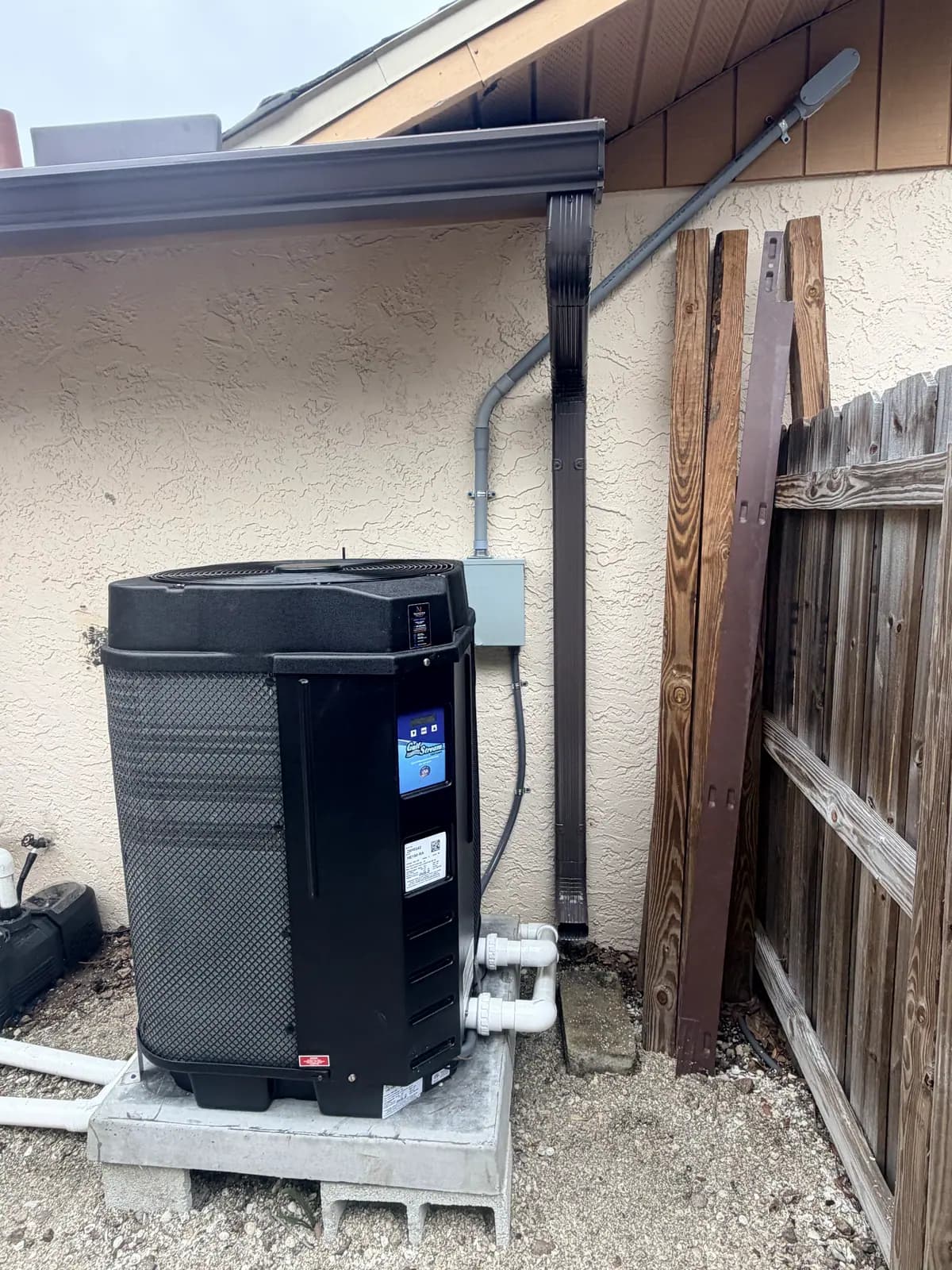
- About $9 per million BTU at COP 5 on Florida's average rate, roughly a third of natural gas.
- Holds a set temperature day or night.
Cons
- Needs a dedicated 40 to 50 A circuit on the units we cite.
- Heats gradually, and COP falls to about 4.0 in 50°F air.
Natural gas
Pros
- Fast heat on demand, whatever the air temperature.
- Needs only a small electrical circuit for its controls.
Cons
- About $29 per million BTU at Florida's average gas price.
- Needs gas at the address and a line sized for the heater.
Propane
Pros
- Gas heat where there's no gas main.
Cons
- About $46.50 per million BTU at the East Coast price, the highest here.
- Tank deliveries to manage through cold snaps.
Real installations
Recent jobs from our installation library that relate to this topic.