

Updated September 17, 2026 · Affordable Solar & Pool Heating, LLC · Owner/operator Henry Manna
Start with whether natural gas actually reaches your address
This question settles most Florida pool heater decisions, and it is worth answering before you compare a single spec sheet. Natural gas is a piped utility: no main in your street means no natural gas option at any price.
Florida's gas utilities are a patchwork. The Public Service Commission's statewide map shows investor-owned utilities — Peoples Gas System, Florida Public Utilities, Chesapeake Utilities, Florida City Gas and others — alongside municipal systems and gas districts, and it carries a warning worth repeating: service areas are approximations, to be used only as general guidelines, so you contact the individual utility for anything specific. On the Gulf Coast, service tends to follow older incorporated areas and newer master-planned communities and skip a good deal in between.
So the first call is to the utility, with your address: is there a main on my street, and what would a service line and meter to my equipment pad cost? If the answer is no, propane is not a consolation prize — it is the same appliance burning a fuel that costs more per BTU, with a tank, a delivery contract and a gauge somebody has to watch.
The same heater, a different letter at the end
Manufacturers build both versions on the same chassis and distinguish them in the model number. Jandy's published model key reads the fuel character directly — N for natural gas, P for propane — so a JXI400N and a JXI400P are the same 399,000 BTU/hr heater with different gas orifices. Raypak uses EN and EP inside its AVIA part numbers: P-R404A-EN-C is the natural gas copper heater, P-R404A-EP-C the propane one.
What differs inside is the gas train. Propane carries roughly two and a half times the energy per cubic foot that natural gas does, so the orifices are smaller and the supply pressure is higher. Raypak specifies a minimum dynamic inlet pressure of 3.5 inches of water column on natural gas against 8.0 inches on propane, with static maximums of 10.5 and 13 inches; Jandy's JXiQ asks for a 4.0 inch W.C. minimum with a 10.5 inch maximum on natural gas and 14.0 inches on propane. The two versions are separately certified appliances — Raypak's natural gas AVIA models are approved to 10,000 feet of elevation and the propane versions only to 4,500 — not one heater with a different sticker.
What a therm and a gallon actually buy you
The two fuels are sold in units that are not comparable, which is where most homeowners go wrong. The U.S. Energy Information Administration publishes the conversion factors: a therm of natural gas is 100,000 BTU and a gallon of propane is 91,452 BTU.
Run those against a real heater and it gets concrete. A 399,000 BTU/hr heater at full fire consumes about 4.0 therms of natural gas an hour, or about 4.4 gallons of propane. A 260,000 BTU/hr heater burns about 2.6 therms or about 2.8 gallons. Nothing about the heater changes; only the unit on the bill does.
To compare prices honestly, convert both to dollars per million BTU — ten therms of natural gas, or about 10.9 gallons of propane. Multiply your utility's per-therm rate by ten, multiply your supplier's delivered per-gallon propane price by 10.9, and compare those two numbers. That calculation beats any general claim about which fuel is cheaper, because propane is a delivered retail price that moves with the supplier and the contract. Efficiency does not enter into it: a heater rated at 84% is 84% efficient on either fuel.
- Natural gas: 1 therm = 100,000 BTU; 1 cubic foot = 1,036 BTU (EIA).
- Propane: 1 gallon = 91,452 BTU (EIA).
- A million BTU takes 10 therms of natural gas or about 10.9 gallons of propane.
Gas piping: propane needs less pipe, natural gas needs more
Because propane packs more energy into each cubic foot, a propane line can be smaller or longer than a natural gas line feeding the same heater. Jandy publishes the difference in one table: a JXi400 gets 20 feet of 1-inch pipe on natural gas, or 55 feet of the same pipe on propane, and 3/4-inch pipe is allowed for only about 5 feet from the gas valve on natural gas but carries a propane JXi400 for 15 feet.
This matters most on retrofits. The commonest reason a gas heater replacement costs more than the quote is that the existing line was sized for a smaller heater: going from a 250,000 to a 400,000 BTU/hr heater on natural gas, assume the line is a question until somebody measures it, while on propane the same upgrade is often absorbed by the pipe already in the ground. Both fuels need a sediment trap and a manual shutoff outside the heater body, and both need the incoming pressure verified while the heater is firing rather than at rest.
Tanks, deliveries and what a propane install actually involves
Tank size follows straight from the arithmetic above. Tanks fill to about 80% of nominal capacity, so a 500-gallon tank holds roughly 400 usable gallons — about 36.6 million BTU at EIA's figure, or roughly 92 hours of full-fire run time on a 399,000 BTU/hr heater and about 140 hours on a 260,000 BTU/hr one.
Hold that number in your head when a supplier suggests a tank. A 120-gallon vertical tank is fine for a grill and disappears quickly under a pool heater in a January cold snap, so where the heater is the main load most installations end up on a 250 or 500 gallon tank — often leased from the supplier, which ties you to that supplier's pricing. Pool heating loads are spiky: nothing for months, then a lot in a week, which is the pattern that catches out a will-call customer over a holiday weekend.
In Florida the LP gas trade is regulated by the Department of Agriculture and Consumer Services, which runs the state's Liquefied Petroleum Gas (LP Gas) licensing program for the businesses that work with propane. We could not extract the licensing categories from the FDACS page's rendered body, so ask your installer which FDACS license they hold rather than taking a general description from us. Tank placement, setbacks and the permit run through that licensed installer and your local building department — ask who is pulling the permit before work starts.
Can a heater be converted from one fuel to the other?
Sometimes, and it depends on the manufacturer. Raypak lists conversion kits for the AVIA in both directions — propane to natural and natural to propane — in its own installation manual, with a plain condition attached: gas conversions are to be done only by a qualified agency.
Jandy is more cautious. Its JXi manual states that any change to the heater, gas controls, gas valve or gas orifices may void the warranty, and tells you to contact your local distributor first. Orifice kits for JXi heaters do circulate in the trade, but that warranty language is the part that should decide it.
The practical advice is the same either way: treat a later conversion as a possibility rather than a plan. A conversion changes the appliance's certification basis, and one done outside the manufacturer's instructions by someone unlicensed is a combustion safety problem before it is ever a warranty argument.
Safety and installation differences that actually matter
The important physical difference is that propane vapor is heavier than air. Jandy puts it in its own manual: LP gas is more dense than air and will more readily collect in enclosed areas without adequate ventilation, so LP heaters should not be installed in enclosed areas such as pits, and should be located a safe distance from LP cylinders and filling equipment.
That has direct consequences on a Florida equipment pad: sunken pits, boxed-in enclosures and heaters tucked behind a wall are all worse ideas on propane. Jandy states that indoor installation is not recommended for liquid propane heaters at all, while its natural gas models are certified for indoor, outdoor and covered-shelter installation; Raypak's AVIA is certified indoor or outdoor on either fuel with the right vent cover. Everything else is common to both — an unblocked vent cap, the manufacturer's clearances from windows, doors, soffits and air intakes, and a properly bonded heater.
How to decide
Work through these in order. The first one that clearly applies usually settles it:
- Call the gas utility with your address first. No main, no natural gas — the rest is academic.
- If gas is available, get the service line and meter quote in writing. A large connection charge can flip the decision to propane or to an electric heat pump.
- Compare fuels on dollars per million BTU: ten therms, or about 10.9 gallons, buys the same million BTU.
- Match the tank to the heater, not to the house — a 500-gallon tank at 80% fill is roughly 92 hours of full fire on a 399,000 BTU/hr heater.
- If the pool will be heated all winter rather than for the odd weekend, price an electric heat pump against both. Gas buys speed, not economy.
- Buy the heater built for the fuel you will actually have, and use a licensed installer for the gas work either way.
Real installations
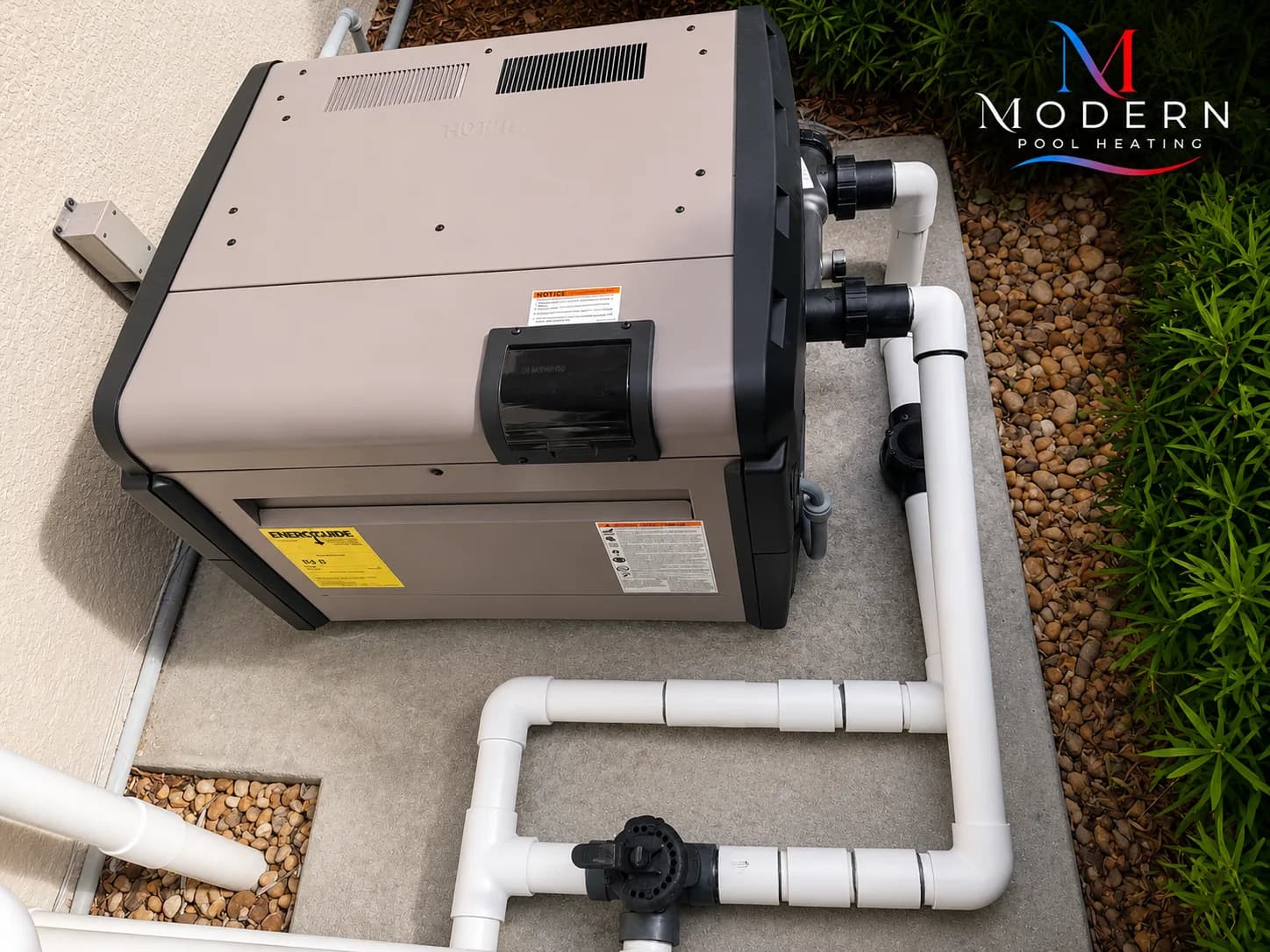
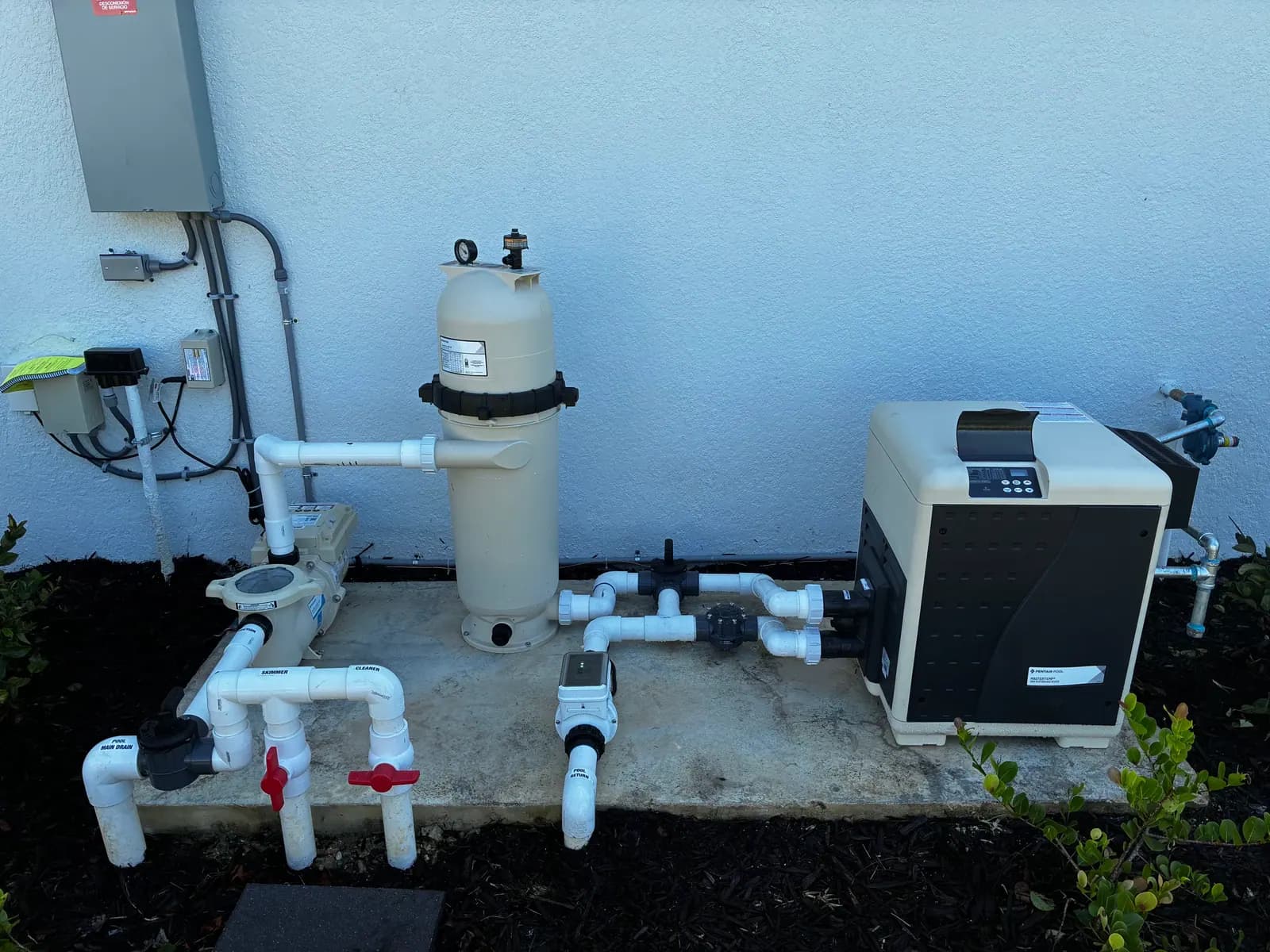
Recent jobs from our installation library that involve the equipment in this guide.
Heaters mentioned in this guide
Hayward · Universal H-Series
Hayward Universal H-Series H400FDN Gas Pool Heater
Model H400FDN
- BTU input
- 399,900 BTU/hr
- Thermal efficiency
- 84%
- Heat exchanger
- Cupro-nickel
- Warranty
- 3-Year Parts / 1-Year Labor
- Wi-Fi / automation
- App Control via AutomationAutomation Compatible (Relay)
A large Florida pool, or a pool and spa combination, that needs to reach temperature on demand rather than hold it all season.
Hayward · Universal H-Series
Hayward Universal H-Series H400FDP Propane Pool Heater
Model H400FDP
- BTU input
- 399,900 BTU/hr
- Thermal efficiency
- 84%
- Heat exchanger
- Cupro-nickel
- Warranty
- 3-Year Parts / 1-Year Labor
- Wi-Fi / automation
- App Control via AutomationAutomation Compatible (Relay)
A large pool or a pool-and-spa combination on a lot with no gas main, where fast heat matters more than the cost of the propane it burns.
Jandy · JXi
Jandy JXi400N Gas Pool & Spa Heater
Model JXI400N
- BTU input
- 399,000 BTU/hr
- Thermal efficiency
- 84%
- Heat exchanger
- Copper
- Warranty
- 1-Year Parts
- Wi-Fi / automation
- App Control via AutomationAutomation Compatible
A large Gulf Coast pool, or a pool and spa combination, where the spa needs to be ready in under an hour and the equipment pad has no room to spare.
Jandy · JXi
Jandy JXi260N Gas Pool & Spa Heater
Model JXI260N
- BTU input
- 260,000 BTU/hr
- Thermal efficiency
- 84%
- Heat exchanger
- Copper
- Warranty
- 1-Year Parts
- Wi-Fi / automation
- App Control via AutomationAutomation Compatible
An average-size Florida pool, or a pool with a small attached spa, on a pad where there is no room for a 400,000 BTU cabinet and no appetite for a 1-inch gas line.
Raypak · AVIA
Raypak AVIA 404A Gas Pool & Spa Heater
Model P-R404A-EN-C
- BTU input
- 399,000 BTU/hr
- Thermal efficiency
- 84%
- Heat exchanger
- Copper
- Warranty
- 3-Year Parts & Labor
- Wi-Fi / automation
- Wi-Fi Built InAutomation Compatible (Relay)
A large Florida pool, or a pool and spa, where the owner wants spa-speed output and three years of parts and labor cover.
Raypak · AVIA
Raypak AVIA 264A Gas Pool & Spa Heater
Model P-R264A-EN-C
- BTU input
- 264,000 BTU/hr
- Thermal efficiency
- 84%
- Heat exchanger
- Copper
- Warranty
- 3-Year Parts & Labor
- Wi-Fi / automation
- Wi-Fi Built InAutomation Compatible (Relay)
An average-size Florida pool where the owner wants three years of parts and labor cover, plus app control, without buying into an automation system.
Last verified September 17, 2026
Specifications and warranty terms are taken from the manufacturer documents below. Manufacturers revise these without notice, so confirm the current terms before you buy. If you spot something out of date, email us and we will fix it.
Sources
- Jackson Energy Authority (public utility) — Reading a tank gauge (propane tanks read about 80% full after a fill, to leave room for expansion)
- U.S. Energy Information Administration — Units and calculators explained (BTU content of natural gas, a therm and a gallon of propane)
- Florida Public Service Commission — State of Florida Natural Gas Utilities service area map (utilities listed; service areas are approximations)
- Florida Department of Agriculture and Consumer Services — Liquefied Petroleum Gas (LP Gas) program (state licensing for the LP gas trade)
- Jandy / Fluidra — 2024 Product Catalog Addendum, Gas Heaters, 61356_SA (model-number key: N = natural gas, P = propane; natural gas and propane pipe sizing table)
- Jandy — JXi Installation & Operation Manual, H0574300 (gas pipe sizing by fuel, special precautions for LP gas, warranty note on changing gas orifices)
- Raypak — AVIA Installation & Operation Manual, 100-10000111 (natural gas and propane inlet pressures, sediment trap requirement, conversion kits and the qualified-agency condition)
- Raypak — AVIA brochure, RP-P-600-1 Rev E (EN / EP natural gas and propane part numbers, elevation ratings by fuel)
Ratings on this site are the editorial opinion of Affordable Solar & Pool Heating, LLC, trading as Modern Pool Heating. How we rate heaters. Corrections: modernpoolheating@icloud.com.