

Updated September 18, 2026 · Affordable Solar & Pool Heating, LLC · Owner/operator Henry Manna
What the heat exchanger is, and why it decides the heater's life
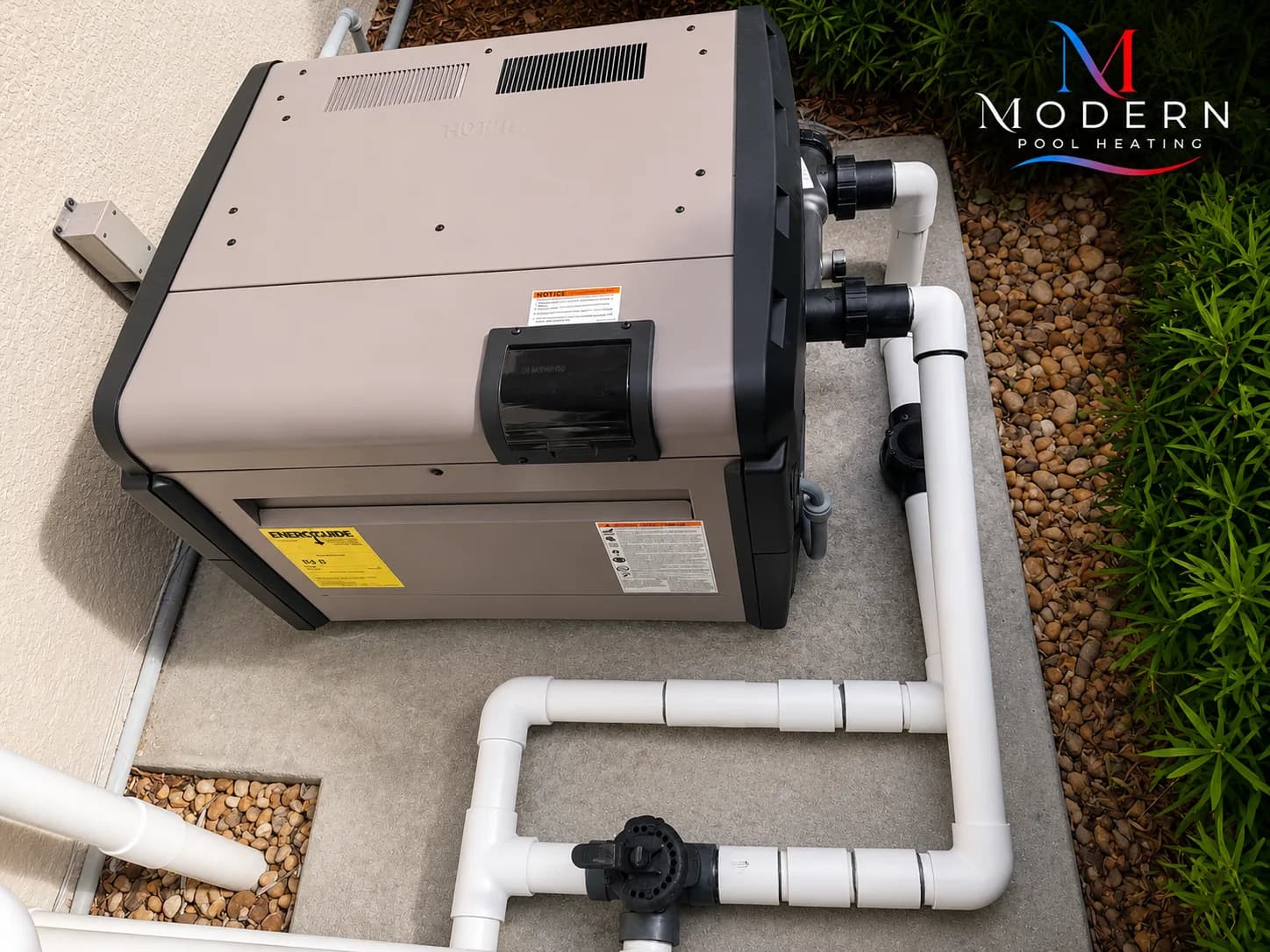
Inside every pool heater is a bundle of tubes with fire or refrigerant on one side and pool water on the other. In a gas heater it sits directly above the burners, so the metal is hot, the water is moving fast, and anything aggressive in that water is concentrated right where the heat is. In a heat pump it is a coaxial or shell-and-tube exchanger carrying refrigerant against the same pool water — cooler, but running many more hours a year.
When a pool heater dies young, this is usually the part that killed it, and a leaking exchanger on a gas heater often costs enough to make replacement the sensible choice. That is why the material is worth thinking about at purchase rather than at failure — and it is, conveniently for manufacturers, the one spec most retail listings leave out. There are four you will realistically be quoted: copper, cupro-nickel, a nickel-rich proprietary alloy such as Raypak's NiTek, and titanium.
How a pool heat exchanger actually fails
Four mechanisms account for nearly everything we see on a Florida equipment pad, and knowing them tells you what a better material does and does not fix.
Acid attack. Water below about pH 7.2 dissolves copper — usually self-inflicted, from a pool left acidic for weeks or an acid wash done with the heater in the loop. It is the fastest way to destroy an exchanger. Titanium does not care; copper does.
Chloride pitting. Copper alloys survive in chlorinated water because they build a thin, self-repairing oxide film. A 2019 study of 90/10 copper-nickel in seawater, published in the journal Materials, tracked that film over 56 days and found it is a layered mixture of copper oxides and hydroxides that is also porous and prone to cracking, so chloride ions reach the metal at the defects and start localized pitting. Nickel in the alloy makes the film more resistant — which is precisely why cupro-nickel outlasts plain copper in salt water rather than being immune to it.
Scale. Hard water and high pH deposit calcium carbonate on the hottest surfaces. Scale insulates, so the metal behind it runs hotter than designed, efficiency drops and the tube eventually fails from the fire side. Scale is a chemistry problem that presents as a metal problem.
Erosion-corrosion. Water moving too fast strips the protective film off the tube wall faster than it can re-form, which is why manufacturers publish a maximum flow as well as a minimum — GulfStream's heat pumps specify 30 to 70 GPM with 45-50 GPM optimal — and why pump speed is not simply a case of more is better.
Copper and cupro-nickel: the gas heater decision
Copper is the default. It conducts heat better than anything else in this list, it is inexpensive, and it is what most gas heaters ship with. Pentair's MasterTemp is the clearest published example: the standard copper exchanger models are rated 84% efficient, and the heavy-duty cupro-nickel models are rated 82%. That two-point difference is the honest price of the upgrade — cupro-nickel conducts heat slightly less well than copper, so you trade a little efficiency for a lot of chemical tolerance.
Cupro-nickel is copper alloyed with nickel, and the nickel is what buys the durability. Hayward fits it as standard across the entire Universal H-Series line — the H400FDN product page describes a "standard cupro nickel heat exchanger" with "excellent salt water and chemical corrosion resistance" — so there is no upgrade decision to make on that line, which is one of the genuinely useful things about it on a Gulf Coast pad. Pentair sells it as the HD variant; other manufacturers sell it as an option or on selected models.
It is worth being precise about what cupro-nickel is proven in: its long service record is in seawater systems at around 35,000 ppm salinity, roughly ten times a salt chlorine pool. The alloy is not being asked to do anything unusual — but a salt pool adds something the ocean does not have, a cell manufacturing chlorine continuously in the plumbing. That is why every manufacturer we have read wants the salt cell or chlorinator downstream of the heater, ideally with a check valve between them.
Our own rule on the Gulf Coast is simple. On a gas heater, if the pool is on salt, near the water, or owned by someone who is honest about not testing the water every week, pay for cupro-nickel. On a screened, chlorine-tablet pool with a service company and stable chemistry, copper is a reasonable, cheaper choice.
NiTek: Raypak's nickel-rich alternative
Raypak has taken a third path with NiTek, used on its AVIA HD models. Raypak's claims for it are specific, and we quote them as the manufacturer's own: NiTek has "900% more nickel compared to cupronickel in critical surfaces", it "reduces more than 50% scale formation", it "produces up to 2% more thermal efficiency than cupronickel, and the same thermal efficiency as copper", and it is "300% more erosion resistant than copper, and 200% more than cupronickel".
If those numbers hold up in service, NiTek targets the two failure modes hardest to design out with alloy choice alone — scale and erosion — without the efficiency penalty conventional cupro-nickel carries. We have not had NiTek heaters in the field long enough to tell you how they age on a Sarasota pad, and we would rather say so than guess.
Titanium: standard in heat pumps, rare in gas heaters
Titanium is essentially inert in chlorinated water. It does not care about low pH, it does not care about salt, and it does not pit the way copper alloys do. Its drawback is that it conducts heat poorly compared with copper and it costs more, which is why you do not see it under a gas burner very often.
In heat pumps, it has become the default and for good reason — the water side of a heat pump exchanger is large, the temperature difference is small, and the unit runs for hours at a time, so titanium's lower conductivity is easy to design around. Every GulfStream HE Series model uses a titanium exchanger with a 2-inch full-flow water path; Jandy's VersaTemp specification sheet lists titanium across the JRT range, and the manual for the newer 160,000 BTU/hr JRT4001R lists a titanium twisted coil; Pentair describes the UltraTemp's exchanger as "100% titanium" and its warranty table covers the "UltraTemp Titanium Heat Exchanger" for a lifetime; Built Right's Florida-built XW series lists a titanium heat exchanger. If you are shopping heat pumps and one of them does not say titanium, ask why.
The exception in gas is Pentair's ETi 400, which Pentair markets around a "Titan-Tough Direct-Fire Titanium Heat Exchanger" and rates at 96% thermal efficiency — the highest in its class by a wide margin. Putting titanium directly in the fire path is a different engineering approach from the tube bundle above a burner, and it is the reason that heater is both the most efficient and the most expensive gas option on this site.
One caveat that applies to every material: freezing. Water left in any exchanger and frozen will split the tubes, and manufacturers exclude that damage from warranty. In our four counties it is a rare problem, but a pool heater at an unoccupied second home during a January cold snap is exactly the scenario the exclusion was written for.
Which brands use which material
A quick reference, using each manufacturer's own published figures:
- Hayward Universal H-Series (gas): cupro-nickel standard on every model in the line, described by Hayward as offering excellent salt water and chemical corrosion resistance.
- Pentair MasterTemp (gas): copper standard at 84% thermal efficiency; the HD models use a cupro-nickel exchanger at 82% thermal efficiency.
- Pentair ETi 400 (gas): direct-fire titanium heat exchanger, 96% thermal efficiency, 3-year parts and labor warranty.
- Raypak AVIA (gas): 84% thermal efficiency, with AVIA HD models using Raypak's NiTek nickel-rich exchanger.
- GulfStream HE Series (heat pump): titanium exchanger, 2-inch full-flow, standard on all five models, in a UV-stabilized ABS cabinet that cannot rust.
- Jandy VersaTemp (heat pump): titanium heat exchanger listed across the JRT range on Jandy's specification sheet, and a titanium twisted coil on the 160,000 BTU/hr JRT4001R in that model's own manual.
- Pentair UltraTemp (heat pump): "100% titanium" exchanger, covered for a lifetime under Pentair's published warranty table.
- Built Right XW (heat pump, built in Florida): titanium heat exchanger across the XW range including the H/C models.
The material does not replace water chemistry
This is the part the marketing does not say loudly, so we will. No exchanger material on the market is a substitute for balanced water, and every manufacturer writes the warranty accordingly. Pentair's product registration card excludes damage caused by failure to maintain water chemistry in conformity with the standards of the swimming pool industry, for any length of time. That clause, or one very like it, is in every warranty we have read.
Manufacturers also publish the window they expect you to stay inside. GulfStream's manual asks for pH 7.4 to 7.6, free chlorine 1 to 3 ppm in a pool (3 to 5 in a spa), total alkalinity 100 to 120 ppm, calcium hardness 200 to 400 ppm and total dissolved solids under 2,000 ppm, and it adds two warnings worth repeating: never put chemicals in the skimmer, because that sends a slug of concentrated chemistry straight through the equipment, and do not let lawn sprinklers spray the unit.
Three installation details protect the exchanger more than any upgrade does. Put the chlorinator or salt cell downstream of the heater, with a check valve between them. Respect the published flow window, which on a variable-speed pump means programming the heating speed rather than running the pump as slowly as it will go. And keep the filter clean, because low flow and dirty filters cause the hot-spot failures that get blamed on the metal.
What we would specify on a Gulf Coast pool
For a heat pump, the decision is already made for you: buy titanium, which in practice means buy any current model from a serious manufacturer. For a gas heater, the material is a live decision and it is worth roughly what a service call costs — pay for cupro-nickel, NiTek or titanium if the pool runs on salt, sits near the water, or belongs to a household that is realistically not testing the water weekly. Straight copper is a fair choice on a stable, well-maintained, chlorine-tablet pool.
Whatever the metal, the heater will last longer if the chemistry is boring and the plumbing order is right. We install and service gas heaters and heat pumps across Sarasota, Manatee, Charlotte & Pinellas County, Florida, and when we are called to a failed exchanger the water test tells the story more often than the spec sheet does. The comparison content on this site is written for pool owners anywhere; the installation offer is local.
Real installations
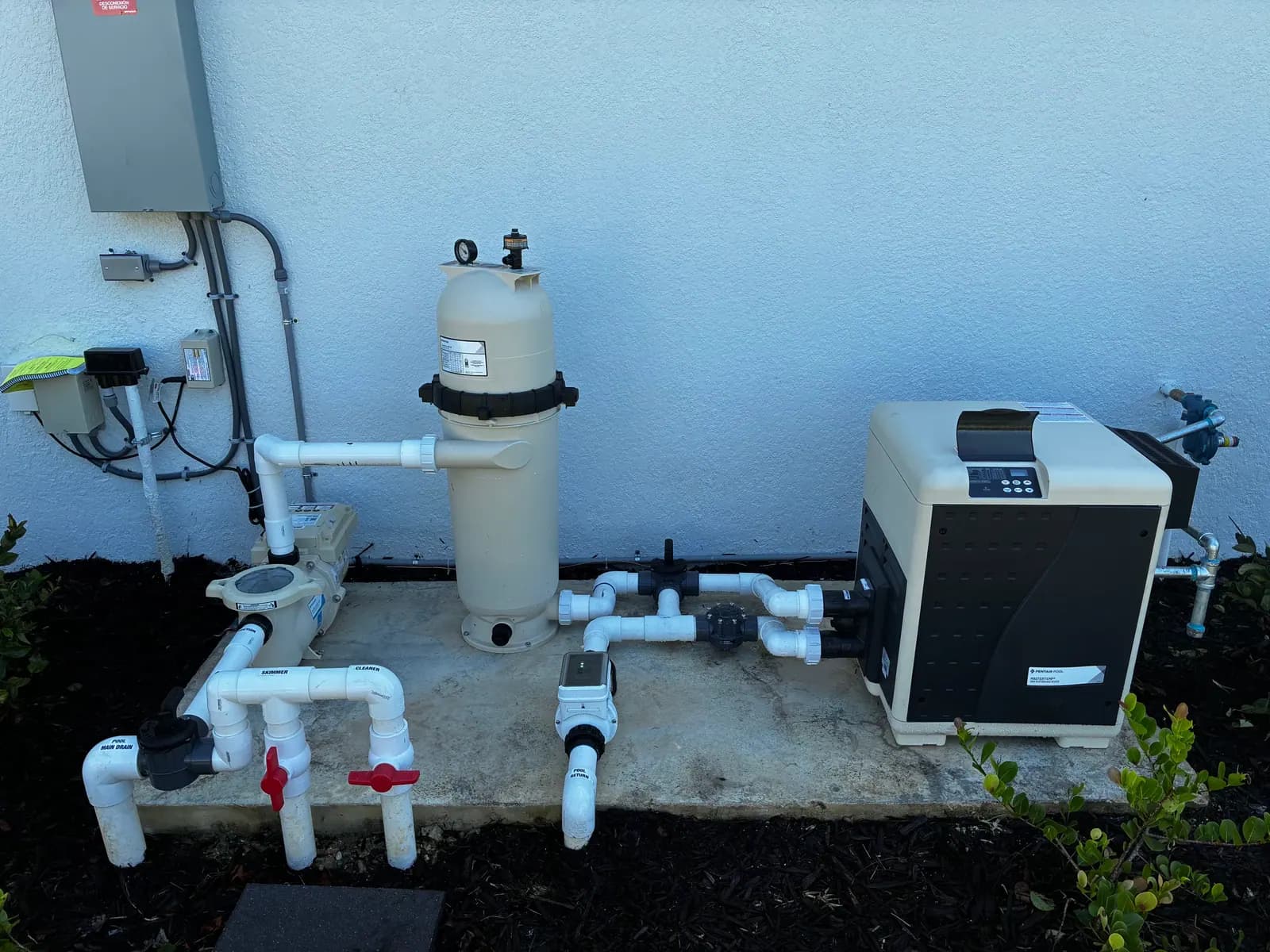
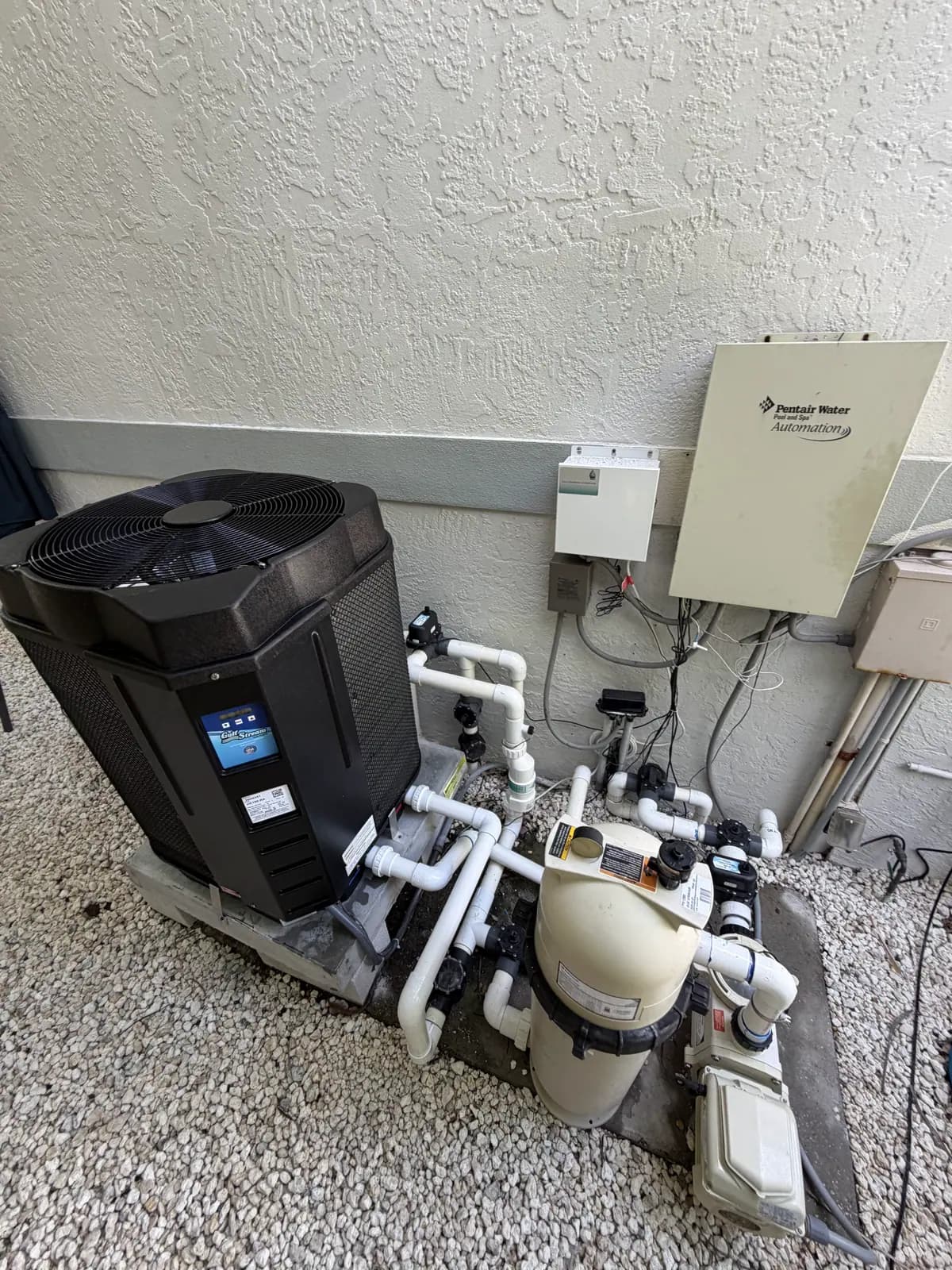
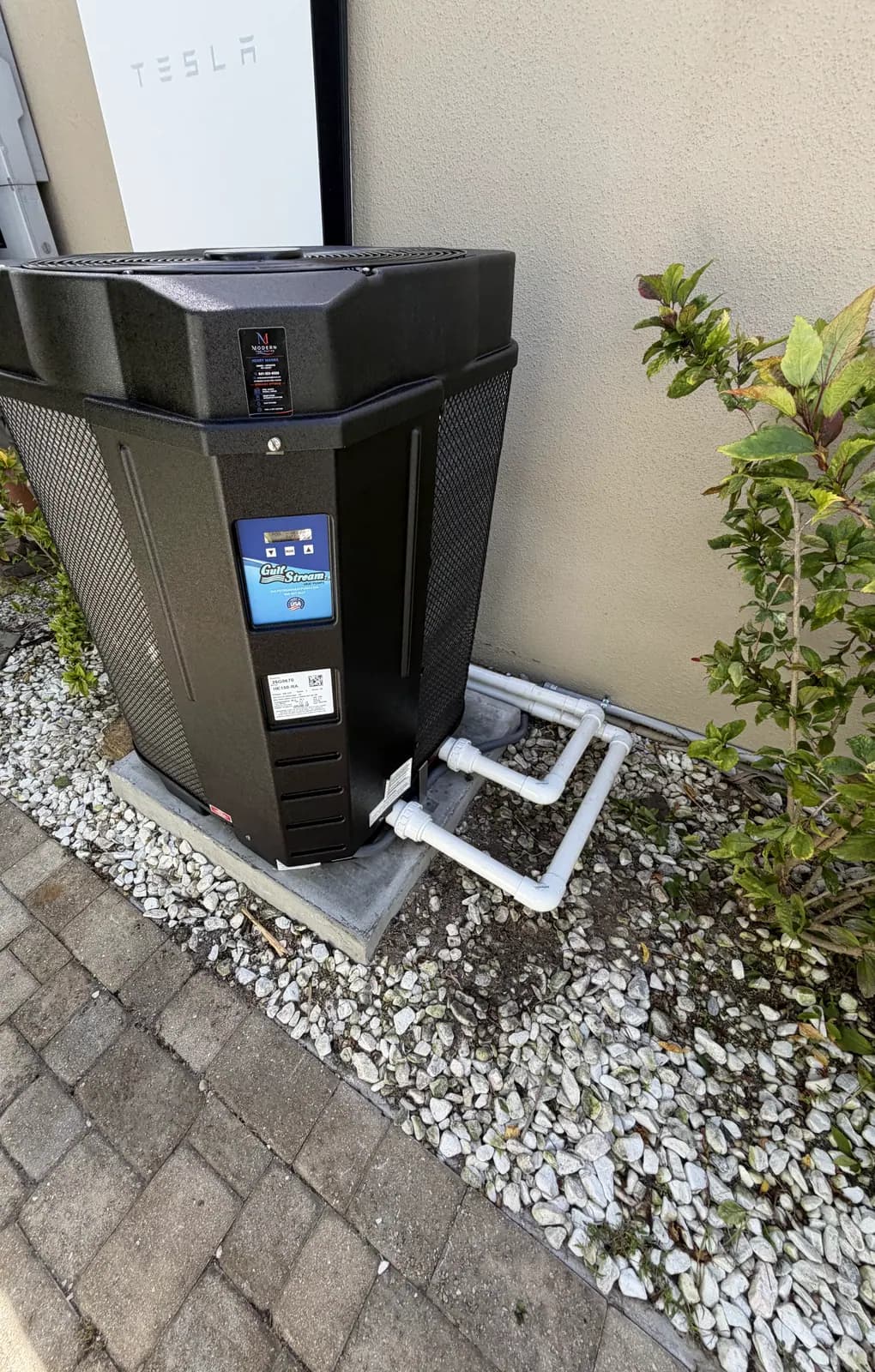
Recent jobs from our installation library that involve the equipment in this guide.
Heaters mentioned in this guide
Hayward · Universal H-Series
Hayward Universal H-Series H400FDN Gas Pool Heater
Model H400FDN
- BTU input
- 399,900 BTU/hr
- Thermal efficiency
- 84%
- Heat exchanger
- Cupro-nickel
- Warranty
- 3-Year Parts / 1-Year Labor
- Wi-Fi / automation
- App Control via AutomationAutomation Compatible (Relay)
A large Florida pool, or a pool and spa combination, that needs to reach temperature on demand rather than hold it all season.
Pentair · MasterTemp HD
Pentair MasterTemp 400HD Heavy Duty Gas Pool Heater
Model MasterTemp 400HD
- BTU input
- 400,000 BTU/hr
- Thermal efficiency
- 82%
- Heat exchanger
- Cupro-nickel
- Warranty
- 2-Year Parts & Labor
- Wi-Fi / automation
- Automation Compatible
A large salt-water or coastal pool, or a pool and spa that gets used hard, where the exchanger material matters more than the last two points of efficiency.
Pentair · ETi
Pentair ETi 400 High-Efficiency Gas Pool Heater
Model ETi 400
- BTU input
- 400,000 BTU/hr
- Thermal efficiency
- 96%
- Heat exchanger
- Titanium
- Warranty
- 3-Year Parts & Labor
- Wi-Fi / automation
- Automation Compatible (Relay)
A high-use pool or pool-and-spa where the fuel bill is the deciding factor, and an owner willing to pay premium money up front and manage a condensing heater's condensate.
Raypak · AVIA HD with NiTek
Raypak AVIA HD 404A with NiTek Gas Pool & Spa Heater
Model P-R404A-EN-N
- BTU input
- 399,000 BTU/hr
- Thermal efficiency
- 84%
- Heat exchanger
- NiTek (nickel alloy)
- Warranty
- 3-Year Parts & Labor
- Wi-Fi / automation
- Wi-Fi Built InAutomation Compatible (Relay)
A salt pool, a coastal lot, or any Florida pool whose chemistry does not get watched closely — the version of the AVIA to buy when the heat exchanger is the part you are worried about.
GulfStream · GulfStream HE Series
GulfStream HE150-TA Heat/Cool Pool Heat Pump
Model HE150-TA
- Heating capacity
- 135,000 BTU/hr
- Efficiency (COP)
- COP 6.0
- Heat exchanger
- Titanium
- Warranty
- 7-Year Parts / 2-Year Labor
- Wi-Fi / automation
- Automation Compatible (Relay)
A Gulf Coast pool that gets used most of the year and an owner who also wants the option to take the edge off the water in late summer.
GulfStream · GulfStream HE Series
GulfStream HE125-RA Heat-Only Pool Heat Pump
Model HE125-RA
- Heating capacity
- 118,000 BTU/hr
- Efficiency (COP)
- COP 6.0
- Heat exchanger
- Titanium
- Warranty
- 7-Year Parts / 2-Year Labor
- Wi-Fi / automation
- Automation Compatible (Relay)
The middle of the GulfStream line: a typical Gulf Coast residential pool that gets swum in most of the year and does not need the water chilled.
Last verified September 18, 2026
Specifications and warranty terms are taken from the manufacturer documents below. Manufacturers revise these without notice, so confirm the current terms before you buy. If you spot something out of date, email us and we will fix it.
Sources
- Hayward — Universal H-Series H400FDN product page (cupro-nickel standard, salt water corrosion resistance)
- Pentair — MasterTemp product page (copper 84% vs HD cupro-nickel 82% thermal efficiency)
- Pentair — ETi 400 product page (direct-fire titanium heat exchanger, 96% thermal efficiency)
- Raypak — NiTek heat exchanger technology page (nickel content, scale, erosion and efficiency claims)
- Raypak — AVIA pool and spa heater product page (AVIA 264A and 404A, 84% thermal efficiency)
- Pentair — UltraTemp High Performance Heat Pump product page (100% titanium heat exchanger)
- Pentair — pool product warranty information (UltraTemp lifetime titanium exchanger; GulfStream terms)
- Pentair — product registration card and general warranty terms (water chemistry exclusion)
- GulfStream Heat Pumps — Installation and User Guide (titanium exchanger, water chemistry window, chlorinator placement, flow window)
- Jandy — VersaTemp Heat/Chill Pump sell sheet (titanium heat exchanger across the JRT range)
- Jandy — VersaTemp JRT4001R Installation & Operation Manual, H0902200 Rev C (Table 1: titanium twisted coil heat exchanger, ABS cabinet)
- Surface Characterization and Corrosion Behavior of 90/10 Copper-Nickel Alloy in Marine Environment, Materials (Basel), 2019
Ratings on this site are the editorial opinion of Affordable Solar & Pool Heating, LLC, trading as Modern Pool Heating. How we rate heaters. Corrections: modernpoolheating@icloud.com.