

Updated September 17, 2026 · Affordable Solar & Pool Heating, LLC · Owner/operator Henry Manna
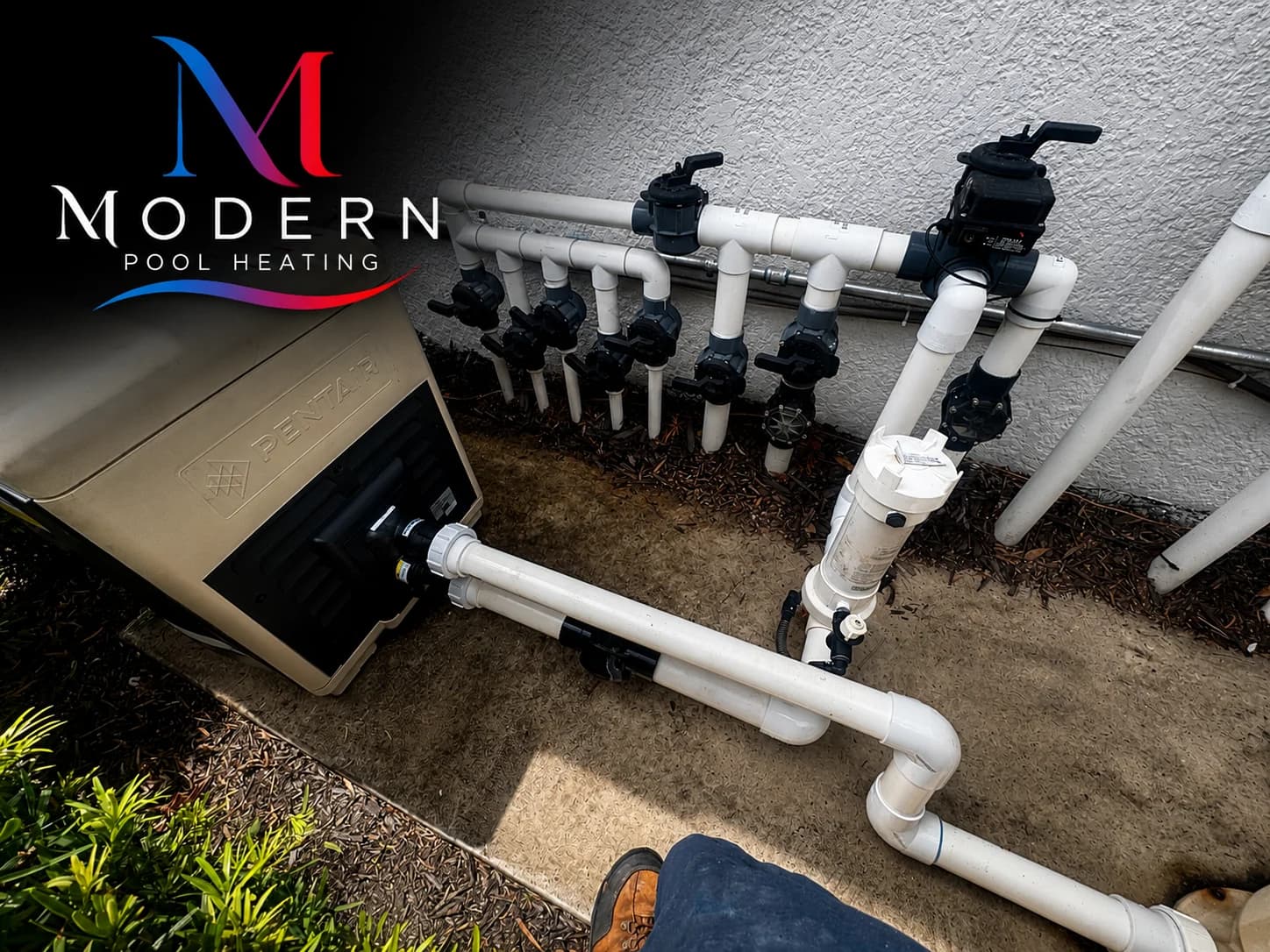
Three facts decide it: age, what failed, and what the repair costs
Every honest repair-or-replace conversation starts in the same place. How old is the heater, what exactly failed, and what does the fix cost against a new unit? Everything else is commentary.
Age gives you the baseline. The Department of Energy says that with proper installation and maintenance, heat pump pool heaters can last 10 or more years and gas pool heaters typically last five or more. Florida's salt air, salt chlorine generators and year-round run hours generally push toward the lower end of those ranges.
What failed matters more than how old the unit is. A board, an igniter, a contactor, a fan motor, a pressure switch or a thermistor are ordinary wear parts and are usually worth replacing. A heat exchanger, a compressor or a cracked cabinet is a different category of decision, because those are the expensive parts the rest of the machine is built around.
The heat exchanger is the decision point
On a gas heater, a leaking heat exchanger is normally the end of the road. The symptoms are recognizable: water inside the cabinet or the burner tray, rust streaks below the unit, corroded burners, or a heater that keeps extinguishing itself. Once water reaches the combustion section, running it damages everything it touches, and the exchanger is a large enough share of the heater's value to tip the arithmetic toward replacement.
Cause matters because it predicts recurrence. Plain copper exchangers are the ones that fail earliest in salt pools and chemically aggressive water, which is why cupro-nickel is worth specifying on a Florida gas heater and titanium is standard on every current heat pump worth buying. If the original heater failed because the chlorinator sat upstream of it, or because chemistry ran low-pH for months, the same failure will come back on a new heater unless the plumbing order and chemistry are corrected at the same time.
It is also the failure warranties are least likely to cover: AquaCal excludes damage from freezing, negligence, abuse and installation in corrosive environments, and Built Right requires proper pool chemical balance to be maintained. Manufacturers know what kills exchangers and write it into the document.
On a heat pump, titanium exchangers rarely fail. The equivalent judgment call is the compressor: expensive, sometimes still covered by a parts warranty years after labor has run out, and the one part whose replacement cost on an older unit usually justifies a new machine instead.
Repeat failures are a pattern, not bad luck
One ignition failure on a gas heater is a repair. Three across two seasons is a machine telling you something. Individually cheap parts — igniter, flame sensor, gas valve, board, pressure switch — add up when they arrive one at a time, and by the third visit most owners have spent a meaningful fraction of a new heater without buying any remaining life.
Efficiency quietly slides at the same time: DOE notes that scaling in the burner or heat exchanger may decrease a gas heater's efficiency over time, so an aging heater is no longer delivering the number on its nameplate. Ask your technician for the failure history rather than just the current fault — a string of unrelated components means the harness, board and sensors have aged together, and the next failure is a question of when.
Check the warranty before you authorize a single repair
Owners routinely pay for repairs a manufacturer would have covered, because coverage often runs longer than people remember. Find the model and serial number on the data plate, then find the manufacturer's current warranty document for that exact model before anyone starts work.
Examples from brands we see on Gulf Coast pads: AquaCal's current national warranty gives HeatWave SuperQuiet and TropiCal models three years of parts and labor, years four and five of limited parts on the compressor, heat exchanger and evaporator coil, and a limited lifetime part-only term on the ThermoLink titanium tubing. Built Right covers five years of parts and on-site labor. Moov publishes three years labor, five years parts and ten years on the exchanger. Thermeau's Prestige line is five years labor and parts, Signature two years labor and seven years parts.
The conditions are where claims die. Most require prior authorization and an approved service agent; AquaCal states that parts which do not meet OEM specification void the warranty, Built Right requires registration within thirty days, a licensed installer and correct bonding, and Moov requires claims to be approved by an authorized Moov employee. A repair paid out of pocket by an unauthorized tech can end coverage that was still live.
Parts availability, and what it tells you
The practical question that decides a lot of these calls is simple: can the part be had, and how fast? A heater that needs a board which is three weeks out is a different proposition in February than in June, and an obsolete part with no aftermarket equivalent effectively ends the discussion regardless of the unit's age.
Widely distributed brands hold an advantage that does not show on any spec sheet — boards, igniters, sensors and blowers for the big pro-channel gas heaters are stocked regionally in Florida. Regional and newer brands vary; Built Right, for example, still hosts owner's manuals going back to pre-2012 units, which helps when identifying parts on an older heat pump.
So ask two questions before approving a repair: is this part still manufactured, and what is the lead time? If the answer to the first is no, you are buying time on a machine whose next failure has no fix.
The 50% rule, and better arithmetic than the rule
The heuristic most HVAC contractors use is the 50% rule: if the repair estimate reaches half the price of a comparable new system, replacement is typically the better financial move. It is an industry rule of thumb rather than a published standard, and the contractors who use it are clear that it carries the most weight on equipment ten years old or older and much less under about seven years.
Better is to put numbers on what a new heater would save. DOE publishes the gas formula directly: Current Annual Cost x [1 - (Current Efficiency / New Efficiency)]. Spending $1,200 a year on a tired 70% efficient heater, with a current model at 84%, returns about $200 a year. DOE's table makes the bigger point: for every $1,000 spent annually on a 55% efficient heater, a 95% efficient model costs $422 less.
If the replacement also changes fuel, the gap widens sharply. DOE estimates that for every $1,000 of annual pool heating on a 55% efficient gas heater, the same heating on a heat pump with a seasonal COP of 5.0 costs about $700 — and against electric resistance heating, about $200. In Florida, where the heating season is long and mild, that is the calculation that most often turns a marginal repair into a sensible replacement.
Put those together — the repair quote against a new heater, the annual energy saving, and the realistic remaining life of the old unit — and the decision usually makes itself without any rule of thumb.
Safety problems that end the conversation
Some findings are not economic decisions. If a technician reports any of the following, replacement is normally the right answer regardless of the unit's age:
- Water leaking into the combustion section of a gas heater, or a heat exchanger leaking onto burners — a combustion problem as well as a plumbing one.
- Soot, scorching, melted wiring, a burnt contactor or heat damage inside the control box.
- Any suspected gas leak, or a heater that will not stay lit and vents incorrectly. Shut the gas off at the appliance valve and call a licensed contractor rather than resetting it repeatedly.
- A heater submerged in a storm surge or flood, or with water standing in the control box. Moov's warranty excludes weather-event damage, and flooded electrical equipment is not worth rehabilitating.
- Equipment that is not properly bonded. Built Right voids its warranty if the system is not bonded, and bonding is a life-safety requirement on a pool pad, not a preference — it gets corrected either way.
- Refrigerant leaks on an old heat pump that uses a phased-out refrigerant, where recharging is expensive, temporary and environmentally pointless.
How our repair service works on the Gulf Coast
We diagnose before we quote. Our technicians service solar systems, electric heat pumps and gas heaters across most makes and models regardless of who installed them, and the first visit is about finding the actual fault — not selling a heater. If the fix is a $200 part on a seven-year-old unit with parts on the shelf, that is what we will tell you.
When replacement is the honest answer we show the arithmetic: the repair quote, what a correctly sized new heater costs installed, what it saves per year at current energy prices, and what the warranty actually covers. If the old heater failed because of a plumbing-order or chemistry problem, we fix the cause at the same time — otherwise the new heater inherits the old one's fate.
We install and service pool heating throughout Sarasota, Manatee, Charlotte & Pinellas County, Florida. The decision framework on this page is written for pool owners anywhere; the service visit is local.
Heaters mentioned in this guide
GulfStream · GulfStream HE Series
GulfStream HE150-TA Heat/Cool Pool Heat Pump
Model HE150-TA
- Heating capacity
- 135,000 BTU/hr
- Efficiency (COP)
- COP 6.0
- Heat exchanger
- Titanium
- Warranty
- 7-Year Parts / 2-Year Labor
- Wi-Fi / automation
- Automation Compatible (Relay)
A Gulf Coast pool that gets used most of the year and an owner who also wants the option to take the edge off the water in late summer.
AquaCal · HeatWave SuperQuiet
AquaCal HeatWave SuperQuiet Pool Heat Pumps
Model SQ140R
- Heating capacity
- 114,000 BTU/hr
- Efficiency (COP)
- COP 5.7
- Heat exchanger
- Titanium
- Warranty
- 3-Year Parts & LaborLimited Lifetime Heat Exchanger
- Wi-Fi / automation
- Wi-Fi Built InAutomation Compatible (Relay)
A Gulf Coast owner who wants a heat pump from a Florida manufacturer with a real service organization behind it, built-in Wi-Fi out of the box, and the option to cool the pool in late summer.
Built Right · XW Series
Built Right XW Series Pool Heat Pumps
Model BR135XW
- Heating capacity
- 135,000 BTU/hr
- Efficiency (COP)
- COP 6.0
- Heat exchanger
- Titanium
- Warranty
- 5-Year Parts & Labor
- Wi-Fi / automation
- Automation Compatible (Relay)
A Sarasota, Charlotte or Manatee County pool owner who wants five years of parts and on-site labor on one warranty term from a factory an hour down the road, and does not need app control.
Thermeau · Signature and Prestige
Thermeau Signature & Prestige Pool Heat Pumps
Model TH125
- Heating capacity
- 121,000 BTU/hr
- Efficiency (COP)
- COP 5.5
- Heat exchanger
- Titanium
- Warranty
- 5-Year Parts & Labor10-Year Heat Exchanger
- Wi-Fi / automation
- Onboard controls only
An owner who wants published, model-by-model performance data and a long warranty, and who has confirmed there is a Thermeau service dealer near the pool.
Hayward · Universal H-Series
Hayward Universal H-Series H400FDN Gas Pool Heater
Model H400FDN
- BTU input
- 399,900 BTU/hr
- Thermal efficiency
- 84%
- Heat exchanger
- Cupro-nickel
- Warranty
- 3-Year Parts / 1-Year Labor
- Wi-Fi / automation
- App Control via AutomationAutomation Compatible (Relay)
A large Florida pool, or a pool and spa combination, that needs to reach temperature on demand rather than hold it all season.
Last verified September 17, 2026
Specifications and warranty terms are taken from the manufacturer documents below. Manufacturers revise these without notice, so confirm the current terms before you buy. If you spot something out of date, email us and we will fix it.
Sources
- U.S. Department of Energy, Energy Saver — Heat Pump Swimming Pool Heaters (10 or more years of service life; savings against gas and electric resistance) — archived copy, energy.gov currently returns 404 for this page
- U.S. Department of Energy, Energy Saver — Gas Pool Heaters (five or more years of service life, scaling and efficiency loss, efficiency savings table and replacement savings formula) — archived copy
- AquaCal — National Heat Pump Warranty LTP0159 Rev. H, 02/26, the document linked from aquacal.com (3 years parts and labor, years 4-5 limited parts, lifetime ThermoLink titanium tubing, OEM parts and corrosive-environment exclusions)
- Built Right Pool Heaters — warranty page (5 years parts and on-site labor, registration, licensed installer, chemistry and corrosive-environment conditions)
- Moov Pool Products — Moov Inverter owner's manual (warranty exclusions: winterization, weather events, unqualified installers)
- Thermeau — support page (Prestige 5 years labor and parts; Signature 2 years labor and 7 years parts; no registration required)
- Heat & AC Solutions — "AC Repair vs. Replacement: The 50% Rule and When It Applies" (an HVAC contractor's statement of the rule of thumb and its age caveats; not a published standard)
Ratings on this site are the editorial opinion of Affordable Solar & Pool Heating, LLC, trading as Modern Pool Heating. How we rate heaters. Corrections: modernpoolheating@icloud.com.