Modern Pool Heating · Owner/operator Henry Manna, Florida Certified Pool/Spa Contractor CPC1460367
Updated October 16, 2026
Short answer
Before any heat loss, raising a 15,000-gallon pool by 10°F takes about 1.25 million BTU: roughly 9 to 11 hours of output from a 110,000-138,000 BTU/hr heat pump (ratings at 80°F air, 80°F water and 80% humidity) and roughly 4 to 6 hours from a 250,000-400,000 BTU input gas heater at 84% thermal efficiency. Real pools take longer, because they keep losing heat to evaporation, wind and cool air while they warm. Heat pumps warm a swimming pool gradually over many hours. Actual heating speed depends on pool volume, heater output, starting water temperature, outdoor air temperature, humidity, wind conditions and whether the pool is covered.
What we usually recommend
If you want the pool warm whenever you walk outside, we'd usually set a heat pump at your target temperature, leave it there and keep a cover on, rather than heating from cold every weekend. If you need the pool or spa hot on a schedule, a gas heater sized for the job, on a gas line sized for the heater, is the right tool. Proper heater sizing and the use of a pool cover can significantly affect recovery time.
- Heat needed = gallons x 8.34 x degrees of rise. A 15,000-gallon pool needs about 125,100 BTU per degree.
- Gas heaters are rated by BTU input. Multiply by thermal efficiency for the heat that reaches the water: 400,000 x 84% = 336,000 BTU/hr.
- Heat pumps are rated by heating capacity at a test point, usually 80°F air, 80°F water and 80% humidity, and deliver less in cooler air.
- GulfStream's manual: a properly sized heat pump in those ideal conditions raises water temperature an average of about 1°F per hour.
- Idealized times ignore heat loss. Evaporation, wind and cool nights slow real heat-up; a cover speeds it up.
The physics: how much heat a pool actually needs
A BTU (British thermal unit) is the heat needed to raise one pound of water by one degree Fahrenheit; DOE and Pentair both define it that way. A gallon of water weighs about 8.34 pounds (Raypak's sizing formula uses 8.33, the weight at 62°F, and the difference is rounding). So the heat a pool needs is simple multiplication: gallons x 8.34 x the number of degrees you want to raise it.
For a 15,000-gallon pool, each degree takes about 125,100 BTU (15,000 x 8.34). A 10°F rise, say from 72°F after a cold front back up to 82°F, takes about 1.25 million BTU. Divide that by the heater's real output in BTU per hour and you have the number of hours it would take if the pool lost no heat at all while it warmed. That is the idealized time, and it is a floor: a real pool can only take longer.
Manufacturers use the same arithmetic. Raypak's Crosswind V submittal prints the California Title 24 sizing formula, output = gallons x 8.33 x temperature rise / hours, and states plainly that it does not account for wind, heat loss and other environmental factors. Pentair's published heat-up times for its gas heaters match the same no-loss math to the minute, as the gas section below shows.
Idealized heat-up times for a 15,000-gallon pool
The table uses capacity figures from the heater comparison on this site. The heat pump rows use each manufacturer's rating at 80°F air, 80°F water and 80% relative humidity, plus Hayward's published figure at 50°F air, because that is closer to a January morning on the Gulf Coast. The gas rows use BTU input multiplied by 84 percent thermal efficiency, which is the heat that actually reaches the water. None of the figures include heat loss.
Two things stand out. Gas delivers roughly one and a half to three times the hourly heat of a residential heat pump at its rating point, which is why it wins on speed. And the same heat pump on a 50°F morning delivers about 40 percent less than at its rating point: Hayward's HP21405T drops from 138,000 BTU/hr to 82,000 BTU/hr, which stretches the idealized 10°F time from about 9 hours to about 15.
| Heater and rating used | Heat delivered to the water | Per 1°F | For a 10°F rise |
|---|---|---|---|
| GulfStream HE110-RA heat pump at 80°F air / 80°F water / 80% RH | 110,000 BTU/hr | About 68 minutes | About 11.4 hours |
| GulfStream HE150-RA or Hayward HP21405T heat pump at 80°F air / 80°F water / 80% RH | 138,000 BTU/hr | About 54 minutes | About 9.1 hours |
| Hayward HP21405T heat pump at 50°F air / 63% RH / 80°F water | 82,000 BTU/hr | About 92 minutes | About 15.3 hours |
| 250,000 BTU input gas heater at 84% thermal efficiency (Hayward H250FDN, Pentair MasterTemp 250) | About 210,000 BTU/hr | About 36 minutes | About 6.0 hours |
| 400,000 BTU input gas heater at 84% thermal efficiency (Pentair MasterTemp 400; Hayward H400FDN is 399,900 input) | About 336,000 BTU/hr | About 22 minutes | About 3.7 hours |
Heat pumps: what the ratings mean for heat-up time
Heat pumps warm a swimming pool gradually over many hours. Actual heating speed depends on pool volume, heater output, starting water temperature, outdoor air temperature, humidity, wind conditions and whether the pool is covered. Proper heater sizing and the use of a pool cover can significantly affect recovery time.
GulfStream's manual gives the one manufacturer benchmark worth quoting, with its condition attached: under ideal conditions of 80°F air, 80% relative humidity and 80°F water, a properly sized heat pump should raise water temperature an average of about 1°F per hour. That is consistent with the idealized table for a 15,000-gallon pool. The same manual is just as clear about the other half of the story: heat pumps are best used to maintain a set water temperature, they are not intended to heat quickly the way gas heaters do, and after being switched off for a long stretch they may take some time to bring the pool back.
The rating conditions are kinder than a Gulf Coast winter. The National Weather Service's 1991-2020 normals for Sarasota-Bradenton put the average January low at 52.3°F, right around the 50°F test point, and the coldest hours are also when a pool loses heat fastest. Humidity matters too: Hayward rates the HP21405T at 138,000 BTU/hr at 80°F air and 80% humidity, but 128,000 BTU/hr at the same air temperature and 63% humidity. That is why we size heat pumps for January, and why a heat pump left at a steady setpoint is far easier to live with than one asked to recover a cold pool overnight.
Gas heaters: input is not output
Gas heaters are rated by BTU input, the fuel they burn each hour. Pentair's MasterTemp manual states that the model size is the BTU input in thousands of BTU per hour, so a MasterTemp 400 burns 400,000 BTU/hr of gas. Thermal efficiency tells you how much of that reaches the water: at 84 percent, about 336,000 BTU/hr, with the rest leaving through the vent. Treating the input number as heat delivered overstates a gas heater's speed by about 19 percent.
Pentair's own heat-up chart is a good check on the arithmetic. It estimates 4 hours 58 minutes to raise a 20,000-gallon pool by 10°F with a MasterTemp 400 (84 percent), 5 hours 5 minutes with the MasterTemp HD (82 percent) and 4 hours 20 minutes with the ETi 400 (96 percent). Run the no-loss math, 20,000 x 8.34 x 10 = 1,668,000 BTU divided by 336,000, 328,000 or 384,000 BTU/hr, and you get the same times to the minute. Pentair labels them estimates based on operation in a controlled environment, which is exactly what they are.
Efficiency also decides what each degree costs. Using the EIA prices in our cost guide, the 1.25 million BTU that a 15,000-gallon pool needs for a 10°F rise costs about $37 of natural gas at 84 percent efficiency, about $58 of propane at the East Coast residential price, and about $11 of electricity through a heat pump at a COP of 5.0, all before heat loss. Speed and running cost pull in opposite directions, which is the whole gas-versus-heat-pump decision in one line.
How quickly does a 400K BTU heater heat a pool?
On paper, quickly. A 400,000 BTU input heater at 84 percent thermal efficiency delivers about 336,000 BTU/hr. In idealized arithmetic that is about 22 minutes per degree on a 15,000-gallon pool, about 30 minutes per degree on 20,000 gallons, and about 3.7 hours for a 10°F rise on 15,000 gallons. A 250,000 BTU input heater at the same efficiency delivers about 210,000 BTU/hr, roughly 36 minutes per degree on 15,000 gallons.
In a real backyard those times stretch, and by how much depends on the day. An uncovered pool on a windy, cool evening loses heat much faster than a covered pool on a still afternoon, and every BTU lost has to be replaced before the temperature climbs. The 400 earns its place on large pools, pools with attached spas, and pools heated on demand for weekends; on a typical pool that is kept warm, a 250 often does the job at the same efficiency with a smaller gas line. Our 250K versus 400K article walks through that choice.
On a spa the difference is easier to feel. Hayward's published table puts its 400,000 BTU heater at about 18 minutes to raise a 400-gallon covered, insulated spa by 30°F, against about 29 minutes for the 250,000 BTU model. Real spas lose heat to their surroundings, so treat those as best cases.
Why real-world heating takes longer than the math
The idealized numbers assume the pool stops losing heat the moment the heater starts, and it does not. DOE calls evaporation by far the largest source of energy loss from a pool, and its numbers are striking: it takes 1 BTU to raise a pound of water 1°F, but each pound of 80°F water that evaporates takes 1,048 BTU out of the pool. Put another way, every gallon that evaporates (about 8.34 pounds) carries off roughly 8,700 BTU, enough to have warmed about 1,050 gallons of pool water by a degree. On a 15,000-gallon pool, losing about 14 gallons to evaporation cancels a full degree of heating.
DOE says evaporation rises with water temperature and wind speed and falls as humidity rises, so the warmer you are trying to make the pool and the windier the lot, the harder the heater works just to hold its ground. That is why a cover matters so much during heat-up. DOE calls covering a pool when it is not in use the single most effective way to reduce heating costs, with savings of 50 to 70 percent possible, and a screen enclosure helps for a related reason: it cuts the wind over the water.
Air temperature counts twice for a heat pump, because cooler air means more heat lost from the pool and less heat available to the heat pump. Sun works the other way: DOE says an outdoor pool absorbs 75 to 85 percent of the solar energy striking its surface, and a transparent bubble cover reduces that gain by only 5 to 15 percent. Finally, a heater only heats while water flows through it, so hours when the pump is scheduled off do not count toward heat-up at all.
What is the fastest way to heat a pool?
If speed is the goal, these are the levers, roughly in order of effect. None of them is exotic, and the cover costs the least of anything on the list.
Solar is not on the list because it cannot be switched on; it adds heat when the sun is out. A heat pump can be part of a fast-recovery plan if it is sized generously and the pool is covered, but on a cold evening it will not match a gas heater.
- Use gas. A correctly sized gas heater on a correctly sized gas line is the fastest equipment option, and its output does not depend on the weather.
- Cover the pool while it heats. Stopping evaporation removes the biggest loss, so more of the heater's output goes into raising the temperature.
- Run the pump continuously during heat-up, at a speed that meets the heater's minimum flow: 40 GPM on a MasterTemp 400, 30 GPM on a Hayward H400FDN, and 30-70 GPM (45-50 GPM optimal) on a GulfStream heat pump.
- Do not let the pool fall far in the first place. Holding a setpoint with a heat pump avoids the long climb from cold.
- For a spa, heat only the spa. Heating a few hundred gallons instead of the whole pool is why spa heat-up is measured in minutes.
Real installations
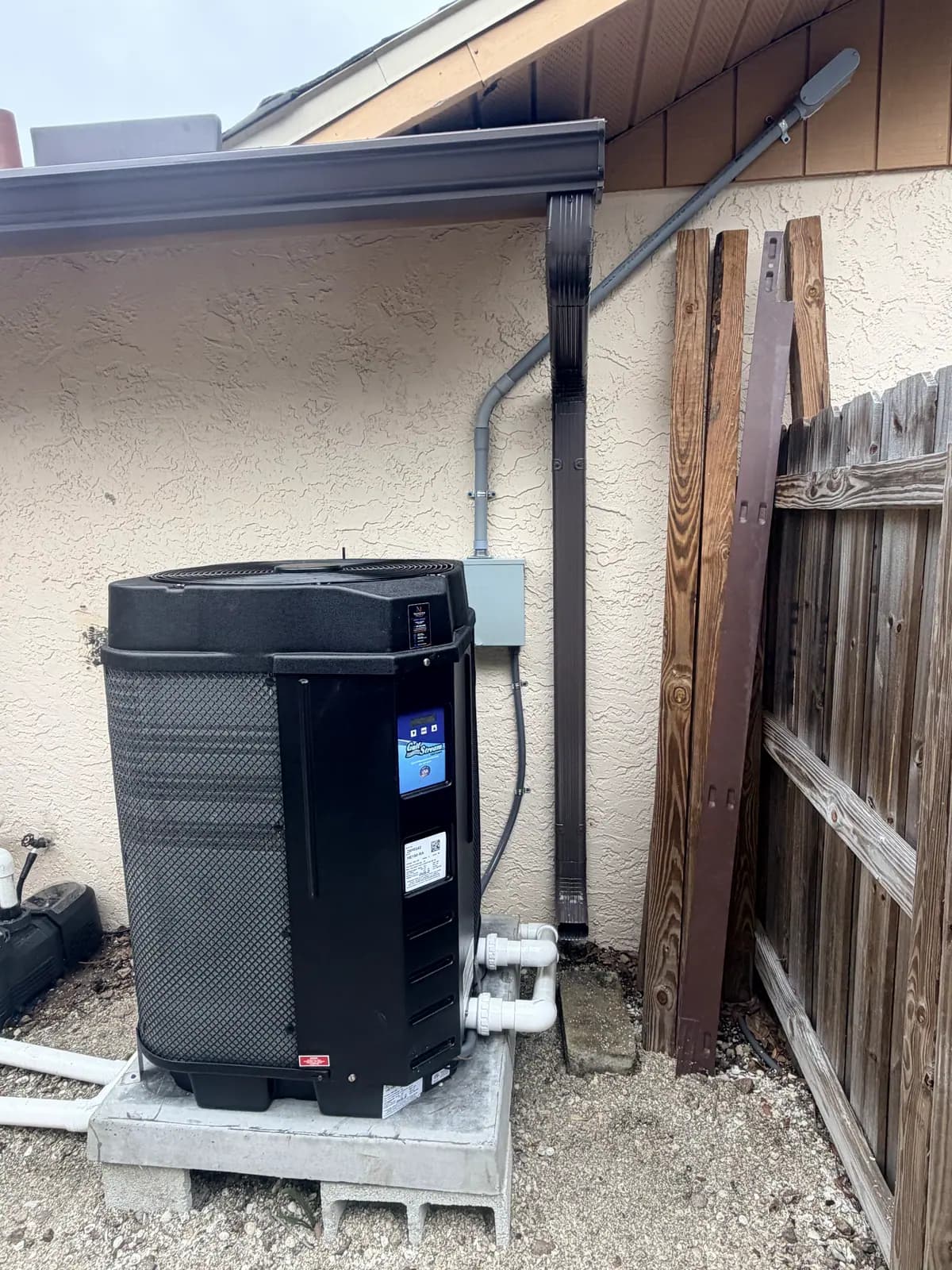
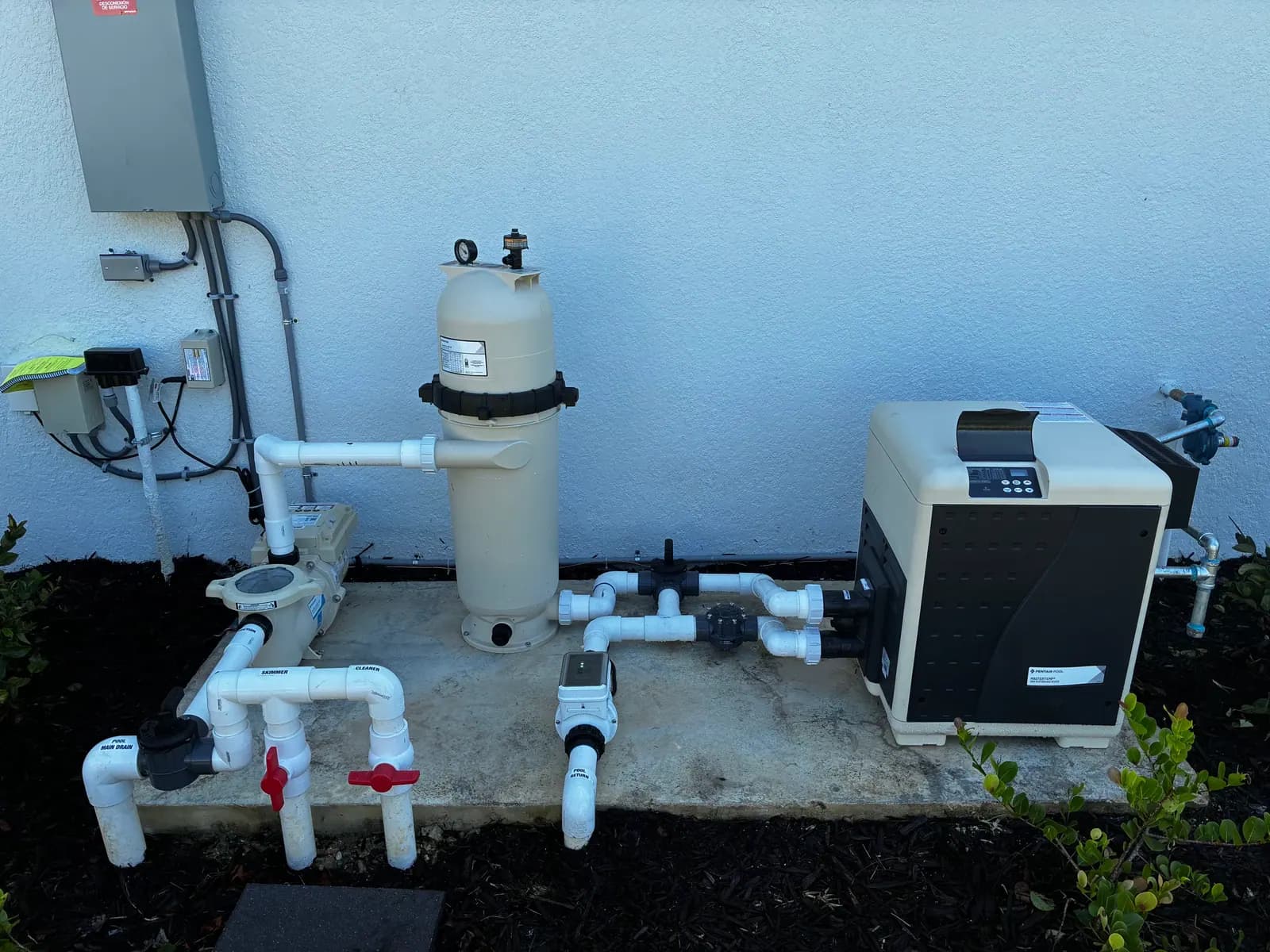
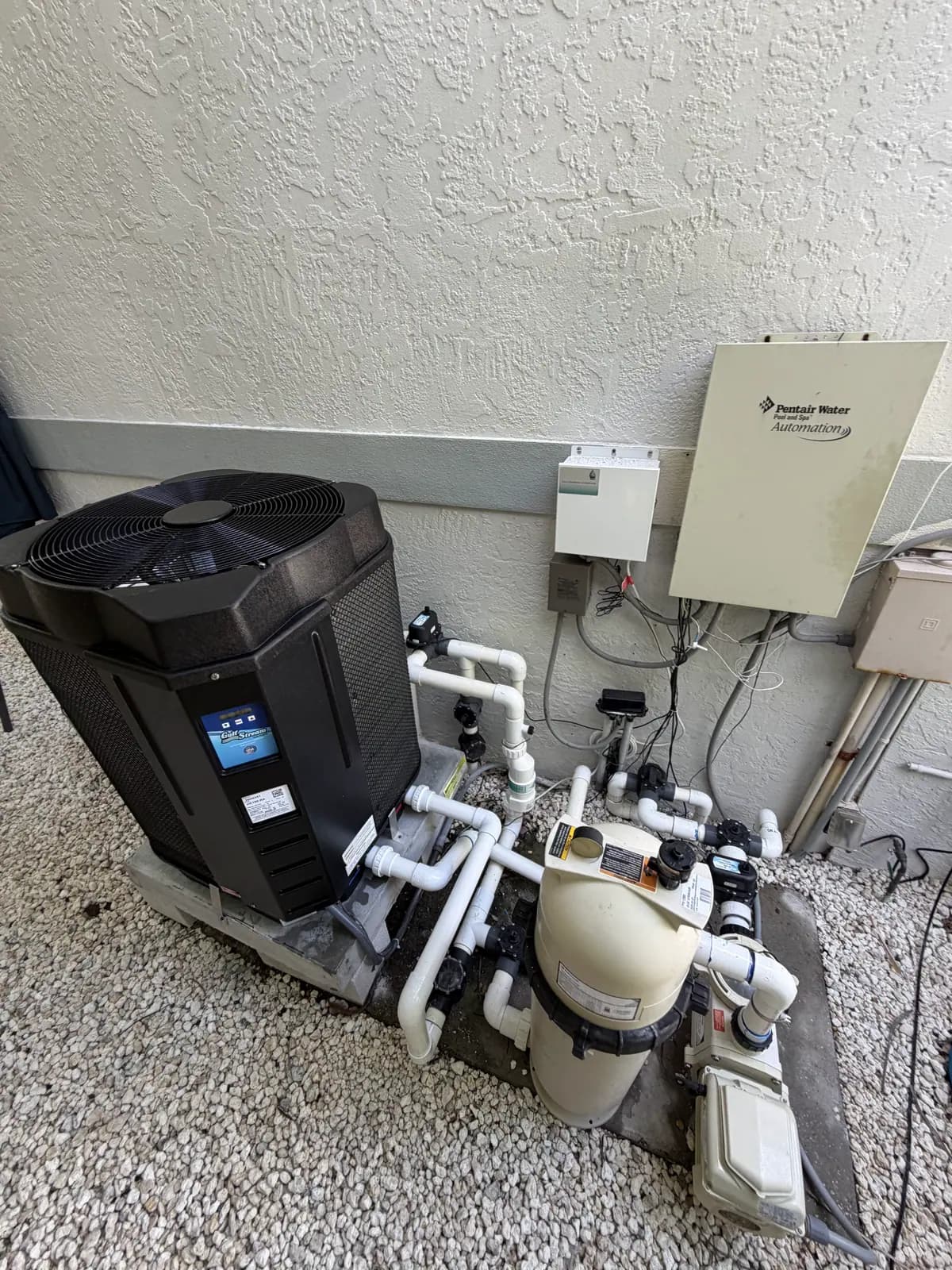
Recent jobs from our installation library that relate to this topic.