Modern Pool Heating · Owner/operator Henry Manna, Florida Certified Pool/Spa Contractor CPC1460367
Updated October 16, 2026
Short answer
A 250,000 BTU gas heater is enough for an average residential pool, especially one with no spa or where gas backs up a heat pump or solar. A 400,000 BTU heater suits large pools, pool-and-spa combinations and owners who want the water hot on short notice. Most current models in both sizes are rated at 84% thermal efficiency, so the bigger heater doesn't cost more per degree of heat; it burns gas faster, which means a larger gas line, more supply from the meter or tank, and on propane, more deliveries.
What we usually recommend
If your pool is an ordinary size with no attached spa, or gas is the backup to a heat pump or solar, we'd usually fit a 250,000 BTU-class heater and keep the gas line simple. If you have a spa you use often, a large or exposed pool, or you want the pool warm for a weekend without starting days ahead, we'd usually go to 400,000 BTU, but only after confirming the gas line, the meter or the propane tank can actually feed it.
- The size on a gas heater is BTU input. Heat into the water is input times thermal efficiency: about 210,000 BTU/hr from a 250,000 BTU heater at 84%, about 336,000 BTU/hr from a 400,000.
- With zero heat loss, a 400K-class heater lifts a 15,000-gallon pool about 2.7°F an hour and a 250K-class about 1.7°F. A real pool loses heat while it warms, so expect less.
- Hayward's table: about 18 minutes for its 400K and 29 minutes for its 250K to raise a covered 400-gallon spa by 30°F.
- Gas line size depends on BTU input, pipe length, fuel and supply pressure. The manufacturer tables we quote allow a 400K only 20 feet of 1-inch natural gas pipe.
Input versus output: what the BTU number actually means
The 250 or 400 in a gas heater's name is BTU input: the gas it burns at full fire, not the heat that reaches your pool. Pentair's MasterTemp manual says so in plain terms, defining the model size as BTU input in thousands of BTU per hour. The heat delivered to the water is the input multiplied by the thermal efficiency, and the rest goes up the vent.
Because the efficiencies match, a 400 doesn't cost more than a 250 for each BTU it puts in the pool. It simply burns gas faster: at full fire a 400,000 BTU heater uses about 386 cubic feet of natural gas an hour and a 250,000 BTU heater about 241, using EIA's 1,036 BTU per cubic foot. What you pay depends on how many hours it runs, and the bigger heater reaches setpoint in fewer of them. The one efficiency exception worth knowing is Pentair's cupro-nickel MasterTemp HD, rated at 82% instead of 84%.
Here is what that looks like across the eight heaters in our heater comparison in these two sizes. The output column is our arithmetic from each manufacturer's published input and efficiency; the minimum flow is what each one needs through it before it will fire.
| Heater | BTU input | Thermal efficiency | Heat into the water | Minimum flow |
|---|---|---|---|---|
| Hayward H250FDN | 250,000 BTU/hr | 84% | About 210,000 BTU/hr | 25 GPM |
| Hayward H400FDN | 399,900 BTU/hr | 84% | About 335,900 BTU/hr | 30 GPM |
| Pentair MasterTemp 250 | 250,000 BTU/hr | 84% | About 210,000 BTU/hr | 25 GPM |
| Pentair MasterTemp 400 | 400,000 BTU/hr | 84% | About 336,000 BTU/hr | 40 GPM |
| Raypak AVIA 264A | 264,000 BTU/hr | 84% | About 221,800 BTU/hr | 40 GPM |
| Raypak AVIA 404A | 399,000 BTU/hr | 84% | About 335,200 BTU/hr | 40 GPM |
| Jandy JXi260N | 260,000 BTU/hr | 84% | About 218,400 BTU/hr | 30 GPM |
| Jandy JXi400N | 399,000 BTU/hr | 84% | About 335,200 BTU/hr | 30 GPM |
Sizing by pool, spa and how you use it
The Department of Energy sizes a gas heater the same way it sizes a heat pump: on the pool's surface area and the difference between the pool temperature you want and the average air temperature in the coldest month you swim. Its formula is surface area times temperature rise times 12, which gives the output in BTU per hour for a rise of 1 to 1-1/4°F an hour in a 3-1/2 mph wind. For 1-1/2°F an hour multiply by 1.5, and for 2°F an hour by 2. Our heat pump sizing guide walks through the formula step by step.
Two quick examples show where the line falls. A 15 by 30 foot pool (450 square feet) asking for a 20°F rise needs 450 x 20 x 12 = 108,000 BTU/hr, or 216,000 BTU/hr to come up at 2°F an hour, which is right at the output of a 250K-class heater, roughly 210,000 to 222,000 BTU/hr. A 20 by 40 foot pool (800 square feet) with the same 20°F rise needs 192,000 BTU/hr at the base rate and 288,000 BTU/hr at 1-1/2°F an hour, which is 400K territory.
Hayward's own chart recommends its H250 for up to about 750 square feet of pool surface and its H400 for about 1,200 square feet, based on a 30°F rise, a 3-1/2 mph average wind and elevation up to 2,000 feet. That is more generous than the DOE formula, which for 750 square feet and a 30°F rise would call for 270,000 BTU/hr of output (750 x 30 x 12); Hayward doesn't state the heat-up rate behind its chart. Neither is wrong; they answer different questions, which is why we ask how you want to use the pool before we pick a size.
On a pool with an attached spa, the spa usually makes the decision. Hayward publishes how long each size takes to raise an insulated, covered spa by 30°F, and Pentair's estimate for the MasterTemp 400, 27 minutes for a 600-gallon spa, lines up with Hayward's 400.
| Spa size | Hayward 250,000 BTU (H250) | Hayward 399,900 BTU (H400) |
|---|---|---|
| 300 gallons | 22 minutes | Not listed |
| 400 gallons | 29 minutes | 18 minutes |
| 500 gallons | 36 minutes | 23 minutes |
| 600 gallons | 43 minutes | 27 minutes |
How quickly does a 400K BTU heater heat a pool?
Start with the idealized math, which assumes no heat is lost while the pool warms. Raypak's AVIA manual gives the formula: heater output in BTU per hour divided by the pool's gallons times 8.33 gives the approximate rise in °F per hour, and it notes that this does not account for heat lost to the weather. That follows from EIA's definition of a BTU as the heat that raises one pound of water by 1°F.
A real pool gives heat back while you heat it. The Department of Energy calls evaporation the largest source of heat loss from a pool, and wind, cool nights and an uncovered surface all speed it up. A heater also only delivers its rating while the pump is running, the flow is inside its window and the gas supply holds pressure at full fire. So on a breezy January evening an uncovered pool will come up noticeably slower than the zero-loss figures, and with a cover on it gets much closer to them. For a weekend, start the day before rather than the hour before.
Pentair's lab estimate for the MasterTemp 400, 4 hours 58 minutes to lift a 20,000-gallon pool by 10°F, is almost exactly the zero-loss figure below, and Hayward's spa times match the same arithmetic, so treat all of them as best cases. Here is the zero-loss math, using the outputs from the table above:
- 15,000 gallons (124,950 lb of water) on a 400K-class heater: 336,000 ÷ 124,950 = about 2.7°F per hour.
- 15,000 gallons on a 250K-class heater: 210,000 ÷ 124,950 = about 1.7°F per hour.
- 20,000 gallons raised 10°F (about 1.67 million BTU): about 5 hours on a 400K-class heater and about 8 hours on a 250K-class heater.
- 400-gallon spa raised 30°F (about 100,000 BTU): about 18 minutes on a 400K-class heater and about 29 minutes on a 250K-class heater.
What gas line size does a pool heater require?
There's no single pipe size, because the answer depends on four things: the heater's BTU input, the length of pipe from the meter or tank regulator to the heater, the fuel, and the supply pressure. Fittings count as length; Pentair and Jandy both add 3 feet of straight pipe for every elbow. The manufacturer tables rate natural gas at 1,000 BTU per cubic foot and propane at 2,500, and the Jandy and Raypak tables are built on a 0.5-inch water column pressure drop. The 3/4-inch connection on the heater is not the pipe size either: Pentair notes the line from the meter is usually larger and should be reduced as close to the heater as possible.
The table below shows rows we read in the installation manuals for natural gas, as maximum equivalent length for each pipe size; Jandy's natural gas figures for the JXi match Raypak's for the AVIA. Read it this way: a 400K heater on natural gas gets 1-inch pipe only if it sits within about 20 equivalent feet of the meter, and needs 1-1/4-inch out to roughly 95 to 100 feet. A 250K-class heater can run 15 to 20 feet on 3/4-inch and 50 to 70 feet on 1-inch. That gap is why swapping a 250 for a 400 on an existing line can turn a heater replacement into a gas-line job as well.
Pipe size is only half of it. Each heater needs a minimum inlet pressure while it is firing: Pentair calls for at least 4 inches of water column with no more than a 2-inch drop from static to running, Hayward 4.5 to 10.5 inches on natural gas, Raypak a 3.5-inch dynamic minimum, Jandy 4.0 inches. Jandy says to take the reading with the heater, and if possible every other gas appliance on the same supply, running, and if it is low, to look for an undersized pipe, a restrictive fitting or an undersized meter.
This is not a homeowner calculation. Pentair's manual requires the gas supply to be installed to the National Fuel Gas Code, ANSI Z223.1, and local codes, by a qualified installer, service agency or the gas supplier, and Raypak notes that installers may be required by some states to be licensed. A licensed professional measures the actual run, counts the fittings, confirms the meter or regulator capacity with the utility or propane supplier, then tests pressure with a manometer at full fire. The table shows why the answer changes; it is not a substitute for that measurement.
| Heater | 3/4-inch | 1-inch | 1-1/4-inch | 1-1/2-inch |
|---|---|---|---|---|
| Pentair MasterTemp 250 | 20 ft | 70 ft | 250 ft | 600 ft |
| Pentair MasterTemp 400 | Not listed | 20 ft | 100 ft | 200 ft |
| Raypak AVIA 264A | 15 ft | 50 ft | 210 ft | 445 ft |
| Raypak AVIA 404A | 5 ft from the gas valve only | 20 ft | 95 ft | 215 ft |
| Jandy JXi260 | 15 ft | 50 ft | 210 ft | 445 ft |
| Jandy JXi400 | 5 ft from the gas valve only | 20 ft | 95 ft | 215 ft |
Propane: pipe, tank and supply
Propane carries more energy per cubic foot, so the same heater can run on smaller or longer pipe. In Pentair's table a MasterTemp 400 on propane gets 60 feet of 1-inch pipe against 20 feet on natural gas, and Raypak gives the AVIA 404A 55 feet of 1-inch on propane against 20. Propane also runs at a higher inlet pressure, 10.0 to 13.0 inches of water column on a Hayward and an 8.0-inch dynamic minimum on a Raypak, so the regulator setup is different. Heaters are built for one fuel or the other, which is why Hayward sells the H400FDN for natural gas and the H400FDP for propane.
The tank is where size shows up on propane. EIA puts a gallon of propane at 91,452 BTU, so at full fire a 399,000 BTU heater burns about 4.4 gallons an hour and a 250,000 BTU heater about 2.7; Hayward's own product Q&A puts its 400 at about 4.5 gallons an hour. That means 100 gallons in the tank is roughly 23 hours of full fire on a 400K-class heater and about 37 hours on a 250K. Pool heating is lumpy, nothing for weeks and then a lot during a cold front, so talk to your propane supplier about tank size, whether the tank and regulator can deliver the heater's full input, and getting a delivery scheduled before the cold weather rather than during it.
Placement matters more on propane. Pentair warns of an explosion risk if a propane heater is installed in a pit or other low spot, because propane is heavier than air, and requires installations to meet NFPA 58 and local codes on the relationship between the heater, the tank and filling equipment. Our natural gas versus propane guide covers the fuel choice itself.
What the bigger size changes at installation
On most brands the cabinet doesn't change. The MasterTemp 250 and 400 share the same 23-inch-wide cabinet, the Raypak AVIA 264A and 404A have identical dimensions, and every JXi size uses the same cabinet. Hayward is the exception: the H400 is 34 inches wide against 25 inches for the H250, which can decide whether a swap drops straight in. Flow can change too, from 25 GPM minimum on a MasterTemp 250 to 40 on the 400, which matters on a variable-speed pump.
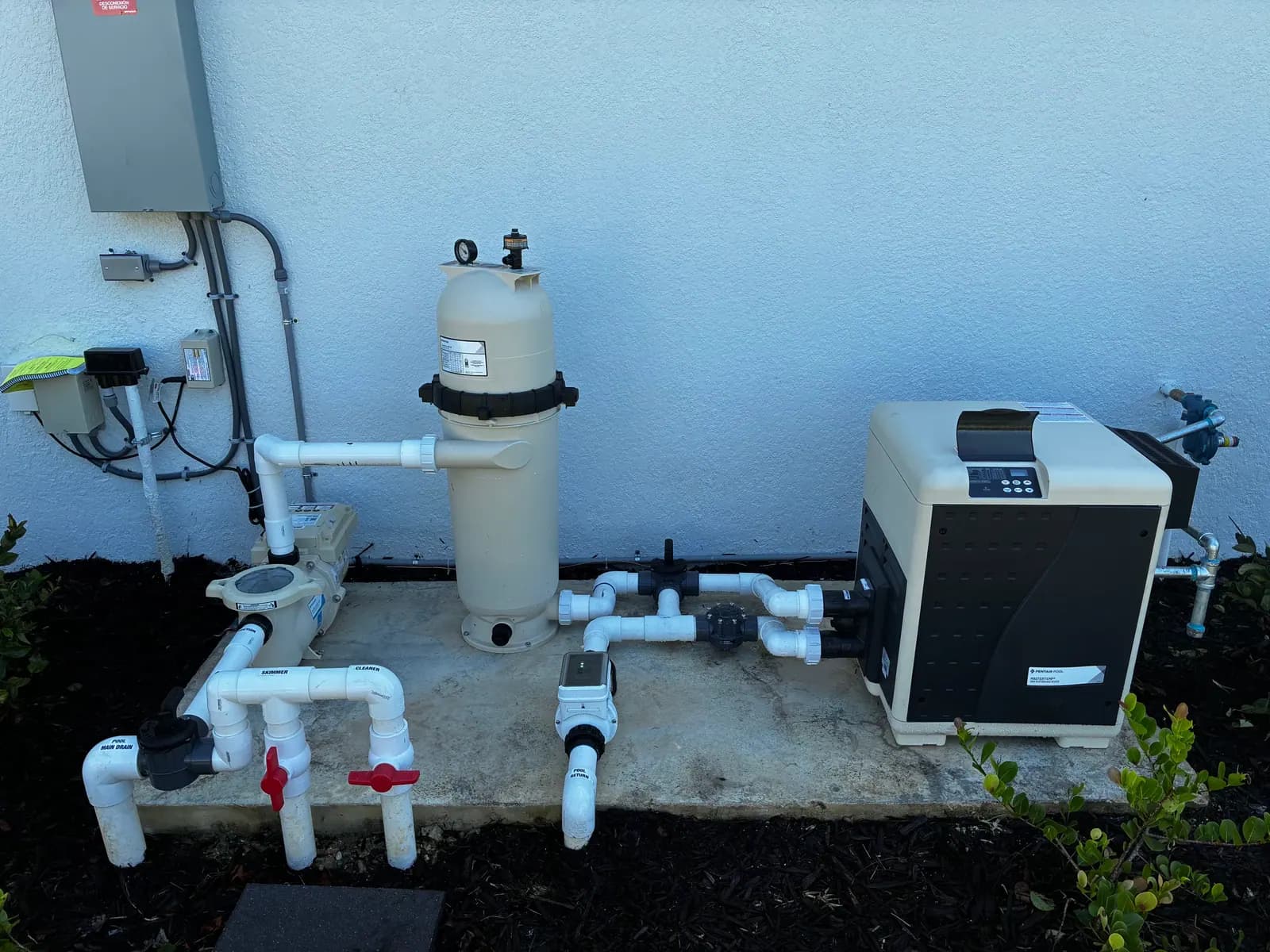
The real cost difference is often in the gas supply: a longer or larger line, a meter upgrade, or a bigger propane tank. Removal of the old heater, the pad, access to the equipment and anything unusual about the site all move the installed price as well. Our gallery publishes what two specific gas jobs cost: a Hayward gas heater set on its own pad plus a Jandy TruClear salt system, finished in May 2026, at $4,500 to $5,500, and a Naples job that added a gas heater and redid the pool equipment plumbing at $5,500 to $6,500. Those are those jobs, not a quote for yours.
Going bigger than the pool needs doesn't buy efficiency either. As our sizing guide notes, an oversized gas heater brings a larger gas line, larger venting, a bigger meter or tank and more short cycling, with nothing gained per BTU.
Is it right for you?
Good fit if
- 250K-class: an average residential pool with no attached spa.
- 250K-class: gas as the backup to a heat pump or solar, covering cold fronts and guests.
- 250K-class: a long gas run or a meter you'd rather not upgrade.
- 400K-class: a pool with an attached spa you use often.
- 400K-class: a large or exposed pool you want warm for a weekend on short notice.
Look elsewhere if
- 250K-class: a spa you expect hot in under half an hour, or a large pool you heat from cold.
- 400K-class: a natural gas line already at the limit for a smaller heater, unless you budget to upsize it.
- 400K-class: a small propane tank and a pool heated all winter.
- Either size as the everyday heater for a pool swum all winter: a heat pump usually costs far less to run.
What this costs
We give a written, itemized price after we have seen your equipment pad. The pad, the plumbing, the electrical service and the gas supply decide most of the cost, so a number given before anyone has looked at them is a guess.
What moves the price
- Gas supply: natural gas at the street, an existing propane tank, or a new tank and line.
- Gas-line sizing: the line has to deliver the heater's full BTU input over its length, which can mean upsizing.
- Existing heater removal: disconnecting, hauling and disposing of the old unit.
- Equipment pad: whether there is a level pad in the right spot or one has to be poured or built.
- Equipment access: tight side yards, long carries and anything that slows the install.
- Installation complexity: permits, multi-story roofs, long pipe runs and anything unusual about the site.
What recent jobs cost
These are the actual price ranges for specific past jobs shown in our gallery, not quotes or averages. Your price depends on your pad, plumbing and electrical.
Hayward Gas Heater & Salt System
$4,500-$5,500Completed in May 2026. A Hayward gas heater set on its own pad beside the home, plus a Jandy TruClear salt chlorine system added as part of the same project.
See it in the gallery: Hayward Gas Heater & Salt SystemPool Equipment Upgrade
$5,500-$6,500A project in Naples, Florida where the customer wanted to add a gas heater and redo all of the plumbing equipment.
See it in the gallery: Pool Equipment UpgradeReal installations
Recent jobs from our installation library that relate to this topic.