Modern Pool Heating · Owner/operator Henry Manna, Florida Certified Pool/Spa Contractor CPC1460367
Updated October 16, 2026
Short answer
The Department of Energy says that with proper installation and maintenance a heat pump pool heater can last 10 or more years, and that heat pumps typically outlast gas pool heaters, which it puts at five or more years. On the Gulf Coast, how far past those figures a unit goes depends less on the brand than on salt air, water chemistry, airflow around the cabinet, water flow through it and the quality of the installation. Manufacturer warranties, which run from 2 to 7 years on parts across the brands we track, are the floor a manufacturer will stand behind, not a prediction of lifespan.
What we usually recommend
If your pool is near the water, put the heat pump where it is out of direct salt spray, keep sprinklers off it and rinse the coil regularly. If your pool runs on salt, make sure the cell is plumbed after the heat pump and the chemistry stays in the manufacturer's window. If an older heat pump is out of warranty and needs a compressor or a heat exchanger, get a repair-versus-replace price before you approve the repair; our repair-or-replace guide explains how we weigh it.
- DOE: heat pump pool heaters can last 10 or more years with proper installation and maintenance, and typically last longer than gas heaters.
- DOE: gas pool heaters typically last five or more years with proper installation and maintenance.
- On the coast, salt air works on the air side of a heat pump (coil, cabinet, electrical box); titanium protects the water side.
- Several warranties exclude corrosion from the environment or placement, freeze damage or poor water chemistry. Read the exclusions before you rely on the term.
What the published figures say
There is very little honest lifespan data for pool heaters, and we would rather give you the few figures that are published than invent an average. The Department of Energy's guidance is that, with proper installation and maintenance, heat pump pool heaters can last 10 or more years, and that they typically last longer than gas pool heaters. For gas, DOE says that with proper installation and maintenance they typically last five or more years.
Both statements carry the same condition, and it is not boilerplate. DOE suggests an annual tune-up for either type and notes that, because a heat pump has many moving and electrical parts, it will probably need periodic service from an air conditioning technician. A heat pump that is installed with poor airflow, run on unbalanced water or never cleaned can fall well short of those figures; one that is installed and looked after properly often goes beyond them.
We are not publishing a lifespan figure from our own jobs yet. When we do, it will come from the units we actually service along this coast, not from a national average.
Salt air: why the coast is hard on the air side
A pool heat pump has two sides, and in Florida they age differently. The water side is a titanium heat exchanger on every heat pump in our heater comparison, and titanium shrugs off salt and chlorine. The air side, the evaporator coil, the fan, the cabinet and the electrical box, lives outdoors in whatever the wind brings, and on a barrier island or a canal lot that is salt.
The manufacturers say so in their manuals. Hayward's HeatPro manual tells oceanfront owners to place the unit out of direct spray of sand and salt, which it says will clog, damage and corrode it, and suggests a physical barrier outside the minimum clearances between the unit and the prevailing beachfront wind. GulfStream's manual says a unit located near salt water will need its coil cleaned regularly to remove salt and sand. Built Right's manual gives owners near the ocean or the Gulf the same advice. Both GulfStream and Hayward also warn against sprinklers hitting the unit; Hayward notes that many sprinkler systems run on well water high in minerals, sulphur and salt.
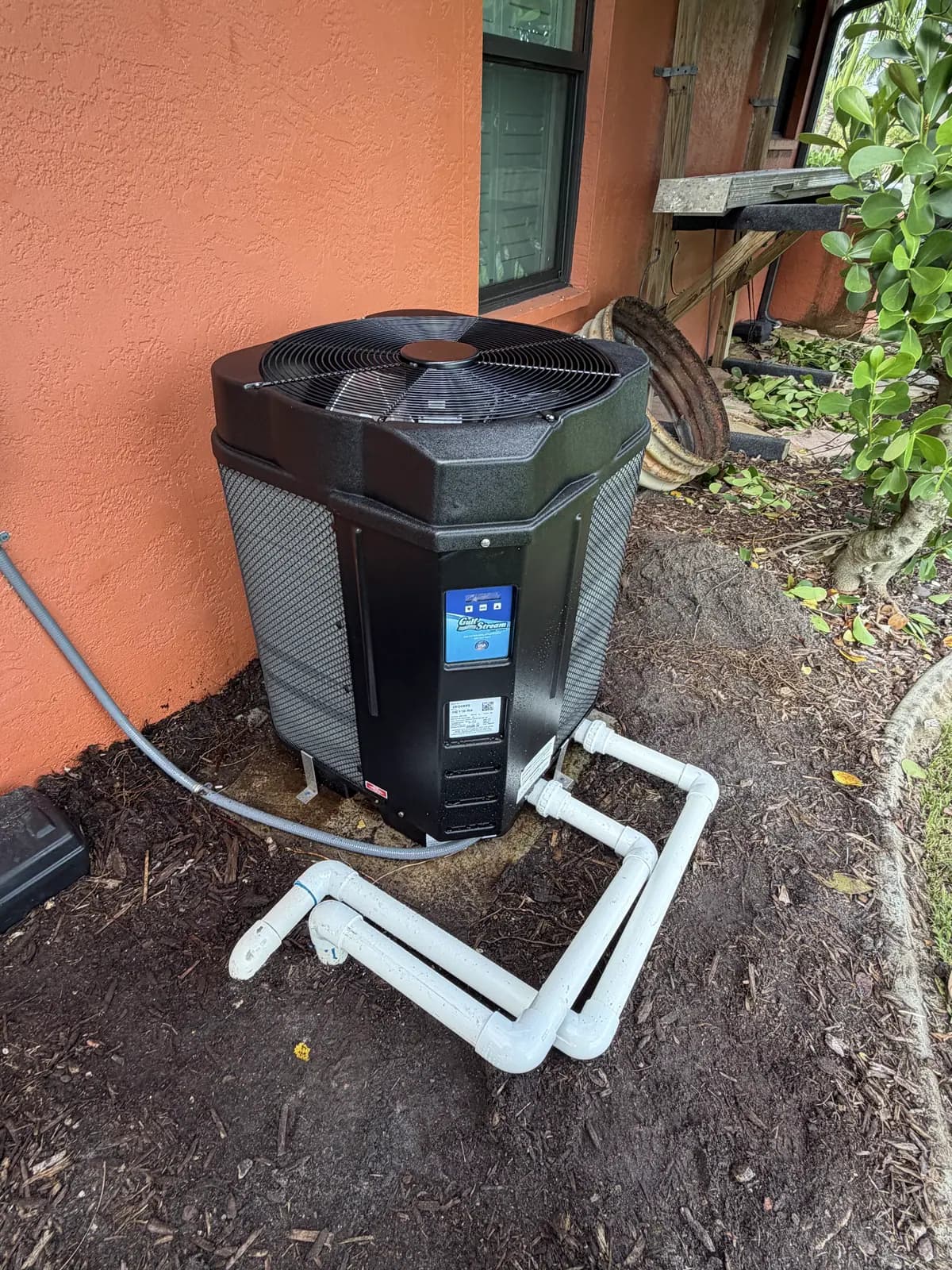
Cabinet material is part of the answer. GulfStream and Jandy use ABS, Built Right a polymer housing, Pentair's UltraTemp a composite and AquaCal a corrosion-proof cabinet; Raypak's Crosswind V uses powder-coated metal. On the coil, Hayward coats its microchannel evaporator with a Trivalent Chromium Process finish that it positions as corrosion protection. Our Siesta Key and Treasure Island installs are both barrier-island jobs, and on both the GulfStream HE150-RA's titanium exchanger and ABS cabinet, which cannot rust, are exactly the materials we want in salt air.
Water chemistry and flow: protecting the water side
Titanium is forgiving, not invincible, and the warranties are written accordingly. Hayward's HeatPro manual says heat exchanger damage from improper flow, improperly balanced pool water or the improper addition of sanitizer is not covered. Pentair states that failing to hold its UltraTemp chemistry ranges may void the warranty. GulfStream's manual says maintaining proper water chemistry is critical to the heat pump's service life, publishes a window (pH 7.4 to 7.6, free chlorine 1 to 3 ppm in a pool, calcium hardness 200 to 400 ppm, total dissolved solids under 2,000 ppm), and warns never to put chemicals or solid chlorine in the skimmer, because it sends concentrated chlorine through the equipment and causes premature corrosion.
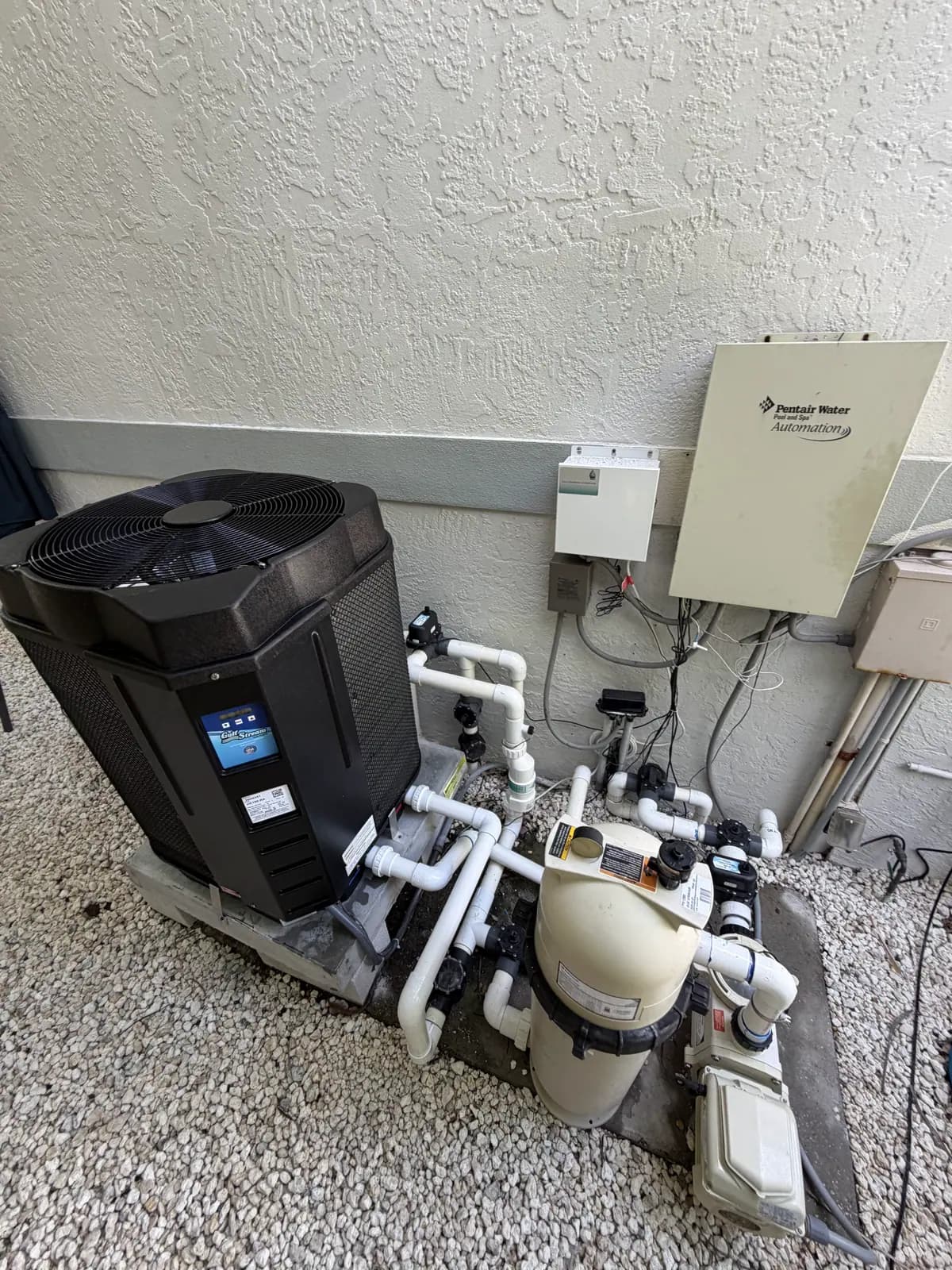
Plumbing order protects the exchanger more than any material upgrade. GulfStream's published sequence is pool pump, filter, heat pump, solar, chlorinating system, pool, with a check valve between the chlorinator and the heat pump to stop backflow. A salt cell ahead of the heater is a warranty problem for every brand we have read.
Flow matters for the refrigerant side too. GulfStream's manual explains that if water flow is too low to carry the heat away, refrigerant pressure builds and the unit shuts down to protect itself; repeated low-flow faults lock it out. A dirty filter is one of the three common causes it lists. Running a heat pump starved of flow is hard on it, so a flow fault is worth fixing rather than resetting.
Airflow and installation quality
Much of a heat pump's life is decided on installation day. GulfStream asks for 12 inches of clearance on each side and four feet above, outdoors only, and its installation manual warns that enclosed spaces such as garages and sheds without proper ventilation should be avoided and may void the warranty on the refrigerant components. A unit that recirculates its own cold air works harder, defrosts more and runs longer for the same heat.
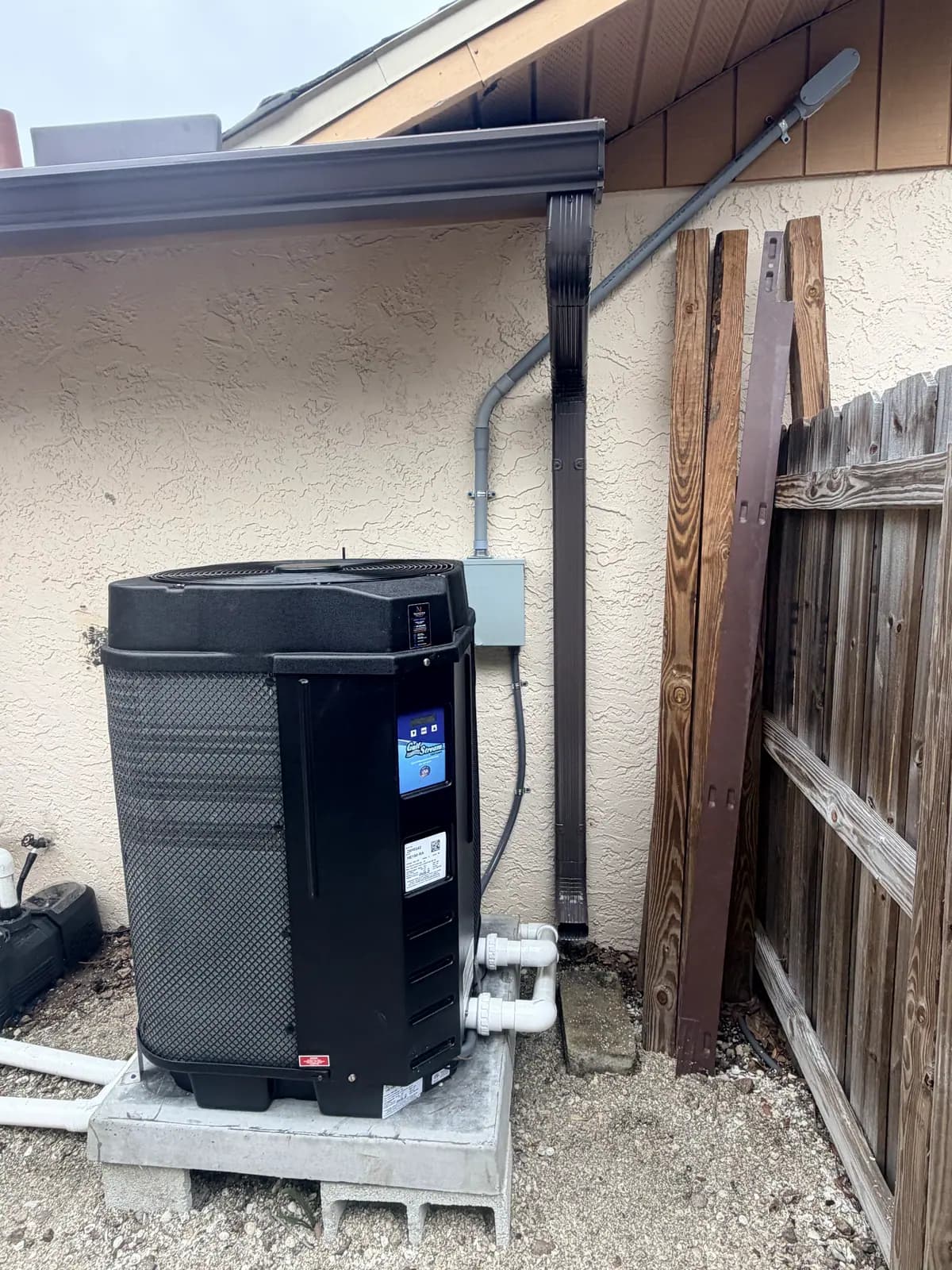
The smaller details add up. GulfStream wants the unit on a flat concrete or fabricated pad with a slight grade so condensation drains, isolated from the building wall so vibration does not carry into the house, and protected by a gutter if it sits under a roof edge. Its installation manual says conduit has to run all the way into the electrical box, because open wiring lets snakes, insects and lizards in, and that damage from incorrect or missing bonding is not covered. Hayward's manual adds anchoring where local codes require it.
Two of our jobs show why we care. In Tampa there was no pad where the heat pump had to go, so the crew built a level base from concrete block first: a 239-pound unit that is not level drains condensate unevenly and can rock on its feet. In Punta Gorda the HE110-RA went in with unions at both connections, so the unit can be isolated and removed for service without cutting pipe.
What commonly fails
The expensive failures on any heat pump are the compressor and the heat exchanger, which is why several manufacturers give those two parts longer terms than the rest of the unit: Pentair covers the UltraTemp compressor for 10 years and its titanium exchanger for life, Hayward covers the titanium tube for 10 years, Raypak covers its titanium tube for 10 years and Jandy covers compressor and exchanger for 5. Refrigerant leaks are the other serious failure; Hayward says the 85 percent reduction in braze joints on its microchannel coil means fewer leak opportunities.
The more common faults are electrical and mechanical, as you would expect from a machine DOE describes as having many moving and electrical parts. GulfStream's own troubleshooting guide is a fair picture of what service calls look like: a blank display from a tripped breaker or a failed transformer, a countdown that never starts the compressor (it says the unit may need a new contactor), a low refrigerant pressure fault from a refrigerant loss, a faulty pressure switch or a fan that is not running, and water or evaporator sensor faults. It also warns that wiring an automation relay that sends voltage, rather than a dry contact, will damage the heat pump's transformer.
One thing that is usually not a failure: water under the unit. A heat pump makes condensation while it runs, up to 3 gallons an hour on a GulfStream and usually 3 to 5 on a Hayward. GulfStream's test is to switch the heat pump off and leave the circulation pump running for an hour; if the water stops, it was condensation. A chlorine test strip settles it too, because condensation contains no chlorine.
Warranty terms are the floor, not the forecast
A warranty tells you what the manufacturer will pay for, for how long, and on what conditions. It is a useful floor and a poor forecast, because it says nothing about the years after it ends. The terms also vary widely, so the table below sets them side by side as each manufacturer publishes them.
Read the exclusions with the coast in mind. AquaCal's current warranty excludes freeze damage and installation in corrosive environments. Built Right's warranty page excludes freezing, corrosion and similar damage caused by or related to weather, climate, improper equipment placement, inadequate ventilation, roof run-off, sprinklers or irrigation. Raypak calls out rainwater running off a roof directly onto the unit as not covered. None of that means a coastal heat pump is uninsurable, but it does mean placement, a gutter and routine rinsing protect your warranty as well as the unit.
| Line | Parts | Labor | Longer component terms |
|---|---|---|---|
| GulfStream HE Series | 7 years | 2 years | None separate; exchanger under parts |
| Hayward HeatPro MCHX | 5 years | 2 years field labor (3 through a Hayward Rewards dealer) | Titanium tube 10 years (in-ground) |
| Pentair UltraTemp | 2 years | 2 years | Compressor 10 years parts and labor; titanium exchanger lifetime |
| Raypak Crosswind V | 7 years | 2 years | Titanium tube 10 years parts, 2 years labor |
| AquaCal HeatWave SuperQuiet | 3 years, then years 4-5 limited parts | 3 years on-site | Titanium tubing limited lifetime, part only |
| Built Right XW | 5 years | 5 years on-site | Exchanger covered for the full term |
| Jandy VersaTemp | 2 years | Not covered | Compressor and heat exchanger 5 years |
| Moov Inverter | 5 years | 3 years | Heat exchanger 10 years |
| Thermeau Prestige | 5 years | 5 years | 10-year corrosion protection on the titanium exchanger |
A maintenance checklist that actually extends life
GulfStream's manual names good airflow through the evaporator and proper drainage as the two main maintenance tasks, and most of this list follows from those two. None of it requires tools beyond a garden hose and a test kit, and the items marked for a technician are the ones DOE has in mind when it recommends an annual tune-up.
The pattern behind the list is simple: keep air moving freely across the coil, keep water moving through the exchanger at the right rate and chemistry, and keep salt, sprinkler water and roof runoff off the cabinet. A heat pump that gets those three things has the best chance of reaching, and passing, the DOE figures.
- Keep shrubs, fences and stored items out of the clearances, at least 12 inches at the sides and four feet above on a GulfStream.
- Rinse the coil with a low-pressure garden hose, more often near salt water. GulfStream suggests a very soft brush and soapy water for build-up, and warns never to spray the control box. Switch the power off first.
- Keep the drain holes in the base clear so condensation can escape.
- Keep lawn sprinklers off the unit and add a gutter if it sits under a roof edge.
- Hold the water chemistry in the manufacturer's window, and never add chemicals or tablets through the skimmer.
- Clean or replace the filter on schedule; low flow is one of the most common causes of faults.
- If the heat pump sits unused for long periods, GulfStream recommends running it at least 30 minutes a month to keep the mechanical parts in good condition.
- Book an annual check with a qualified technician: refrigerant pressures, electrical connections, contactor, fan and sensors.
- Register the unit and keep the receipt; several manufacturers require registration or proof of purchase for warranty service.
How long should a gas pool heater last in Florida?
DOE's published figure for gas heaters is five or more years with proper installation and maintenance, and it adds that scaling in the burner or heat exchanger may reduce efficiency over time. The heat exchanger is usually what ends a gas heater's life, so its material and the water running through it matter most. Copper is the default and conducts heat best; cupro-nickel trades a little efficiency for much better tolerance of salt and chemistry, which is why Hayward fits it as standard across the Universal H-Series and Pentair sells it as the MasterTemp HD (82% thermal efficiency against 84% for the copper models). Raypak's AVIA HD uses its nickel-rich NiTek, and Pentair's ETi 400 uses a direct-fire titanium exchanger.
Chemistry and flow decide the rest. Low pH dissolves copper, scale insulates the hottest tubes until they fail, and water moving too fast erodes the protective film inside them. Gas heaters also have minimum flows: Hayward specifies 25 GPM on the H250FDN and 30 GPM on the H400FDN, and Raypak's AVIA needs 40 GPM. Raypak's AVIA also carries a ProTek Shield sacrificial anode that is excluded from warranty, and Raypak states the warranty does not cover damage caused by a depleted anode that was not replaced. Our heat exchanger guide covers the failure mechanisms in detail.
Gas warranty terms are shorter than most heat pump terms: Hayward's Universal H-Series carries 3 years parts and 1 year field labor as standard, Pentair's MasterTemp 2 years parts and labor, Raypak's AVIA 3 years parts and labor, and Jandy's JXi 1 year with no labor coverage. If a gas heater keeps lighting and then shutting off, or the exchanger has started to leak, our troubleshooting article and repair-or-replace guide are the next stops.
Real installations
Recent jobs from our installation library that relate to this topic.