

Updated September 17, 2026 · Affordable Solar & Pool Heating, LLC · Owner/operator Henry Manna
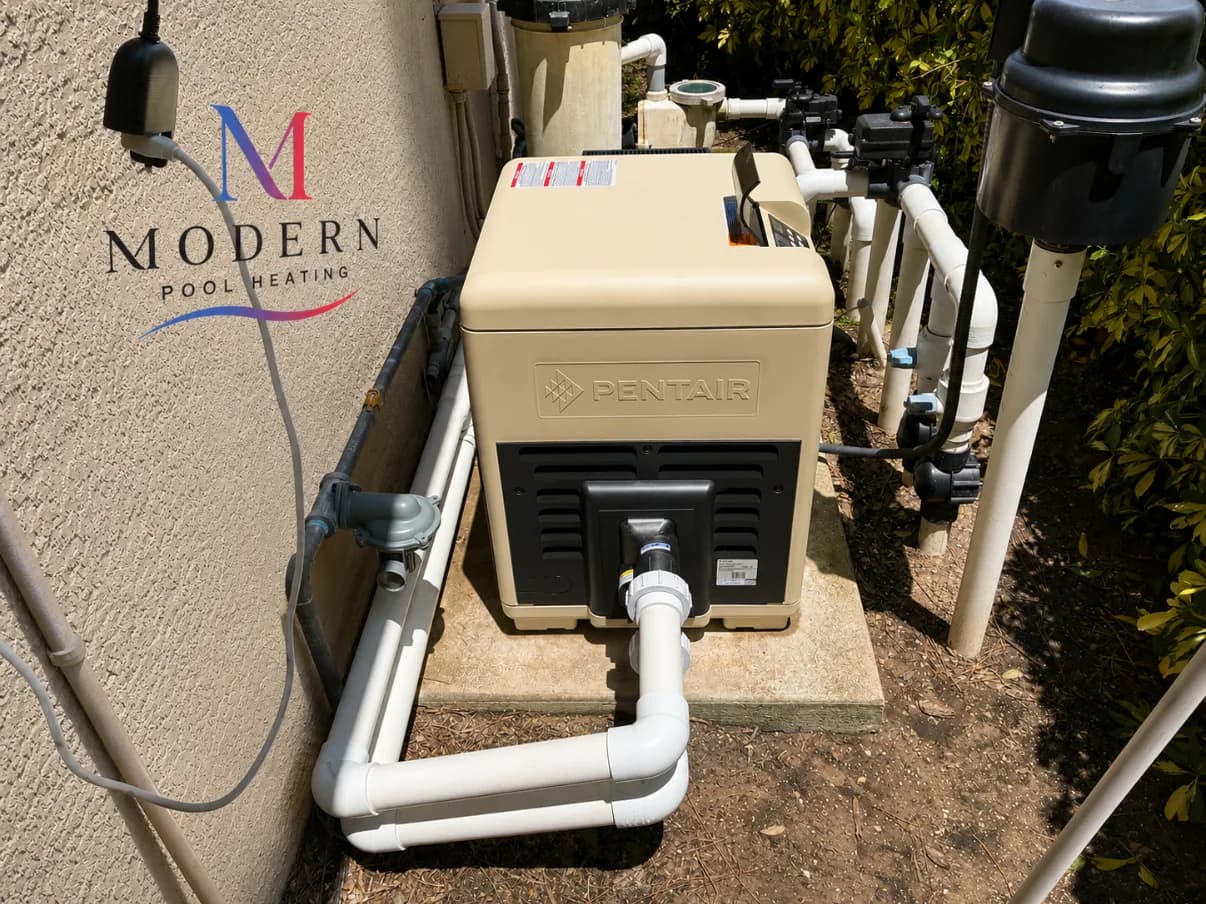
First, work out which MasterTemp you have
Pentair has built the MasterTemp for a long time and the control panel changed along the way. That matters, because the two generations report faults completely differently and most of the advice you will find online does not say which one it is describing.
Older heaters — the Rev. M manual is dated January 2015 — have a digital temperature display and five indicator lights: POOL ON, SPA ON, HEATING, SERVICE SYSTEM and SERVICE HEATER. There are no codes on the front panel; the diagnostic detail sits on red LEDs on the back of the control board, which means opening the cabinet.
Current heaters have a two-line LCD that spells faults out as text, plus a menu worth knowing about. Press MENU/BACK and you can read HISTORY (the last five errors), CYCLES, RUNTIME, SFS TEMP (the live stack flue temperature) and FLAME (normal or low). If a heater is misbehaving intermittently, those screens are the most useful thing you can read out to us over the phone.
What the two service lights mean
SERVICE SYSTEM means the water side. Pentair's manual says it indicates insufficient water flow to the heater, and that if the pump is running it usually means the filter and skimmers need cleaning — some filters need backwashing. This is the one fault a homeowner can often clear without tools. If it stays on after the filter and skimmers are clean, stop and have it checked.
SERVICE HEATER means the heater side, and Pentair's instruction is unambiguous: it indicates a fault in the heater or its controls, so shut the heater down, turn off the gas to the appliance and have a qualified service technician check the system. The manual carries an explicit warning not to run the heater with that fault showing, or when the blower or burner will not start.
One more light is worth knowing. HEATING should be solid while the burner is firing. If it is blinking, the heater is calling for heat and not firing — usually the prelude to a service light coming on.
The fault codes Pentair actually publishes
On an LCD heater the fault appears as text. Pentair's current MasterTemp manual documents this list and no other — if you are looking at a code that is not here, check you are not reading a Pentair heat pump or an ETi heater, which use their own symbols.
- ERR PS — the water pressure switch is open: insufficient water flow. Pentair's note is that the error clears and normal operation resumes once flow is re-established.
- ERR HLS — the high limit opened because water leaving the first pass of the exchanger exceeded 135°F. It clears itself below 135°F, and it is almost always a flow problem rather than a thermostat problem.
- ERR AFS — the air flow switch is open. The blower is not running or the air through it is restricted; the heater resumes if adequate airflow returns within 60 seconds.
- ERR IGN — the ignition control module could not light the burner. If it is not corrected within 60 seconds the heater has to be turned off with the HEATER OFF button before it will retry.
- ERR AGS — the automatic gas shut-off opened because water after the second pass exceeded 140°F. The second flow-related safety, cleared with the HEATER OFF button.
- ERR SFS — excessive stack flue temperature, above 480°F. Not a code to reset and ignore: it usually points at a fouled or scaled heat exchanger.
- E01 — open water temperature sensor; 126 — shorted water temperature sensor. Both are cleared with the HEATER OFF button.
- E05 and E06 — open and shorted stack flue sensor. On these two the front panel buttons are disabled entirely and the only reset is to cycle power to the heater.
Low flow is the most common problem, by a wide margin
Count how many of those codes are really about water: ERR PS, ERR HLS and ERR AGS all point at flow, and SERVICE SYSTEM on an older heater is the same story. A MasterTemp needs a real amount of water through it — 25 GPM minimum on a 250 and 40 GPM minimum on a 400, with 120 GPM the maximum before a bypass valve is required.
The causes, in the order we find them: a dirty filter or a blocked skimmer basket; a variable-speed pump whose heating speed was never programmed high enough to satisfy the pressure switch; a valve on the pad that has been moved; an automatic pool cleaner running at the same time, which Pentair's manual tells you not to do; and a two-speed pump that cannot make enough pressure on low speed. Two installation faults produce the same symptoms and never fix themselves — a heater plumbed backwards will cycle continuously, and a heater more than five feet above the pool, or more than four feet below pool level, needs a flow switch rather than the pressure switch.
One symptom should make you switch the heater off immediately. After start-up the outlet pipe should feel only slightly warmer than the inlet. If it feels hot, or you can hear water boiling or bumping inside the heater, there is not enough flow going through it.
Condensation, sooting and corrosion — the slow killers
The faults above announce themselves. The problems that actually end a heater's life are quieter, and two of them come from how the heater is used rather than from anything failing.
The first is condensation. Pentair puts this in a boxed caution: operating the heater continuously with water below 68°F causes harmful condensation, damages the heater and voids the warranty. A gas heater is not a freeze-protection device. If you want to leave one on through a cool spell, Pentair's own spring and fall advice is to set the thermostat to 68°F and leave it there. A related symptom is worth naming: the MasterTemp uses an internal bypass and what Pentair's troubleshooting table calls a thermal governor (the parts list calls the same component a thermal regulator) to hold the right outlet temperature, and that table lists a thermal governor stuck closed under the symptom 'sweating'. Water under a heater is not always a leak.
The second is combustion drift and sooting. Pentair's burner table describes a lean flame as fluttery, with an acrid smell in the exhaust or a burner that will not stay lit, and points at the gas regulator setting and the gas orifice; the symptom it ties to an exhaust vent that is too long is a burner that pulses or surges on ignition. The combination gas valve is factory set to a manifold pressure of -0.2 inches water column, and Pentair states it must not be altered and that any adjustment is for a qualified service agency only. Soot inside the exchanger also shows up indirectly: a fouled exchanger drives flue temperature up, which is one route to an ERR SFS.
The third is corrosion, and Florida makes it worse. Pentair warns against prolonged exposure to driving water — lawn sprinklers, heavy roof runoff, hoses — and against operation in persistent, extreme, moist or salty environments. It also publishes a table of corrosive vapors naming pool chemicals, muriatic acid, construction adhesives and chloride-bearing cleaners, and states that combustion air contaminated by corrosive fumes can void the warranty. So: do not store chemicals near the heater, and do not put chlorine tablets in the skimmer — with the pump off that sends concentrated chlorine straight into the exchanger. Any chemical feeder belongs downstream of the heater with a non-corrosive check valve between the two.
The maintenance Pentair actually asks for
Pentair's maintenance list is short, and it is worth doing exactly as written — every six months and at the start of every swimming season:
- Inspect the heater panels and venting system so nothing obstructs ventilating air or burner exhaust, and check that any room air intakes are clear.
- Keep the area around the heater free of combustible materials, flammable vapors and corrosive liquids.
- Test the pressure relief valve, if one is fitted, by lifting the lever — Pentair asks for this at least once a year.
- Test the operation of the water pressure switch, following the procedure in the manual.
- On enclosed installations with high-temperature vent systems, re-check every vent joint for leakage, slipped joints, cracks or breaks.
- Keep water chemistry in range and the chemical feeder downstream of the heater. This does more for the heat exchanger than anything else on the list.
- In Florida, check the heater is still anchored. Pentair states anchor clamps are required in Florida under the Florida Building Code, and sells the Bolt Down Bracket Kit (P/N 460738) for the job.
What you can check, and what needs a licensed technician
The line here is drawn by Pentair, not by us. Anything on the water side is fair game for a homeowner. Anything on the gas or combustion side is not.
Safe to check yourself: clean the filter and backwash if it needs it; empty the skimmer and pump baskets; confirm the pump is running and no valve has been moved; make sure the pump's heating speed is high enough; check the setpoint is above the current water temperature; read the HISTORY, RUNTIME and CYCLES screens; and make sure nothing has grown, blown or been stacked against the heater's air intake or exhaust.
Not safe to do yourself: anything involving the gas valve, manifold pressure, burner, orifices, igniter, venting or combustion air. Pentair states this product must be installed and serviced by authorized personnel qualified in pool and spa heater installation, that improper installation or operation can create carbon monoxide gas, and that the gas regulator setting must not be altered. It also warns in capitals against jumpering a safety switch terminal to get around a failed switch. The interlocks — pressure switch, 135°F high limit, air flow switch, 140°F gas shut-off and 480°F stack flue sensor — are what stands between a fouled heat exchanger and a dangerous one. Leave the 12-pin voltage plug alone too: the heater ships with the 240 VAC plug fitted, and Pentair warns that fitting the 120 V plug and connecting 240 V will immediately destroy the transformer, control board and ignition module, and voids the warranty.
When repair stops making sense
Most MasterTemp faults are worth fixing. Pressure switches, air flow switches, thermistors, igniters, stack flue sensors and control boards are all stocked parts, and this is the gas heater most technicians in our market have opened the most times, which usually means a one-visit repair rather than a two-week wait.
The calculation changes when the heat exchanger is the problem. A MasterTemp carries 2 years parts and labor when bought through the professional channel and installed by a qualified professional who charges a fee — and only 1 year parts with no labor if it came from an internet retailer. Past that, an exchanger plus the labor to fit it is a large fraction of a new heater, and an exchanger that failed from corrosion or years of condensation is rarely the only tired part in the cabinet. That is also the moment to ask whether gas is still the right answer: if the old MasterTemp ran every week from November to March, the real question is whether a heat pump would cost less to own, or whether a cupro-nickel MasterTemp HD or a titanium ETi 400 would have survived your water in the first place.
Getting it looked at on the Gulf Coast
We install and service Pentair gas heaters throughout Sarasota, Manatee, Charlotte & Pinellas County, Florida, and MasterTemps are among the units we open most often. If yours is showing a service light or an ERR code, tell us the exact message and, on an LCD heater, what the HISTORY screen shows — that usually tells us whether we are bringing a pressure switch or a control board. If you are outside our area, take the same information to a licensed pool heater technician near you. The guidance here is written for pool owners anywhere; the repair and installation offer is local.
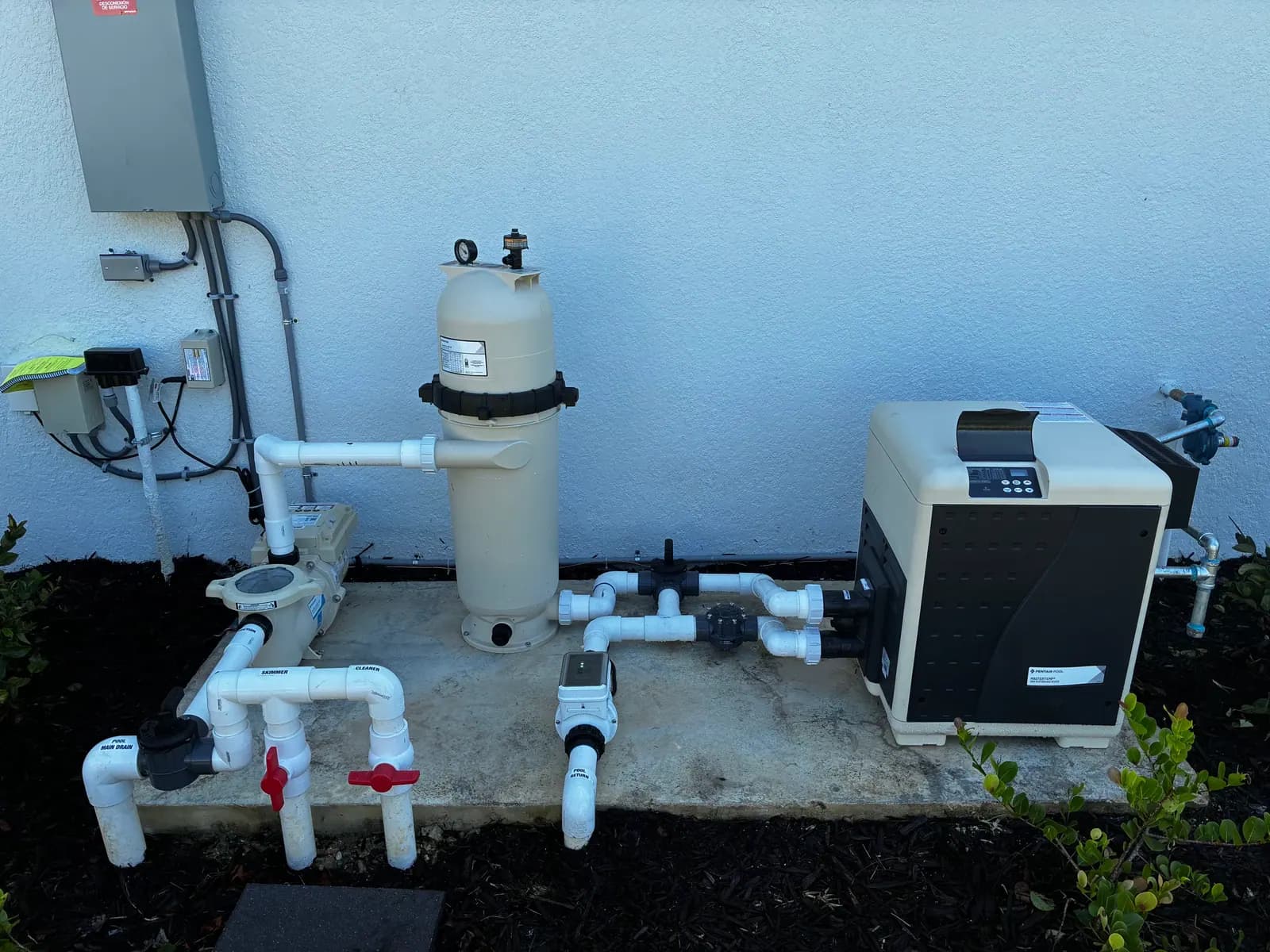
Real installations
Recent jobs from our installation library that involve the equipment in this guide.
Heaters mentioned in this guide
Pentair · MasterTemp
Pentair MasterTemp 400 NG Gas Pool Heater
Model MasterTemp 400 NG
- BTU input
- 400,000 BTU/hr
- Thermal efficiency
- 84%
- Heat exchanger
- Copper
- Warranty
- 2-Year Parts & Labor
- Wi-Fi / automation
- Automation Compatible
A large pool, or a pool and spa combination, on a pad that is already Pentair and an owner who wants heat on demand rather than an everyday running cost.
Pentair · MasterTemp
Pentair MasterTemp 250 NG Gas Pool Heater
Model MasterTemp 250 NG
- BTU input
- 250,000 BTU/hr
- Thermal efficiency
- 84%
- Heat exchanger
- Copper
- Warranty
- 2-Year Parts & Labor
- Wi-Fi / automation
- Automation Compatible
An average-sized Florida pool with no spa, or a pool where gas is the backup to solar or a heat pump rather than the everyday heat source.
Pentair · MasterTemp HD
Pentair MasterTemp 400HD Heavy Duty Gas Pool Heater
Model MasterTemp 400HD
- BTU input
- 400,000 BTU/hr
- Thermal efficiency
- 82%
- Heat exchanger
- Cupro-nickel
- Warranty
- 2-Year Parts & Labor
- Wi-Fi / automation
- Automation Compatible
A large salt-water or coastal pool, or a pool and spa that gets used hard, where the exchanger material matters more than the last two points of efficiency.
Pentair · MasterTemp HD
Pentair MasterTemp 250HD Heavy Duty Gas Pool Heater
Model MasterTemp 250HD
- BTU input
- 250,000 BTU/hr
- Thermal efficiency
- 82%
- Heat exchanger
- Cupro-nickel
- Warranty
- 2-Year Parts & Labor
- Wi-Fi / automation
- Automation Compatible
An average-sized salt-water or coastal pool that wants a corrosion-resistant exchanger without the gas line, flow rate and fuel bill of a 400,000 BTU heater.
Pentair · ETi
Pentair ETi 400 High-Efficiency Gas Pool Heater
Model ETi 400
- BTU input
- 400,000 BTU/hr
- Thermal efficiency
- 96%
- Heat exchanger
- Titanium
- Warranty
- 3-Year Parts & Labor
- Wi-Fi / automation
- Automation Compatible (Relay)
A high-use pool or pool-and-spa where the fuel bill is the deciding factor, and an owner willing to pay premium money up front and manage a condensing heater's condensate.
Last verified September 17, 2026
Specifications and warranty terms are taken from the manufacturer documents below. Manufacturers revise these without notice, so confirm the current terms before you buy. If you spot something out of date, email us and we will fix it.
Sources
- Pentair — MasterTemp Pool and Spa Heater Installation and User's Guide (fault code table, interlock temperatures, flow rates, maintenance, safety instructions)
- Pentair — MasterTemp Pool and Spa Heater Installation and User's Guide, Rev. M 1/2015 (the indicator-light generation: SERVICE SYSTEM and SERVICE HEATER)
- Pentair — MasterTemp High Performance Heater product page (models, efficiency, heat exchanger)
- Pentair — Pool product warranty information (MasterTemp terms and channel conditions)
- Pentair — MasterTemp Heater Submittal Data (safety interlocks, headers, enclosure, clearances)
Ratings on this site are the editorial opinion of Affordable Solar & Pool Heating, LLC, trading as Modern Pool Heating. How we rate heaters. Corrections: modernpoolheating@icloud.com.