Modern Pool Heating · Owner/operator Henry Manna, Florida Certified Pool/Spa Contractor CPC1460367
Updated October 16, 2026
Short answer
A gas pool heater that lights and then shuts off is almost always a safety control doing its job: the control has lost confirmation of something it needs, usually enough water flow, steady gas pressure or a flame it can sense. We check water flow first, because it is the most common cause and the one a homeowner can fix: a dirty filter, a closed valve or a variable-speed pump on too low a speed. After that come gas supply, flame sensing, overheating limits, venting and the control board, which are technician work. If you smell gas, don't try to relight anything; leave the area and call your gas supplier from a neighbor's phone.
What we usually recommend
If your heater lights and then quits, we'd start with the water-side checks below: clean the filter, empty the baskets, confirm every valve is open and the pump is on its heating speed, and write down exactly what the display says. If it still shuts off, or the message points at gas, flame or ignition, we'd switch it off and have it looked at rather than resetting it again and again. A heater that keeps lighting and dropping out is telling you something, and repeated attempts on a gas or venting fault aren't safe.
- Check flow first: a dirty filter, closed or moved valves, a variable-speed pump below the heater's minimum flow, or a bypass set wrong.
- A flame that lights for a few seconds and drops out points at gas pressure under load or flame sensing. Both need a technician with the right instruments.
- Limit trips a few minutes into a run are usually flow problems; air and vent switch faults point at blocked combustion air or exhaust.
- Smell gas? Don't light anything, don't touch electrical switches or use a phone in the building, and call your gas supplier from a neighbor's phone.
How a gas heater decides to shut itself off
Every modern gas pool heater runs a fixed start-up sequence and stops the moment any step can't be confirmed. On a Hayward Universal H-Series, the control checks the blower vacuum switch, runs a 20-second pre-purge while the igniter heats, then opens the gas valve for a 4-second trial and looks for flame. Once flame is sensed, it keeps watching the blower vacuum switch, the control loop, the temperature sensor and the flame sensor for as long as it is heating. A Pentair MasterTemp works the same way: the blower and hot surface igniter come on, the gas valve opens after about 20 seconds, and the igniter switches to sensing the flame. If any safety interlock opens while the burner is running, Pentair says the burner shuts off immediately and the blower runs on for about 45 seconds.
So "lights, then shuts off" means one of three things: the flame was never properly confirmed, a safety switch opened after it lit, or the gas supply couldn't hold the flame. The heater will usually try again on its own. Hayward's control retries three times, shows an IF ignition-failure code, waits 60 minutes and tries again; Jandy's JXi makes three attempts and then restarts automatically after an hour. Two details tell a technician where to look: the exact message on the display, and whether it shuts off seconds after lighting or minutes into a run. Write both down before you call.
1. Water flow and the pressure switch
This is where we start, because it is the most common cause and the one you can usually fix yourself. A gas heater has a water pressure switch, or on some installs a flow switch, that must stay closed for the burner to run. When flow drops, it opens and the flame goes out. Hayward shows LO (it notes LO is normal whenever the pump is off), Pentair shows ERR PS, and Jandy shows CHECK FLOW. Minimums vary: Hayward asks for 25 GPM through its H250 and 30 GPM through its H400, and Pentair 40 GPM through a MasterTemp 400. Hayward's quick reference guide tells installers to set flow above the minimum while allowing for a dirty filter.
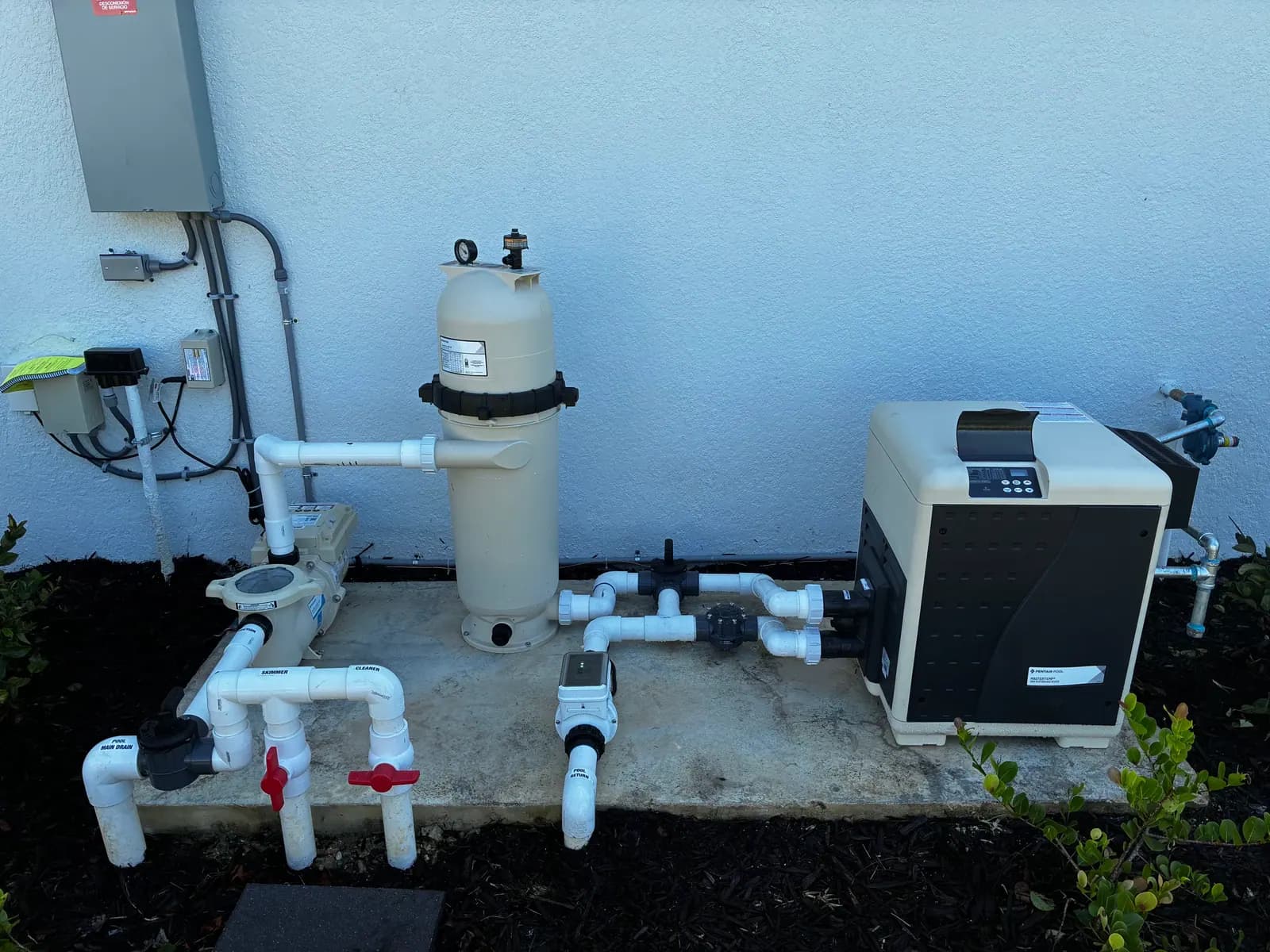
The usual causes, in the order we find them: a dirty filter (Raypak's tip is a filter gauge reading higher than usual), full skimmer or pump baskets, low pool water, a valve on the pad that has been moved, a variable-speed pump running at a filtration speed too slow for the heater, and a pump that has lost its prime, which shows as no pressure on the filter gauge. Pentair also says not to run the heater while an automatic pool cleaner is running. Raypak lists an external bypass out of adjustment and a pressure switch out of adjustment as causes of a heater cycling on and off, and Hayward says the internal bypass should be inspected periodically because it can cause low or high flow through the exchanger.
Two installation faults never fix themselves. Pentair warns that a heater plumbed in backwards will cycle continuously, and that the pressure switch needs adjusting if the heater sits below pool level or more than two feet above it.
2. Gas supply: pressure, line size, propane and the regulator
Next is the classic winter cause: the gas holds pressure at rest but sags at full fire. Pentair asks for at least 4 inches of water column at a MasterTemp while it is running, with no more than a 2-inch drop from static. Hayward specifies 4.5 inches minimum on natural gas and has technicians measure static pressure with the heater off and load pressure with it firing. Jandy's troubleshooting table lists a heater that turns off and on, ignites slowly, or has a flame that lifts and goes out, and points at low supply pressure, a gas meter that's too small, and a gas line from the meter that's too small. When Pentair's ignition chart finds low gas pressure, the fixes it lists are a larger gas line, a new regulator, a new meter, or all three.
A homeowner can check three things: that the shutoff valve outside the heater is fully open, that the propane tank gauge isn't low, and whether the trouble began after a bigger heater went on an old line. On a brand-new install, Pentair and Jandy both note the burner may fail to light at first because of air in the gas line. Anything beyond that needs a manometer and a licensed technician; Hayward's own procedure says not to touch the manifold adjustment until the inlet pressure has been confirmed against the data plate.
3. Flame sensing and the igniter
If the burner lights for a few seconds and then goes out, flame sensing is the prime suspect. Pentair's ignition chart covers exactly that case, gas flowing and the burner firing for less than 7 seconds, and sends the technician to the hot surface igniter's connection, whether the igniter is broken, and the flame current. MasterTemp heaters sense flame by flame rectification, and the LCD's FLAME screen reads Normal or Low. Pentair's burner table adds that when combustion looks normal but the flame won't stay lit, the cause is flame current not being sensed: check for a wet or damaged igniter, check the burner is properly grounded, then the ignition control module.
Hayward's IF procedure checks that the flame sensor and gas valve are securely connected to the control board, that the correct 5-inch flame sensor is fitted rather than a 3-inch one, that the blower air inlet plate is right, and that the burner tubes and orifices aren't blocked. Raypak's AVIA shows a Flame Strength reading in its service menu, where Raypak treats a signal below 1.0 microamp as weak; its fixes for a Flame Lost or flickering flame are to verify the gas supply and gas valve and to clean the igniter rods. Raypak's table also lists insects and debris clogging the burner intake ports, as a cause of sooting, which on a Florida pad is not a hypothetical.
4. High limits and overheating
A heater that runs for a few minutes and then shuts off with a limit fault is telling you the water inside it is getting too hot. Pentair's MasterTemp opens a high limit when water leaving the first pass of the exchanger passes 135°F (ERR HLS), shuts off the gas when water after the second pass passes 140°F (ERR AGS), and stops on a stack flue temperature above 480°F (ERR SFS). Jandy's JXi has limits at 135°F on the first pass and 150°F at the outlet. Hayward's HS code means return water above 105°F or a rise of more than 6°F in 60 seconds, and Hayward notes that reversed inlet and outlet plumbing often causes frequent HS codes.
The cause is nearly always flow again: a dirty filter, a pump speed set too low, a bypass valve stuck open or a failed thermal regulator, or an exchanger plugged with scale. Pentair's manual says the outlet pipe should feel only slightly warmer than the inlet after start-up; if it feels hot, or you hear water boiling or bumping inside the heater, there isn't enough flow, and if the temperature stays high, turn the heater off and call a technician. Hayward's newer heaters also carry an exhaust gas limit switch that Hayward describes as a one-time safety: once it trips it must be replaced and the heat exchanger inspected for soot. A limit that trips repeatedly is a warning about the heat exchanger, not a nuisance.
5. Venting, wind and combustion air
A gas heater has to pull in combustion air and push out exhaust, and air or vent switches prove both are happening. Hayward's AC and AO codes are the blower vacuum switch, Pentair's ERR AFS means the blower isn't running or its air is restricted (the heater resumes if airflow returns within 60 seconds), and Raypak's Vent Sw Open and Air SW Open messages tell the technician to look for vent and air inlet obstructions. Jandy lists pinched or disconnected air switch tubing, a slow fan, and air flow restricted at the intake or discharge, and on indoor installs asks for the vent to be checked for birds, insects and rodents.
Installation and placement matter too. Pentair's burner table ties a fluttery, lean flame that may fail to stay lit to the gas regulator setting, and a burner that pulses or surges on ignition to an exhaust vent that is too long, and it tells installers to avoid corners and alcoves where wind can affect a vent termination. The homeowner part is simple: keep leaves, mulch, plants, pool toys and stored items away from the heater and never cover the top or the vent cap. Keep pool chemicals elsewhere as well; Pentair lists chlorine and acid fumes among the vapors that corrode a heater.
6. Control board, sensors and power
We leave the electronics until last because a board is the most expensive guess and the causes above are cheaper to rule out. Hayward's PF code means reversed polarity or low voltage, SF is a temperature sensor reading out of range, and CE, EE and bd point at the board or display. Pentair's E01 and 126 are the water temperature sensor, and E05 and E06 the stack flue sensor, reset only by cycling power. Jandy's ignition control flashes an LED: a triple flash is a lockout after three failed attempts, a double flash is flame sensed with no call for heat. On a new install, Hayward says an AO code can simply mean the wrong voltage selector plug is fitted.
Rule out the schedule before blaming the board. If the pump timer or automation ends the filtration cycle, the heater shuts off with it; that is normal, which is why Hayward calls LO normal with the pump off. For the full code lists, see our Hayward error code guide and our Pentair MasterTemp guide rather than a forum post, and give the technician the code and the circumstances.
What you can safely check, and when to stop
The manufacturers draw the line for us. Pentair says installation and service must be done by a qualified installer, service agency or the gas supplier, Jandy strongly recommends a qualified technician for all service and repairs, and Raypak says people who are not qualified should not attempt repairs. The water side is fair game for a homeowner. Gas, combustion, venting and electrical work are not, and Pentair warns never to jumper a safety switch to get around a failed one.
If you smell gas, the manuals agree: don't try to light any appliance, don't touch any electrical switch or use any phone in your building, and call your gas supplier from a neighbor's phone and follow their instructions. If you can't reach the gas supplier, call the fire department. Jandy's manual also says to switch off the main gas supply immediately.
If the heater still shuts off after the checks below, or the message points at ignition, flame, gas pressure, venting or the board, turn it off and book a repair visit. The same goes for boiling or banging noises, soot or scorch marks, or a heater that lights and drops out over and over.
- Clean or backwash the filter and empty the skimmer and pump baskets.
- Check the water level is up in the skimmer and the pump has its prime, with pressure showing on the filter gauge.
- Check every valve on the pad is where it should be, and that the pump runs at its heating speed whenever the heater is on.
- Turn off any automatic cleaner that runs at the same time as the heater.
- Check the propane tank gauge, and that the gas shutoff valve outside the heater is fully open.
- Clear leaves, mulch, plants and stored items away from the heater and its vent.
- Write down the exact code or message and how long the burner ran before it shut off.
Real installations
Recent jobs from our installation library that relate to this topic.