Modern Pool Heating · Owner/operator Henry Manna, Florida Certified Pool/Spa Contractor CPC1460367
Updated October 16, 2026
Short answer
For a Florida pool that gets swum in most weeks, an electric heat pump is usually the better everyday heater: worked from current EIA Florida prices, a million BTU of pool heat costs about $9 from a heat pump at a COP of 5.0, against about $29 on natural gas and about $46 on propane at 84% thermal efficiency. Gas wins on speed and on demand, because it heats regardless of the weather. If you use your spa frequently and want it hot quickly, gas may make more sense than relying entirely on a heat pump. Many pool-and-spa owners end up with both.
What we usually recommend
If you swim most weeks from fall to spring and don't have a spa, we'd usually start with a correctly sized heat pump and a pool cover. If you have an attached spa you use often, or a pool you only heat for occasional weekends and guests, we'd usually look at gas, either on its own or alongside a heat pump that carries the pool. And if natural gas isn't at your street, we'd price propane honestly against a heat pump before you commit to either.
- Running cost: about $9 per million BTU on a heat pump at COP 5.0, about $29 on Florida natural gas and about $46 on East Coast propane, worked from EIA prices.
- Speed: a gas heater puts its BTU input times its thermal efficiency into the water whatever the weather. A heat pump heats gradually and loses output in cold air.
- Spa: gas is the practical way to heat a spa on short notice.
- Installation: gas needs fuel at the address, a correctly sized gas line and venting clearances. A heat pump needs a dedicated 208-230 V circuit and open air around it.
What each one costs to run on Florida energy prices
Running cost is where these two heaters separate the most, and it is simple arithmetic once you have three numbers: the heat the pool needs, the heater's efficiency, and the price of the energy it uses. We use one million BTU delivered to the water as the yardstick. By the U.S. Energy Information Administration's definition, one BTU raises one pound of water by 1°F, so a million BTU is roughly what it takes to lift a 15,000-gallon pool about 8°F before any heat is lost to the air.
The prices below are the ones our cost guide uses, all from EIA and checked on September 17, 2026: Florida residential electricity at 15.36 cents per kWh (year to date through June 2026), Florida residential natural gas at $25.48 per thousand cubic feet (2025 annual average), and residential propane at $3.572 per gallon on the East Coast and $2.668 as the U.S. average (March 2026). The conversions are EIA's as well: 3,412 BTU per kWh, 1,036 BTU per cubic foot of natural gas and 91,452 BTU per gallon of propane.
Worked through in the table below, that comes to roughly three to one between natural gas and a heat pump, and about five to one on propane. Two caveats keep it honest. Florida's average residential gas price is high partly because most gas customers here use very little, so a household running a pool heater often pays less per therm than the state average; ask your utility for its actual rates. And none of this includes buying or installing the equipment. The order doesn't change, though: a heat pump is one of the lowest-cost powered ways to heat a Florida pool, and gas costs several times as much for the same heat.
| Heater | Efficiency used | Energy bought for 1 million BTU in the water | Cost |
|---|---|---|---|
| Heat pump, typical conditions | COP 5.0 | 293 kWh of heat ÷ 5.0 = 58.6 kWh of electricity | 58.6 × $0.1536 = about $9.00 |
| Heat pump, warm humid air | COP 6.0 | 293 ÷ 6.0 = 48.8 kWh | About $7.50 |
| Heat pump, 50°F air | COP 4.0 | 293 ÷ 4.0 = 73.3 kWh | About $11.25 |
| Natural gas heater | 84% thermal efficiency | 1,000,000 ÷ 0.84 = 1.19 million BTU of gas, about 1.15 thousand cubic feet | 1.15 × $25.48 = about $29 |
| Propane heater | 84% thermal efficiency | 1.19 million BTU ÷ 91,452 = about 13 gallons | 13 × $3.572 = about $46 (about $35 at the U.S. average) |
How fast each one heats
A gas heater's speed is easy to work out because it doesn't depend on the weather. The number on its rating plate is BTU input, the gas it burns, and the heat that reaches the water is that input times the thermal efficiency. A Pentair MasterTemp 400 burns 400,000 BTU/hr at 84% thermal efficiency, so about 336,000 BTU/hr goes into the pool. A Hayward H250FDN puts about 210,000 BTU/hr into the water from 250,000 BTU/hr of input. The Department of Energy describes gas heaters as ideal for quickly heating pools and notes they can hold a temperature regardless of the weather. Pentair's own lab estimate for the MasterTemp 400 is 4 hours 58 minutes to raise a 20,000-gallon pool by 10°F.
Heat pumps are a different kind of machine. Heat pumps warm a swimming pool gradually over many hours. Actual heating speed depends on pool volume, heater output, starting water temperature, outdoor air temperature, humidity, wind conditions and whether the pool is covered. Proper heater sizing and the use of a pool cover can significantly affect recovery time. GulfStream's manual gives a benchmark of an average rise of about 1°F per hour under ideal conditions, and output falls as the air cools: Hayward rates its HP21405T at 138,000 BTU/hr with 80°F air at 80% humidity, and 82,000 BTU/hr with 50°F air.
In practice the two get used differently. A heat pump is happiest left at a setpoint so it only has to make up each day's losses. A gas heater rewards being switched on for an occasion, a cold weekend or a spa night, and switched off afterwards. Owners who run a heat pump like a gas heater, off all week and on Saturday morning, are usually disappointed. Owners who run gas like a heat pump all winter are usually surprised by the bill.
Pool and spa: where gas earns its place
If you use your spa frequently and want it hot quickly, gas may make more sense than relying entirely on a heat pump. A spa holds a few hundred gallons and is usually wanted at short notice, which is exactly the job a burner does well. Hayward's sizing table puts its 400,000 BTU Universal H-Series at about 18 minutes to raise a 400-gallon spa by 30°F, and the 250,000 BTU model at about 29 minutes. Hayward bases those times on an insulated, covered spa and notes that heat lost to the spa walls adds time, so treat them as best cases.
A heat pump can heat a spa, but it does it the way it heats a pool: gradually, and best when the spa is held near temperature rather than brought up from cold for each soak. That suits an owner who uses the spa every evening and is happy to keep it warm. It does not suit an owner who decides at seven o'clock that tonight is a spa night.
Gas also fits pools that are heated only now and then: a second home, a rental, or a family that wants the pool warm for holidays and visitors. DOE makes the same point, calling gas heaters a good choice for pools that are only used periodically. The running cost only happens when you use it.
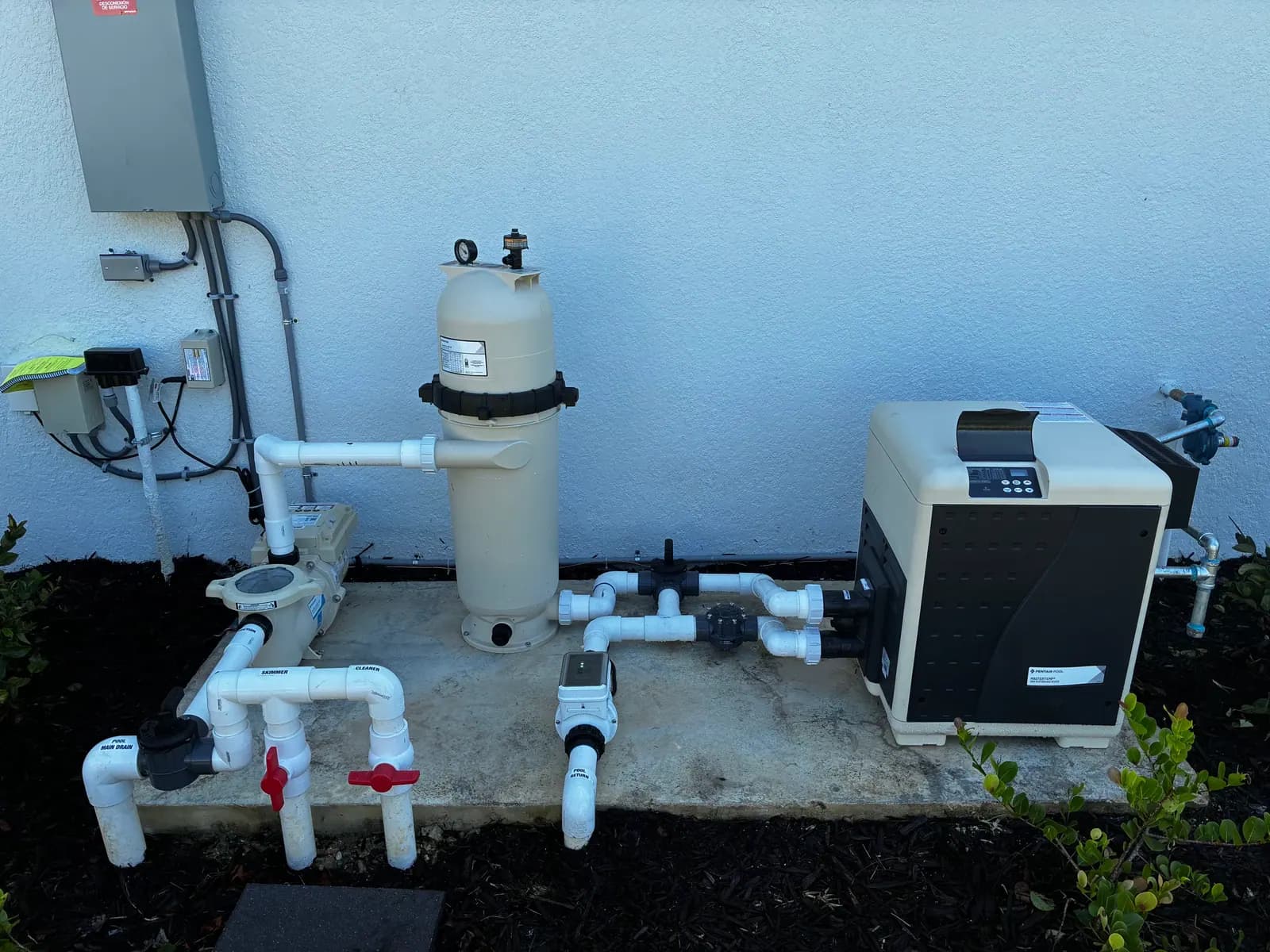
One of our recent gas installs shows what the equipment side looks like. In Babcock Ranch we set a Pentair MasterTemp gas heater on a full equipment pad with a cartridge filter, a variable-speed pump and labeled suction and return valves. Water runs pump, then filter, then heater, and the gas line comes to the heater's side connection through a regulator.
What the Florida climate changes
Heat pumps take their heat from the air, so air temperature decides how well they work. DOE says heat pump pool heaters work efficiently as long as the outside air stays above the 45-50°F range. Manufacturers publish their own limits: the GulfStream HE Series goes into a defrost cycle below 48°F and will not run below 35°F, and Hayward rates its HeatPro to operate in air from 40°F to 115°F. On the Gulf Coast, air that cold usually arrives with winter cold fronts rather than settling in for months, which is why a heat pump spends most of the heating season in the range it was built for. Humidity helps as well; heat pumps are rated at 80% relative humidity for a reason.
Gas output doesn't care about air temperature, and that is its advantage during a cold snap. It is not a freeze-protection device, though. Pentair warns that running a MasterTemp continuously with water below 68°F causes harmful condensation, damages the heater and voids the warranty. Keeping water moving during a freeze is the pump's job.
Salt air and salt pools are the other Florida factor. Every heat pump in our heater comparison uses a titanium water-side exchanger. Gas heaters vary: Hayward's Universal H-Series uses cupro-nickel as standard, while the standard Pentair MasterTemp and Jandy JXi use copper, with cupro-nickel versions available (Pentair's HD models and Jandy's JXi400NN). On a salt pool or a barrier-island lot that choice matters more than a point of efficiency, and our heat exchanger guide covers it in detail.
What each heater needs at your equipment pad
A gas heater needs fuel at the address first: a natural gas main in your street, or room for a propane tank. Then the gas line has to deliver the heater's full input over its whole length, which is where retrofits go wrong. Pentair's MasterTemp manual calls for at least 4 inches of water column at the heater while it is firing, with no more than a 2-inch drop between static and running pressure, and its sizing table allows 1-inch pipe for only 20 equivalent feet on natural gas for the 400. Venting has clearances of its own: Pentair asks for 3 feet between the top of the exhaust vent and any roof overhang, and 36 inches from an air conditioner or heat pump. The electrical side is light, a 15 A circuit at 120 or 240 V.
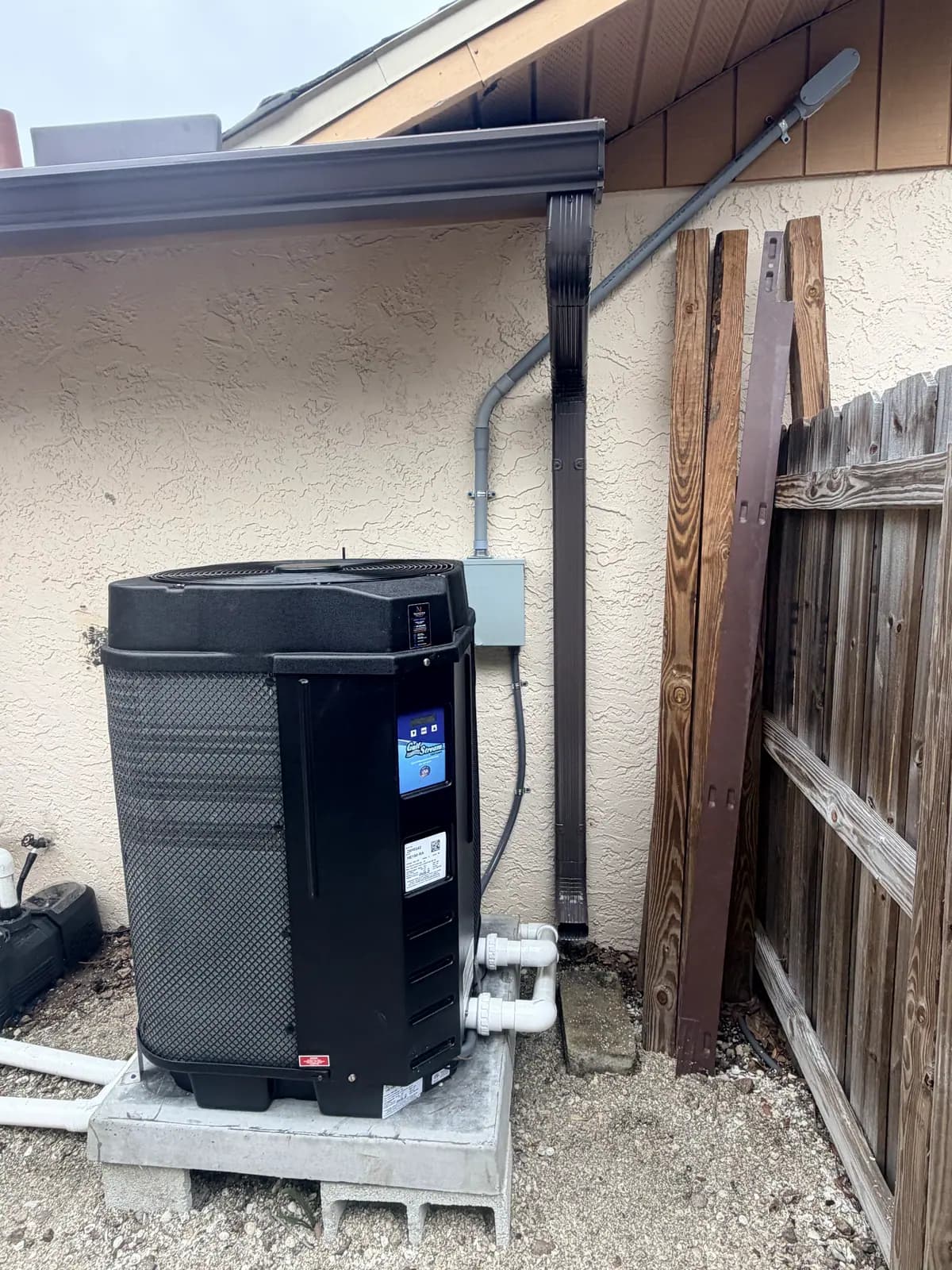
A heat pump needs the opposite: no fuel, but a real electrical circuit and plenty of air. GulfStream's HE150-RA runs on 208-230 V single phase with a 37 A minimum circuit ampacity and a 50 A maximum breaker. Hayward's HP21405T calls for 42.5 A minimum circuit ampacity and a 50 A recommended breaker. GulfStream wants 12 inches of clearance on each side and four feet above the unit, outdoors only, and Hayward asks for 60 inches from the pool wall. A heat pump also makes condensate, up to 3 gallons an hour on a GulfStream according to its manual, so the pad has to drain.
Both need water flow inside their window. A MasterTemp 400 needs at least 40 GPM through it, and an HE150-RA wants 30 to 70 GPM. On a variable-speed pump the heating speed has to be programmed to meet that, or the heater will refuse to fire. The usual surprises on a site visit are a gas line sized for a smaller heater, an electrical panel with no room for a new 240-volt circuit, and a heat pump squeezed into a corner where it breathes its own cold discharge air.
Running both on the same pool
On a lot of pool-and-spa homes the right answer is not one heater. A heat pump carries the pool through most of the year at the lower running cost, and a gas heater handles spa nights and the occasional cold-front rescue. Because the gas heater is not carrying the pool all winter, its fuel bill stays small, and because the heat pump is never asked to heat a cold spa in half an hour, nobody is disappointed by it.
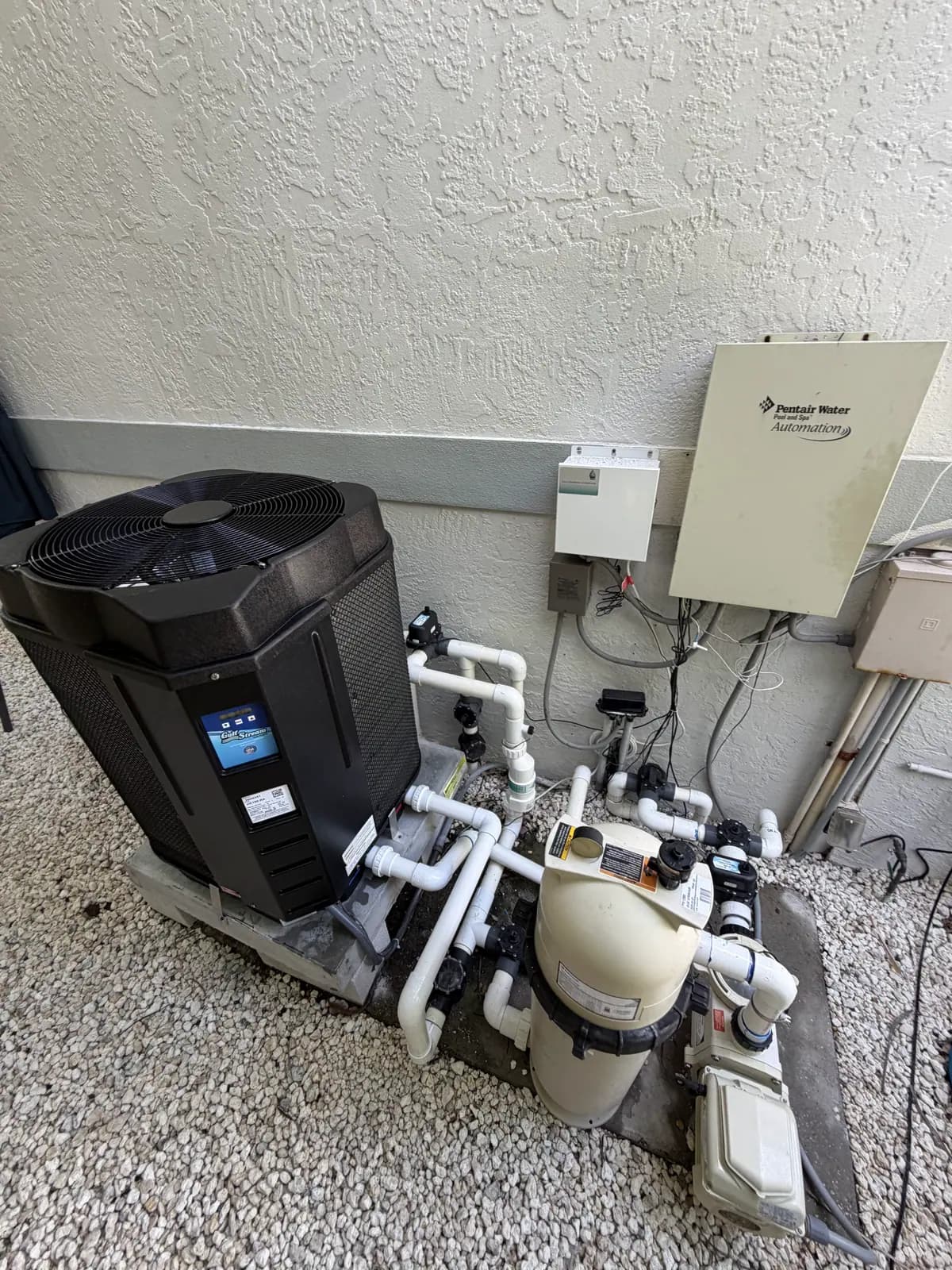
Two heaters means two sets of requirements on one pad: the gas line and venting for one, the dedicated circuit and airflow for the other, and enough space between them. Pentair's 36-inch separation between a MasterTemp and a heat pump is the kind of detail that decides where everything goes. Controls matter too. The pump schedule and any automation have to make it clear which heater is in charge, so the gas heater isn't quietly firing to hold a pool temperature the heat pump was supposed to be holding.
It costs more up front than either heater alone, so it earns its place mainly where the spa gets regular use. If the spa is used a few times a year, a heat pump alone, set and left, is often enough.
Who should choose which
Work through these in order. The first one that clearly fits usually settles it.
- You swim most weeks from fall through spring and have no spa: start with a heat pump sized for January, plus a cover.
- You have an attached spa you use often and want hot on short notice: gas, at least for the spa.
- The pool is heated only for occasional weekends, guests or a rental: gas usually costs less overall, because you only buy fuel when you use it.
- There's no natural gas at your street: compare propane per million BTU against a heat pump before deciding.
- Your panel can't take a heat pump's dedicated 240-volt circuit and a service upgrade isn't practical: gas, or solar where the roof suits it, may be the realistic route.
- You want year-round swimming and a spa you use often: a heat pump for the pool and gas for the spa.
Pros and cons
Electric heat pump
Pros
- Much lower running cost: about $9 per million BTU at a COP of 5.0 on EIA Florida prices.
- No gas line, tank or fuel deliveries.
- Holds a steady temperature when left at a setpoint.
- Titanium water-side exchanger on every model in our heater comparison; some models also cool.
Cons
- Heats gradually; not built to bring a pool or spa up from cold on short notice.
- Output falls in cold air, for example 138,000 to 82,000 BTU/hr on Hayward's HP21405T from 80°F to 50°F air.
- Needs a dedicated 208-230 V circuit and open air around the unit.
Gas heater (natural gas or propane)
Pros
- Heats regardless of air temperature.
- Fast spa heating: about 18 minutes for a covered 400-gallon spa rising 30°F on Hayward's 400,000 BTU model, per Hayward's table.
- Light electrical requirement.
- Running cost only when you use it, which suits occasional heating.
Cons
- Several times the running cost: about $29 per million BTU on Florida natural gas and about $46 on East Coast propane.
- Needs fuel at the address, a correctly sized gas line and venting clearances.
- Not for continuous running with water below 68°F, per Pentair.
Real installations
Recent jobs from our installation library that relate to this topic.