Modern Pool Heating · Owner/operator Henry Manna, Florida Certified Pool/Spa Contractor CPC1460367
Updated October 16, 2026
Short answer
A gas heater's installed price turns on the gas supply: with natural gas or a propane line already at the pad, the job is mostly the heater, the plumbing and the clearances, but with no gas at the pad, the line, meter or tank can be a large part of the total. Two gas heater jobs in our gallery show how scope moves the number: a Hayward gas heater on its own pad plus a Jandy salt system came in at $4,500–$5,500, and a Naples job that added a gas heater and redid all the equipment plumbing came in at $5,500–$6,500. To run, a million BTU of pool heat costs about $29 on natural gas and about $46.50 on propane at current EIA prices with an 84% efficient heater. Call (941) 323-6559 for current pricing on your pad.
What we usually recommend
If natural gas already reaches your pad and you want an attached spa hot quickly, or heat on demand for weekends and guests, a gas heater makes sense and the install is usually simple. If there's no gas at the address, get the utility's or propane supplier's price for the line and meter or tank first, because that number decides whether gas still makes sense. And if you plan to keep the pool warm all winter, price a heat pump alongside it: gas buys speed, not economy.
- Gas supply is the biggest variable: natural gas at the street, an existing propane tank, or a new tank and line.
- Gas-line sizing follows the heater's BTU input and the length of the run, so a bigger heater can mean new pipe.
- Gas heaters need only a small electrical circuit: Pentair's MasterTemp calls for a 15 A circuit and Hayward lists a 15 A maximum breaker.
- Operating cost at current EIA prices: about $29 per million BTU on natural gas and about $46.50 on propane at the East Coast price.
- A 400,000 BTU heater at full fire burns about 4 therms an hour, roughly $9.84 at Florida's average natural gas price.
What a gas heater install involves, and two priced jobs
A gas pool heater install has four parts: the heater, the gas supply to it, the water plumbing, and a pad with the clearances the manufacturer calls for. The heater is the predictable part. The gas supply is where quotes for the same heater end up far apart, because a pad with natural gas already piped to it and a pad with no gas at all are completely different jobs.
Here's what the two gas heater jobs in our gallery with a published price included. In May 2026 we set a Hayward gas heater on its own pad beside the home and added a Jandy TruClear salt chlorine system as part of the same project; that came in at $4,500–$5,500. On a Naples project the customer wanted to add a gas heater and redo all of the plumbing equipment; that came in at $5,500–$6,500. Those are what those two jobs cost, including the extra work each one had. They aren't averages or a quote for your pool, and the gallery doesn't record the heater size or the gas work on either.
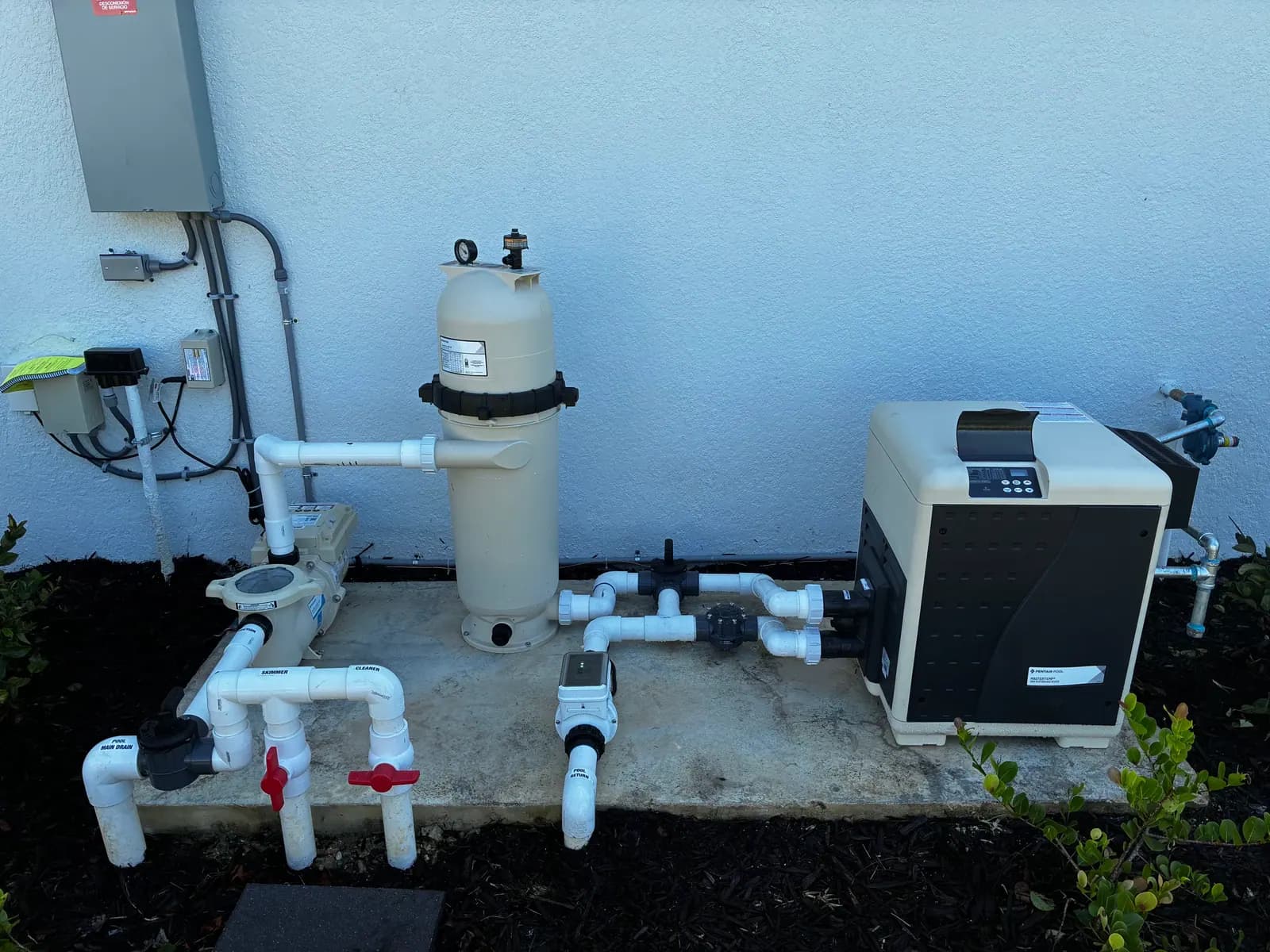
Our other gas jobs are on the projects and gallery pages without prices: a Pentair MasterTemp on a full equipment pad in Babcock Ranch, with the gas line and regulator brought to the heater's side connection, and a Pentair gas heater fitted into a narrow side yard where the gas line and PVC had to thread past the existing filter and valves without crowding the service clearances. For current pricing on a specific heater, call us at (941) 323-6559.
Gas supply: the line item that decides the quote
Start with whether natural gas reaches your address at all. It's a piped utility, so no main in your street means no natural gas option at any price. The Florida Public Service Commission's map of the state's gas utilities shows a patchwork of companies and warns that service areas are approximations, so the only reliable answer comes from calling the utility with your address. Ask whether there's a main on your street and what a service line and meter to the equipment pad would cost. That charge is set by the utility, not by us, and it belongs in your budget before you compare heaters.
If natural gas isn't available, propane means the propane version of the same heater, plus a tank. The tank has to be sized for the heater, not for a grill: at full fire a 399,000 BTU/hr heater burns about 4.4 gallons an hour (EIA's 91,452 BTU per gallon), so every 100 gallons in the tank is roughly 23 hours of full fire. The Department of Agriculture and Consumer Services licenses the businesses that install LP gas containers and systems in Florida, so the tank and its line are set by a licensed LP gas business.
If you already have gas at the pad from an old heater, the question becomes whether the existing line is big enough for the new one, which is the next section.
Gas-line sizing: why a bigger heater can mean new pipe
The gas line has to deliver the heater's full BTU input over its whole length, and the longer the run, the bigger the pipe. Manufacturers publish the limits. Pentair's MasterTemp manual counts the length in equivalent feet, adding 3 feet for every elbow, and the limits for natural gas are in the table below.
Here's how that plays out. Say the run from the meter to the heater is 50 feet of pipe with four elbows: 50 plus 4 times 3 is 62 equivalent feet. A MasterTemp 250 is fine on 1-inch pipe at that length, because 1-inch is good to 70 feet. A MasterTemp 400 isn't: on natural gas, 1-inch pipe only reaches 20 feet, so the same run needs 1-1/4 inch pipe. Upgrading from a 250 to a 400 on that pad means replacing the gas line, so the new pipe belongs in the price of the upgrade, not just the difference between the two heaters.
Propane is more forgiving because it carries more energy per cubic foot. Jandy's sizing table shows it clearly: a JXi400 gets 20 feet of 1-inch pipe on natural gas, or 55 feet of the same pipe on propane. Whichever fuel you have, the incoming gas pressure should be checked with the heater firing, not just at rest; Pentair lists a 4-inch water column minimum and 14-inch maximum inlet pressure for the MasterTemp, and Hayward a 4.5-inch minimum and 10.5-inch maximum on natural gas for its H-Series.
| Pipe size | MasterTemp 250 (250,000 BTU/hr input) | MasterTemp 400 (400,000 BTU/hr input) |
|---|---|---|
| 3/4 inch | Up to 20 ft | Not listed |
| 1 inch | Up to 70 ft | Up to 20 ft |
| 1-1/4 inch | Up to 250 ft | Up to 100 ft |
| 1-1/2 inch | Up to 600 ft | Up to 200 ft |
250K vs 400K: what the size changes in price
Gas heaters are sized by BTU input, and the heat that reaches the water is input times thermal efficiency. A 400,000 BTU/hr heater at 84% delivers about 336,000 BTU/hr; a 250,000 BTU/hr heater at 84% delivers about 210,000. The bigger heater heats faster, which is the whole point of gas, and it costs more to buy: on our comparison pages Hayward's H400FDN and Pentair's MasterTemp 400 sit one relative price tier above their 250,000 BTU siblings.
The installation can change too. As the sizing table shows, a 400 needs a bigger gas line than a 250 over the same run, and on propane it drains the tank faster. If the heater ever goes indoors, the vent is bigger: Hayward lists a 4-inch vent pipe for the H250FDN and a 6-inch vent for the H400FDN on natural gas. Water-side requirements differ a little as well; Pentair lists a 25 GPM minimum flow for the MasterTemp 250 and 40 GPM for the 400.
Running cost per unit of heat is the same for both sizes at the same efficiency. The bigger heater burns more gas per hour but gets the job done in fewer hours. Our 250K vs 400K article covers which pools and spas need which.
Pad, clearances, plumbing and the old heater
The rest of a gas heater quote is the work around the unit. None of it is exotic, but each item is time, and an itemized quote should show which ones apply to your pad.
- Pad and anchoring. The heater needs a solid, level base. Pentair sells a bolt-down bracket kit for the MasterTemp and states that anchor clamps are required in Florida.
- Clearances. Pentair asks for 6 inches from combustible surfaces on the top, exhaust side, header side and door panels, 3 feet between the top of the exhaust vent and any roof overhang, and 36 inches from an air conditioner or heat pump. Hayward lists 6 inches at the rear and 12 inches at the sides for its H-Series. A heater tucked under an eave or against the AC condenser may have to move.
- Existing plumbing. MasterTemp heaters come with 2-inch PVC slip unions; Hayward's H-Series uses 2-inch by 2-1/2-inch CPVC unions. Swapping brands usually means re-plumbing the last few feet. The heater goes after the pump and filter, as on our Babcock Ranch pad, with any salt cell or chlorinator downstream of it.
- Bypass. Pentair lists a 120 GPM maximum flow for the MasterTemp and calls for a bypass valve above that; Hayward lists a 125 GPM system maximum. A large pump, or a pad that also feeds water features, can exceed it.
- Electrical. Gas heaters need only a small circuit for their controls: Pentair calls for a 15 A circuit at 120 or 240 VAC for the MasterTemp, and Hayward's product page lists a 15 A maximum breaker for the H250FDN. That's a much smaller job than the 40 to 50 A breaker GulfStream's HE heat pumps call for.
- Old heater removal. Disconnecting the gas and water, hauling the old unit away and cleaning up the pad. One of our gallery photos shows a new MasterTemp set on the existing pad, with the rust stains from the old unit still visible, plumbed into the existing manifold.
- Automation and access. Wiring the heater to an existing controller, and anything about the site that slows the work: a narrow side yard, a long carry, a pad boxed in by other equipment.
What a gas pool heater costs to operate
Operating cost comes down to the price of the fuel per unit of energy and the heater's efficiency. Using EIA's figures: one million BTU delivered by an 84% efficient heater needs 1.19 million BTU of gas (1,000,000 divided by 0.84). Natural gas carries 1,036 BTU per cubic foot, so that's about 1.15 thousand cubic feet, and at Florida's 2025 residential average of $25.48 per thousand cubic feet it costs about $29.28. Propane carries 91,452 BTU per gallon, so the same heat takes about 13 gallons: about $46.50 at the East Coast residential price of $3.572 a gallon, or about $34.73 at the U.S. average of $2.668. A heat pump at COP 5 delivers the same million BTU for about $9.00 at Florida's average electric rate.
Per hour at full fire, a 399,900 BTU/hr heater burns about 4 therms of natural gas (a therm is 100,000 BTU). Florida's average works out to about $2.46 a therm ($25.48 divided by 10.36 therms per thousand cubic feet), so that's about $9.84 an hour. On propane it burns about 4.4 gallons an hour, about $15.62 at the East Coast price. A 250,000 BTU/hr heater burns about 2.5 therms, roughly $6.15 an hour, or about 2.7 gallons of propane, roughly $9.76.
For a whole year, the Department of Energy's gas table for Miami lists $3,880 uncovered and $796 covered for a 1,000 square foot pool held at 80°F year-round, using an 80% efficient heater and gas at $1.09 a therm. Scaled to a 450 square foot pool (times 0.45) and to Florida's $2.46 a therm (times 2.46 divided by 1.09), that's roughly $3,940 a year uncovered and roughly $808 with a cover. On propane at the East Coast price it's about 1.6 times those figures. With a current 84% heater instead of DOE's 80%, multiply by 80 divided by 84, which takes about 5% off.
One caveat from our cost guide: Florida's average residential gas price is high partly because most households here burn very little gas, which spreads fixed monthly charges over few therms. A pool-heating household uses far more, so its effective price per therm is usually lower. Use the per-therm rate on your own bill if you have one. And remember these are year-round, every-day figures; gas makes the most sense used in shorter bursts.
What an itemized gas heater quote should include
Two gas heater quotes are only comparable if they cover the same work. A complete one states:
- The make, model, BTU input and thermal efficiency, and whether it's the natural gas or propane version.
- The gas scope: tying into an existing line, upsizing it, or a new line, with the pipe size and run length, and who handles the meter or tank.
- The pad, anchoring and clearances, and whether the heater stays where the old one was.
- The water plumbing: unions, valves, any bypass, and the heater's position after the filter.
- The electrical connection for the heater's controls, and any automation wiring.
- Removal and disposal of the old heater.
- The permit and the manufacturer's warranty terms in writing.
How to get a firm number fast
Most gas heater jobs can be priced from photos. Attach them to the quote form on our contact page (it takes up to four photos), email them to modernpoolheating@icloud.com, or call (941) 323-6559 and let us know they're coming. The useful ones are the data plate on your old heater, which shows the model, BTU input and fuel type; a wide shot of the equipment pad; the gas line where it reaches the heater, including any regulator; and the gas meter or propane tank with its label. If there's no gas at the pad yet, a photo of the side of the house from the meter or tank to the pad tells us the run.
A recent gas bill helps too, both for the per-therm rate and to confirm which utility serves you. We install and service natural gas and propane pool heaters across Sarasota, Manatee, Charlotte & Pinellas County. Pool heater work generally needs a permit, and the requirements differ between the City of Sarasota, unincorporated Sarasota County and the surrounding municipalities; we're a Florida Certified Pool/Spa Contractor (License #CPC1460367), and we handle the permitting a job calls for rather than leaving it with you.
Is it right for you?
Good fit if
- Natural gas already reaches your property, or you have a propane tank sized for a pool heater.
- You want an attached spa hot quickly, or heat on demand for weekends and guests.
- You heat in short bursts rather than holding a temperature all winter.
Look elsewhere if
- You plan to keep the pool warm all winter. On Florida's average prices a heat pump costs roughly a third as much per unit of heat as natural gas.
- There's no gas at the address and the line, meter or tank would cost more than you want to spend on the heater.
- You'd rather not track propane deliveries through a cold snap.
What this costs
We give a written, itemized price after we have seen your equipment pad. The pad, the plumbing, the electrical service and the gas supply decide most of the cost, so a number given before anyone has looked at them is a guess.
What moves the price
- Gas supply: natural gas at the street, an existing propane tank, or a new tank and line.
- Gas-line sizing: the line has to deliver the heater's full BTU input over its length, which can mean upsizing.
- Existing heater removal: disconnecting, hauling and disposing of the old unit.
- Equipment pad: whether there is a level pad in the right spot or one has to be poured or built.
- Existing plumbing: whether the current lines can be reused or need re-piping to reach the new equipment.
- Equipment access: tight side yards, long carries and anything that slows the install.
- Automation: tying the heater into an existing controller, or adding one.
- Installation complexity: permits, multi-story roofs, long pipe runs and anything unusual about the site.
What recent jobs cost
These are the actual price ranges for specific past jobs shown in our gallery, not quotes or averages. Your price depends on your pad, plumbing and electrical.
Hayward Gas Heater & Salt System
$4,500-$5,500Completed in May 2026. A Hayward gas heater set on its own pad beside the home, plus a Jandy TruClear salt chlorine system added as part of the same project.
See it in the gallery: Hayward Gas Heater & Salt SystemPool Equipment Upgrade
$5,500-$6,500A project in Naples, Florida where the customer wanted to add a gas heater and redo all of the plumbing equipment.
See it in the gallery: Pool Equipment UpgradeReal installations
Recent jobs from our installation library that relate to this topic.