

Updated September 17, 2026 · Affordable Solar & Pool Heating, LLC · Owner/operator Henry Manna
Why nobody can quote your heating bill over the phone
Pool heating cost is the product of three things, and a contractor who gives you a number without all three is guessing: how much heat your pool needs, how efficiently the heater converts fuel into that heat, and what you pay for the fuel. Change any one and the answer moves by hundreds of dollars a year.
The first depends on surface area, target temperature, how many months you heat, and whether the pool is covered, screened or exposed. The second is published by the manufacturer — a thermal efficiency percentage for a gas heater, a COP for a heat pump. The third is on your utility bill.
What this page does is show the arithmetic with current, sourced Florida energy prices, so you can redo it with your own rate and your own pool rather than trusting a number written for a different climate and a different electricity market.
The energy prices used here, and when they were checked
All prices below are from the U.S. Energy Information Administration and were checked on September 17, 2026. Energy prices move; the method does not.
- Electricity, Florida residential average: 15.36 cents per kilowatt-hour, year-to-date through June 2026 (the U.S. average was 18.16 cents).
- Natural gas, Florida residential average: $25.48 per thousand cubic feet for 2025, the most recent annual figure — EIA's monthly Florida residential series shows no published value for 2026 (the U.S. average was $15.34).
- Propane, residential: $2.668 per gallon for the U.S. average and $3.572 per gallon on the East Coast (PADD 1) in March 2026, the most recent month in EIA's residential propane series.
- Conversion factors, also from EIA: 1 kilowatt-hour = 3,412 BTU; 1 cubic foot of natural gas = 1,036 BTU, so 1 thousand cubic feet is about 10.36 therms; 1 gallon of propane = 91,452 BTU.
- One caveat on the gas figure: Florida's average residential gas price is high partly because households here burn very little gas, spreading fixed monthly charges over few therms. A pool-heating household uses far more, so its effective price per therm is usually lower. Ask your utility for the commodity and delivery rates.
What a million BTU of pool heat costs, by fuel
A million BTU is a convenient yardstick — roughly what it takes to raise a 15,000 gallon pool by 8°F — and it puts every fuel on the same basis. Using the prices above:
Electric heat pump at a COP of 5.0: one million BTU of heat is 293 kWh, and at a COP of 5.0 the compressor draws 58.6 kWh to move it — about $9.00 at 15.36 cents. At a COP of 6.0, which Florida's warm humid air supports for most of the year, it falls to about $7.50; at the 4.0 manufacturers publish for 50°F air it rises to about $11.25.
Natural gas at 84% thermal efficiency: one million BTU delivered needs 1.19 million BTU of gas, about 1.15 thousand cubic feet. At Florida's $25.48 average that is about $29 — subject to the caveat above, since a heavy user's real rate is usually better than the state average. Propane at the same efficiency needs about 13 gallons: roughly $46 at the East Coast residential price, or $35 at the U.S. average.
Electric resistance heating, for context, has no multiplier at all: 293 kWh at 15.36 cents is about $45 per million BTU, which is a useful reminder of what a heat pump's COP is actually buying you. Solar has no fuel cost at all — only the extra pump time needed to push water through the collectors, which for two extra hours a day of a 1 kW pump is about 60 kWh a month, roughly $9 at Florida's average rate.
Turning that into a monthly bill: a worked example
The Department of Energy publishes annual pool heating cost estimates by city, and Miami is the closest Gulf Coast proxy in its table. Both DOE tables are built on a 1,000 square foot pool — more than twice a typical 15 by 30 foot residential pool — and both use energy prices that are now out of date, so the numbers below adjust for pool size and today's Florida prices with every step shown. Treat the result as an estimate, not a quote.
DOE's heat pump table (an air-to-water heat pump at an average COP of 5.0, electricity at 13.01 cents) puts a year-round Miami pool held at 80°F at $1,989 a year uncovered, and $409 a year with a cover. Scaling to a 450 square foot pool (multiply by 0.45, since the heating load is driven by surface area) and updating the electricity price (15.36 divided by 13.01, so multiply by 1.18) gives roughly $1,060 a year uncovered — about $88 a month averaged across the year — and roughly $215 a year, or $18 a month, with a cover.
DOE's gas table (an 80% efficient natural gas heater at $1.09 per therm) puts the same Miami pool at $3,880 a year uncovered and $796 with a cover. Scaling for the smaller pool and updating to Florida's $2.46 per therm — $25.48 per thousand cubic feet divided by 10.36 therms — gives roughly $3,900 a year, about $330 a month, uncovered, and roughly $800 a year, about $67 a month, with a cover. On propane at the East Coast residential price the same job is around 1.6 times the natural gas figure.
Two honest caveats. These are year-round figures for a pool held at 80°F every single day, and most Florida owners heat for part of the year, so a real bill is usually a fraction of this; and DOE's two tables make slightly different cover assumptions, so they are not perfectly parallel. What the comparison establishes reliably is the ratio: gas costs several times what a heat pump costs for the same heat, and a cover changes everything.
What moves the number most
Roughly in order of impact, these decide your bill:
- A pool cover. Evaporation is by far the largest source of heat loss — DOE notes each pound of 80°F water that evaporates takes 1,048 BTU out of the pool — and covering a pool when it is not in use is the single most effective way to cut heating costs, with savings of 50-70% possible.
- Your target temperature. In DOE's Miami heat pump table, moving from 78°F to 82°F takes the annual cost from $1,499 to $2,514 — a 68% increase for four degrees. Every degree is compound interest on your bill.
- How many months you heat, and wind exposure. Evaporation rises with wind speed, so an exposed waterfront lot costs more than a screened lanai, and DOE suggests a windbreak high and close enough to cut wind without shading the pool.
- Cold-air derate on a heat pump. Manufacturers publish about 4.0 COP at 50°F air against 5.5-6.0 at 80°F, so the most expensive heat is what you chase during a cold front.
- Gas heater efficiency. DOE's table shows that for every $1,000 spent on a 55% efficient heater, a 95% efficient one costs $422 less. Current models run from the low 80s into the mid 90s.
- Pump scheduling. The heater only works when water moves through it, so a variable-speed pump set near the heater's minimum flow saves electricity on both sides of the pad.
Where solar changes the arithmetic
Solar is the only option here with no fuel cost, which makes it structurally different: you are buying the equipment, not the energy, and the running cost does not move when utility rates do.
The constraint is roof area. DOE's guidance is that collector area should equal 50-100% of the pool's surface area, and that a 15 by 30 foot pool in Florida typically needs collectors equal to 100% of the pool — about 450 square feet — for year-round use. If the available unshaded roof plane cannot take that, the system will underperform, which is why it gets measured before it gets quoted.
The pairing that works best on many Gulf Coast pools is solar carrying the load most of the year with a heat pump filling in cold mornings and cloudy weeks, so the heat pump runs a fraction of the hours it would alone.
Getting a real number for your pool
To estimate your own cost you need four things: the pool's surface area, the temperature you want, the months you intend to heat, and the efficiency figure for the heater you are considering (thermal efficiency for gas, COP at both the 80°F and 50°F test points for a heat pump). Run those through the cost-per-million-BTU figures above with your own utility rate and you will land in a sensible range — which is all anybody can honestly promise before the pool is measured.
It is also worth pricing the cover first: a solar blanket is the cheapest thing on any quote we write, and on the DOE numbers it does more for the annual bill than any equipment upgrade.
If your pool is in Sarasota, Manatee, Charlotte & Pinellas County, we will look at the pool, the enclosure, the pad and your utility situation — including whether natural gas is available at your address at all — before recommending anything. The method here is written for pool owners anywhere; the site visit is local.
Real installations
Recent jobs from our installation library that involve the equipment in this guide.
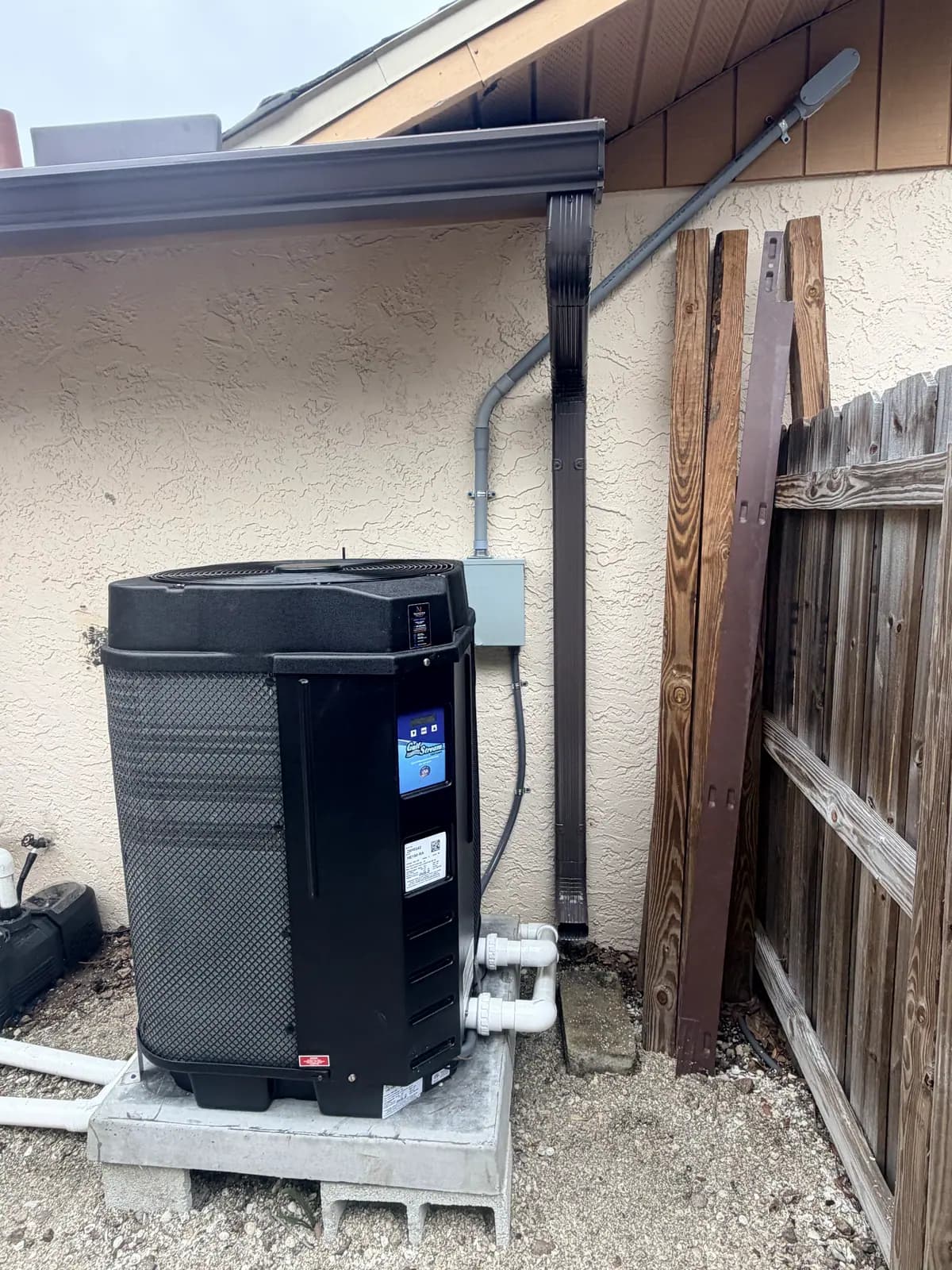
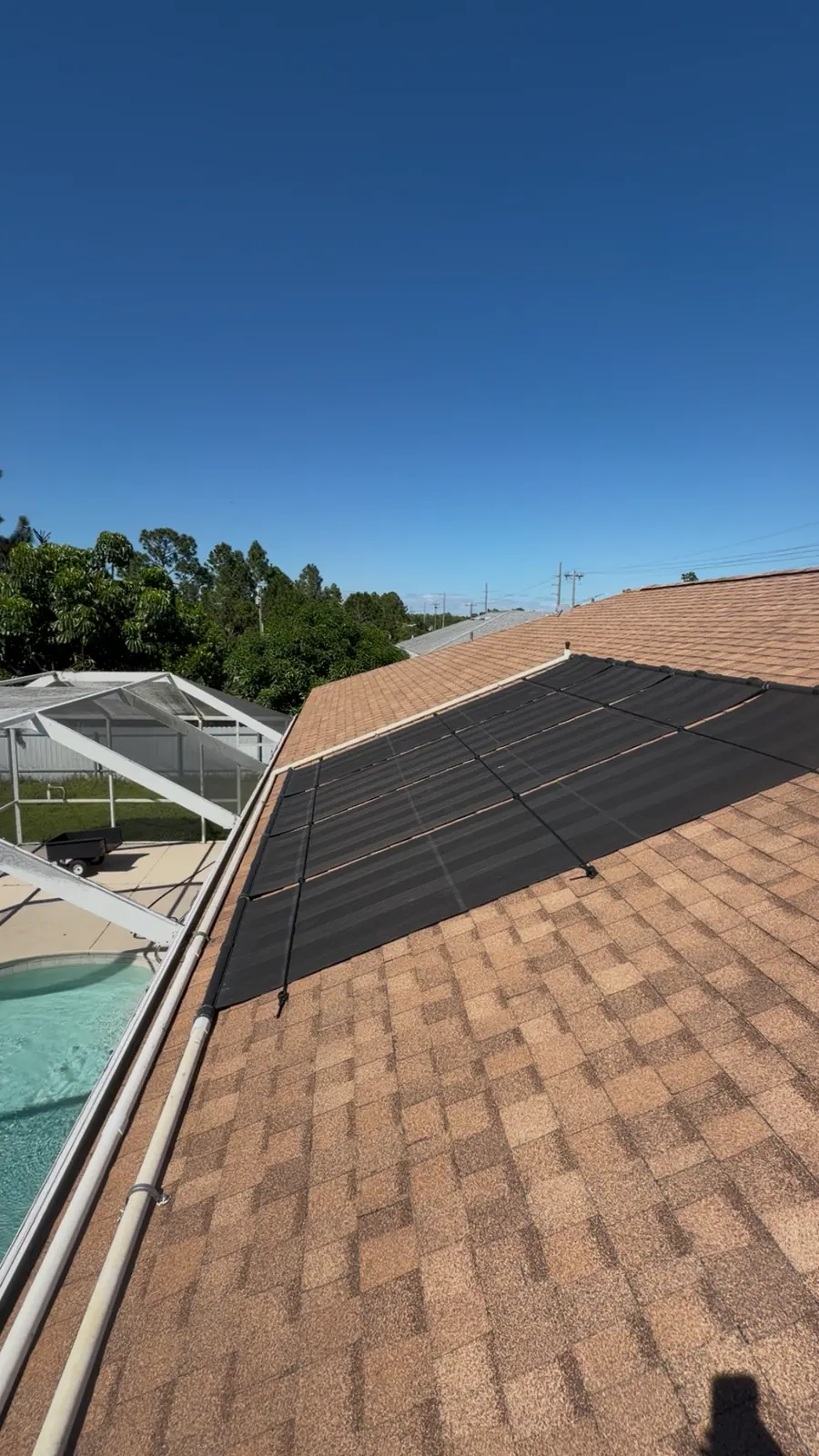
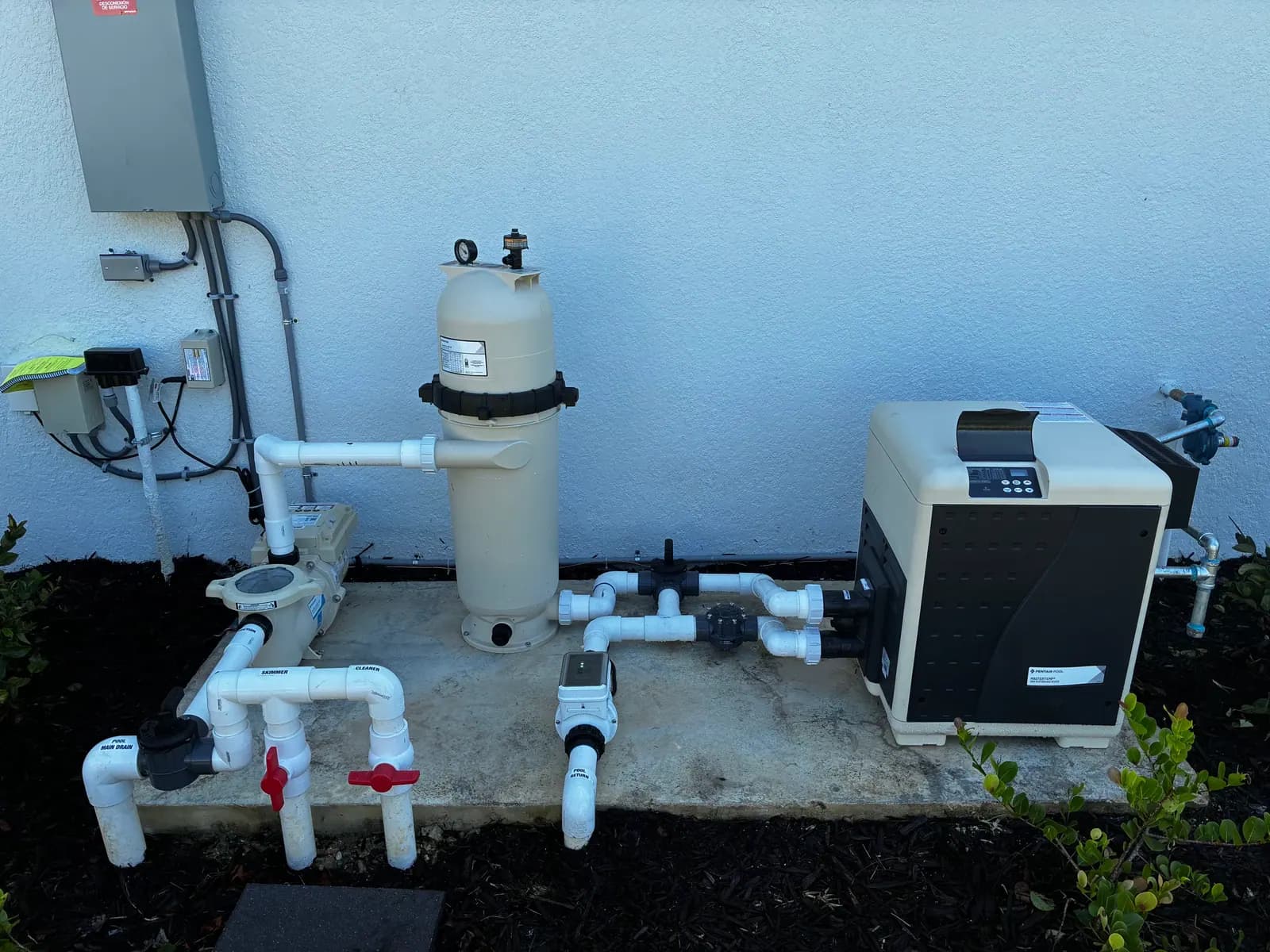
Heaters mentioned in this guide
GulfStream · GulfStream HE Series
GulfStream HE150-TA Heat/Cool Pool Heat Pump
Model HE150-TA
- Heating capacity
- 135,000 BTU/hr
- Efficiency (COP)
- COP 6.0
- Heat exchanger
- Titanium
- Warranty
- 7-Year Parts / 2-Year Labor
- Wi-Fi / automation
- Automation Compatible (Relay)
A Gulf Coast pool that gets used most of the year and an owner who also wants the option to take the edge off the water in late summer.
AquaCal · HeatWave SuperQuiet
AquaCal HeatWave SuperQuiet Pool Heat Pumps
Model SQ140R
- Heating capacity
- 114,000 BTU/hr
- Efficiency (COP)
- COP 5.7
- Heat exchanger
- Titanium
- Warranty
- 3-Year Parts & LaborLimited Lifetime Heat Exchanger
- Wi-Fi / automation
- Wi-Fi Built InAutomation Compatible (Relay)
A Gulf Coast owner who wants a heat pump from a Florida manufacturer with a real service organization behind it, built-in Wi-Fi out of the box, and the option to cool the pool in late summer.
Built Right · XW Series
Built Right XW Series Pool Heat Pumps
Model BR135XW
- Heating capacity
- 135,000 BTU/hr
- Efficiency (COP)
- COP 6.0
- Heat exchanger
- Titanium
- Warranty
- 5-Year Parts & Labor
- Wi-Fi / automation
- Automation Compatible (Relay)
A Sarasota, Charlotte or Manatee County pool owner who wants five years of parts and on-site labor on one warranty term from a factory an hour down the road, and does not need app control.
Hayward · Universal H-Series
Hayward Universal H-Series H400FDN Gas Pool Heater
Model H400FDN
- BTU input
- 399,900 BTU/hr
- Thermal efficiency
- 84%
- Heat exchanger
- Cupro-nickel
- Warranty
- 3-Year Parts / 1-Year Labor
- Wi-Fi / automation
- App Control via AutomationAutomation Compatible (Relay)
A large Florida pool, or a pool and spa combination, that needs to reach temperature on demand rather than hold it all season.
Last verified September 17, 2026
Specifications and warranty terms are taken from the manufacturer documents below. Manufacturers revise these without notice, so confirm the current terms before you buy. If you spot something out of date, email us and we will fix it.
Sources
- U.S. Energy Information Administration — Electric Power Monthly, Table 5.6.B: average price of electricity by state and end-use sector (Florida residential 15.36 cents/kWh, year-to-date through June 2026)
- U.S. Energy Information Administration — Natural gas prices by state, annual (Florida residential $25.48 per thousand cubic feet, 2025; U.S. $15.34)
- U.S. Energy Information Administration — Residential propane prices, monthly (U.S. $2.668/gal and East Coast PADD 1 $3.572/gal, March 2026)
- U.S. Energy Information Administration — British thermal units and energy conversion calculators (3,412 BTU per kWh; 1,036 BTU per cubic foot of natural gas; 91,452 BTU per gallon of propane)
- U.S. Department of Energy, Energy Saver — Heat Pump Swimming Pool Heaters (annual heat pump heating cost table by city, COP explanation) — archived copy, energy.gov currently returns 404 for this page
- U.S. Department of Energy, Energy Saver — Gas Pool Heaters (annual gas heating cost table by city, efficiency savings table) — archived copy
- U.S. Department of Energy, Energy Saver — Swimming Pool Covers (1,048 BTU per pound of evaporated water; 50-70% savings) — archived copy
- U.S. Department of Energy, Energy Saver — Solar Swimming Pool Heaters (collector area 50-100% of pool area; 100% for year-round use in Florida) — archived copy
Ratings on this site are the editorial opinion of Affordable Solar & Pool Heating, LLC, trading as Modern Pool Heating. How we rate heaters. Corrections: modernpoolheating@icloud.com.