Modern Pool Heating · Owner/operator Henry Manna, Florida Certified Pool/Spa Contractor CPC1460367
Updated October 16, 2026
Short answer
Solar pool heating is priced mostly by collector area, so the installed cost follows your pool's surface area, how many months you want to swim, whether you use a cover, your roof and how far the panels sit from the pool equipment. The one job in our gallery with a published price that includes solar was a full rebuild, with new plumbing and valves, a new electric heater, automation and pool solar, at $11,500–$12,500, so it isn't a solar-only price. Once installed, solar's running cost is mostly extra pump time: about $9 a month for two extra hours a day on a 1 kW pump at Florida's average electric rate. Call (941) 323-6559 for current pricing on a system sized to your pool.
What we usually recommend
If you have unshaded roof area with good sun exposure and you mainly want to stretch the swimming season from spring into late fall, solar is usually where we'd start, because once it's paid for it costs very little to run. If the roof can't take enough collector area for the season you want, we'd rather size it honestly and pair it with a heat pump than sell an undersized array. Whatever you decide, plan on a pool cover: on FSEC's numbers it cuts the collector area a year-round pool needs by more than half.
- Collector area drives the price, and collector area follows pool surface area, season length, enclosure and whether the pool is covered.
- DOE's rule of thumb is collector area equal to 50-100% of the pool's surface area, with 100% typical for year-round use in Florida.
- Roof type, the number of roof planes, the pipe run to the pad and the controls make up most of the rest of a solar quote.
- Running cost is the extra pump time: about $9 a month for two extra hours a day on a 1 kW pump at 15.36 cents per kWh.
- There is no federal residential clean energy credit for expenditures made after December 31, 2025.
What solar costs, and the one priced job we can point to
A solar pool heating system is collectors on the roof, the plumbing that carries pool water up to them and back, and the valves and controls that decide when water goes up. The number of collectors you need is set by your pool rather than by the brand, and that number drives most of the rest of the job. That's why nobody can price solar honestly without knowing the pool's surface area, the season you want to swim and the roof the panels will sit on.
We have one job in our gallery with a published price that includes solar, and it was much more than a solar install. It was a 2024 rebuild of the pool's plumbing with new valves, a new electric heater and automation, plus pool solar to help hold the heat and lower the electric heater's running cost. That whole project came in at $11,500–$12,500. It tells you what that combined job cost; it doesn't tell you what solar alone costs, and we won't pretend it does.
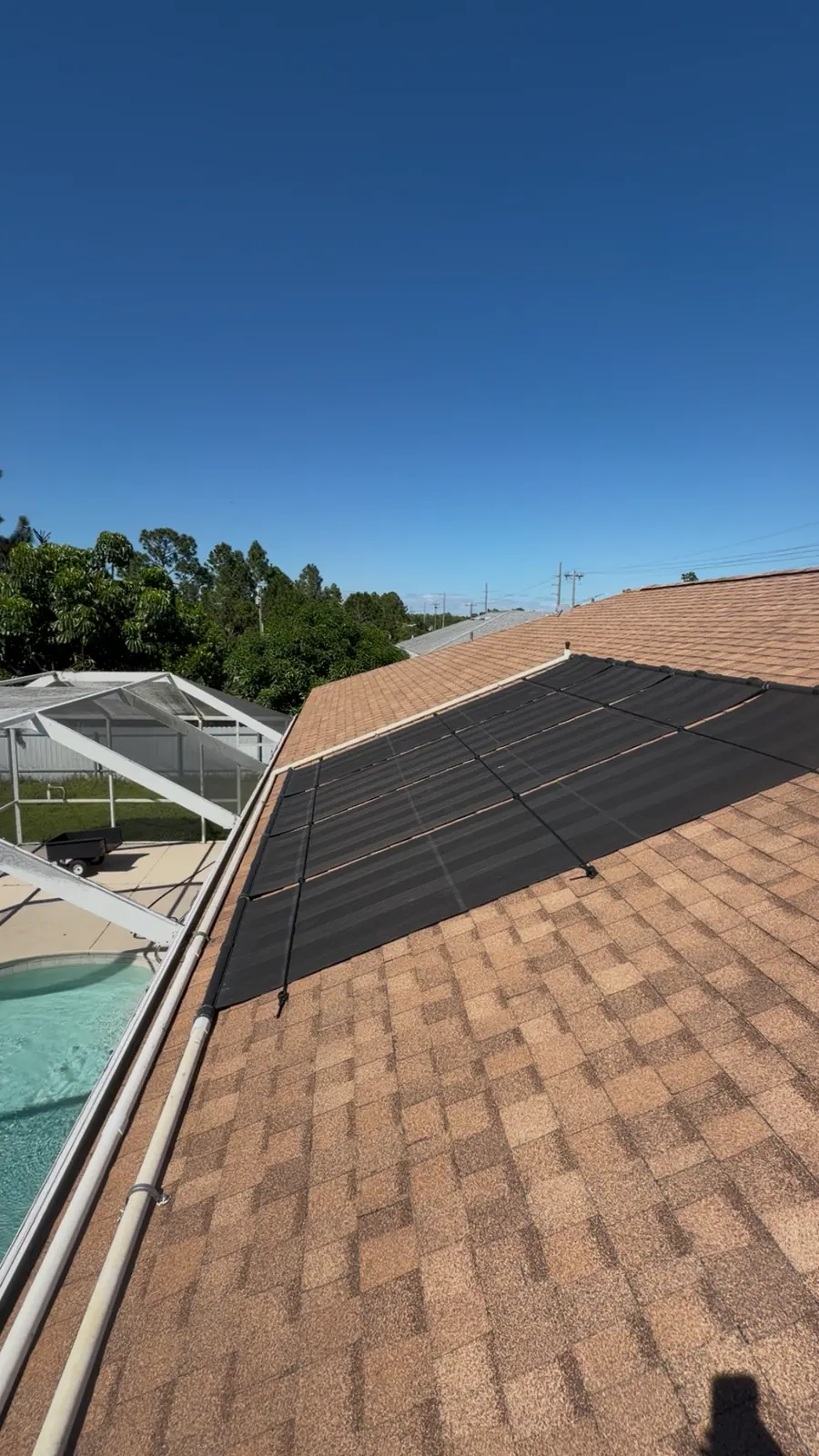
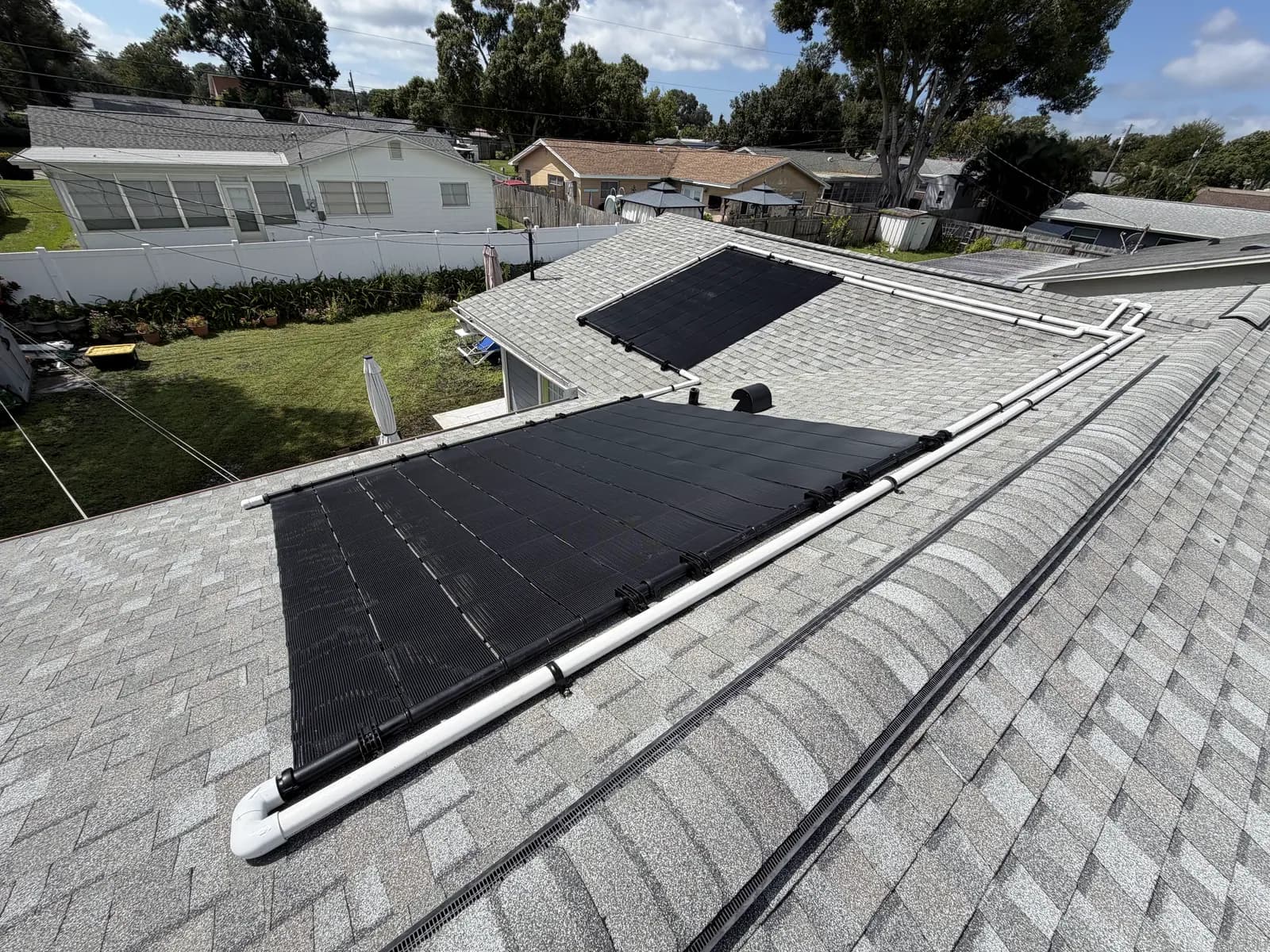
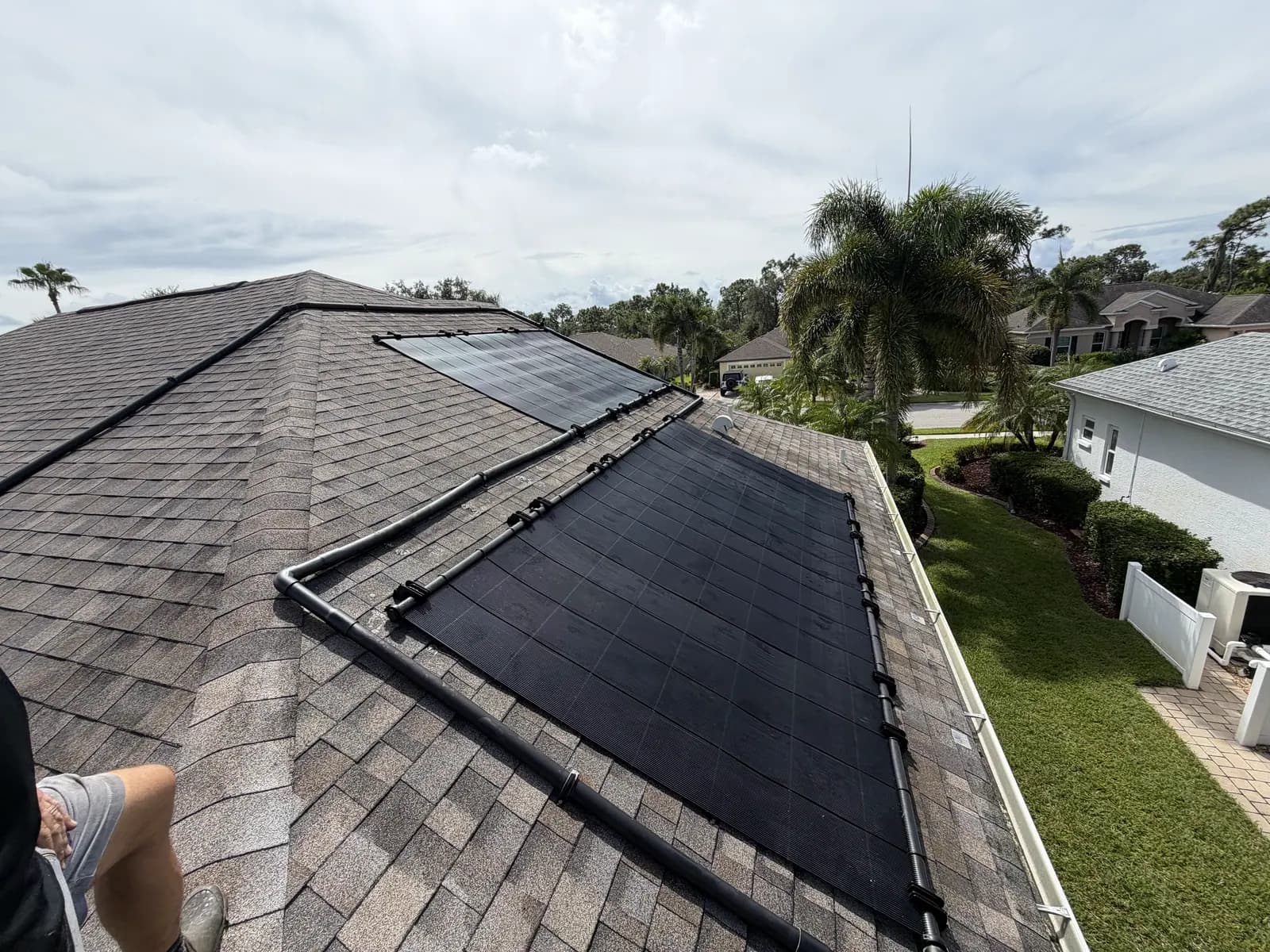
Our other solar jobs, on shingle roofs in Largo, Lakewood Ranch and Lehigh Acres, are on our projects pages with photos, but without prices. For current pricing on a system sized to your pool, call us at (941) 323-6559, or send the photos listed at the end of this page.
Collector area is what you're really paying for
The Department of Energy's guidance is that solar collector area should equal 50-100% of the pool's surface area, and that a pool in Florida typically needs collectors equal to 100% of its surface area for year-round use. A 15 by 30 foot pool has 450 square feet of surface, so the DOE range for it is roughly 225 to 450 square feet of collector, at the top of that range for year-round swimming.
The Florida Solar Energy Center's sizing method is more specific. It defines a ratio, R, of collector area to pool surface area, and publishes values by region of Florida, months of swimming and whether the pool is screened. Its tables assume the pool is covered; for an uncovered pool, FSEC says to multiply by 2.9 for a nine-month season, 2.4 for ten months, 2.2 for eleven and 2.1 for twelve. FSEC says the method is good to within about 20 percent. The table below applies FSEC's Central and South Florida values to a 450 square foot pool.
Sarasota, Manatee and Charlotte counties lie south of Orlando, FSEC's Central Florida example, and FSEC's text doesn't say where its regions divide, so for a pool here it makes sense to look at both the Central and South Florida columns. Two things jump out. A screened pool needs noticeably more collector than an unscreened one in FSEC's tables; a screen cuts wind, but it also shades the water. And the cover matters more than anything: FSEC's own example, a covered, screened 450 square foot pool in Orlando swum all year, needs about 470 square feet of collector; leave the cover off and it needs about 990.
To turn collector area into a panel count, divide it by the area of one panel on your quote. More panels means more material, more roof mounting and more plumbing between them, which is why collector area moves a solar quote more than anything else.
| Swimming season | Central FL, unscreened | South FL, unscreened | Central FL, screened | South FL, screened |
|---|---|---|---|---|
| 9 months | 0.37 (about 167 sq ft) | 0.25 (about 113 sq ft) | 0.70 (about 315 sq ft) | 0.55 (about 248 sq ft) |
| 10 months | 0.55 (about 248 sq ft) | 0.40 (about 180 sq ft) | 0.85 (about 383 sq ft) | 0.68 (about 306 sq ft) |
| 11 months | 0.65 (about 293 sq ft) | 0.50 (about 225 sq ft) | 0.95 (about 428 sq ft) | 0.75 (about 338 sq ft) |
| 12 months | 0.75 (about 338 sq ft) | 0.60 (about 270 sq ft) | 1.05 (about 473 sq ft) | 0.83 (about 374 sq ft) |
Roof, layout and plumbing: the rest of the quote
Once the collector area is known, the roof decides how hard it is to install. Shingle is the most straightforward roof for pool solar, with the mounting hardware and roof penetrations sealed into the shingle field; our Largo, Lakewood Ranch and Lehigh Acres jobs are all on shingle roofs. Tile and metal roofs each take a different mounting approach, and our roof article explains how. For pricing, what matters is that the roof type is known before the number is written and the mounting method is stated on the quote.
Layout is next. If no single roof plane is big enough, the collectors get split into arrays on two planes, as on our Largo and Lakewood Ranch jobs, which means more plumbing to tie the arrays into one loop. The length of the run from the roof down to the equipment pad matters too: our Lehigh Acres array sits on the roof plane right above the screened pool, so the run back to the equipment stays short. A two-story roof, a steep pitch or a long run across the house adds labor and pipe.
Appearance can be a line item. On the Lakewood Ranch job the supply and return lines are dark rather than white so the plumbing reads as part of the roof from the street, something many architectural review boards there care about. If your community has rules about how solar plumbing looks, tell us before the quote is written.
Finally, the pool pump has to lift water to the roof and push it through the collectors. Whether your existing pump can do that depends on the pump and on the height and length of the run. On a tall roof or a long run, an older or smaller pump may not keep up, and a pump change becomes part of the quote. We check the pump label during the quote for that reason.
Controls, automation and the equipment you already have
Solar needs a way to send water to the roof only when there's heat to collect. Many systems use a controller with temperature sensors that turns the solar valve automatically; simpler systems use a manual valve. A controller costs more and saves you from sending pool water across a cool roof in the evening. If your pad already has pool automation, the solar valve can often be run from it, which changes what the quote needs.
Existing plumbing matters as well. The solar loop has to tee into the return side after the filter, and if your pad already has a heat pump, the order of the equipment is set by the manufacturer. GulfStream's manual, for example, puts the equipment in this order: pool pump, filter, heat pump, solar, then the chlorinator or salt cell, then the pool. A pad that has grown piece by piece over the years sometimes needs re-plumbing to get that order right, and that's labor.
This is also where combining solar with a heat pump comes in. The 2024 rebuild in our gallery paired pool solar with a new electric heater so the solar carries much of the load and the heater runs less. Solar can be one of Florida's lowest-operating-cost methods for heating a pool when the home has suitable roof orientation and sun exposure, and a heat pump fills in on cool mornings and cloudy weeks when the panels can't keep up.
What solar costs to run
Solar has no fuel bill. What it uses is pool pump electricity to move water through the collectors, beyond what the pump would run anyway. The existing cost guide's working: two extra hours a day of a 1 kW pump is 2 kWh a day, about 60 kWh over a 30-day month, and at EIA's Florida residential average of 15.36 cents per kWh that's about $9.22 a month. If your pump draws more or less than 1 kW, scale it: a pump drawing 1.5 kW for the same two hours is about $13.82 a month.
For comparison, the same cost guide puts a million BTU of pool heat at about $9.00 from a heat pump at COP 5, about $29 from natural gas and about $46.50 from propane at the East Coast price. Solar's running cost doesn't move with the price of gas or propane at all, and it only moves with your electric rate through the pump.
That running-cost advantage is what you're buying up front. Whether solar costs less to own than a heat pump over the years depends on how much collector area your pool needs and on whether your roof can take it, which is exactly why we size it before we quote it. The cost calculator lets you compare the running costs with your own rates.
Tax credits and incentives in 2026
Homeowners often ask about the federal solar tax credit. The IRS instructions for Form 5695 state that residential clean energy credits can't be claimed for expenditures made after December 31, 2025. A solar pool heating system installed in 2026 doesn't come with a federal residential clean energy credit to subtract from the quote, so compare quotes on their own numbers.
If you hear about a local rebate or utility program, ask whoever offers it for the terms in writing, including whether pool heating qualifies, before you count it in your budget.
What an itemized solar quote should include
Solar quotes are easy to compare if they state the same things. Ours is itemized with panel count, and any quote you get should show:
- The collector make and model, the number of panels, and the total collector area, along with that area as a percentage of your pool's surface area.
- Which roof planes the collectors go on, the mounting method for your roof type, and how roof penetrations are sealed.
- The plumbing route from the roof to the pad, the pipe color if appearance matters, and how the solar loop ties into your existing equipment.
- The valves and controls: automatic controller or manual valve, and any tie-in to existing automation.
- Whether the existing pump can do the job, or whether a pump change is included.
- The permit, the collector warranty terms in writing, and what happens if the panels ever have to come off for a re-roof.
How to get a solar quote fast
We can do a lot of the sizing from photos before anyone climbs a ladder. Attach them to the quote form on our contact page (it takes up to four photos), email them to modernpoolheating@icloud.com, or call (941) 323-6559 and let us know they're coming. The useful ones are the roof from the ground on each side of the house (or a screenshot of an aerial map view) so we can see which planes face which way and what shades them; the roof material and its rough age; the equipment pad and the pool pump's label; and the pool's rough dimensions, whether it's screened, and whether you use a cover.
If your roof is due for replacement in the next few years, say so. It's usually better to re-roof first than to take the collectors off and put them back later. We install and service solar pool heating across Sarasota, Manatee, Charlotte & Pinellas County, and we repair existing systems too, including ones we didn't install.
Is it right for you?
Good fit if
- You have unshaded roof area large enough for the collector area your pool needs.
- You mainly swim spring through late fall and want the lowest running cost you can get.
- You'll use a pool cover, which cuts the collector area a year-round pool needs by more than half on FSEC's numbers.
- Your roof has plenty of life left before it needs replacing.
Look elsewhere if
- Your roof is heavily shaded or too small for the collector area the pool needs. An undersized array disappoints.
- You want the pool held at a set temperature through a cold, cloudy week with no backup heater.
- Your roof is due for replacement soon. Re-roof first, then add solar.
- You want heat on demand for an attached spa. Gas or a heat pump does that job.
What this costs
We give a written, itemized price after we have seen your equipment pad. The pad, the plumbing, the electrical service and the gas supply decide most of the cost, so a number given before anyone has looked at them is a guess.
What moves the price
- Roof type (solar): shingle, tile and metal roofs each mount differently.
- Number and size of solar collectors: driven by pool surface area and how much heat you want.
- Existing plumbing: whether the current lines can be reused or need re-piping to reach the new equipment.
- Equipment access: tight side yards, long carries and anything that slows the install.
- Automation: tying the heater into an existing controller, or adding one.
- Installation complexity: permits, multi-story roofs, long pipe runs and anything unusual about the site.
What recent jobs cost
These are the actual price ranges for specific past jobs shown in our gallery, not quotes or averages. Your price depends on your pad, plumbing and electrical.
Pool Equipment Rebuild
$11,500-$12,500A full rebuild of the pool's plumbing with new valves, a new electric heater and automation, plus pool solar to help hold the heat and lower the operating cost of the electric heater. Completed in 2024.
See it in the gallery: Pool Equipment RebuildReal installations
Recent jobs from our installation library that relate to this topic.