Modern Pool Heating · Owner/operator Henry Manna, Florida Certified Pool/Spa Contractor CPC1460367
Updated October 16, 2026
Short answer
Yes. Pool solar collectors can go on asphalt shingle, flat or barrel tile and metal roofs, but each attaches differently and tile takes the most care. On every roof the collectors should be mechanically fastened into the structure with each penetration sealed and flashed to code; on tile, the waterproof underlayment beneath the tile, not the tile itself, is what has to stay watertight. In Florida an HOA cannot prohibit solar collectors, though it may choose their location on the roof within south to 45 degrees east or west of due south if that does not impair their performance.
What we usually recommend
If your roof is shingle, solar is straightforward, and we'd want every attachment fastened into the framing and sealed and flashed. If it's tile, we'd agree on the attachment method, how the underlayment gets resealed and who replaces any broken tiles before anything is drilled. If it's metal, we'd confirm what's underneath (a solid deck or furring strips) and the metal's gauge first. If the roof has only a few years left, we'd usually re-roof first and put the solar on the new roof.
- Shingle is the simplest roof for pool solar and the one manufacturer manuals detail step by step.
- On tile, FSEC says the underlayment is the moisture barrier and sealing at the tile surface does not work.
- On metal, the fastener has to reach a wood deck or the furring strip; Heliocol prohibits adhesive mounting.
- Florida Statutes 163.04: an HOA cannot prohibit solar collectors but may choose the spot within south to 45° east or west of due south.
Shingle roofs: the straightforward case
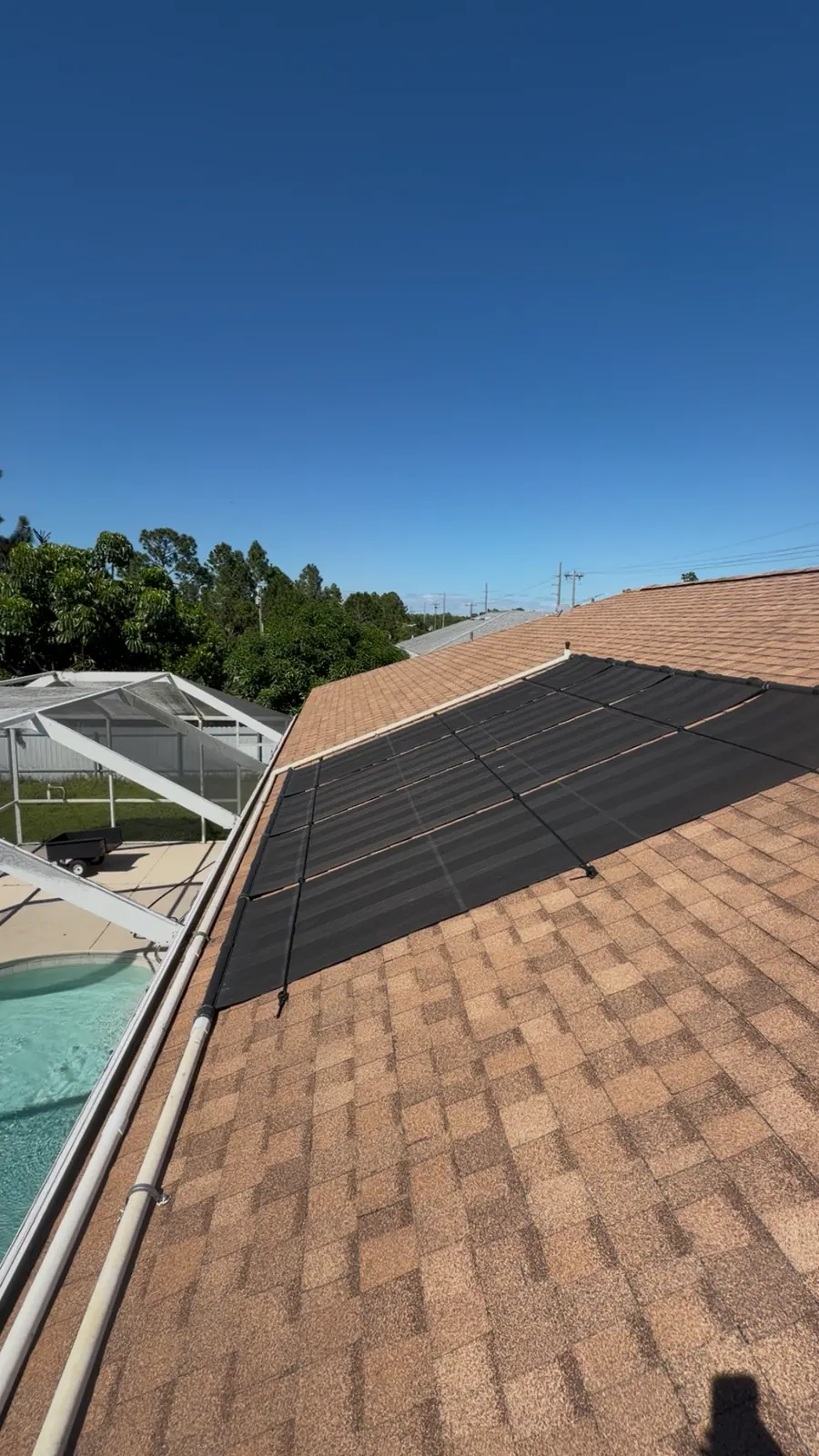
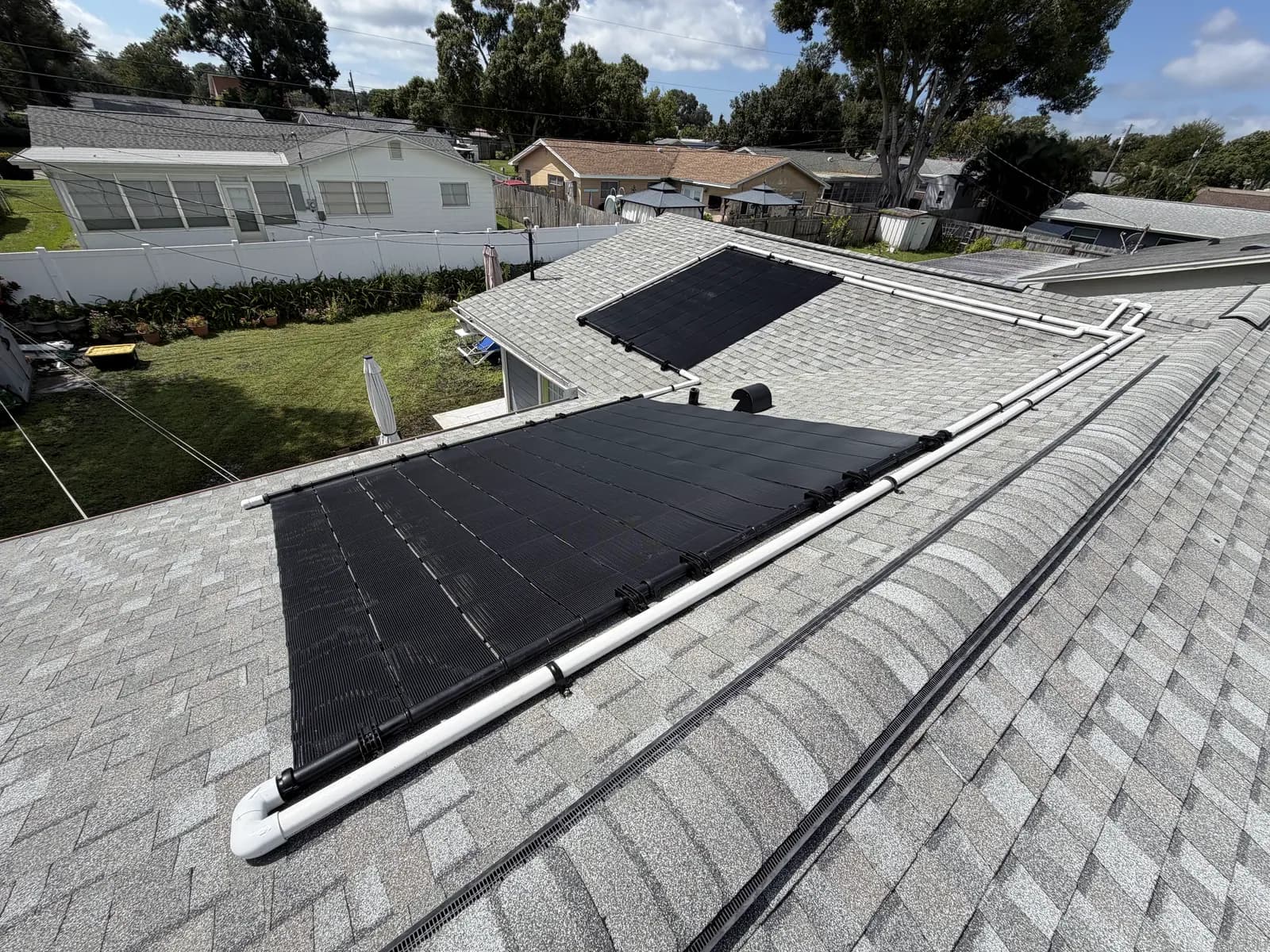
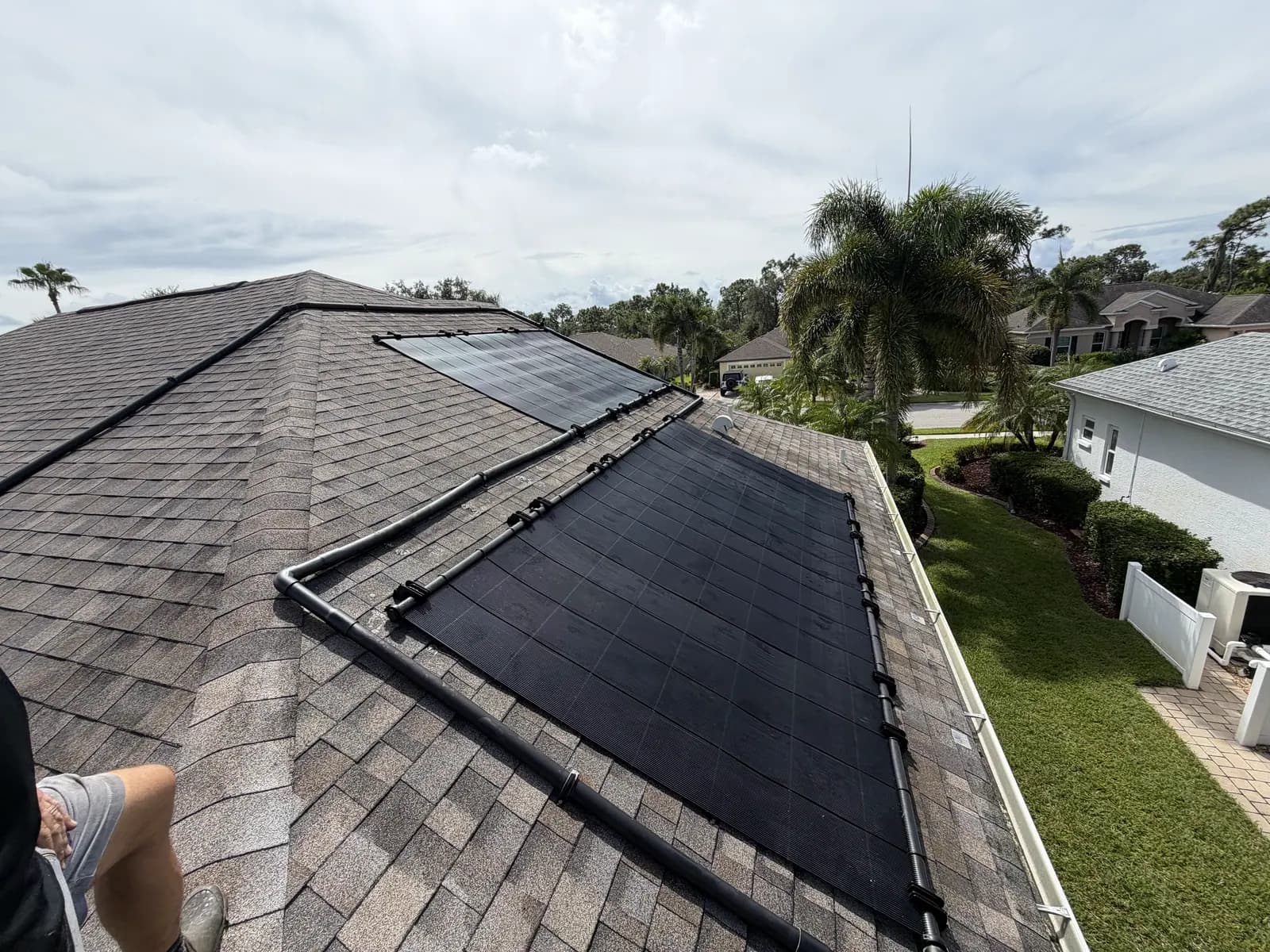
Asphalt shingle is the easiest roof for pool solar, and it is the one the manuals spell out step by step. Heliocol's installation manual details only shingle installs in depth, noting that the vast majority of residential roofing in the US is asphalt shingle. All three of our recent solar jobs, in Largo, Lakewood Ranch and Lehigh Acres, are on shingle roofs.
The attachment goes into the framing, not just the roof deck. Heliocol positions its top mounting clamps over roof trusses, requires at least two mounts on the top and bottom header of each collector, and specifies lag bolts with typically 2 inches of embedment into the truss unless the engineering plans say otherwise. FSEC's manual describes the same principle: lag screws into as many rafters as possible, sealant injected into each pilot hole, and enough sealant to form a seal under the mounting clip.
The detail that has changed is flashing. Heliocol's manual says direct-mounting the clamps with sealant is structurally sound but creates a risk of roof leaks if not done perfectly, and that current building codes call for all roof penetrations to be sealed and flashed with approved products, which is why it specifies a flashed mount for those cases. Ask how each penetration on your roof will be sealed and flashed, not just where it will go.
Collectors also move. FSEC says a 10 foot plastic collector may expand and contract as much as an inch in length, so the hardware fixes one header and lets the other slide: Heliocol's bottom clamps are longer to allow for it, and Techno-Solis secures only the top headers with brackets and leaves the bottom free. Where a design uses straps across the panels, Techno-Solis notes they may need re-tensioning after the first warm weeks or months.
Tile roofs: possible, with more care
Tile is where pool solar gets harder, and the published guidance does not all agree. FSEC's manual says concrete tile roofs, especially common in south Florida, present special mounting difficulties. Its safest solution is a rack of a durable material such as aluminum that holds the collectors above the tile and is fastened to the roof trusses rather than the sheathing. To install each bracket a tile has to be removed or broken to expose the waterproof membrane underneath, and FSEC is explicit that this membrane, not the tile, forms the moisture barrier and must be resealed where the bolts go through. A substitute for a broken tile can be cast from cement and tinted to match.
FSEC also warns against the shortcut. Fastening schemes that rely on sealing the penetration at the tile surface are not effective and should be avoided, because the tile is not the waterproofing. It is blunt about barrel tile too: it is extremely difficult to walk on without breaking some tiles, and substitute tiles are hard to make.
Manufacturers offer more than one method. Techno-Solis publishes two: a standard method that screws the mounting hardware into the tile itself through a pilot hole drilled with a masonry bit, with a warning not to drill into the substrate below because that will cause a roof leak, and a bracket method that fastens an aluminum or treated-wood bracket to the roof trusses and clamps the collectors to it. It publishes an engineering detail for the bracket method at a 170 mph basic wind speed. Heliocol's manual says concrete tile can support its systems but requires different mounting hardware and a call to its representative.
What that means for you: before anyone drills, agree on which method will be used, how and where the underlayment is resealed, whether the method has an engineered detail your permit office will accept, and who supplies and replaces broken tiles. FSEC's own method involves removing or breaking a tile at each attachment point, so replacement tiles are part of the job, not a surprise.
Metal roofs
Metal roofs take pool solar well when the attachment matches what is under the metal. Heliocol's manual allows its flashed RoofTech RT-Mini mount on metal roofs with an underlying wood deck and structure, for metal of 20 gauge maximum with a flat area at least 4-1/4 by 4-3/4 inches flush with the roof deck, and the screw holes pre-drilled. Techno-Solis says a metal roof over plywood can use its normal installation method, but where the metal sits on furring strips the mounting hardware must go into the strip to make a good seal and avoid bending the metal surface.
Two things are off the table. Heliocol states that its collectors must always be mechanically attached to the structure and that using adhesives to mount collectors to a roof surface is strictly prohibited. And on furring strips the fastener has to reach the strip; a screw that only grabs the metal skin is not a sound attachment.
Because metal profiles and decks vary, ask whether the mounting detail is engineered for your specific roof, and ask your roofer whether the roof warranty says anything about added penetrations before the work is scheduled.
Wind, hurricanes and permits
Every roof-mounted array in Florida has to be fastened for wind. FSEC's manual tells installers to secure collectors to withstand maximum expected wind loads, notes that wind loads at roof level may exceed 75 pounds per square foot, and says to check local building regulations for the wind provisions where you live. It adds that most collector suppliers employ professional engineers to approve their mounting details, and that some code jurisdictions require it.
That is what the manufacturer paperwork is for. Heliocol tells installers to check with the local building department on permits and code requirements and notes that a licensed engineer may need to provide plans. Techno-Solis publishes engineering notes for its mounting details at a 170 mph basic wind speed and exposure category C, working the uplift on a 10-panel bank against the holding force of the fasteners. Heliocol says its open, individual-tube design lets wind pass through the collector, reducing the wind load on the roof and the number of anchor points that have to penetrate it.
Florida also regulates the equipment itself. Under Florida Statutes section 377.705, solar energy systems manufactured or sold in the state must meet standards set by the Florida Solar Energy Center and display accepted results of approved performance tests, unless a licensed engineer certifies them under the Florida Building Code. DOE points buyers to the Solar Rating and Certification Corporation, which rates solar pool heaters under its OG-400 standard and keeps a directory of certified systems.
Placement matters for wind as well as sun. Heliocol calls for setbacks from ridges, valleys, edges and vents, and FSEC says a roof-mounted collector should not block drainage or keep the roof from shedding rain.
Roof age and re-roofing
Pool solar can outlast a roof, so plan for the overlap. Because the collectors are clamped rather than glued, they can come off and go back. Heliocol's collectors hang in mounting clamps whose tops snap over the header, and they join each other with plastic panel clamps; Techno-Solis panels join with rubber couplings and hose clamps and are held down by brackets and straps. On a re-roof the array is disconnected and lifted off, and once the new roofing is on, the mounts are reinstalled and flashed into it, the collectors re-hung and the loop pressure-tested again.
The best plan is to avoid doing that twice. If your roof is within a few years of replacement, re-roof first and install solar on the new roof; otherwise you pay to remove and reinstall the array partway through the roof's life. If the collectors are already old, ask whether it makes more sense to reinstall them or replace them at the same time.
Tell your roofer about the solar before the job is scheduled, and have the solar contractor handle the disconnect and the reinstall. The supply and return lines run over the eave and down the wall to the pool equipment, and the system has to drain back properly and hold pressure when it is put back together.
Can an HOA prevent pool solar in Florida?
Generally, no. Florida Statutes section 163.04 says a deed restriction, covenant, declaration or similar binding agreement may not prohibit, or have the effect of prohibiting, solar collectors or other energy devices based on renewable resources from being installed on buildings on the lots it covers. It also says a property owner may not be denied permission to install solar collectors by any entity that holds the power under those documents to approve or control alterations to residential dwellings, which is the kind of approval power an HOA or architectural review board holds, and that protection extends within the boundaries of a condominium unit.
What the association may do is pick the spot. The statute lets it determine the specific location on the roof where collectors go, within an orientation to the south or within 45 degrees east or west of due south, provided that determination does not impair the collectors' effective operation. Local governments are limited as well: the same section prohibits ordinances that ban, or have the effect of banning, solar collectors. In litigation under the section, the prevailing party is entitled to costs and reasonable attorney's fees. The section does not apply to patio railings in condominiums, cooperatives or apartments.
In practice you still submit whatever application your association requires, with a layout showing where the collectors and piping will go. The statute's text addresses prohibition and location; it does not address details such as pipe color, so expect those to come up. On our Lakewood Ranch job, the supply and return lines are dark rather than white so the plumbing reads as part of the roof from the street. This is a summary of the statute, not legal advice; if an association refuses outright, a Florida attorney can tell you how the law applies to your documents.
Questions to ask before anyone drills
Every question below comes straight out of the manufacturer manuals and FSEC guidance covered above, so a contractor who installs to them will have ready answers.
Ask these before you sign, whatever your roof is made of:
- How will the collectors attach on this roof, and do the fasteners go into the trusses or rafters?
- How is each penetration sealed and flashed, and on tile, how is the underlayment resealed?
- Is there an engineered mounting detail for the wind requirements at this address, and who pulls the permit?
- On tile, who supplies replacement tiles and replaces any that break?
- Will the array keep its setbacks from ridges, valleys, edges and vents, and will it drain back to the pool when the pump stops?
- Where will the supply and return lines run, and what color will they be?
- If the roof is replaced later, what does removing and reinstalling the array involve?
Pros and cons
Shingle roof
Pros
- The simplest roof to mount on, and the case manufacturer manuals detail step by step
- Fasteners go straight through the shingle field into the framing
- Flashed mounts for shingle are published by manufacturers
Cons
- Every penetration still needs proper sealing and flashing
- Heliocol notes direct-mounted clamps carry a leak risk if not done perfectly
Tile roof (flat or barrel)
Pros
- Can be done: FSEC and manufacturers publish tile methods
- Rack and bracket methods lift collectors above the tile and anchor to the trusses
Cons
- Tiles are removed or broken at attachment points and the underlayment has to be resealed
- Barrel tile is hard to walk on without breakage and hard to match
- Published methods differ, so the plan has to be agreed before work starts
Metal roof
Pros
- No tiles to break
- Flashed mounts exist for metal over a wood deck
Cons
- The attachment depends on what is under the metal (deck or furring strips) and its gauge
- Adhesive mounting is prohibited by Heliocol; fasteners must reach wood
Real installations
Recent jobs from our installation library that relate to this topic.