Modern Pool Heating · Owner/operator Henry Manna, Florida Certified Pool/Spa Contractor CPC1460367
Updated October 16, 2026
Short answer
Most solar pool heating leaks come from a few places: the joints between panels (rubber couplings and hose clamps, or plastic panel clamps and gaskets), pinholes in riser tubes from roof abrasion, animals or age, freeze or impact damage, and the PVC joints and valves in the plumbing. Many are repairable, because couplings, clamps, gaskets, valves, sensors and individual riser tubes all have published repair procedures or replacement parts. Replacement makes more sense when the collectors are brittle with age or leaking in many places at once.
What we usually recommend
If you see water on the roof, a wet wall under the solar pipes or a pool that loses water mainly when the solar runs, we'd turn the solar function off at the controller and have it checked rather than keep running it. If it isn't leaking but isn't heating, check the basics first: the pump running in daylight, solar enabled on the controller, and the setpoint above the pool temperature. If the collectors are old and leaking in several places, we'd price repair and replacement side by side so you can decide.
- Typical leak points: panel-to-panel joints, riser tubes, header and end-cap connections, PVC joints and valves.
- Heliocol's homeowner manual says the most common controller issues are temperature sensors.
- A healthy system returns water only a few degrees warmer than the pool, and the panels feel cool in full sun.
- Check valves and the vacuum relief valve let the roof loop drain; Heliocol warns that skipping the vacuum relief valve risks freeze damage and collapsed piping.
Where solar pool heating leaks
Solar leaks tend to show up in a handful of places, and the manufacturers' troubleshooting tables point to most of them. Not every leak is water, either. If the system is drawing air instead of losing water, the symptom is bubbles at the pool jets; Techno-Solis notes that on some systems water drains down from the panels faster than the pump supplies it, which draws air in at the rubber connectors until the hose clamps are tightened or the return is throttled slightly.
The usual suspects, from the roof down to the pad:
- Joints between panels. On coupling-style collectors, panels join with short rubber couplings and stainless hose clamps, a connection FSEC's manual describes and Techno-Solis tells owners to tighten when air or water gets in. On clamp-style collectors such as Heliocol's, Heliocol traces leaks between headers to a panel clamp latch that is not tight enough or a clamp not seated squarely in its grooves.
- Riser tubes. Heliocol lists three causes of a pinhole in a riser tube: a manufacturing defect on a new installation, tubes rubbing on the roof surface, and damage from birds or squirrels.
- Header, end-cap and pipe connections at the corners of each bank, where the feed and return lines and the vacuum relief valve attach.
- Freeze damage. Water that freezes inside a collector damages it, and Heliocol says its collectors are not warrantied against that. Systems that do not drain properly are the ones at risk.
- Impact and storm damage from debris and branches. Techno-Solis's warranty, for one, excludes damage caused by storms and abnormal weather.
- PVC plumbing. FSEC says leaks are avoided with the correct cement and properly prepared joints, and Heliocol calls for every joint to be cleaned and cemented, with multi-purpose cement wherever CPVC meets PVC. Heliocol also warns that uncontrolled expansion and contraction can rupture pipe, which is why long runs need supports and room to move.
- Age and sunlight. FSEC notes that ultraviolet light breaks the chemical bonds in most plastics and will eventually destroy the material if the process is not slowed, which is what the UV inhibitors in collector plastic are for.
- Valves at the equipment pad: the three-way diverter, check valves and isolation valves.
What can be repaired, and when replacement makes more sense
Most solar leaks are fixable with parts and procedures the manufacturers publish. Couplings and hose clamps are replaceable parts. Heliocol's fix for a leaking panel clamp is to slide the latch farther across or to take the clamp apart and reseat the gasket. For damaged riser tubes it sells a repair tool kit and publishes a step-by-step riser repair procedure, and for a diverter valve that will not turn it says to grease the valve with silicone grease or replace worn or broken parts. Sensors, actuators, check valves and vacuum relief valves are all replaceable components.
After any repair, the loop should be proven tight. Heliocol's procedure is a pressure test at 40-50 PSI: the loop is filled, isolated and pressurized through a gauge, and any drop on the gauge means there is still a leak to find.
Replacement makes more sense when the problem is the collectors themselves rather than a part: panels brittle with age, leaks appearing in many places at once, or the same array needing repair after repair. DOE's 10-20 year service life for a maintained system is a reasonable point to start asking the question. If the system is fairly new, check the warranty first. Heliocol directs a pinhole leak in a new installation to the distributor for warranty repair, and manufacturers' terms differ on labor, freeze damage and storms.
Controllers, sensors and the automatic valve
An automatic solar system has three parts at the pad: a differential controller, two temperature sensors and a motorized three-way diverter valve. The controller compares a sensor on the roof with a sensor in the pool water. Hayward's GL-235, a common example, turns the valve to send water to the roof when the collector sensor is at least 4°F warmer than the pool and the pool is below the setpoint, and turns it back when the two readings are within 1.5°F or the pool reaches the setpoint. The valve actuator runs on 24 volts AC from the controller. Many systems are run by the pool's automation system instead of a stand-alone controller, as Heliocol's homeowner manual notes.
Sensors are the usual culprit. Heliocol's homeowner manual says the most common issues are with temperature sensors and tells owners to check that the sensor wiring is undamaged and properly connected. Hayward's sensors are 10K thermistors that should read about 10,000 ohms at 77°F with the sensor disconnected, which is how a technician tests one, and the GL-235 lights a Check Sensor indicator when it sees an open or shorted sensor circuit.
Placement matters as much as the part. Heliocol mounts the roof sensor on the roof next to the collectors, in contact with the roof surface rather than on the collectors or piping, and Hayward says it only needs to see the same sunlight as the collectors. The pool sensor has to read the true temperature of the pool water; FSEC warns it must not register the ambient air or the warmth of sun on the sensor fitting. A roof sensor in shade or a pool sensor reading a sun-baked pipe will make a healthy system behave as if it is broken.
When the valve does not move, check the simple things first. Hayward's troubleshooting starts with the controller switch in AUTO, the desired temperature set above the actual pool temperature, the solar sensor warmer than the pool, and the switch on the valve actuator not set to OFF. The GL-235 also has a manual test position that should swing the valve to the solar loop, which separates a controller fault from a valve or actuator fault.
Check valves and vacuum relief valves
Two small valves let a solar loop drain safely, and both can cause trouble. The first is a check valve at the filter outlet. Heliocol says one should always be installed there to stop water from the solar loop flowing back through the filter during drainage, and FSEC explains that without it, collector water can backwash through the filter and flush debris from the strainer into the pool when the pump stops. Some layouts, including Techno-Solis's, add a check valve on the solar return line as well, and Heliocol's homeowner manual notes that a check valve with a window shows whether water is flowing.
The diverter valve has to let the roof drain too. Heliocol calls for a three-way valve that allows the system to drain back to the pool, such as a non-positive seal or internal check design, and Hayward says that if you rely on the collectors draining for freeze protection, a positive-seal valve needs a small hole drilled in its diverter.
The second is the vacuum relief valve, usually at the top of the array or high on the supply line. When the pump shuts off, it lets air in so the collectors can drain. Heliocol says vacuum relief valves should be installed on all systems and that leaving them out can lead to damage from freezing water or collapsed piping. FSEC adds that the valve must stay closed while the pump runs; one that admits air during operation makes the system noisy and wastes chemicals through constant bubbling. On older systems, Heliocol suggests checking the valve's mouth for debris or scale.
Signs your solar isn't heating
Before calling anyone, a few checks from the manufacturers' own manuals will often find the problem. If they all check out and the pool still is not gaining heat on sunny days, the cause is usually flow, a sensor or the valve, and that is where a service visit starts.
What to check, roughly in order:
- The pump is not running in daylight. Solar only works while water flows during sun hours; Heliocol suggests a timer window of roughly 10 a.m. to 4 p.m. and Techno-Solis 9 a.m. to 5 p.m., depending on location and time of year.
- The controller's solar function is off, or the setpoint is at or below the current pool temperature.
- The isolation valves on the solar supply and return are closed, or the system was left in its seasonal shutdown.
- The return pipe is no warmer than the supply pipe. Heliocol says that where the pipes are out of direct sun, the return should feel noticeably warmer; an infrared thermometer confirms it.
- Some panels feel warm while others feel cool. Heliocol reads warm panels as low flow, from a dirty filter, a weak pump or an unbalanced array; Techno-Solis says panels in full sun should feel cool to the touch.
- Air bubbles at the return jets that do not clear. Heliocol says bubbles for the first 1-3 minutes after startup are normal; after that, look for a suction-side air leak or a vacuum relief valve that is opening.
- It is simply winter. Heliocol notes the rise through the panels may be only 2-3°F in cooler months or on partly cloudy days, and Techno-Solis lists heat loss at night without a cover, shade on the panels and an undersized system as other causes of weak heating.
What a solar service call involves
A proper solar service visit works through the system in order rather than guessing. At the pad that means reading the controller for warnings, checking the sensor wiring and testing the sensors against their published resistance, running the valve in manual test mode, and confirming flow. Heliocol notes the filter pressure gauge should read slightly higher when the solar loop is running, and Techno-Solis recommends an in-line flow meter or the pump's performance curve to confirm roughly 3-5 GPM per panel.
On the roof it means inspecting every coupling or panel clamp, the riser tubes for rubbing and damage, the mounts and penetrations, any hold-down straps and the vacuum relief valve, then confirming the array drains back to the pool when the pump stops. Repairs finish with a pressure test of the loop. Roof work should be done with fall protection, which Heliocol recommends for anyone working on a roof.
We repair and maintain solar systems we did not install, along with heat pumps and gas heaters, across most makes and models in Sarasota, Manatee, Charlotte & Pinellas County. What a repair costs depends mostly on access, the roof type, how many collectors are involved and how complicated the system is, which is why it is quoted after the system has been looked at.
Keeping it from happening again
Solar needs little routine maintenance, but not none. Heliocol says a properly installed system needs little to no preventive maintenance beyond a visual check for leaks and confirming that the diverter sends water to the roof during the day, and that many installers and pool service companies offer annual checks. DOE says collectors should need little maintenance if the pool's chemical balance and filtering system are checked regularly.
Water chemistry and filtration protect the system. FSEC recommends keeping pool pH normally between 7.4 and 7.8, since low pH breaks down protective films and accelerates corrosion, and Techno-Solis's warranty requires that its panels be supplied with filtered water. Pool cleaners need attention as well: Techno-Solis says automatic cleaner pumps must run at night when the solar is off, or during the day only after the solar is already running, or the cleaner pump may burn out, and Heliocol notes that a suction-type cleaner can cause air bubbles when the solar runs.
Keep freeze protection and drainage working. The array should still drain back when the pump stops, and the controller's freeze setting should match how the system was designed: Heliocol says a system relying on automatic drainback should have the controller's recirculation freeze protection turned off, so it does not send water to the roof during a freeze. If the system is ever shut down for a season, Heliocol's homeowner manual describes disabling the solar function, draining the loop and closing the isolation valves.
What this costs
We give a written, itemized price after we have seen your equipment pad. The pad, the plumbing, the electrical service and the gas supply decide most of the cost, so a number given before anyone has looked at them is a guess.
What moves the price
- Equipment access: tight side yards, long carries and anything that slows the install.
- Roof type (solar): shingle, tile and metal roofs each mount differently.
- Installation complexity: permits, multi-story roofs, long pipe runs and anything unusual about the site.
- Number and size of solar collectors: driven by pool surface area and how much heat you want.
Real installations
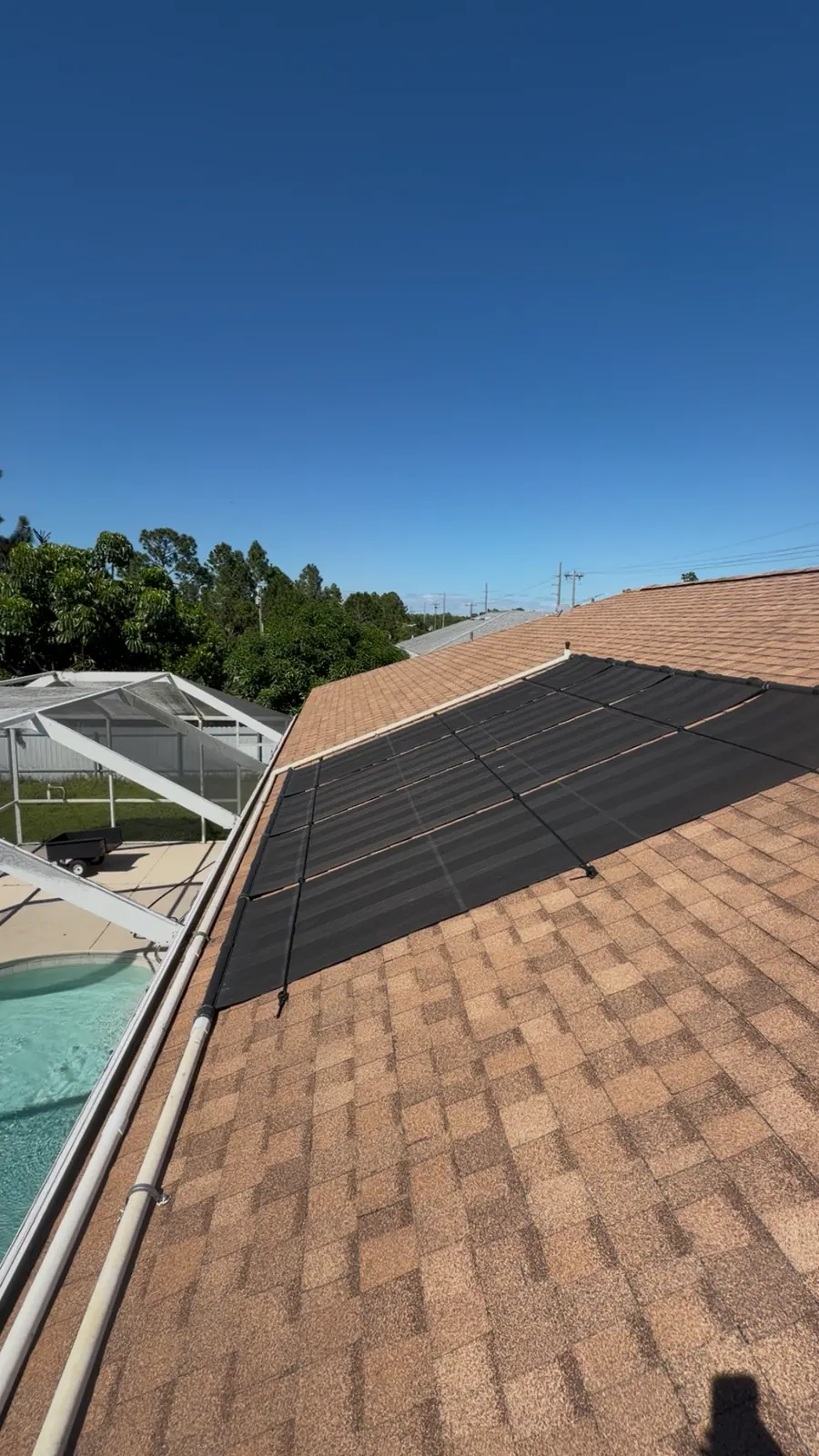
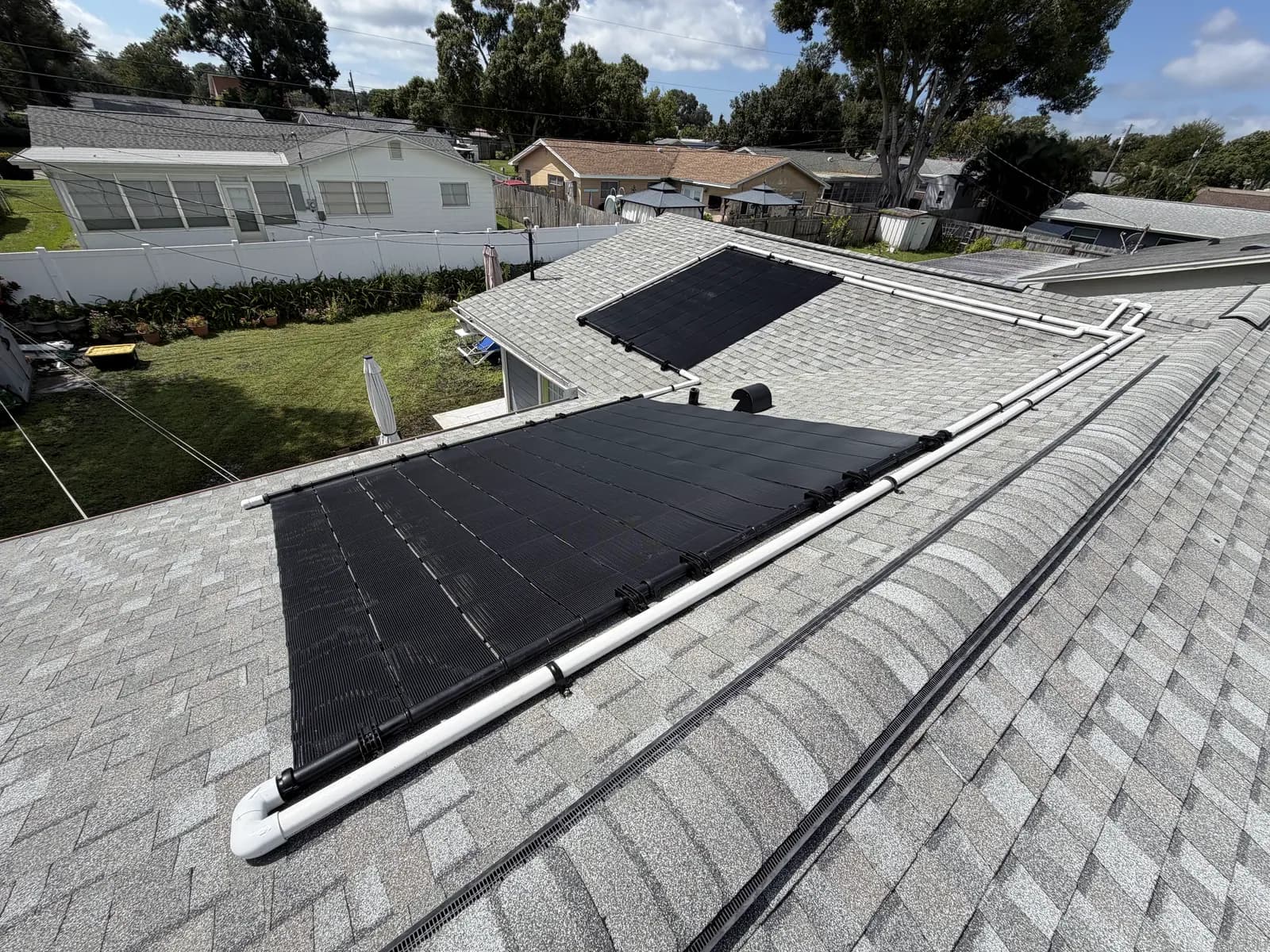
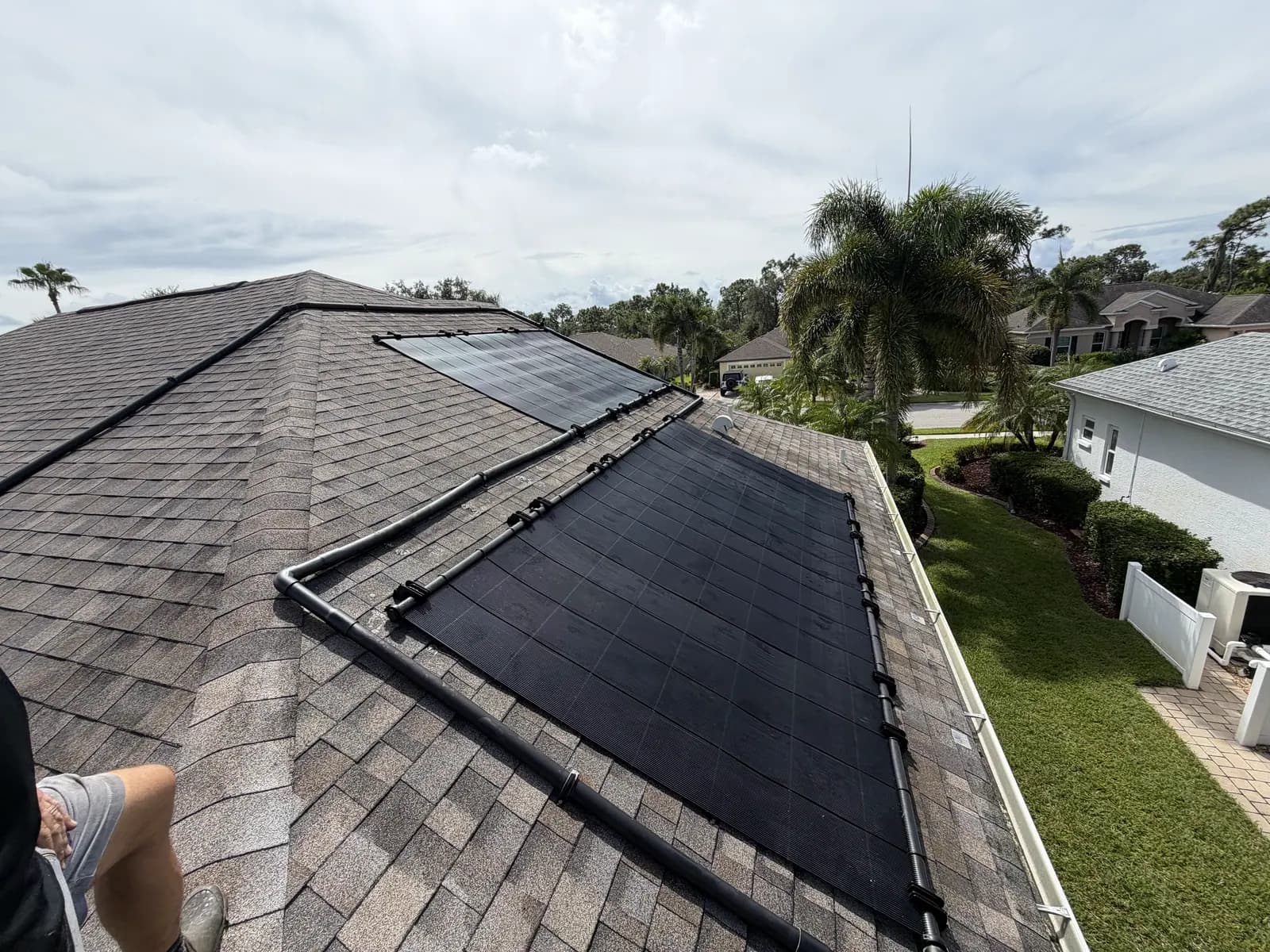
Recent jobs from our installation library that relate to this topic.