Modern Pool Heating · Owner/operator Henry Manna, Florida Certified Pool/Spa Contractor CPC1460367
Updated October 16, 2026
Short answer
Most pool heaters that stop heating are not broken; they are protecting themselves because water flow is low, the setpoint or controls are wrong, or conditions are outside what the heater can do. Start with the pump, the filter, the valves and the setpoint, then read the heater's display code. Water dripping under a running heat pump is usually condensation, which contains no chlorine, while anything involving refrigerant, gas, flame or the electrical box needs a licensed technician, and a gas smell means leave the area and call 911 and your gas utility.
What we usually recommend
If your heater shows a flow code or won't fire, we'd check the filter, baskets, valves and the pump's heating speed before anything else, because low flow is the most common reason heaters shut themselves down. If it is a heat pump on a cold morning, give it until the afternoon before deciding it has failed. If you smell gas, see a code that keeps coming back after the basics, or the unit has sat in floodwater, call us rather than resetting it over and over.
- Check first: pump running, filter clean, baskets empty, valves in position, heating speed high enough, setpoint above the water temperature.
- A working heat pump blows cool air out the top, returns water a few degrees warmer, and drains condensation within about 15 minutes (GulfStream).
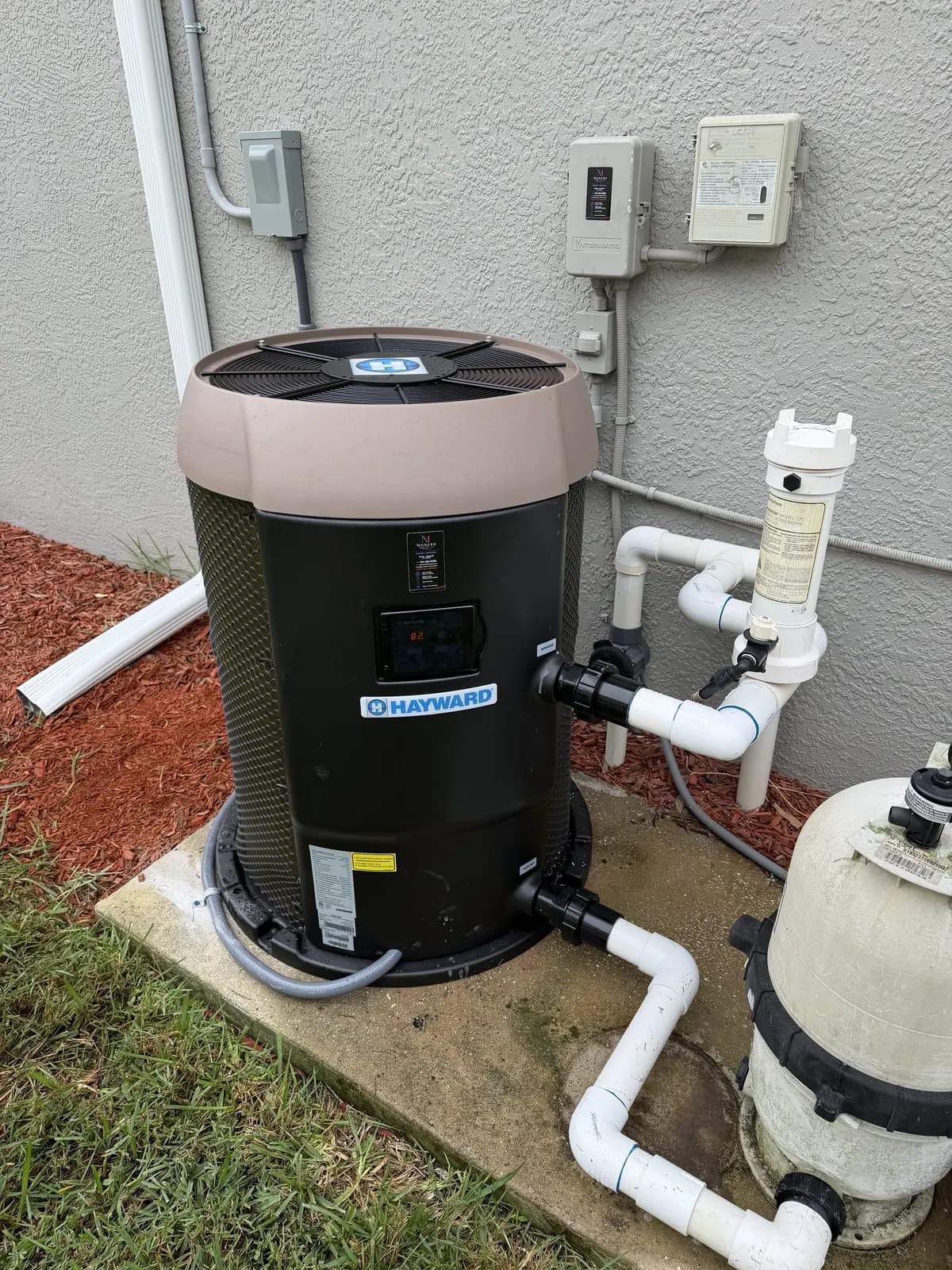
- Water under a running heat pump is normally condensation, up to 3 gallons an hour on a GulfStream. Condensation has no chlorine; pool water does.
- A gas heater that lights then shuts off usually has a flow, gas-pressure, flame-sensing or venting problem.
- Smell gas? Leave the area, then call 911 and your gas utility or propane supplier from somewhere safe.
Start with the five-minute checks
Every heater, whatever the type, needs water moving through it at a minimum rate and a call for heat from its thermostat or controller. As our Hayward error-code guide explains, most of what a heater displays is a protective shutdown rather than a broken part, and the most common codes on both gas heaters and heat pumps are about water flow. These checks take a few minutes and need no tools.
After working through the checks below, read the display. Most heaters name the safety that stopped them, and our guides to Hayward error codes and Pentair MasterTemp problems list what each code means and which ones are safe to deal with yourself. Write the code down before you reset anything; it is the most useful thing you can tell a technician.
- Is the pump running, and on a speed high enough for the heater? A variable-speed pump on a quiet filtration speed often won't satisfy a heater's flow switch. GulfStream's troubleshooting section says to expect about 40-50 GPM through its heat pumps.
- Is the filter clean and are the skimmer and pump baskets empty? GulfStream lists a very dirty filter among the three common causes of its No Flow message.
- Are the valves where they should be? A valve turned the wrong way, an open bypass, or a fountain or cleaner stealing flow can all look like a heater fault.
- Is the water level above the skimmer opening, so the pump is not drawing air?
- Is the setpoint above the current water temperature, and is the heater in the right mode (pool or spa, heat rather than cool)?
- If automation runs the heater, is the remote enabled and actually calling for heat? GulfStream's manual walks through checking the Remote T/Stat setting.
- Is there a countdown on the display? Heat pumps wait after a call for heat before the compressor starts: GulfStream shows a 2-minute delay and Hayward lists a 5-minute delay.
Heat pump running but not heating
First confirm it really isn't heating. GulfStream's manual gives a simple test: after the start delay, hold your hand above the unit and you should feel cool air coming out of the top; the water returning to the pool should be a few degrees warmer than the water going in; and after about 15 minutes of running, condensation should be draining from the base. If all three are happening, the heat pump is working, and the pool is simply losing heat as fast as the unit adds it.
That is common in winter. Heat pumps warm a swimming pool gradually over many hours. Actual heating speed depends on pool volume, heater output, starting water temperature, outdoor air temperature, humidity, wind conditions and whether the pool is covered. GulfStream's own list for a unit that is heating slowly or not reaching its set temperature is short and practical: low or restricted water flow (clean the filter and aim for about 40-50 GPM), air leaks in the plumbing, a pump run time too short for the heater to catch up, and strong wind across the pool, for which it suggests a windbreak and a pool blanket.
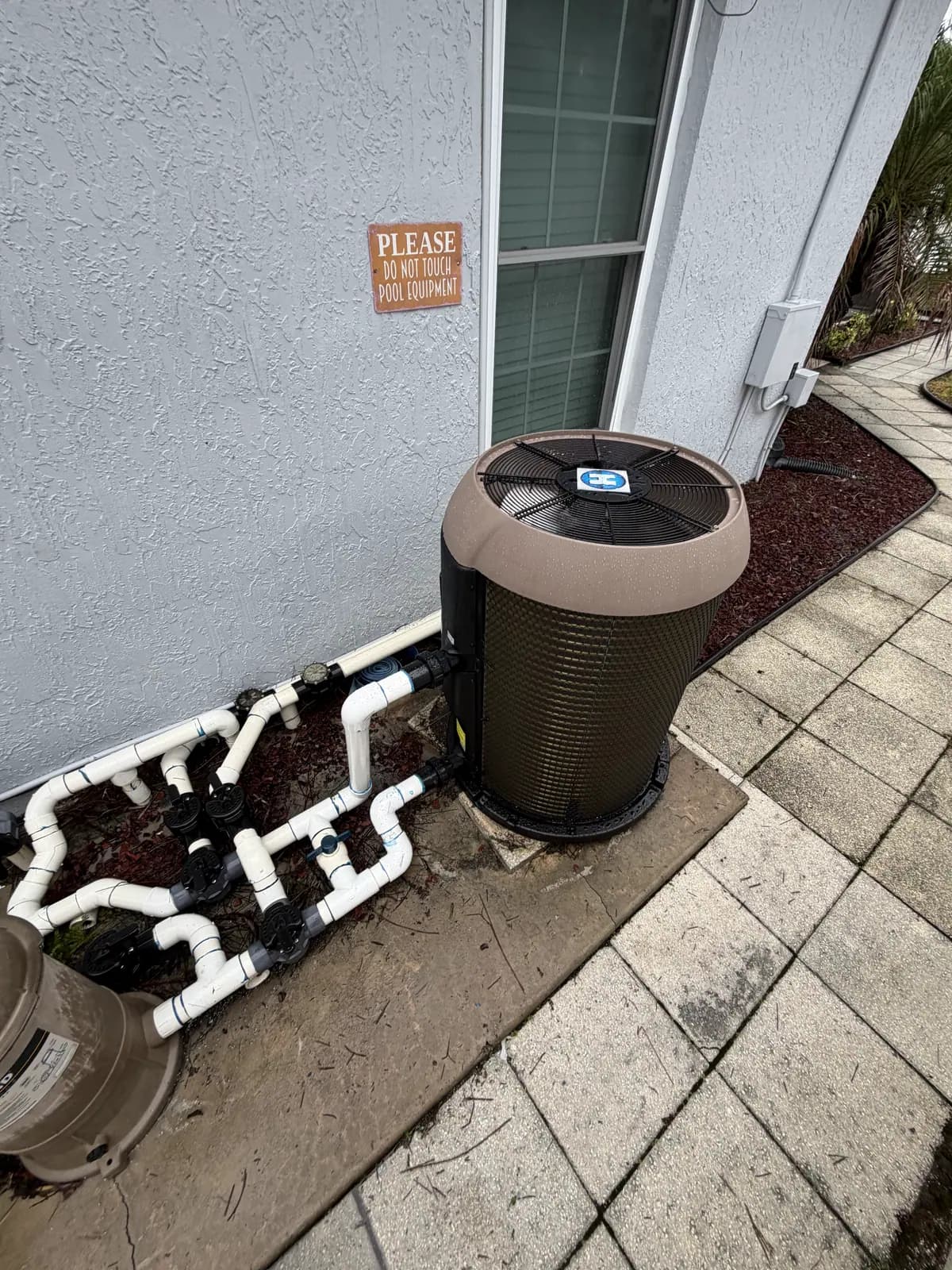
Cold air is the other usual suspect. Output falls as the air cools (Hayward's HP21405T delivers 82,000 BTU/hr at 50°F air against 138,000 BTU/hr at its 80°F rating), and at lower temperatures units defrost or pause. GulfStream's HE models defrost below 48°F and stop below 35°F; Hayward displays FS during defrost, which it says needs no action, and LP for a low-ambient cutoff that clears when the air reaches 60°F. Airflow matters as much as air temperature: a coil blocked by leaves or overgrown shrubs, or a unit boxed in by walls, breathes its own cold air. GulfStream asks for 12 inches on each side and 4 feet clear above, and says to keep shrubs and trees trimmed back.
Some causes are not homeowner work. Hayward lists low refrigerant as one cause of an LP code, and GulfStream's Low Refrigerant Pressure message points to refrigerant loss, a faulty low-pressure switch or a fan that is not running; both say to call for service. So do sensor faults (Hayward's SO, SS, dSO and dSS; GulfStream's water and evaporator sensor messages), and GulfStream says a Max Water Temp message with no other heat source on the line indicates a water temperature sensor out of calibration. A countdown that reaches zero without the unit starting may mean a failed contactor, according to GulfStream.
Water coming from underneath a heat pump
Usually this is normal. A heat pump cools the outdoor air as it pulls heat from it, and moisture in that air condenses on the coil and drains out of the base, the same way an air conditioner drips. GulfStream says its heat pumps can produce up to 3 gallons of condensation an hour, and Hayward's HeatPro manual and Jandy's VersaTemp manual both put it at 3 to 5 gallons an hour in humid conditions. On a humid Florida day that can look like a serious leak.
Two quick tests tell you which it is. GulfStream's suggestion is to turn the heat pump off but leave the circulation pump running, and come back after an hour: if the water has stopped, it was condensation. Its manual also points out that pool water contains chlorine and condensation does not, so a chlorine test strip dipped in the puddle settles it. Water that keeps coming with the heat pump off, or that tests positive for chlorine, points to a leak inside the unit and a service call. While you are there, check that the drain holes in the base are clear; GulfStream lists that as routine maintenance.
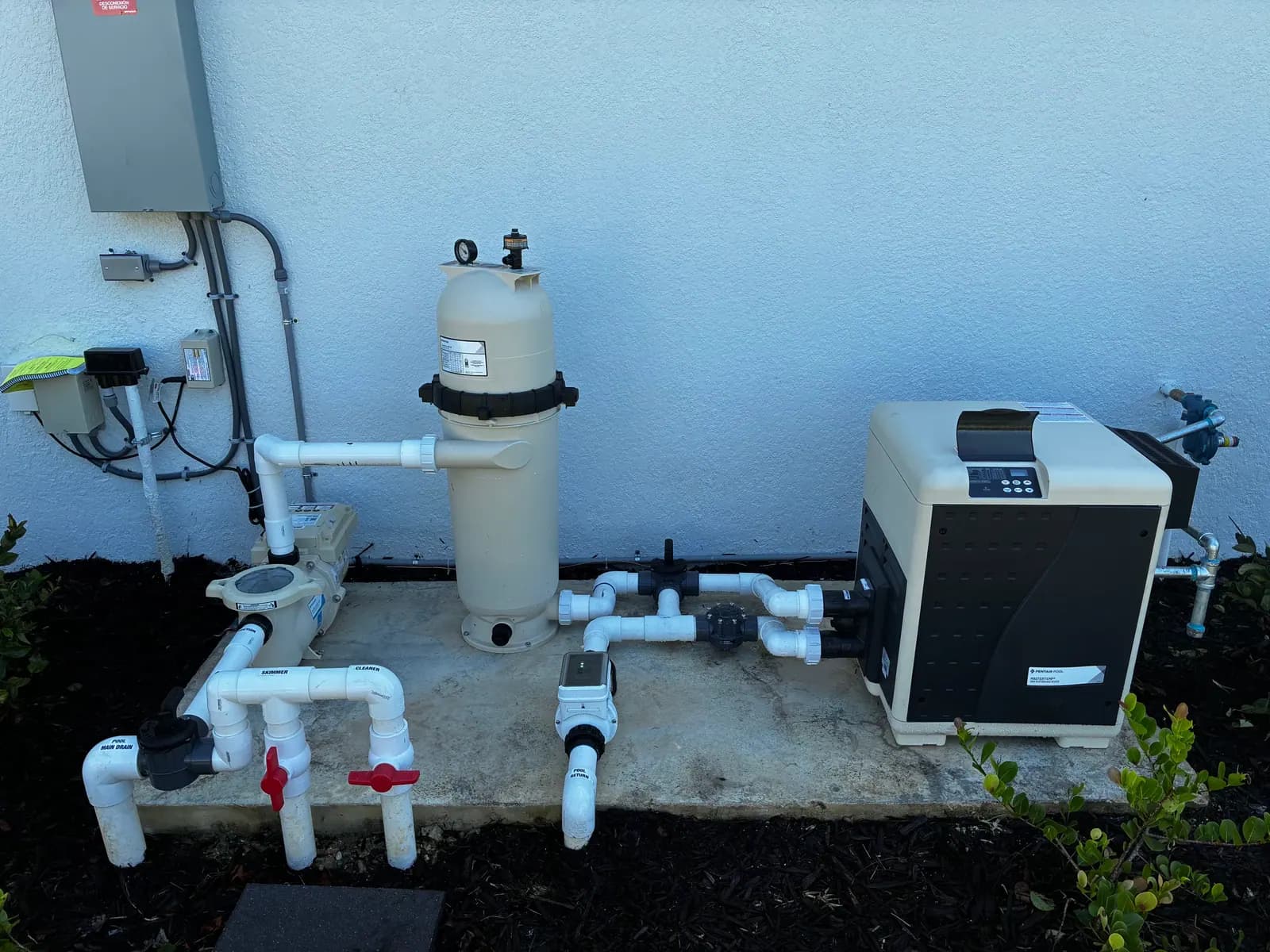
Gas heaters can drip too. Pentair's MasterTemp troubleshooting table lists sweating as a symptom of a stuck thermal regulator, and a condensing heater such as Pentair's ETi 400 makes 2 to 4 gallons of acidic condensate an hour by design, which is why Pentair strongly recommends a neutralizer. Water dripping onto the burners or into the combustion area of any gas heater is a different matter: turn it off and have it inspected.
Gas heater lights, then shuts off
This is a common gas heater complaint, and our full article on it walks through each cause. In short, a gas heater shuts down after lighting when one of its safeties opens. Low flow is the usual culprit: the water pressure switch or a high-limit switch opens because water is not moving through the heat exchanger fast enough. Pentair's MasterTemp codes ERR PS, ERR HLS and ERR AGS are all flow-related, and Hayward's LO code covers the water pressure switch, the vent pressure switch and the temperature limit switches.
Gas supply is the next suspect. A line sized for a smaller heater can hold pressure at rest and sag once the burner fires; Hayward specifies 4.5 to 10.5 inches of water column at the inlet on natural gas and 10.0 to 13.0 on propane, and repeated ignition failures (IF on a Hayward, ERR IGN on a MasterTemp) often trace back to pressure under load. Flame sensing, airflow through the blower (Hayward's AC and AO codes, Pentair's ERR AFS), venting, and plumbing with the inlet and outlet reversed round out the list; Hayward notes reversed plumbing often causes frequent HS codes, and Pentair says a heater plumbed backwards will cycle continuously.
What you can safely check is the water side: the pump, filter, valves, heating speed and setpoint, plus whether the gas supply valve is open. What you should not do is reset a gas heater over and over, adjust the gas valve, or bypass a safety switch. Pentair warns against jumpering a safety switch, and states that improper installation or operation can create carbon monoxide.
Solar not heating
Solar fails in different ways because there is no burner or compressor, only water, collectors and a way of getting water to the roof. DOE describes how controlled systems work: sensors and an automatic or manual valve divert water through the collectors when they are sufficiently warmer than the pool, and send it straight back to the pool when they are not. So a solar system that has stopped heating usually has a controller, sensor or valve that is not sending water up, or a pump that cannot push it there; DOE notes solar systems may need a larger pump, or a separate one, to move water through the collectors.
Check the obvious first: is the pump running during the sunny part of the day, is the controller on and set above the pool temperature, and does the valve actuator move when the controller calls for solar? Then consider the season. Collectors warm the pool when the sun is strong and contribute little on short, cloudy winter days, and DOE says a Florida pool needs collector area equal to its full surface area for year-round use. A system sized well below that can seem to stop working every January when it is doing exactly what its size allows.
Leaks are the other common solar problem: a wet spot on a ceiling, water running off the roof, or a pool losing water faster than evaporation explains. Many leaks can be repaired without replacing the system. Our solar repair article covers leaks, controllers and sensors in detail.
Safety first: gas smells, electrical faults and flooded equipment
If you smell gas, stop troubleshooting. Peoples Gas, a Florida natural gas utility, says to move to safety and call 911, then call the utility; if your gas comes from another company, follow its emergency instructions. For propane, the Propane Education & Research Council's advice is to put out any flames, avoid operating lights, appliances or phones near the leak, leave the area, shut the tank valve only if it is safe to do so, and call your propane retailer or 911 from a neighbor's home or somewhere away from the leak. Don't go back until a professional says it is safe.
Heat pumps run on dedicated 208-230 volt circuits; the 110,000 to 140,000 BTU/hr models in our heater comparison call for 40 to 70 amp breakers. If a heat pump's display is blank, GulfStream's manual suggests flipping the breaker off and back on once; if the display still doesn't come back, or the breaker trips again, leave it off and call. Don't open the control box or wash the unit with the power on; GulfStream says to disconnect all power before washing.
Any heater that has sat in floodwater needs an inspection before it runs. Peoples Gas advises having potentially flooded gas appliances inspected and serviced by a qualified plumber or appliance-service contractor before use. Soot, scorch marks, melted wiring or a burning smell are also reasons to shut a heater down and call, and our repair-or-replace guide explains why those findings usually end the repair conversation.
What we check on a service call
When we come out for a heater that is not heating, we work from the water side to the heater, in roughly the order below. It is the same order whatever the brand, and it means we fix the cause rather than just clearing the code.
Then we tell you what failed, what it will cost to fix, and whether the heater is worth fixing at its age; our repair-or-replace guide explains how we think about that. We repair and maintain most makes and models of solar, heat pump and gas pool heaters across Sarasota, Manatee, Charlotte & Pinellas County, including units someone else installed.
- Water chemistry and the filter: a quick water test, filter pressure, basket condition, and where the salt cell or chlorinator sits relative to the heater.
- Flow: pump speed and schedule, valve positions, bypass settings, and whether flow at the heater meets the manufacturer's minimum.
- Controls: setpoint, mode, remote and automation settings, and the heater's fault history (MasterTemp heaters, for example, store their last five errors).
- Heat pumps: airflow and coil condition, fan operation, defrost behavior, the temperature difference across the unit, and refrigerant pressures where the symptoms point that way.
- Gas heaters: gas pressure at rest and with the burner firing, ignition and flame sensing, blower and venting, and the condition of the heat exchanger.
- Electrical: supply voltage, breaker and disconnect, contactors and sensors.
Real installations
Recent jobs from our installation library that relate to this topic.