Modern Pool Heating · Owner/operator Henry Manna, Florida Certified Pool/Spa Contractor CPC1460367
Updated October 16, 2026
Short answer
Most pool heat pumps keep heating into the 40s°F, but they lose capacity and efficiency as the air cools and start defrost cycles at around 45 to 50°F. The limits vary by model: GulfStream's HE Series enters defrost below 48°F and will not operate below 35°F; Hayward's HeatPro lists an air operating range down to 40°F; Raypak's Crosswind V locks out its compressor below 45°F as shipped. On the Gulf Coast those conditions arrive with cold fronts and clear winter nights, so the practical answer is a unit sized for 50°F air, a cover, and letting the heat pump do its work in the warmest part of the day.
What we usually recommend
If your pool is unscreened or on the water and you want to swim through January, size the heat pump on its 50°F capacity, cover the pool every night, and schedule the heat pump for late morning through afternoon. If you need heat you can count on during the coldest snaps, or a spa on demand, pair the heat pump with a gas heater. If your roof suits it, solar can carry much of the load on sunny days and let the heat pump fill in.
- DOE: heat pump pool heaters work efficiently as long as the outside air stays above the 45-50°F range.
- At the 50°F-air test point, published capacity runs roughly 60-66% of the 80°F headline, and COP is about 4.0.
- GulfStream HE: defrost below 48°F, no operation below 35°F; reverse-cycle defrost on the heat-and-cool TA models allows operation into the mid-30s when enabled.
- A cover and daytime run hours do more in a cold snap than any setting on the heat pump.
Why a heat pump slows down in the cold
A pool heat pump does not burn anything. It pulls heat out of the outdoor air and moves it into the water, and GulfStream's manual puts the principle plainly: the warmer and more humid the air, the more heat is available to the pool. As the air cools there is less heat to collect, so the unit delivers less heat per hour and less heat per kilowatt-hour. The Department of Energy says heat pump pool heaters work efficiently as long as the outside temperature remains above the 45°F to 50°F range, and that the cooler the air, the less efficient they are.
The manufacturers that publish a 50°F-air rating show how big the drop is. Hayward's HP21405T goes from 138,000 BTU/hr at 80°F air to 82,000 at 50°F; AquaCal's SQ200R from 138,000 to 88,000; Jandy's JRT4001R from 160,000 to 101,000. Across the units in our heater comparison with both figures, the cold rating is roughly 60 to 66 percent of the headline, and the COP falls to about 4.0, against 5.5 to 6.1 at 80°F.
Heat pumps warm a swimming pool gradually over many hours. Actual heating speed depends on pool volume, heater output, starting water temperature, outdoor air temperature, humidity, wind conditions and whether the pool is covered. Proper heater sizing and the use of a pool cover can significantly affect recovery time. In a cold snap, all of those variables move against you at once.
Published cold-weather limits, model by model
Manufacturers describe their low-temperature behavior in different ways: some give a defrost point, some a shut-off temperature, some an operating range and some nothing at all. The table collects what each one publishes. Where a manufacturer does not state a figure, we have not supplied one.
Two patterns stand out. Defrost begins in the high 40s to around 50°F on most units, which on the Gulf Coast means cold mornings rather than whole days. And the heat-and-cool models with reverse-cycle or hot gas defrost recover from a defrost faster than heat-only units that wait for the air to clear the coil.
| Model | Defrost | Low-temperature limit | Rating at 50°F air |
|---|---|---|---|
| GulfStream HE RA (heat only) | Defrost cycle below 48°F ambient; may shut down and show DEFROSTING until the air rises above 48°F | Will not operate below 35°F | COP 4.0 or better stated; capacity n/p |
| GulfStream HE TA (heat and cool) | As above, plus reverse-cycle (hot gas) defrost when enabled, allowing operation in the mid-30s°F | Will not operate below 35°F | COP 4.0 or better stated; capacity n/p |
| Hayward HeatPro HP21405T / HP31405T | Defrost function near 50°F air; can run from 15 minutes to several hours | Air operating range 40-115°F; display code index notes a low-ambient cutoff that clears when the air reaches 60°F | 82,000 BTU/hr at COP 4.0 |
| Pentair UltraTemp 140 H/C | May enter defrost around 50°F air | Shuts down with a Low Ambient Temp alarm if defrost does not finish within 15 minutes | COP 4.0; capacity n/p |
| Raypak Crosswind V 8550EHC | n/p in our record | Compressor locked out below an outside lockout temperature, factory set at 45°F and adjustable | 85,000 BTU/hr at COP 4.1 |
| Built Right XW | Defrost below 48°F ambient, displays FS | Manual advises against operating below 45°F | BR135XW 82,000 BTU/hr at COP 4.0 |
| Jandy VersaTemp JRT | Hot gas defrost standard (JRT4001R ships on hot gas, air defrost selectable) | No minimum ambient published | JRT3000R 82,000 BTU/hr at COP 4.0; JRT4001R 101,000 at COP 4.4 |
| AquaCal HeatWave SuperQuiet | ICEBREAKER; AquaCal states it continues heating at freezing temperatures | n/p in our record | SQ140R 72,000 BTU/hr at COP 4.0; SQ200R 88,000 BTU/hr |
| Thermeau Prestige / Signature | Hot gas reversible defrost on Prestige (heating resumes in about two minutes); air defrost on Signature | n/p in our record | TH125 80,000 BTU/hr at COP 4.0 |
| Moov Inverter | n/p in our record | Manual: works well with air at 32-109°F; below 3°C (about 37°F) switch off and drain the exchanger | n/p |
Defrost: what the unit is doing when it stops heating
When the coil gets cold enough, moisture from the air freezes on it, and a frosted coil cannot pull heat from the air. Every heat pump in the table has a way of clearing it. On a standard defrost the unit stops heating and lets the coil clear; GulfStream says its heat-only units may shut down and display DEFROSTING until the air rises above 48°F, and Hayward says its defrost can last anywhere from 15 minutes to several hours depending on conditions. Built Right's control displays FS while it defrosts.
Hot gas or reverse-cycle defrost is quicker. The unit briefly runs its refrigerant backwards to warm the coil from the inside, then goes back to heating. Thermeau says its Prestige models resume heating in about two minutes this way, Jandy ships its VersaTemp on hot gas defrost, and GulfStream offers it on its heat-and-cool TA models only, where it must be enabled in the service menu and allows operation into the mid-30s°F. If cold-morning performance matters to you, that is a genuine reason to consider a heat-and-cool unit even if you never use the cooling.
A defrost message is not a fault. What is worth fixing is unnecessary defrosting: GulfStream's installation manual warns that overhangs and tight spaces that recirculate the unit's cold discharge air will push it into defrost. Pentair's UltraTemp shows a Low Ambient Temp alarm when a defrost does not finish within 15 minutes, which is the unit telling you the air is too cold to work in, not that it is broken.
What a Florida cold front does to a heated pool
Gulf Coast winters are mostly mild, which is why heat pumps work well here, but a cold front stacks every heat loss against you for a day or two: colder air, drier air, more wind across the water and clear nights. The pool loses heat fastest exactly when the heat pump is making the least of it and spending part of the night in defrost.
The heat pump does most of its catching up once the air warms again, usually in the afternoons after the front passes. GulfStream's manual recommends running the heat pump during the warmer daylight hours for this reason: it keeps working as the temperature drops at night, but its efficiency decreases. A heat pump scheduled to run only overnight is choosing the worst hours of the day to work.
Size is the other half of it. A unit chosen to satisfy the sizing formula at its 80°F rating will be roughly a third short on a 50°F morning. Our sizing guide and the 100K versus 140K article explain how to size against the cold-air figure instead, which is the difference between a pool that dips and recovers and one that dips and stays down for the week.
What owners can do during a cold snap
Most of what helps costs little or nothing. The order below is roughly the order of impact.
None of these will make a heat pump heat below its published limit. What they do is keep the pool from losing the heat it already has, so the unit has less to make back when the air warms up.
- Cover the pool, every night of the cold spell. The Department of Energy calls covering a pool when it is not in use the single most effective way to reduce heating costs, with savings of 50-70% possible, because evaporation is the largest heat loss.
- Run the heat pump through the warmest hours of the day rather than overnight.
- Cut the wind. GulfStream's troubleshooting guide suggests a windbreak around the pool when strong winds are stripping heat from the water.
- Keep the unit's clearances open so it is not breathing its own cold air and defrosting more than it needs to.
- Keep water moving. GulfStream's manual says that where freezing is not common, water should be allowed to flow through the heat pump even when it is not heating. Freeze damage is excluded by the warranties we have read, including AquaCal's and Built Right's.
- Let the pool drift a little. The Department of Energy calls it a myth that reheating a pool takes more energy than you save by lowering the temperature, so holding the setpoint through a two-day front costs more than letting the water cool slightly and recover once the weather turns.
Backup heat: gas or solar alongside a heat pump
If you need the pool or spa at temperature regardless of the weather, a heat pump on its own is the wrong tool for the coldest days. The Department of Energy describes gas heaters as ideal for heating pools quickly and notes that, unlike heat pumps and solar, they can maintain any desired temperature regardless of the weather. Gas heaters have their own published limits too; Hayward specifies a 40°F minimum operating temperature for its Universal H-Series gas heaters, but they do not lose output as the air cools the way a heat pump does.
The common Gulf Coast arrangement is a heat pump for the pool day to day and a gas heater for the spa and the occasional cold snap, so the expensive fuel only burns when it is earning its keep. Solar pairs well with a heat pump the other way round: on a home with suitable roof orientation and sun exposure, solar can carry much of the load on sunny days and leave the heat pump to fill in on cold mornings and cloudy weeks.
If you are deciding between those combinations, our heat pump versus gas and solar versus heat pump articles go through the trade-offs, and the buyer's guide compares all three methods side by side.
Real installations
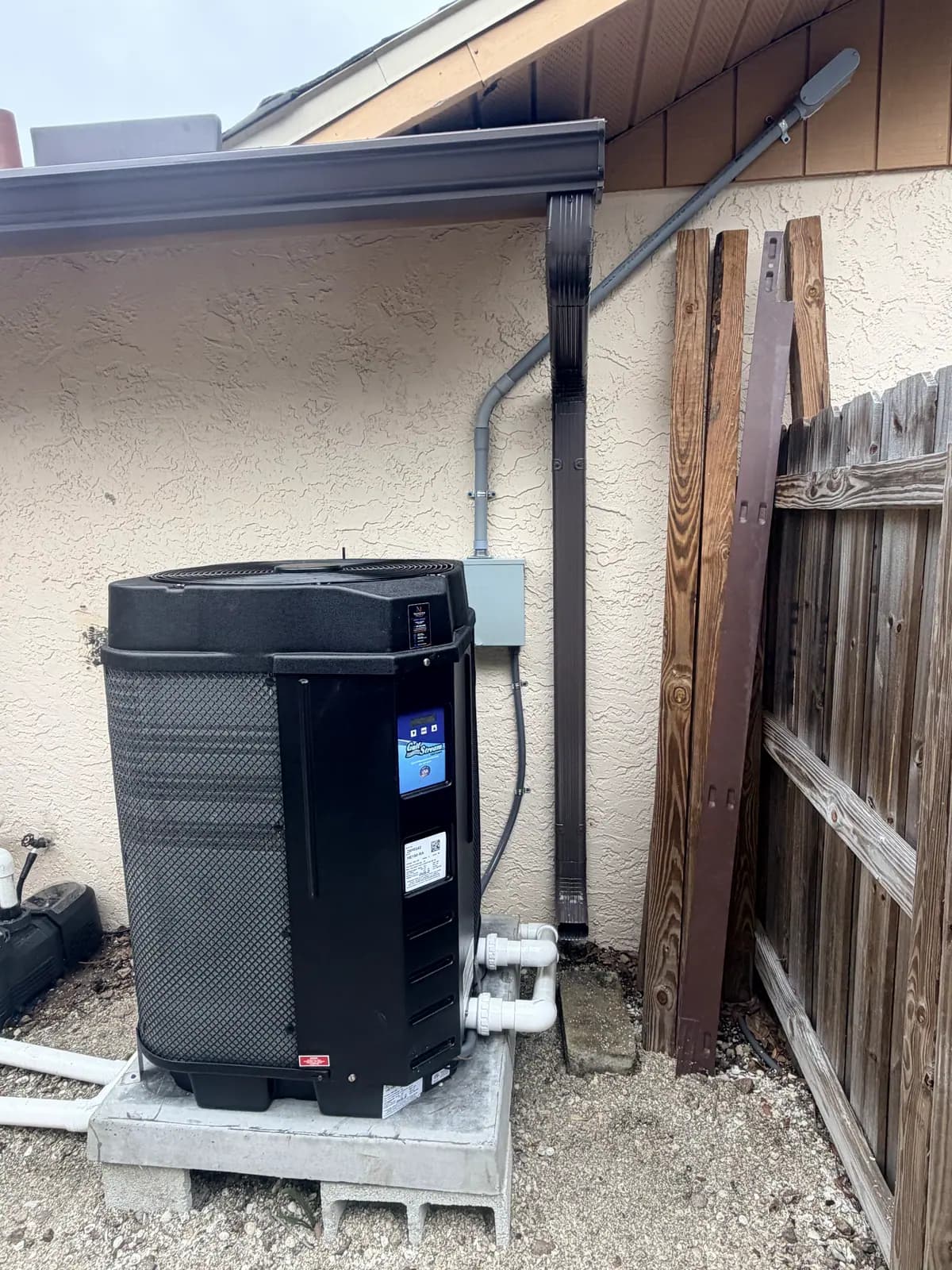
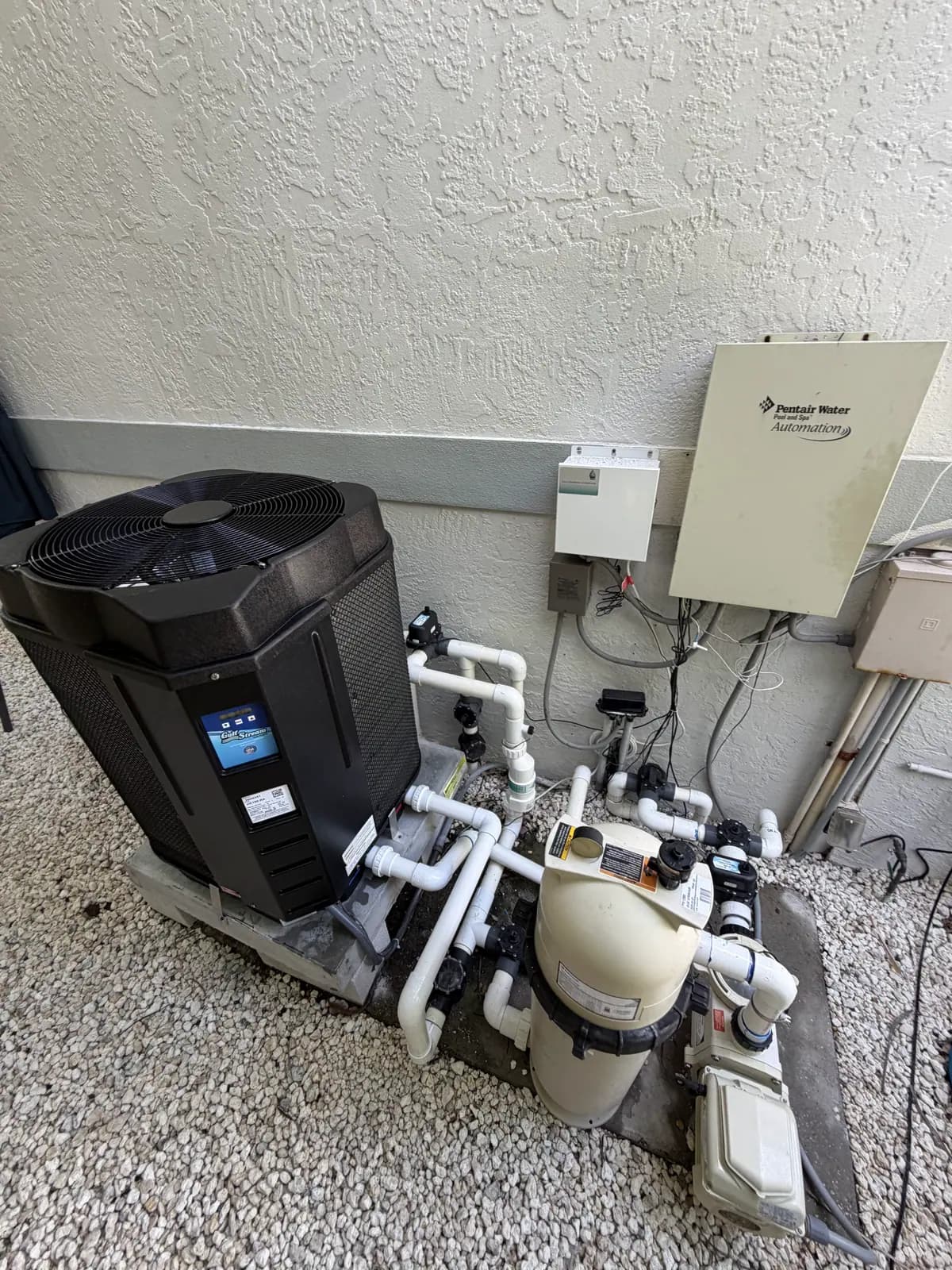
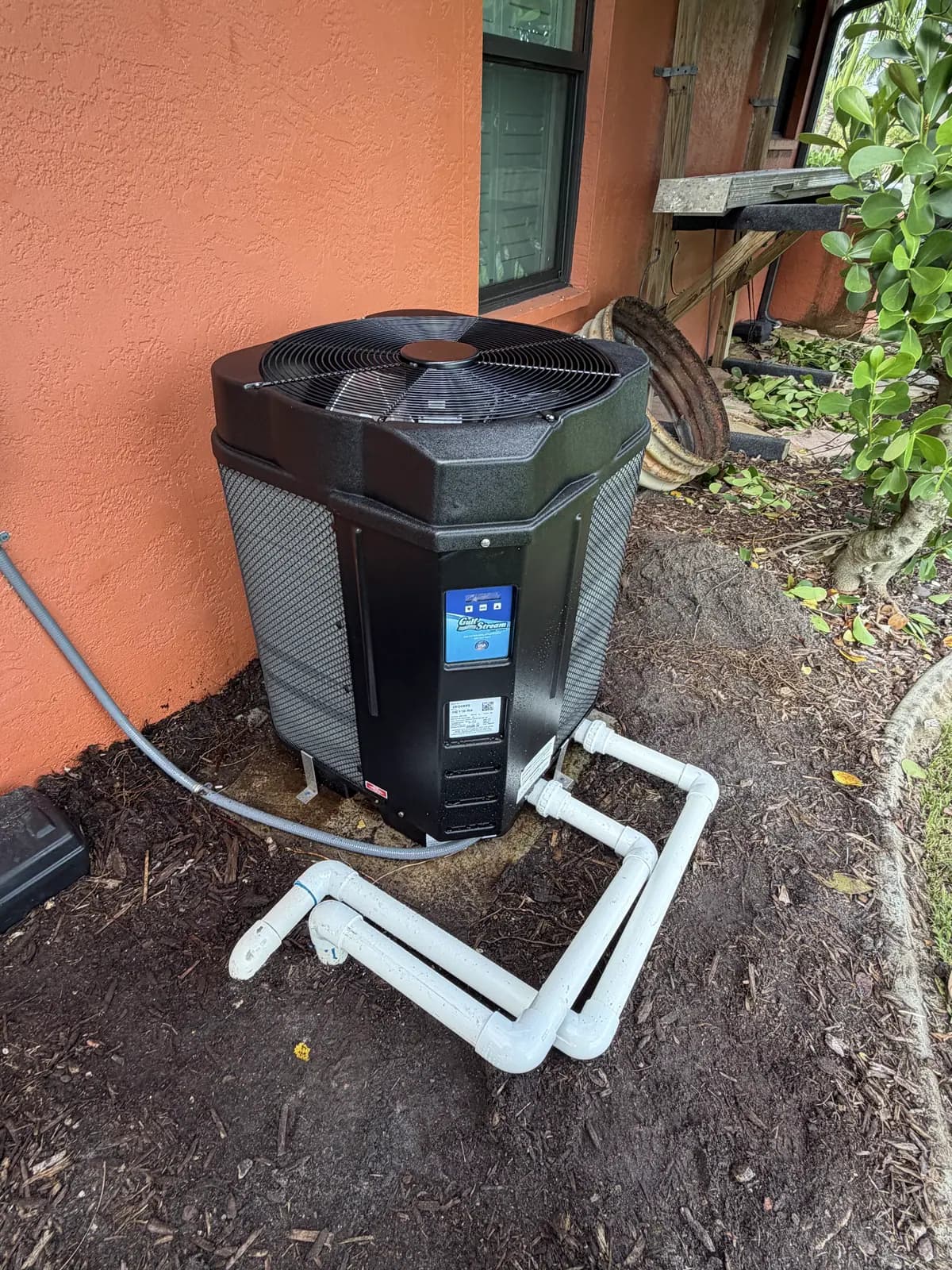
Recent jobs from our installation library that relate to this topic.