

Updated September 18, 2026 · Affordable Solar & Pool Heating, LLC · Owner/operator Henry Manna
What a heat/cool heat pump actually does
A pool heat pump does not make heat, it moves it. A fan pulls warm, humid outdoor air across an evaporator coil, a refrigerant circuit concentrates that low-grade heat, and a titanium heat exchanger hands it to the pool water. A heat/cool model adds one part — a reversing valve — that lets the refrigerant run the other way. Now the exchanger pulls heat out of the water and the coil dumps it into the air. It is the same trick your home air conditioner uses, aimed at the pool instead of the living room.
Manufacturers give the capability different names. GulfStream marks it with a TA suffix; Hayward calls it Heat+Chill; Jandy calls the VersaTemp a Heat/Chill pump; Raypak uses an EHC part number for its heat/cool Crosswind V models; Pentair marks UltraTemp models H/C; Built Right appends H/C. They are all describing the same reversing-valve arrangement.
How the control behaves is worth knowing before you buy. A GulfStream TA offers two modes: heat/cool, which holds one setpoint and swaps between heating and chilling when the water drifts outside a deadband (two degrees by default), and cool-only, which simply chills to a setpoint. One is a thermostat for the pool; the other is an air conditioner with an on switch.
One limitation is nearly universal: cooling is for the pool, not the spa. GulfStream's installation manual states it plainly — the cooling feature is only for the pool. If your complaint is a spa that sits at 100°F in July because it shares water with the pool, a chiller on the pool circuit is not going to fix the spa.
Why a Florida pool gets too warm in the first place
Everywhere else in the country, a pool loses heat faster than an owner would like. Here, in July and August, the same physics works against you. A residential pool is a wide, shallow, dark-bottomed solar collector pointed at the sky for fourteen hours a day, and the ground around it has been warm for months.
The main way a pool cools itself is evaporation, and Florida humidity suppresses exactly that: muggy air already holds most of the water vapor it can carry, so less evaporates off the surface and less heat leaves with it. The same humidity that makes our heat pumps efficient in February — they extract heat from moisture as well as temperature, which is why the industry rates them at 80% relative humidity — is what keeps the pool warm in August. In our own work along the Gulf Coast the pools that generate this complaint are consistent: unscreened, unshaded, shallow, often dark-finished, frequently on a west-facing lot. Screened, shaded, deeper pools rarely need chilling at all, so it is worth knowing which of those two pools you own before spending money.
Which lines offer heat and cool
Most major manufacturers now publish at least one reverse-cycle model. These are the ones a Florida homeowner is most likely to be quoted, with the figures the manufacturers themselves publish:
- GulfStream TA models (a Pentair brand, built in North Fort Myers, Florida): HE125-TA at 115,000 BTU/hr and HE150-TA at 135,000 BTU/hr at the 80/80/80 test point, COP 6.0, titanium exchanger, 7 years parts and 2 years labor published. The chiller components have to be ordered with the unit and the modes enabled in the service menu — a heat-only RA cannot be converted later.
- Hayward HeatPro MCHX Heat+Chill: the HP31405T is nominally 140,000 BTU, rated 135,000 BTU/hr at 80/80/80 in the HeatPro manual, and Hayward states it "chills down to 40°F" for cold-plunge use, on 230V with a 50 A recommended breaker (70 A maximum overcurrent protection), with 5 years parts and 2 years field labor published (longer labor terms run through a Hayward Rewards dealer) and app control through the Omni automation system.
- Jandy VersaTemp Heat/Chill: the single-phase JRT range is published at 103,000, 116,000, 130,000 and 160,000 BTU/hr (80/80/80), plus a three-phase 130,000 BTU/hr model, with a titanium heat exchanger, an LCD controller compatible with AquaLink automation, and an Auto-Heat function that maintains temperature automatically when used with AquaLink. The 160,000 BTU/hr JRT4001R is the 2026 addition; it needs a 50 A minimum circuit at 230 VAC (55 A at 208 VAC) with 70 A maximum over-current protection.
- Raypak Crosswind V: the heat/cool variants carry EHC part numbers — TWPH-6550EHC08 at 115,000 BTU/hr and TWPH-8550EHC08 at 137,000 BTU/hr — on 208-230VAC with a 60 GPM maximum water flow, controlled through Raypak's Raymote app.
- Pentair UltraTemp H/C: Pentair lists UltraTemp 120 H/C, 140 H/C and a 140 H/C Active Defrost alongside the heat-only models, all built around what Pentair describes as a "100% titanium heat exchanger", with transfer of control to an IntelliTouch or EasyTouch system.
- Built Right XW H/C (built in Florida): the BR135XW H/C is published at 130,000 BTU/hr and COP 5.8 at 80/80/80 with a titanium heat exchanger and a 5-year parts and labor warranty.
What the reversing valve costs you
Two things, and both are worth knowing before you sign. The first is heating capacity. Within one manufacturer's line, the heat/cool model is usually rated slightly lower than the heat-only version of the same size, because the reversing valve and the extra refrigerant plumbing are in the way. GulfStream's own spec sheet is the cleanest illustration: HE125-RA 118,000 BTU/hr against HE125-TA 115,000, and HE150-RA 138,000 against HE150-TA 135,000, all at the same test point. It is a small difference, roughly 2%, but it runs the wrong way for anyone buying the heat/cool model mainly for winter heating.
The second is money. A heat/cool model carries a real premium over the heat-only unit of the same size. We publish relative price tiers rather than prices, because installed cost moves with electrical work, pad work, plumbing and permits — but the ranking inside a line is always the same: heat-only is cheaper.
What it does not cost you is efficiency in heating mode. The TA and RA versions of a GulfStream carry the same published COP of 6.0, and the reversing valve sits idle whenever the unit is heating.
Sizing and what to expect when it runs
Heat pumps hold a temperature rather than chase one, and that is as true in cooling mode as in heating. GulfStream's manual gives the benchmark for heating: under ideal conditions — 80°F air, 80°F water, 80% humidity — a properly sized unit raises water temperature an average of about 1°F per hour. Cooling a pool works on the same order of magnitude, which means chilling is an overnight job, not an afternoon one.
That also tells you when a chiller works best: at night, when the air the fan dumps heat into is coolest. A unit fighting 95°F afternoon air has far less temperature difference to work with than the same unit at 3 a.m. And if the pump runs on a schedule, the cooling hours and the pump hours have to overlap — no heat pump moves heat through water that is not flowing.
The other number worth internalizing is how much capacity a heat pump loses as air temperature falls, which matters for the heating half of the year. Jandy publishes its VersaTemp at three test points, and the fall-off is instructive: the JRT2000R is rated 103,000 BTU/hr at COP 6.4 at 80/80/80, 96,000 BTU/hr at COP 6.1 at 80/63/80, and 62,000 BTU/hr at COP 4.1 at the low 50/63/80 point. A heat pump on a 50°F Florida morning is doing roughly 60% of its rated work. GulfStream states the same thing more simply: every HE model meets or exceeds a COP of 4.0 at the AHRI low test point.
Neither GulfStream nor most of its competitors publishes a cooling capacity or a minimum achievable pool temperature, so we will not print one. Hayward and Jandy are the exceptions among the lines above: Hayward states that its Heat+Chill models chill down to 40°F, and Jandy's JRT4001R manual states the heat pump can chill a small body of water, around 800 gallons or less, to 40°F — cold-plunge specifications rather than pool ones. In ordinary use, expect a reverse-cycle heat pump to take the top few degrees off a pool that has drifted into the high 80s or low 90s, and to hold it there, rather than to make it cold.
Electrical, clearances and the equipment pad
Electrically these are the same machines as their heat-only siblings. GulfStream's TA models run on 208-230V single phase with 37 to 40 minimum circuit amps and a 50 amp maximum breaker; Hayward's HP31405T is 230V with a 50 A recommended breaker and 70 A maximum overcurrent protection; Raypak's Crosswind V runs 208-230VAC. On older Florida panels, a dedicated 50 amp circuit is frequently the part of the job that surprises people.
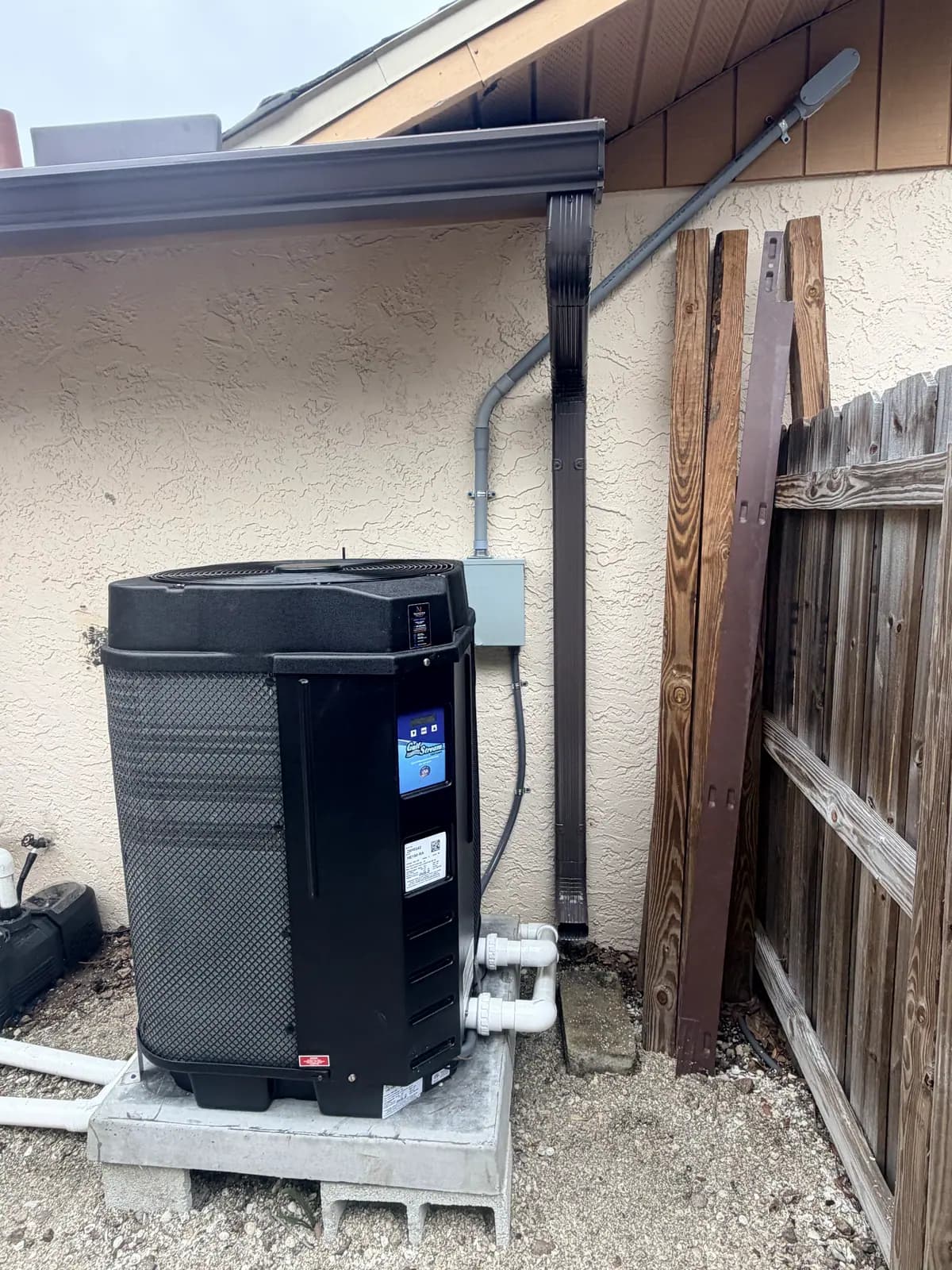
Airflow is the other constraint, and it applies in both directions — a chiller rejects heat into the air just as a heater pulls heat out of it. GulfStream specifies 12 inches of clearance on each side and four feet above the unit, outdoor only, and its installation manual warns that enclosed or overhung locations recirculate the discharged air, cut capacity and may void the warranty on refrigerant components. A heat pump crammed against a wall under a soffit disappoints in both modes.
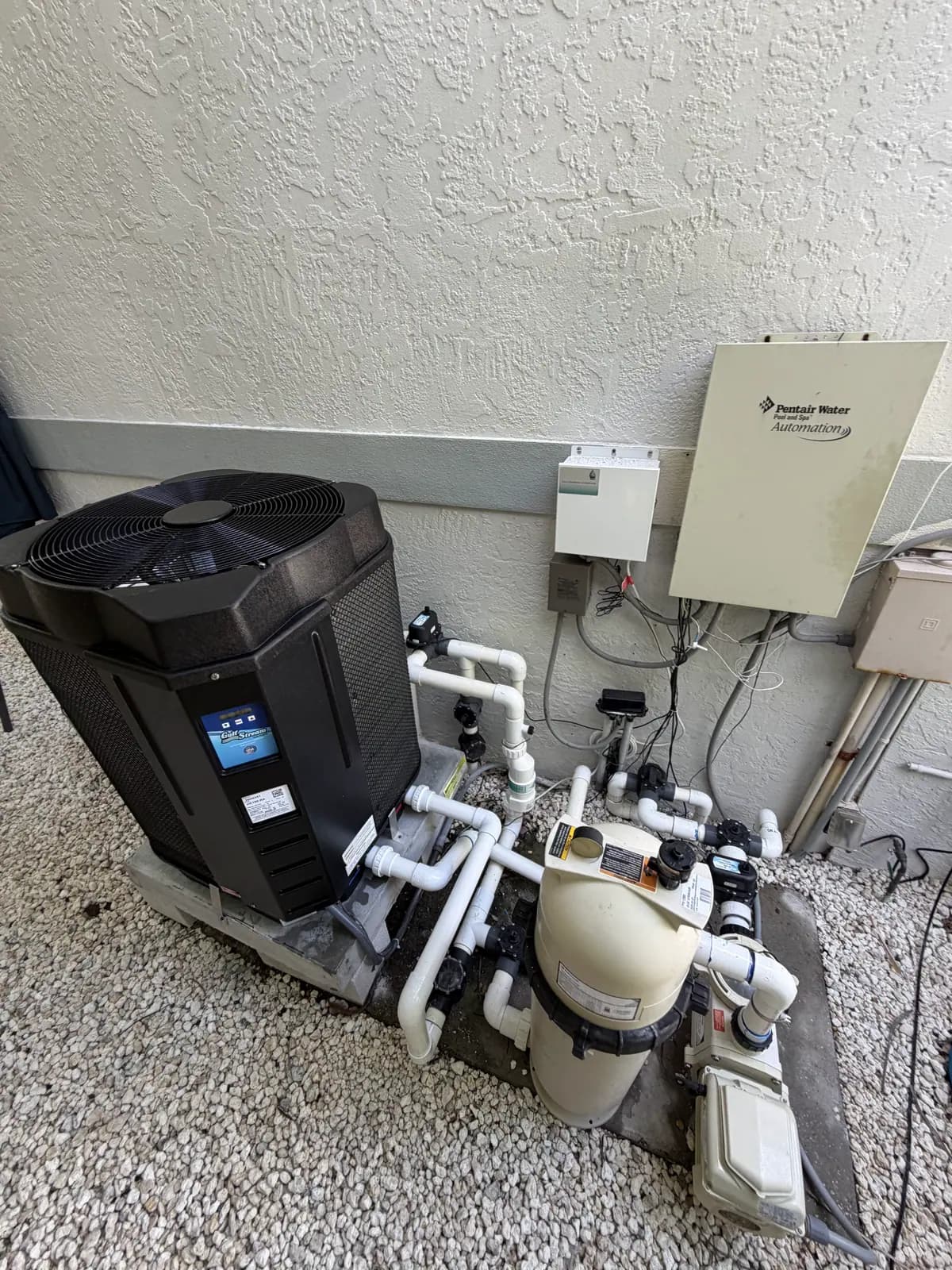
Two plumbing details matter as much as the electrical. Order: GulfStream's published sequence is pool pump, filter, heat pump, solar, then the chlorinator or salt cell, then the pool, with a check valve between the chlorinator and the heat pump — a salt cell upstream of any heater is a warranty problem. Flow: GulfStream asks for 30 to 70 GPM with 45-50 GPM optimal (20 GPM minimum on the smallest model) and Raypak publishes a 60 GPM maximum on the Crosswind V, so variable-speed schedules have to satisfy the flow switch during heating and cooling hours.
One last practical note: heat pumps produce condensation, and a lot of it — GulfStream states up to three gallons an hour, draining out of the base. That is normal and not a leak. A chlorine test strip on the puddle settles the argument, because condensation contains no chlorine and pool water does.
When heat and cool is not worth it
We talk customers out of the chiller version fairly often, and these are the usual reasons.
- The pool is screened, shaded, or both. A lanai cuts the solar gain that causes the problem, and most screened Gulf Coast pools never get uncomfortable enough to justify the premium.
- The pool is deep, or holds a lot of water relative to its surface area. Deep pools take longer to overheat and tend to self-moderate.
- You mostly want the spa cooler. Cooling is a pool-only feature on the lines we have checked, including GulfStream, so a heat/cool unit will not solve a hot spa.
- Your complaint is really about two weeks a year. Running the pump overnight, adding shade or swimming later in the evening costs nothing; a reverse-cycle heat pump earns its money when August is unusable, not briefly unpleasant.
- You need every BTU for winter. If the pool is large and exposed and your real problem is January, the heat-only model in the same line is both cheaper and rated slightly higher for heating.
- You already own a working heat-only heat pump. There is no retrofit — GulfStream's manual is explicit that the chiller components must be built in — so adding cooling means replacing the unit, not upgrading it.
How we decide on a Florida pool
The honest test is simple: if your pool spends more than a few weeks a year above 90°F and you avoid swimming because of it, a heat/cool heat pump is the only equipment that actually fixes it, and the premium over a heat-only unit is small next to the cost of a pool you do not use. If that is not your pool, buy the heat-only model and spend the difference on a variable-speed pump or a cover.
We install and service both kinds throughout Sarasota, Manatee, Charlotte & Pinellas County, Florida, and we will tell you which one your pool needs before we quote it. The comparison content on this site is written for pool owners anywhere; the installation offer is local.
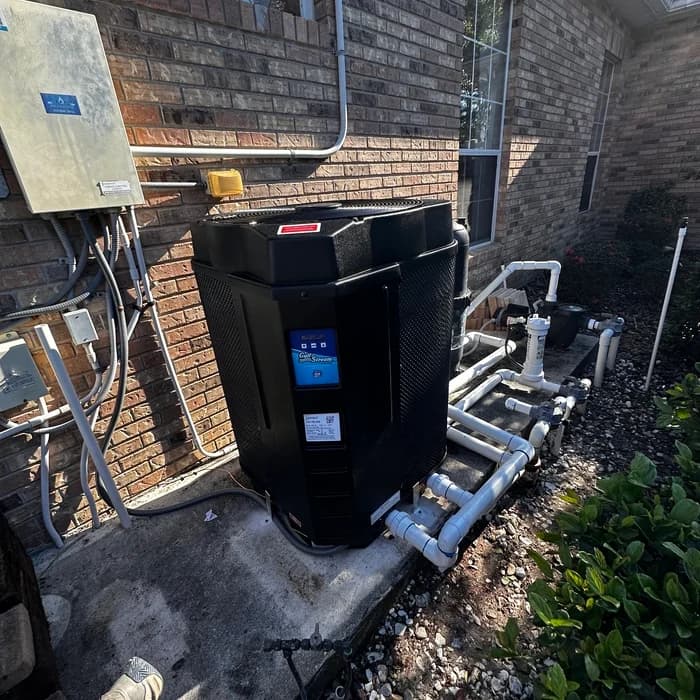
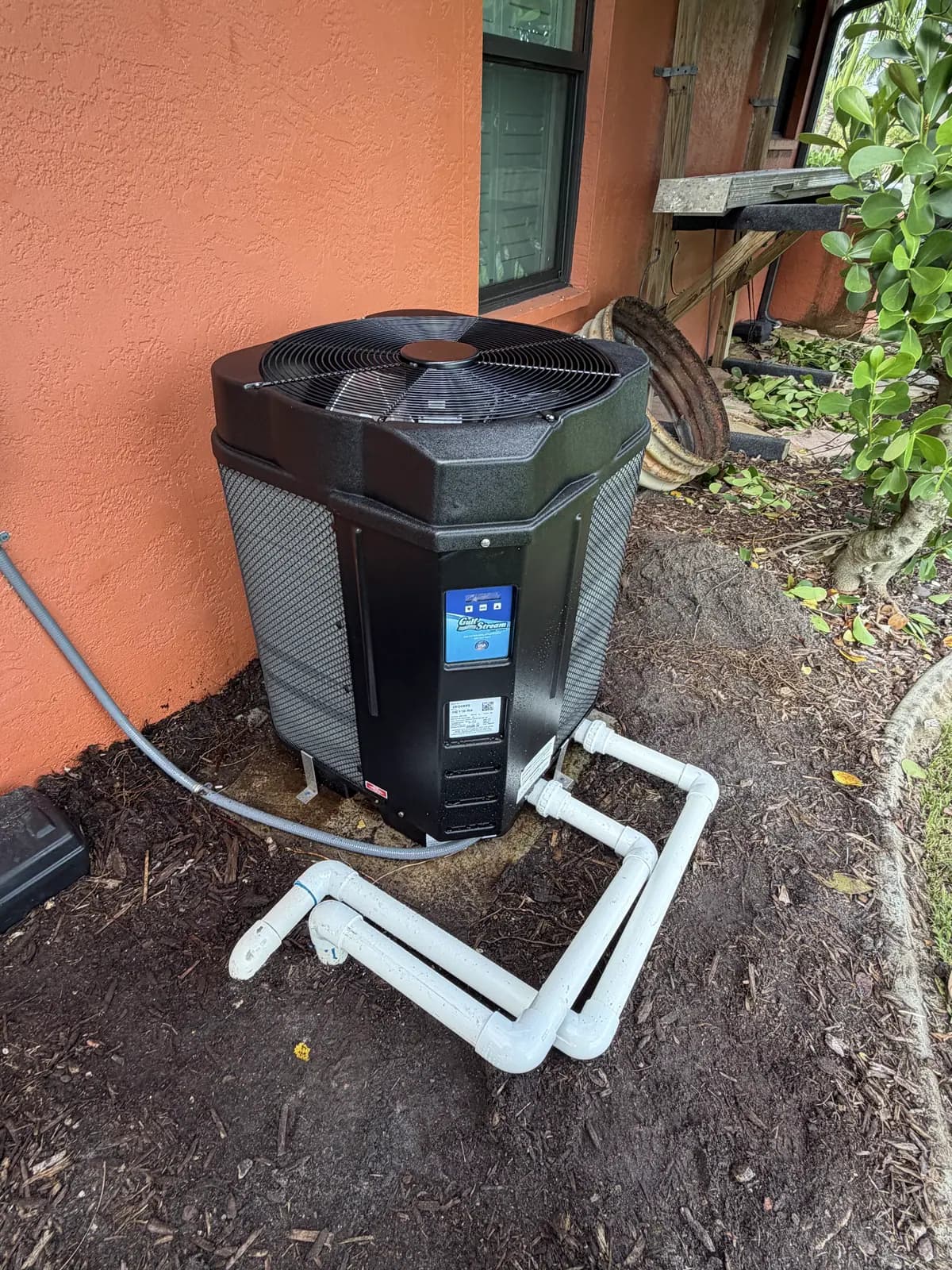
Real installations
Recent jobs from our installation library that involve the equipment in this guide.
Heaters mentioned in this guide
GulfStream · GulfStream HE Series
GulfStream HE125-TA Heat/Cool Pool Heat Pump
Model HE125-TA
- Heating capacity
- 115,000 BTU/hr
- Efficiency (COP)
- COP 6.0
- Heat exchanger
- Titanium
- Warranty
- 7-Year Parts / 2-Year Labor
- Wi-Fi / automation
- Automation Compatible (Relay)
A mid-size Florida pool whose owner wants warm water in February and the option to take the edge off it in August, without stepping up to the largest unit in the line.
GulfStream · GulfStream HE Series
GulfStream HE150-TA Heat/Cool Pool Heat Pump
Model HE150-TA
- Heating capacity
- 135,000 BTU/hr
- Efficiency (COP)
- COP 6.0
- Heat exchanger
- Titanium
- Warranty
- 7-Year Parts / 2-Year Labor
- Wi-Fi / automation
- Automation Compatible (Relay)
A Gulf Coast pool that gets used most of the year and an owner who also wants the option to take the edge off the water in late summer.
Hayward · HeatPro MCHX Series
Hayward HeatPro MCHX HP31405T Heat+Chill Pool Heat Pump
Model HP31405T
- Heating capacity
- 135,000 BTU/hr
- Efficiency (COP)
- COP 5.7
- Heat exchanger
- Titanium
- Warranty
- 5-Year Parts / 2-Year Labor10-Year Heat Exchanger
- Wi-Fi / automation
- Automation Compatible (Relay)
A Florida pool that is too cold in February and too warm in August, where one unit doing both jobs is worth more than the cheapest way to heat.
Jandy · VersaTemp JRT Series
Jandy VersaTemp JRT3000R Heat/Chill Pool Heat Pump
Model JRT3000R
- Heating capacity
- 130,000 BTU/hr
- Efficiency (COP)
- COP 5.8
- Heat exchanger
- Titanium
- Warranty
- 2-Year Parts5-Year Heat Exchanger
- Wi-Fi / automation
- App Control via AutomationAutomation Compatible
A Gulf Coast pool that gets swum in most of the year and an owner who wants the same box to take the edge off the water in August as well as warm it in February.
Jandy · VersaTemp JRT Series
Jandy VersaTemp JRT4001R Heat/Chill Pool Heat Pump
Model JRT4001R
- Heating capacity
- 160,000 BTU/hr
- Efficiency (COP)
- COP 5.9
- Heat exchanger
- Titanium
- Warranty
- 2-Year Parts5-Year Heat Exchanger
- Wi-Fi / automation
- App Control via AutomationAutomation Compatible
A large or exposed Gulf Coast pool that would otherwise be quoted two heat pumps, on a 230-volt service with room for a bigger circuit, where the owner also wants to chill the water in August.
Pentair · UltraTemp
Pentair UltraTemp 140 H/C Heat and Cool Pool Heat Pump
Model UltraTemp 140 H/C
- Heating capacity
- 140,000 BTU/hr
- Efficiency (COP)
- COP 5.6
- Heat exchanger
- Titanium
- Warranty
- 2-Year Parts & LaborLifetime Heat Exchanger
- Wi-Fi / automation
- Automation Compatible
A large Gulf Coast pool that gets swum in most of the year, on a pad that is already Pentair, where the owner also wants the option to chill the water in late summer.
Raypak · Crosswind V
Raypak Crosswind V 8550 Heat/Chill Pool Heat Pump
Model TWPH-8550EHC08
- Heating capacity
- 137,000 BTU/hr
- Efficiency (COP)
- COP 5.8
- Heat exchanger
- Titanium
- Warranty
- 7-Year Parts / 2-Year Labor10-Year Heat Exchanger
- Wi-Fi / automation
- Wi-Fi Built In
A Gulf Coast pool that gets used most of the year, where the owner wants heat in winter, the option to chill in August, and a warranty of seven years parts, two years labor and ten years on the titanium tube.
Last verified September 18, 2026
Specifications and warranty terms are taken from the manufacturer documents below. Manufacturers revise these without notice, so confirm the current terms before you buy. If you spot something out of date, email us and we will fix it.
Sources
- GulfStream Heat Pumps — HE Series spec sheet (capacity and COP for RA and TA models)
- GulfStream Heat Pumps — Installation and User Guide (heat/cool and chiller modes, deadband, defrost, flow, condensation)
- GulfStream Heat Pumps — Installation Manual (cooling is pool only; dry-contact chiller relay; clearances and plumbing order)
- Hayward — HeatPro MCHX Heat+Chill HP31405T product page (chills to 40°F, 140,000 BTU nominal, electrical, warranty)
- Hayward — HeatPro Installation and Operation Manual 51300122601 Rev C, Table 2 (HP31405T rated 135,000 BTU/hr at 80/80/80; 50 A recommended breaker, 70 A MOP)
- Jandy — VersaTemp Heat/Chill Pump sell sheet (JRT capacities and COP at three AHRI test points)
- Jandy — VersaTemp Heat/Chill Pump brochure, 34267_SL, ©2026 (current JRT range including the 160,000 BTU/hr JRT4001R; electrical table; 40°F cold plunge)
- Jandy — VersaTemp JRT4001R Installation & Operation Manual, H0902200 Rev C (chills a small body of water, around 800 gallons or less, to 40°F; electrical specifications)
- Raypak — Crosswind V product page (EHC heat/cool models, capacities, voltage, maximum flow)
- Pentair — UltraTemp High Performance Heat Pump product page (H/C models, 100% titanium exchanger, automation)
- Built Right Pool Heaters — XW Series page (BR135XW H/C capacity, COP, titanium exchanger, warranty)
Ratings on this site are the editorial opinion of Affordable Solar & Pool Heating, LLC, trading as Modern Pool Heating. How we rate heaters. Corrections: modernpoolheating@icloud.com.