

Updated September 17, 2026 · Affordable Solar & Pool Heating, LLC · Owner/operator Henry Manna
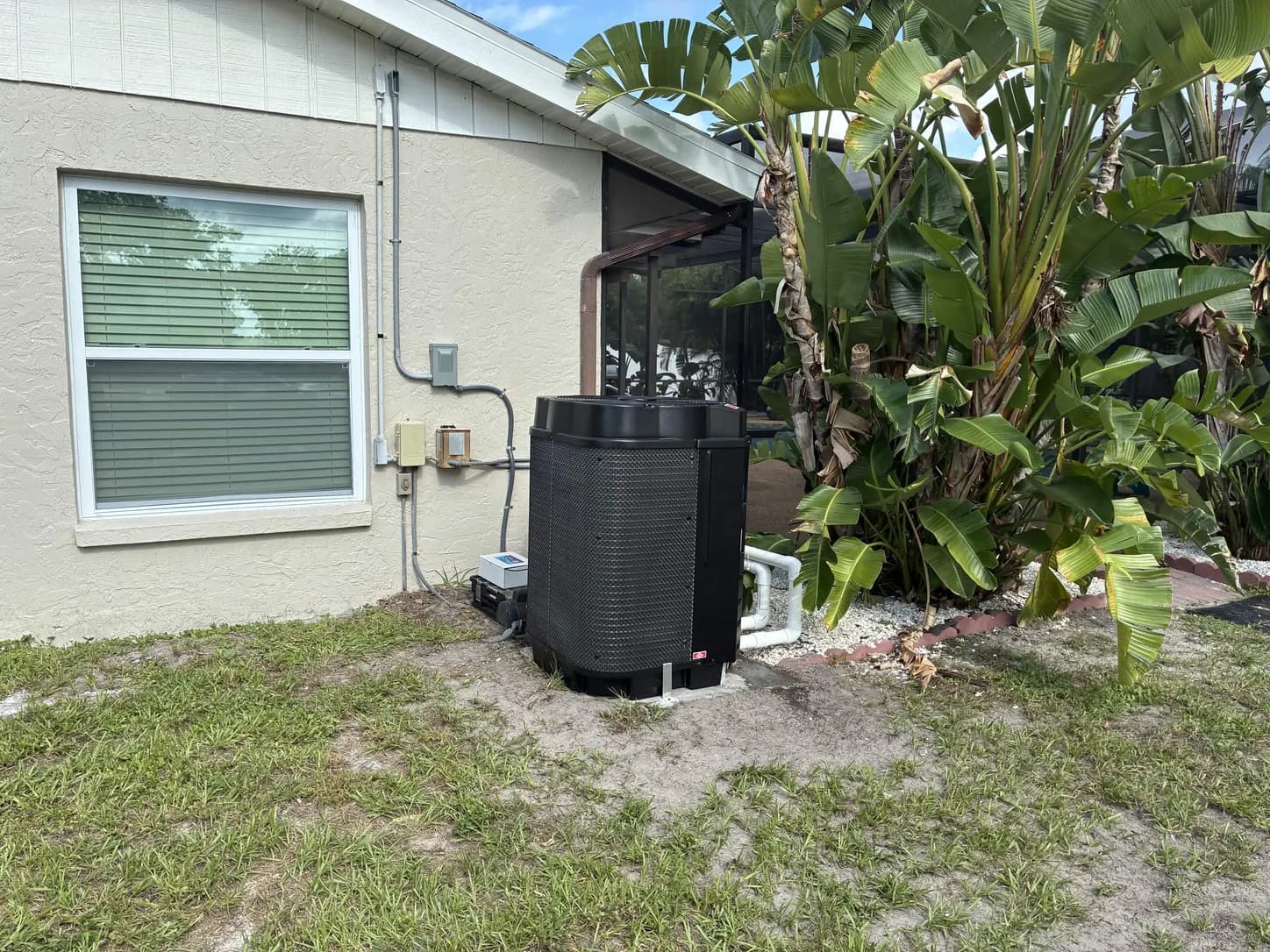
Start with surface area, not gallons
Almost every online pool heater calculator asks for gallons first, and gallons are the least useful number in the calculation. A pool loses heat from its surface — to evaporation, to the air above it, and to the wind moving across it — so a shallow 15 by 30 foot pool and a deep 15 by 30 foot pool lose heat at nearly the same rate even though one holds thousands of gallons more water. Volume affects how long the pool takes to come up to temperature. Surface area affects how much heat it takes to keep it there, and keeping it there is what a heat pump does for a living.
The Department of Energy puts it plainly: a heater is sized according to the surface area of the pool and the difference between the pool and the average air temperatures, with wind exposure, humidity and cool nights affecting the load as well.
So the measurements that matter are the pool's actual water surface area, and the temperature rise you are asking for: the temperature you want the water to hold, minus the average air temperature in the coldest month you intend to swim.
The DOE formula, and what it assumes
The Department of Energy publishes the same approximate sizing method for heat pumps and for gas heaters, in four steps: decide your desired pool temperature, find the average temperature for the coldest month of pool use, subtract one from the other to get the temperature rise needed, and calculate the pool's surface area in square feet. Then:
Pool Area x Temperature Rise x 12 = the BTU per hour output the heater needs.
The assumptions inside that 12 matter. DOE states the formula is based on a 1 to 1-1/4°F temperature rise per hour and a 3-1/2 mile per hour average wind at the pool surface. If you want the pool to come up faster — 1-1/2°F per hour — multiply the result by 1.5; for 2°F per hour, multiply by 2.0. In other words, the formula already contains an assumption about how patient you are, and that assumption is usually what separates two contractors' quotes for the same pool. It also assumes an uncovered pool in average wind: a blanket or a windbreak lowers the requirement, an exposed waterfront lot raises it.
Worked examples for three common Florida pools
Using DOE's formula for a 10°F rise (a typical Gulf Coast ask: holding the mid-80s when average air is in the mid-70s) and for a 15°F rise (holding 85°F through a cool stretch when average air is around 70°F; a Sarasota January averages colder than that, so a pool heated all winter needs a bigger rise), before any adjustment for wind, covers or heat-up speed:
- 12 x 24 ft pool (288 sq ft): 10°F rise = 34,600 BTU/hr; 15°F rise = 51,800 BTU/hr.
- 15 x 30 ft pool (450 sq ft): 10°F rise = 54,000 BTU/hr; 15°F rise = 81,000 BTU/hr.
- 16 x 32 ft pool (512 sq ft): 10°F rise = 61,400 BTU/hr; 15°F rise = 92,200 BTU/hr.
- Want the 15 x 30 pool to recover at 1-1/2°F per hour rather than 1°F? Multiply the 81,000 by 1.5 — 121,500 BTU/hr, which is why 120,000 BTU-class heat pumps are so common on ordinary Florida pools.
- Freeform pools: measure or estimate the real water surface area rather than using the longest length times the widest width, which overstates it.
The number manufacturers do not lead with: capacity at 50°F air
Every heat pump is advertised at the industry test point — 80°F air, 80°F water, 80% relative humidity — and every one produces less heat when the air is colder, because the air is where the heat comes from. The better manufacturers also publish the cold-air number, at 50°F air and 63% relative humidity. One wrinkle worth knowing: the Department of Energy describes the federal test procedure as 80°F ambient dry bulb, 63% relative humidity and 80°F pool water, so the 80/80/80 column every manufacturer leads with is an advertised rating point rather than the federal procedure DOE describes. Compare heaters column to column, and pay most attention to the 50°F one.
The derate is substantial and consistent. Built Right's BR135XW is rated 135,000 BTU/hr at 80/80/80 and 82,000 BTU/hr at 50°F air — a 39% drop. AquaCal's HeatWave SuperQuiet SQ140R goes from 114,000 to 72,000 BTU/hr, a 37% drop. Thermeau's Prestige TH125 goes from 121,000 to 80,000, a 34% drop. The efficiency falls too: those units publish COPs between 5.5 and 6.0 at the warm test point and 4.0 at the cold one.
This is the single most important line in a heat pump sizing conversation, because January is the month you will be unhappy in, not July. A heat pump chosen to exactly satisfy the DOE calculation at its headline rating will be roughly a third short on the mornings when the pool actually needs help.
Why oversizing is normal advice for a heat pump and bad advice for gas
Contractors in Florida routinely recommend going a size up on a heat pump, and it is not an upsell reflex — it follows from the derate above. A larger heat pump does not use more energy per BTU delivered; it simply produces its BTUs in fewer hours. Its efficiency is set by the COP at the conditions of the moment, not by how big the box is. The practical costs of going up a size are a higher purchase price, a larger electrical circuit and a slightly bigger cabinet on the pad.
Gas heaters work the opposite way. Their output does not fall when the air cools, so the DOE calculation holds year round. Oversizing one instead brings real penalties: a larger gas line back to the meter, larger venting, a bigger meter or propane tank, and more short cycling. Size a gas heater to the job; size a heat pump to the coldest month you intend to swim in.
An inverter heat pump softens the decision further: a modulating compressor can run slowly when the load is small, so going a size up costs less in noise and short-cycling than it does on a fixed-speed unit.
What Florida adds: screens, wind, salt and clearances
A screen enclosure helps and hurts at once. Evaporation is by far the largest source of heat loss from a pool, and DOE notes the rate rises with pool temperature and wind speed — so a lanai that blocks the breeze genuinely reduces the heating load. But it also shades the water and, if the equipment is boxed in beside it, restricts the airflow the heat pump depends on.
Clearances are not optional. Built Right specifies at least four feet above the unit for unrestricted air discharge, six inches on all sides, 24 inches of access to the control panel, and notes that totally enclosed areas are not recommended. Moov's manual simply says not to put obstacles near the air inlet and outlet. A heat pump that recirculates its own cold discharge air behaves like a smaller heat pump, which is a sizing problem created after the sizing was done.
Coastal lots are also the windiest ones, so a pool on a canal, a bay or a barrier island should be sized assuming the wind factor is real. Screened or not, a solar blanket remains the cheapest sizing tool available: DOE says covering a pool when it is not in use is the single most effective way to reduce pool heating costs, with savings of 50-70% possible. A cover does not make the heater more efficient; it makes the heating job smaller, which is better.
The limits you cannot design around: water flow and electrical service
Every heat pump has a flow window, and it is narrower than people expect. AquaCal specifies 30 to 70 gpm for the HeatWave SuperQuiet, with a bypass kit required above the maximum; Built Right specifies 30 to 70 gpm on the BR135XW with 45 gpm recommended. On a variable-speed pump the heating speed has to sit inside that window — too slow and the flow switch will not make, too fast and you are wasting pump energy.
The electrical side decides more quotes than anything else. An 82,000 BTU/hr Moov MI900 needs a 30 A breaker at 208-230V; AquaCal's SQ140R needs a 38.5 A minimum circuit ampacity; Thermeau's TH125 draws 32.1 A running and needs 42.5 A of circuit ampacity. On an older Sarasota or Bradenton panel that often means a subpanel or a service upgrade, and it is far better to find that out before choosing a model than after.
When to stop calculating and get a real assessment
The formula above gets you to the right neighborhood, which is exactly what it is for. DOE itself prefaces the method with the instruction to have a trained pool professional perform a proper sizing analysis, and that is not a disclaimer — exposure, enclosure, the pump you already own, the panel you already have and the temperature you actually swim at all move the answer more than the difference between two comparable heat pumps.
A quick reality check: if the calculation and the quote are more than a size apart, ask which assumption changed — the temperature rise, the heat-up rate, or the cold-air derate. A contractor who can name which one is sizing rather than guessing.
If your pool is in Sarasota, Manatee, Charlotte & Pinellas County, we will look at the pool, the pad, the enclosure and the electrical service before recommending a size — and we will tell you when the honest answer is a pool cover and the heater you already own.
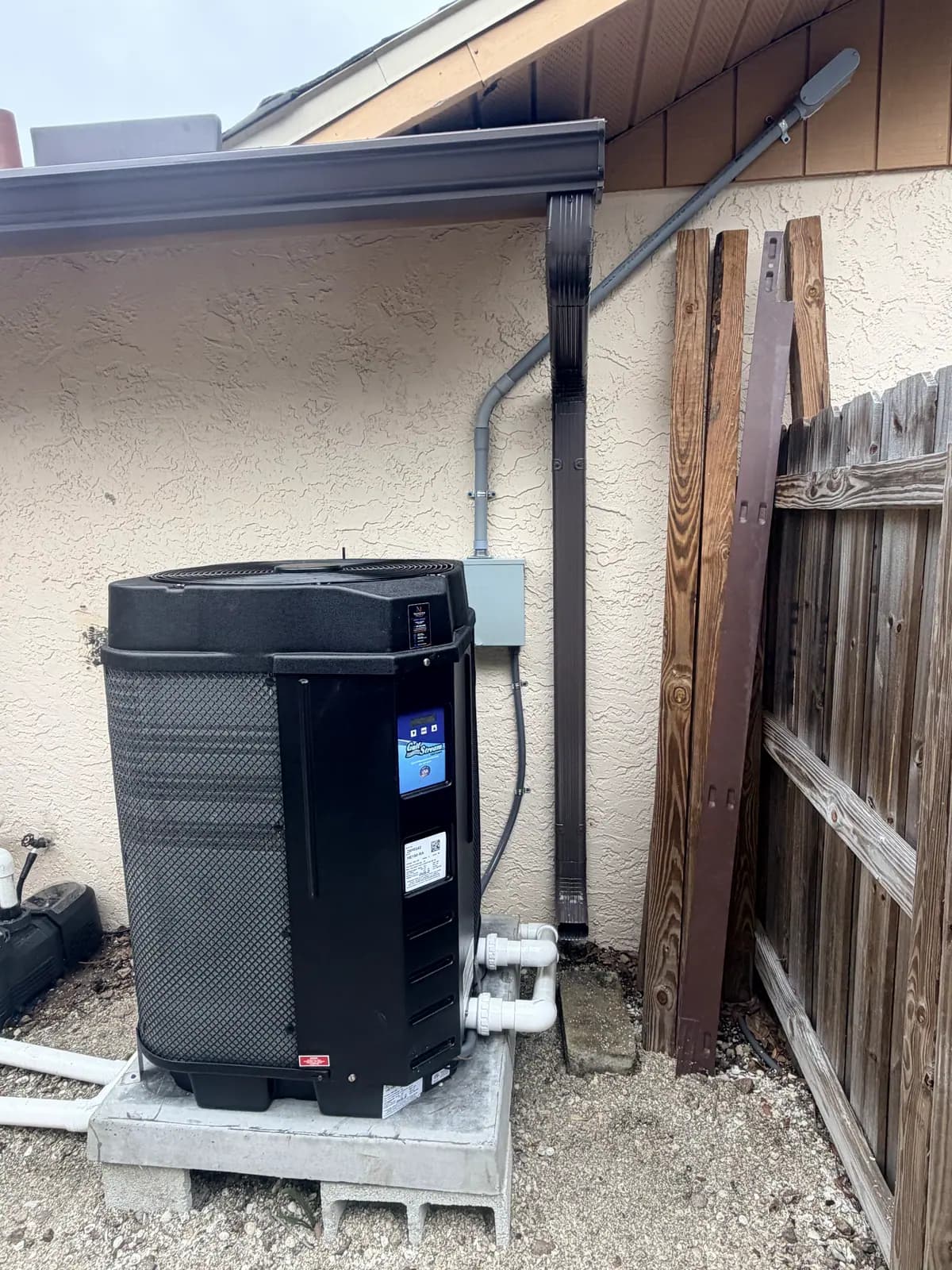
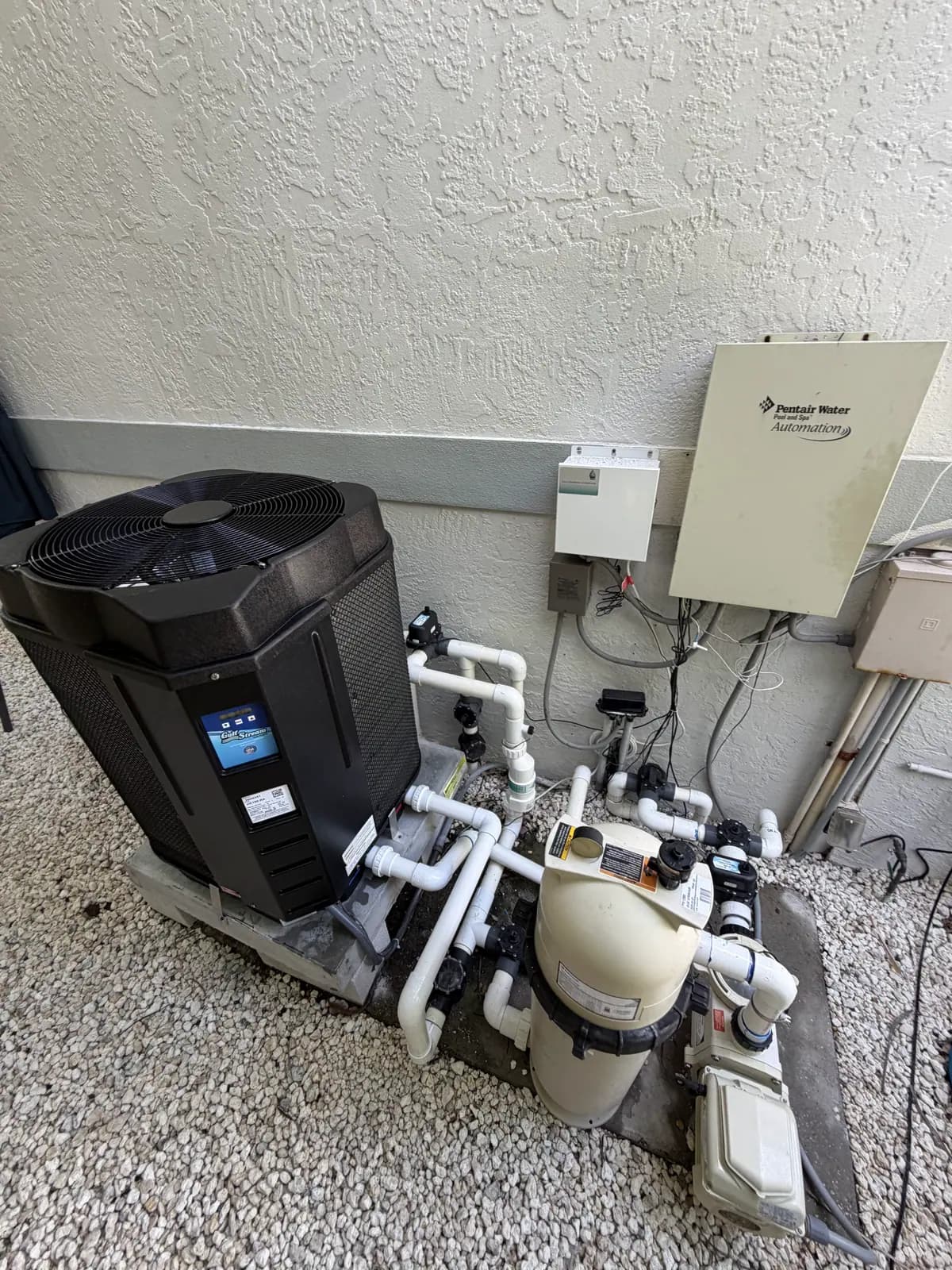
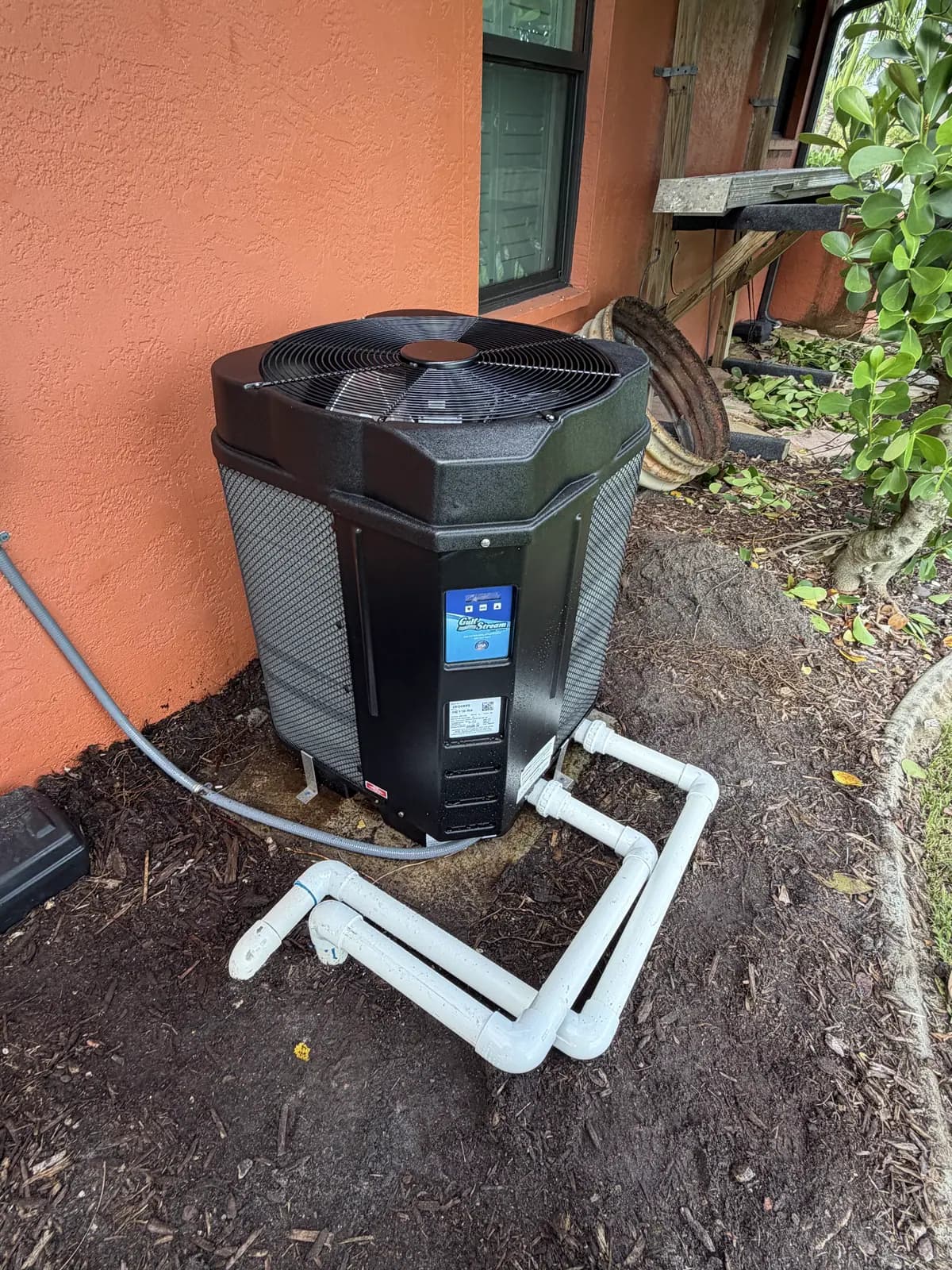
Real installations
Recent jobs from our installation library that involve the equipment in this guide.
Heaters mentioned in this guide
GulfStream · GulfStream HE Series
GulfStream HE150-TA Heat/Cool Pool Heat Pump
Model HE150-TA
- Heating capacity
- 135,000 BTU/hr
- Efficiency (COP)
- COP 6.0
- Heat exchanger
- Titanium
- Warranty
- 7-Year Parts / 2-Year Labor
- Wi-Fi / automation
- Automation Compatible (Relay)
A Gulf Coast pool that gets used most of the year and an owner who also wants the option to take the edge off the water in late summer.
AquaCal · HeatWave SuperQuiet
AquaCal HeatWave SuperQuiet Pool Heat Pumps
Model SQ140R
- Heating capacity
- 114,000 BTU/hr
- Efficiency (COP)
- COP 5.7
- Heat exchanger
- Titanium
- Warranty
- 3-Year Parts & LaborLimited Lifetime Heat Exchanger
- Wi-Fi / automation
- Wi-Fi Built InAutomation Compatible (Relay)
A Gulf Coast owner who wants a heat pump from a Florida manufacturer with a real service organization behind it, built-in Wi-Fi out of the box, and the option to cool the pool in late summer.
Built Right · XW Series
Built Right XW Series Pool Heat Pumps
Model BR135XW
- Heating capacity
- 135,000 BTU/hr
- Efficiency (COP)
- COP 6.0
- Heat exchanger
- Titanium
- Warranty
- 5-Year Parts & Labor
- Wi-Fi / automation
- Automation Compatible (Relay)
A Sarasota, Charlotte or Manatee County pool owner who wants five years of parts and on-site labor on one warranty term from a factory an hour down the road, and does not need app control.
Thermeau · Signature and Prestige
Thermeau Signature & Prestige Pool Heat Pumps
Model TH125
- Heating capacity
- 121,000 BTU/hr
- Efficiency (COP)
- COP 5.5
- Heat exchanger
- Titanium
- Warranty
- 5-Year Parts & Labor10-Year Heat Exchanger
- Wi-Fi / automation
- Onboard controls only
An owner who wants published, model-by-model performance data and a long warranty, and who has confirmed there is a Thermeau service dealer near the pool.
Moov · Moov Inverter
Moov Inverter Pool Heat Pumps
Model MI900
- Heating capacity
- 82,000 BTU/hr
- Heat exchanger
- Titanium
- Warranty
- 5-Year Parts / 3-Year Labor10-Year Heat Exchanger
- Wi-Fi / automation
- Wi-Fi Built In
An owner who wants inverter-style part-load efficiency and low noise on a Florida pool, and who is comfortable buying a newer brand with a smaller installed base than the big pro-channel names.
Last verified September 17, 2026
Specifications and warranty terms are taken from the manufacturer documents below. Manufacturers revise these without notice, so confirm the current terms before you buy. If you spot something out of date, email us and we will fix it.
Sources
- U.S. Department of Energy, Energy Saver — Heat Pump Swimming Pool Heaters (sizing steps and formula, COP, standard sizes, lifespan) — archived copy, energy.gov currently returns 404 for this page
- U.S. Department of Energy, Energy Saver — Swimming Pool Covers (evaporation as the largest heat loss; 50-70% savings from covering a pool) — archived copy
- Built Right Pool Heaters — XW Pool Heaters (BTU and COP at 80/80/80, 80/80/63 and 50/80/63)
- Built Right Pool Heaters — owner's manual, models produced after October 1, 2017 (clearances, flow rates, recommended 45 gpm)
- AquaCal — HeatWave SuperQuiet brochure AC-3232 V3 (capacity and COP by test condition, flow window, electrical)
- Thermeau — Prestige residential pool heater (capacity and COP at three test conditions, electrical requirements)
- Moov Pool Products — Moov Inverter owner's manual (water circulation flow, electrical, installation notes)
Ratings on this site are the editorial opinion of Affordable Solar & Pool Heating, LLC, trading as Modern Pool Heating. How we rate heaters. Corrections: modernpoolheating@icloud.com.