Modern Pool Heating · Owner/operator Henry Manna, Florida Certified Pool/Spa Contractor CPC1460367
Updated October 16, 2026
Short answer
A heat pump in the 100,000 to 120,000 BTU/hr class is usually enough for a screened, average-sized Florida pool that is kept warm through the season. The 135,000 to 140,000 BTU/hr class earns its place on larger, unscreened or windy waterfront pools, and for owners who want the pool back to temperature sooner after a cold front. A bigger heat pump does not use more electricity per degree of heat; it delivers the same heat in fewer hours, for a higher purchase price and sometimes a bigger circuit.
What we usually recommend
If your pool is screened and you keep it warm continuously, we would usually look at the 110,000 to 120,000 BTU/hr class first, especially on an older electrical panel. If it is unscreened, larger than a typical 15 by 30 foot pool, exposed to wind off open water, or you let it cool between uses and want it back quickly, we would lean to the 135,000 to 140,000 BTU/hr class. When the calculation lands between the two, the sizing logic favors going up a size on a heat pump (never on gas), as long as the panel can carry it.
- The labels are nominal. Hayward names the HP21405T a 140,000 BTU unit and rates it 138,000 BTU/hr at 80/80/80; GulfStream's HE150-RA is rated 138,000.
- Capacity at 50°F air sets the size in Florida. In the lines that publish it, the 140K class makes roughly 82,000 to 88,000 BTU/hr there, against about 70,000 to 72,000 for the 110K to 117K units.
- GulfStream's HE110-RA and HE150-RA both list 37 A minimum circuit amps; the maximum breaker is 40 A on the HE110-RA and 50 A on the HE150-RA.
- Running cost follows the heat your pool needs, not the size of the box. The HE110-RA's COP of 6.1 is actually a shade better than the HE150-RA's 6.0.
What the two size classes actually are
100K and 140K are shorthand, and the shorthand is loose. Hayward's product name for the HP21405T says 140,000 BTU, while its own specification table rates it at 138,000 BTU/hr at 80°F air, 80% relative humidity and 80°F water. GulfStream's model numbers are size classes too: the HE150-TA is rated 135,000 BTU/hr. Always compare the rated capacity at a stated test condition, not the number in the name.
Using rated figures from the manufacturers' own documents, the smaller class in our heater comparison includes the GulfStream HE110-RA at 110,000 BTU/hr, the AquaCal SQ140R at 114,000, Built Right's BR115XW at 117,000 and the GulfStream HE125-RA at 118,000. The larger class includes the GulfStream HE150-RA at 138,000, Hayward's HP21405T at 138,000, AquaCal's SQ200R at 138,000, Raypak's Crosswind V 8550 at 137,000, Built Right's BR135XW at 135,000 and Pentair's UltraTemp 140 H/C at 140,000.
Within a class the heat-only and heat-and-cool versions differ slightly. GulfStream rates the heat-only HE150-RA at 138,000 BTU/hr and the heat-and-cool HE150-TA at 135,000, because the reversing hardware costs a little heating capacity. If you are choosing between sizes, choose the mode first so you are comparing like with like.
Pool size and exposure decide it, not gallons
A pool loses heat from its surface, so heat pumps are sized on surface area and the temperature rise you want. The Department of Energy's approximate method is Pool Area x Temperature Rise x 12, which assumes a rise of 1 to 1-1/4°F per hour and a 3-1/2 mph wind at the pool surface; for a 1-1/2°F per hour rise you multiply by 1.5. Run that for a 16 by 32 foot pool (512 square feet) asking for a 15°F rise and you get about 92,000 BTU/hr, or about 138,000 at the faster rate. A 15 by 30 foot pool at the same rise comes to about 81,000, or about 121,500 at the faster rate.
Then the Florida correction. Those are output figures, and a heat pump's output falls as the air cools. The manufacturers that publish capacity at 50°F air show what the two classes really deliver on a cold morning, and that column is the one we size against. The full method, including what a screen enclosure does to the load, is in our sizing guide.
Exposure moves the answer as much as size does. An unscreened pool on a canal or the bay loses far more heat to wind and evaporation than the same pool under a lanai, and the DOE formula already assumes average wind. Waterfront and barrier-island pools are good candidates for the larger class even when the pool itself is ordinary.
| Model | Class | Capacity at 80/80/80 | Capacity at 50°F air |
|---|---|---|---|
| GulfStream HE110-RA | 100K class | 110,000 BTU/hr | n/p (COP 4.0 or better stated) |
| AquaCal SQ140R | 100K class | 114,000 BTU/hr | 72,000 BTU/hr |
| Built Right BR115XW | 100K class | 117,000 BTU/hr | 70,000 BTU/hr |
| GulfStream HE150-RA | 140K class | 138,000 BTU/hr | n/p (COP 4.0 or better stated) |
| Hayward HP21405T | 140K class | 138,000 BTU/hr | 82,000 BTU/hr |
| AquaCal SQ200R | 140K class | 138,000 BTU/hr | 88,000 BTU/hr |
| Built Right BR135XW | 140K class | 135,000 BTU/hr | 82,000 BTU/hr |
| Raypak Crosswind V 8550EHC | 140K class | 137,000 BTU/hr | 85,000 BTU/hr |
Recovery after a cold front
This is where the bigger unit earns its money. Heat pumps warm a swimming pool gradually over many hours. Actual heating speed depends on pool volume, heater output, starting water temperature, outdoor air temperature, humidity, wind conditions and whether the pool is covered. Proper heater sizing and the use of a pool cover can significantly affect recovery time.
GulfStream's own benchmark is that a properly sized unit raises water temperature an average of about 1°F per hour in ideal conditions: 80°F air, 80% humidity and 80°F water. A Florida cold front is the opposite of ideal, so the useful comparison is the ratio between sizes. At the rating point, a 138,000 BTU/hr unit delivers about 25% more heat per hour than a 110,000 BTU/hr unit, so under the same conditions it needs roughly a fifth fewer hours to put the same heat back into the water. At 50°F air the published gap is similar: AquaCal's SQ200R makes 88,000 BTU/hr against 72,000 for the SQ140R, and Built Right's BR135XW 82,000 against 70,000 for the BR115XW.
If you keep the pool warm all season, the larger unit mostly shortens the catch-up after the occasional cold night. If you let the pool drift down between weekends and expect it back by Saturday, the extra capacity matters every week, and a cover matters even more: the Department of Energy calls covering a pool when it is not in use the single most effective way to cut heating costs, with savings of 50-70% possible.
Oversizing: when bigger is fine and when it is not
On a heat pump, going up a size does not waste energy. Efficiency comes from the COP at the conditions of the moment, not from the size of the cabinet, so a larger unit makes the same BTUs in fewer hours. GulfStream's line even runs the other way on paper: the HE110-RA publishes a COP of 6.1 at 80/80/80 against 6.0 for the HE150-RA.
What you pay for a larger unit is up front. It costs more to buy, it may need a larger breaker, and it is a bigger, heavier cabinet to place: GulfStream lists the HE110-RA at 31 x 31 x 38 inches and 215 lb, and the HE150-RA at 31 x 31 x 46 inches and 239 lb. On a small, screened pool, an oversized fixed-speed unit also cycles on and off more without making the water any warmer, which is why we do not put the largest unit on every pool.
The flow window is worth a look too. Pentair's model-by-model spec sheet lists a 20 GPM minimum for the HE110-RA against 30 GPM for the rest of the HE line, though the general manual still quotes 30 GPM across the line. On a variable-speed pump that can let the pump run slower while the heat pump is on. Gas heaters are a different story entirely: oversizing one brings gas-line, venting and short-cycling penalties, which our 250K versus 400K article covers.
Electrical differences, model by model
The circuit is often what decides between the two classes, especially in older Sarasota and Bradenton homes where the panel is already close to full. These are the figures the manufacturers publish; your electrician sizes the wire and breaker from the data plate on the unit actually delivered.
Inside the GulfStream line the difference is smaller than people expect. The HE110-RA and HE150-RA both list 37 A minimum circuit amps; the HE110-RA tops out at a 40 A maximum breaker and the HE150-RA allows up to 50 A. Across brands the 140K class is not uniform: Hayward's HP21405T needs 42.5 A of minimum circuit ampacity, and Raypak's Crosswind V 8550 calls for 46 A with a 60 A recommended breaker.
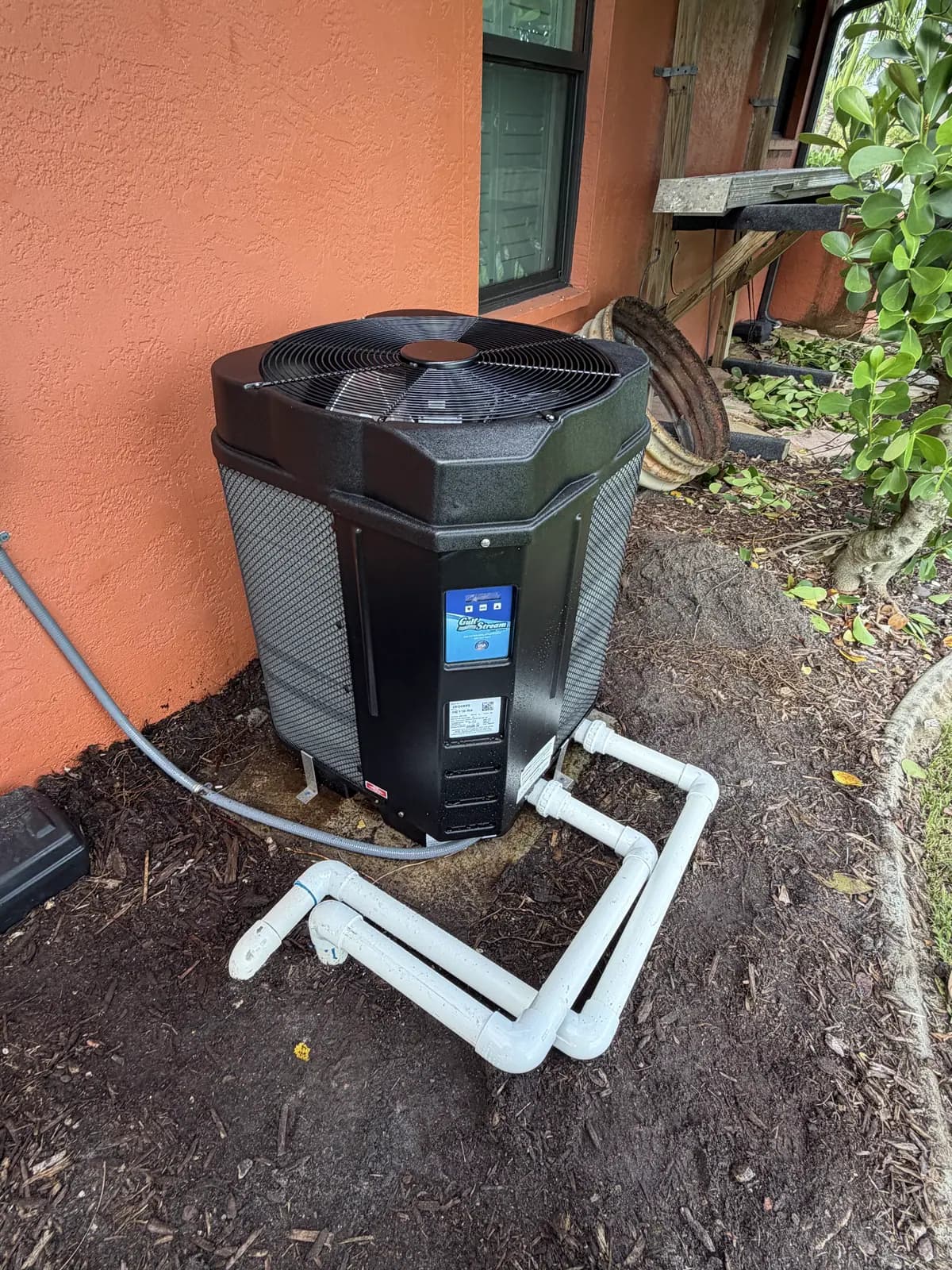
GulfStream's and Hayward's manuals both call for a disconnect within sight of the unit, and Hayward's points to NEC Article 680 for pools and Article 440 for refrigeration equipment. On our Punta Gorda HE110-RA job, power arrives through flexible conduit from the wall, kept clear of the plumbing. The electrical, bypass and placement article goes further into breakers, disconnects and bonding.
| Model | Heating capacity (80/80/80) | Minimum circuit amps | Breaker |
|---|---|---|---|
| GulfStream HE110-RA | 110,000 BTU/hr | 37 A | 40 A maximum |
| GulfStream HE125-RA | 118,000 BTU/hr | 37 A | 50 A maximum |
| GulfStream HE150-RA | 138,000 BTU/hr | 37 A | 50 A maximum |
| GulfStream HE150-TA | 135,000 BTU/hr | 40 A | 50 A maximum |
| AquaCal SQ140R | 114,000 BTU/hr | 38.5 A | 60 A maximum fuse |
| AquaCal SQ200R | 138,000 BTU/hr | 42.1 A | Not in our record |
| Hayward HP21405T | 138,000 BTU/hr | 42.5 A | 50 A recommended, 70 A maximum |
| Raypak Crosswind V 8550EHC | 137,000 BTU/hr | 46 A minimum recommended | 60 A recommended |
| Built Right BR115XW / BR135XW | 117,000 / 135,000 BTU/hr | Per the unit's data label | Per the unit's data label |
Hayward 100K vs GulfStream 142K
This comparison comes up by name, and two parts of it need straightening out before it is useful. First, the GulfStream side. The largest heat-only GulfStream in our heater comparison is the HE150-RA, which Pentair's current spec sheet rates at 138,000 BTU/hr at 80/80/80 with a COP of 6.0. Some retailers advertise it as a 142,000 BTU unit, and the listing we checked labels that figure as 142,000 BTU at 80/80/80 with a COP of 6.2. That is the same test condition, so it is not a different test; it is a different number for the same point, and we could not trace it to a current Pentair document. We size from 138,000.
Second, the Hayward side. We have not yet added a Hayward 100K-class model to our heater comparison, so we will not quote one's specifications here. What we can say is how the classes compare. If the Hayward unit on your quote is rated near 100,000 BTU/hr at the same 80/80/80 point, the HE150-RA's 138,000 is roughly 38% more heat per hour under the same conditions, which shows up as faster recovery and more margin on a cold, windy pool. The smaller unit, in exchange, usually costs less, may need a smaller circuit and leaves more room on the pad.
Brand differences sit on top of the size difference. Hayward's 2026 Expert Line terms for in-ground heat pumps are 5 years parts and 2 years field labor, with 10 years on the titanium tube; GulfStream publishes 7 years parts and 2 years labor. Hayward heat pumps join a Hayward Omni system through a relay; GulfStream is dry contact only. Our GulfStream vs Hayward comparison sets the two brands' 140K-class units side by side. For a 100K Hayward against a GulfStream HE150-RA, ask for the rated capacity at 80/80/80 and at 50°F air, the minimum circuit amps and breaker, and the warranty document for that exact model number.
What changes in cost
Installed price is the obvious difference, and it is not only the unit. A larger heat pump can mean a larger breaker and wire run, and a taller, heavier cabinet can change the pad. The factors that move an installed price are listed on this page. The past jobs listed here are real Modern Pool Heating installs with the prices published in our gallery; those records do not say which size unit was installed, so treat them as examples of what those specific jobs cost, not as a size comparison.
Running cost is a different question with a simpler answer. The electricity a heat pump uses depends on how much heat the pool needs and the COP at the time, not on the size of the box. At the EIA's Florida residential average of 15.36 cents per kWh, a million BTU of pool heat costs about $7.38 at the HE110-RA's COP of 6.1 and about $7.50 at the HE150-RA's 6.0 (1,000,000 divided by COP x 3,412 BTU per kWh, times the rate). Our operating cost article works through monthly examples.
Pros and cons
100,000 to 120,000 BTU/hr class
Pros
- Lower purchase price for the unit.
- Easier on the panel: the GulfStream HE110-RA tops out at a 40 A breaker.
- Smaller cabinet, and on the HE110-RA a wider published flow window.
- Plenty for a screened, average-sized pool kept warm through the season.
Cons
- Less margin on cold, windy mornings and on unscreened or waterfront pools.
- Slower to recover when the pool has been allowed to cool.
- Can be undersized for a large pool once the 50°F derate is applied.
135,000 to 140,000 BTU/hr class
Pros
- More heat per hour, so faster recovery after a cold front.
- Margin for unscreened, larger and waterfront pools.
- No penalty in efficiency per BTU delivered.
Cons
- Higher purchase price.
- May need a larger breaker or circuit, especially outside the GulfStream line.
- Taller, heavier cabinet; more frequent cycling on a small, sheltered pool.
What this costs
We give a written, itemized price after we have seen your equipment pad. The pad, the plumbing, the electrical service and the gas supply decide most of the cost, so a number given before anyone has looked at them is a guess.
What moves the price
- Electrical service: whether the panel has room and capacity for a new 240-volt circuit.
- Breaker and disconnect: a correctly sized dedicated breaker, wire run and outdoor disconnect.
- Equipment pad: whether there is a level pad in the right spot or one has to be poured or built.
- Existing plumbing: whether the current lines can be reused or need re-piping to reach the new equipment.
- Bypass plumbing: valves that let water skip the heater when it isn't needed.
- Existing heater removal: disconnecting, hauling and disposing of the old unit.
- Equipment access: tight side yards, long carries and anything that slows the install.
What recent jobs cost
These are the actual price ranges for specific past jobs shown in our gallery, not quotes or averages. Your price depends on your pad, plumbing and electrical.
GulfStream Heat Pump
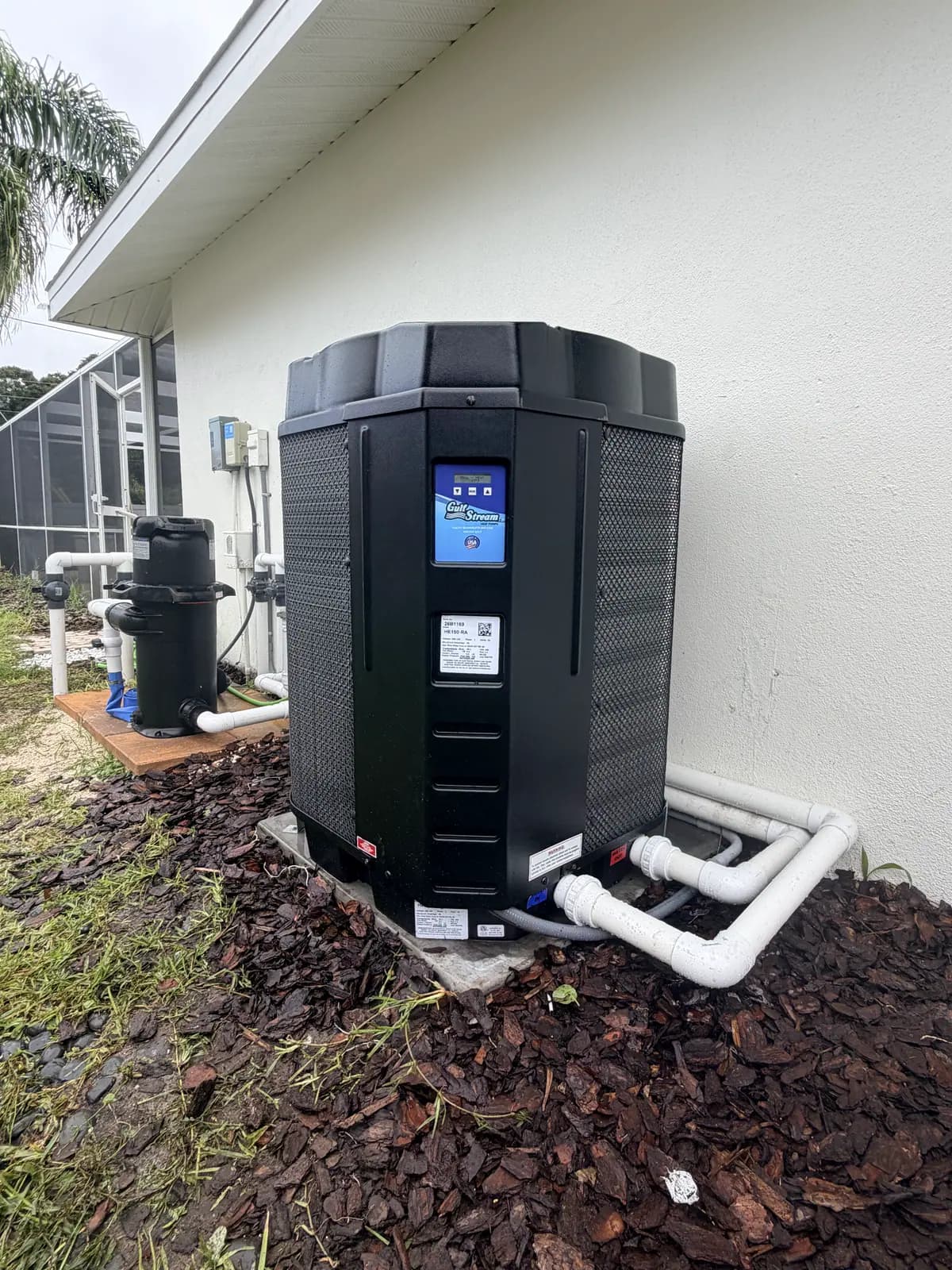
$3,500-$4,500The customer wanted a locally manufactured heater, and GulfStream is made right in North Fort Myers, Florida. We installed it alongside the existing filter and pump for efficient, thermostatically controlled pool heating.
See it in the gallery: GulfStream Heat PumpPool Equipment Rebuild
$11,500-$12,500A full rebuild of the pool's plumbing with new valves, a new electric heater and automation, plus pool solar to help hold the heat and lower the operating cost of the electric heater. Completed in 2024.
See it in the gallery: Pool Equipment RebuildHeater & Pool Equipment
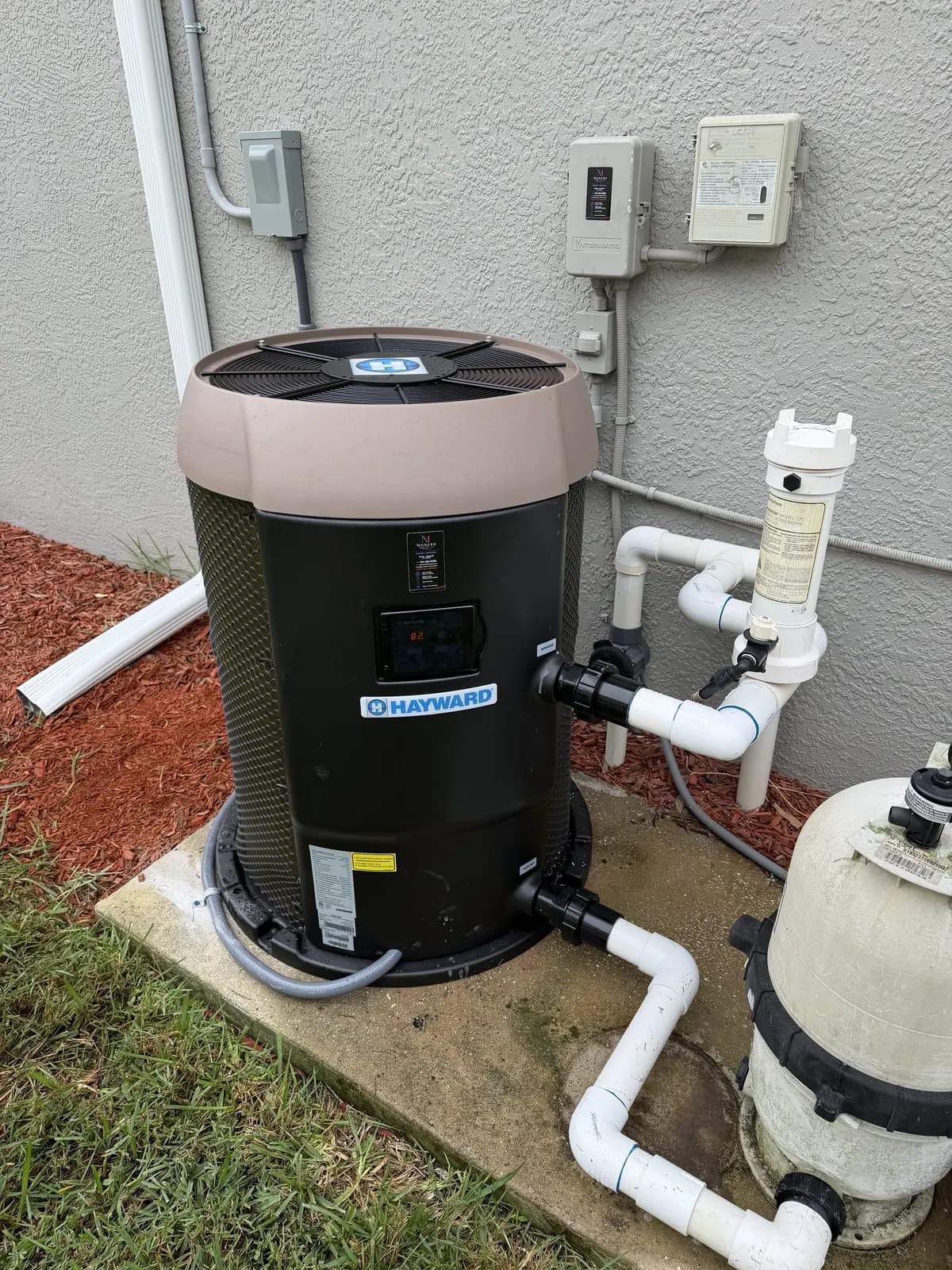
$8,500-$9,500Completed in 2025, this customer wanted a Hayward heater and pool equipment plumbing that is clean and aesthetically pleasing.
See it in the gallery: Heater & Pool EquipmentGulfStream Pool Heat Pump Installation
$3,995-$4,995A GulfStream pool heat pump, manufactured in North Fort Myers, Florida, set on the equipment pad and plumbed into the existing filter and pump.
See it in the gallery: GulfStream Pool Heat Pump InstallationReal installations
Recent jobs from our installation library that relate to this topic.