Modern Pool Heating · Owner/operator Henry Manna, Florida Certified Pool/Spa Contractor CPC1460367
Updated October 16, 2026
Short answer
A residential pool heat pump runs on 208-230 volt single-phase power, on a circuit sized from the unit's data plate: about 37 to 50 amps of minimum circuit ampacity for most of the models in our heater comparison, with maximum breaker ratings from 40 to 70 amps, and a disconnect within sight of the unit. Whether it needs an external bypass depends on the model and your pump: GulfStream's current manual says none is required up to 70 GPM, while Hayward's HeatPro installation calls for one. It works on a saltwater pool as long as the salt cell is plumbed after it, and it needs open air around it, typically 12 inches or more at the sides and four to five feet above.
What we usually recommend
Before you settle on a model, have the electrical panel checked, because the circuit decides more installs than anything else. If your pump is large or runs at high speed, plan for a bypass and set it with a flow meter. If you are on salt, the cell goes after the heat pump with a check valve between them. And put the unit where it can breathe: out in the open, off the house wall, clear of overhangs, sprinklers and roof runoff, on a level pad that drains.
- The heat pumps in our heater comparison run on 208-230 V single-phase power in their residential versions; circuit size varies from 37 A minimum circuit amps (GulfStream HE RA models) to 50 A at 230 V (Jandy JRT4001R).
- GulfStream's and Hayward's manuals both require a disconnect switch within line of sight of the unit.
- Bypass rules differ: none needed up to 70 GPM on a GulfStream (current manual), external bypass assembly on a Hayward HeatPro, bypass above 120 GPM on a Pentair UltraTemp.
- Plumbing order with salt: pump, filter, heat pump, solar, chlorinator or salt cell, pool.
- Expect several gallons an hour of condensation in humid weather (up to 3 on a GulfStream, typically 3 to 5 on Hayward, Built Right and Jandy units). It is not a leak.
Electrical service: voltage, circuit and breaker
Pool heat pumps for homes run on 208-230 volt, single-phase, 60 Hz power, the same kind of supply as a central air conditioner. The two numbers that matter on the data plate are the minimum circuit ampacity (MCA), which sets the minimum wire size, and the maximum breaker or overcurrent protection, which caps the breaker size. Hayward's manual says the minimum wire size is selected per the National Electrical Code from the unit's MCA, and that wiring must conform to NEC Article 680 for pools and Article 440 for air-conditioning and refrigeration equipment.
Voltage matters as well as amps. Hayward and Pentair both warn that supply voltage dropping below 208 V may damage the unit, and Pentair adds that it may void the warranty. On a long wire run from the house panel to a pad at the back of the lot, that is one reason the electrician sizes the wire for the distance as well as the load.
The table below gives the published figures for the heat pumps in our heater comparison. The circuit is often what decides the model on an older Sarasota or Bradenton home, where the panel may not have room for a 50 amp double-pole breaker without work.
| Model | Supply | Minimum circuit amps | Breaker / overcurrent | Water flow window | Clearances |
|---|---|---|---|---|---|
| GulfStream HE110-RA | 208-230 V, 1 phase | 37 A | 40 A maximum | 20 GPM minimum per spec sheet (30 in the manual) to 70 GPM; 45-50 optimal | 12 in each side, 4 ft above; outdoors only |
| GulfStream HE125-RA / HE150-RA | 208-230 V, 1 phase | 37 A | 50 A maximum | 30-70 GPM; 45-50 optimal | 12 in each side, 4 ft above; outdoors only |
| GulfStream HE125-TA / HE150-TA | 208-230 V, 1 phase | 37 A / 40 A | 50 A maximum | 30-70 GPM; 45-50 optimal | 12 in each side, 4 ft above; outdoors only |
| Hayward HeatPro HP21405T / HP31405T | 230 V, 1 phase | 42.5 A | 50 A recommended, 70 A maximum | 30-75 GPM; 60 recommended; external bypass assembly | 12 in perimeter, 24-36 in front, top open (72 in under an overhang), 60 in from the pool or spa wall |
| Pentair UltraTemp 140 H/C | 208-230 V, 1 phase | 43 A | 50 A recommended fuse, 70 A maximum | 30-120 GPM; bypass required above 120 | 24 in front, 12 in other sides, 5 ft above if under a cover, 6 in from the house wall, 5 ft from the pool wall unless a 5 ft barrier separates them |
| Jandy VersaTemp JRT3000R | 208/230 V, 1 phase | 40 A | 50 A maximum | 30-70 GPM; 57 optimal | 24 in front, 12 in rear and sides, 60 in above |
| Jandy VersaTemp JRT4001R | 208-230 V, 1 phase | 50 A at 230 V, 55 A at 208 V | 70 A maximum | 30-80 GPM; 64 optimal; manual's plumbing section calls for a bypass above 70 | 24 in front, 12 in rear and sides, 60 in above |
| Raypak Crosswind V 8550EHC | 208-230 V, 1 phase | 46 A minimum recommended | 60 A recommended | 20 GPM minimum recommended to 60 GPM (product page); bypass above 50 GPM, included with EHC models | 5 ft above, 12 in each side, 3 ft in front |
| AquaCal SQ140R | 208/230 V, 1 phase (3-phase versions exist) | 38.5 A | 60 A maximum fuse | 30-70 GPM; bypass kit required above 70 | Not in the records we compare |
| Built Right BR135XW | 208-230 V, 1 phase | Per the unit's data label | Per the unit's data label | 30-70 GPM; 45 recommended; bypass above 70 | 4 ft above, 6 in all sides, 24 in at the control panel |
| Moov Inverter MI900 | 208-230 V, 1 phase | Not in the records we compare | 30 A breaker | About 33-42 GPM (125-158 L/min) | Keep the air inlet and outlet free of obstacles (manual) |
| Thermeau Prestige TH125 | 230 V, 1 phase | 42.5 A | 70 A maximum | Not in the records we compare | Not in the records we compare |
Does it need a dedicated breaker and a disconnect?
In practice, yes, it gets its own circuit. Every manufacturer sizes the minimum circuit ampacity and maximum breaker for the heat pump alone, so the wire and breaker are chosen for that one appliance. GulfStream's manual says the heat pump's electrical supply must be installed by a qualified professional in accordance with the National Electrical Code and all applicable local codes; its installation manual says a qualified electrician must install the power to local code.
Both GulfStream and Hayward require a disconnect. GulfStream's manual says the installer must provide an electrical cutoff switch that interrupts all power to the unit, within line of sight of the heat pump, and to check local codes for further requirements. Hayward's says the same: an electric disconnect switch that interrupts all power, which must be within line of sight of the heat pump. That is what lets a technician work on the unit knowing nobody can switch it on from the house.
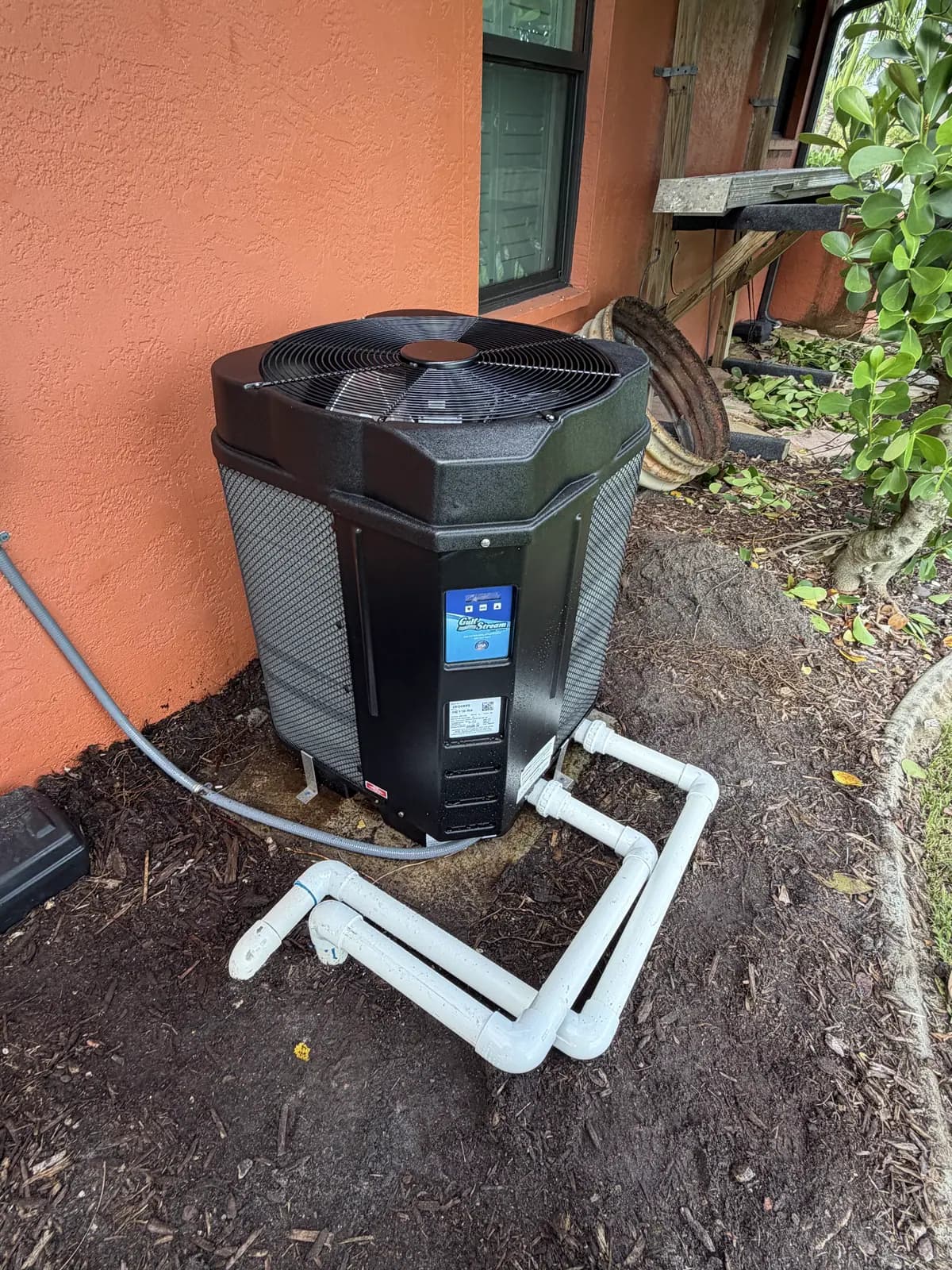
Bonding is the other non-negotiable. GulfStream's installation manual points to the bonding lug on the control box, says all metal and electrical components of the pool system must be bonded together, and states that damage from incorrect or missing bonding is not covered by the warranty. Hayward specifies a solid copper bonding conductor of No. 8 AWG or larger, and Built Right's manual says its warranty is void if the system is not properly bonded. GulfStream's installation manual also requires conduit all the way into the electrical box, because open wiring lets insects and lizards in and voids the warranty on the electrical components. On our Punta Gorda HE110-RA job, the power runs in flexible conduit from the wall to the unit, kept clear of the plumbing.
Does a pool heat pump need a bypass?
Every heat pump has a water flow window: too little flow and it will not run, too much and it wastes pump energy and can damage the exchanger. Whether you need an external bypass, a valve loop that sends part of the water around the heat pump, depends on how your pump's flow compares with the unit's maximum. GulfStream's current Installation and User Guide (March 2026) says no external bypass is required up to 70 GPM; the older G&F installation manual that Pentair also hosts says up to 60 GPM, so ask your installer which figure they are working to. AquaCal and Built Right both call for a bypass above 70 GPM, Pentair's UltraTemp above 120 GPM, and Raypak's Crosswind V 5550 to 8550 models above 50 GPM, with the bypass assembly included in the box on the heat-and-cool EHC models.
Hayward treats it as part of the installation. Its HeatPro manual specifies 30 to 75 GPM, warns that failing to install an external bypass assembly when flow reaches 75 GPM can cause damage, and describes setting the manual bypass valve with a temporary flow meter on the heater outlet, then removing the valve handle so nobody knocks it out of adjustment. Jandy's JRT4001R table allows 80 GPM, but the plumbing section of the same manual still calls for an external bypass above 70 GPM.
The more common Florida problem is the opposite: a variable-speed pump turned down so low that the heat pump does not get enough flow and reports no flow or locks out. The fix is programming a heating speed that lands inside the window. GulfStream's troubleshooting guide suggests about 40 to 50 GPM through the unit. A bypass with isolation valves also lets water skip the heat pump when it is not needed and lets the unit be serviced without draining the system, which is why unions and valves at the heater are worth having even when the flow does not demand a bypass.
Plumbing order with salt cells and solar
Yes, a pool heat pump works with saltwater, because the water side is titanium on every unit in our heater comparison. What protects it is where the salt cell sits. GulfStream's published sequence is pool pump, filter, heat pump, solar, chlorinating system, then the pool, with a check valve between the chlorinator and the heat pump to stop chlorinated water flowing back into the exchanger when the pump stops. Built Right's manual gives the same order without the solar: pump, filter, heater, chlorinator, pool, with any in-line chlorination device last.
Hayward's manual is just as specific: nothing should restrict the pipe between the heater outlet and the pool except a three-way switching valve, an in-line chlorinator or a chlorinator check valve. Jandy's manual allows salt pools up to 4,500 ppm with the sanitizer on the outlet side and a check valve between, and Raypak's water chemistry table also allows up to 4,500 ppm. Hayward's manual says its heat pumps are not for seawater, which it defines as above 5,000 ppm.
If solar heating shares the system, GulfStream's installation manual shows it plumbed after the heat pump. It says plumbing solar before the heat pump is possible but not recommended, because solar-warmed water entering the unit may stop it reaching the temperature the owner wants.
Where it goes: clearances, cold air and how close to the house
A heat pump pulls air through its coil and blows it out, colder, through the top. If that cold air cannot get away, the unit breathes it back in, loses capacity and, as GulfStream's installation manual puts it, goes into defrost. That is why the manufacturers publish clearances and why none of the manuals we have read allows a fully enclosed space: GulfStream warns that sheds and garages without proper ventilation may void the warranty on the refrigerant components, and Raypak says its up-flow Crosswind V must not go under a porch, a deck or inside a shed.
How close to the house? GulfStream asks for 12 inches on each side and four feet above, no overhang lower than four feet, and wants the unit completely isolated from the building foundation or wall so vibration does not carry into the house. It also suggests locating the heat pump as close to the pool pump and filter as possible to minimize pressure and heat loss. Hayward publishes best-practice clearances but notes its testing allows the coil sides as close as 12 inches to a wall or fence, wants 72 inches under any overhang with the area open on three sides, and 60 inches from the inside wall of the pool or spa. Pentair asks for 6 inches from the house wall on the UltraTemp and 5 feet from the pool wall unless a 5 foot barrier separates them.
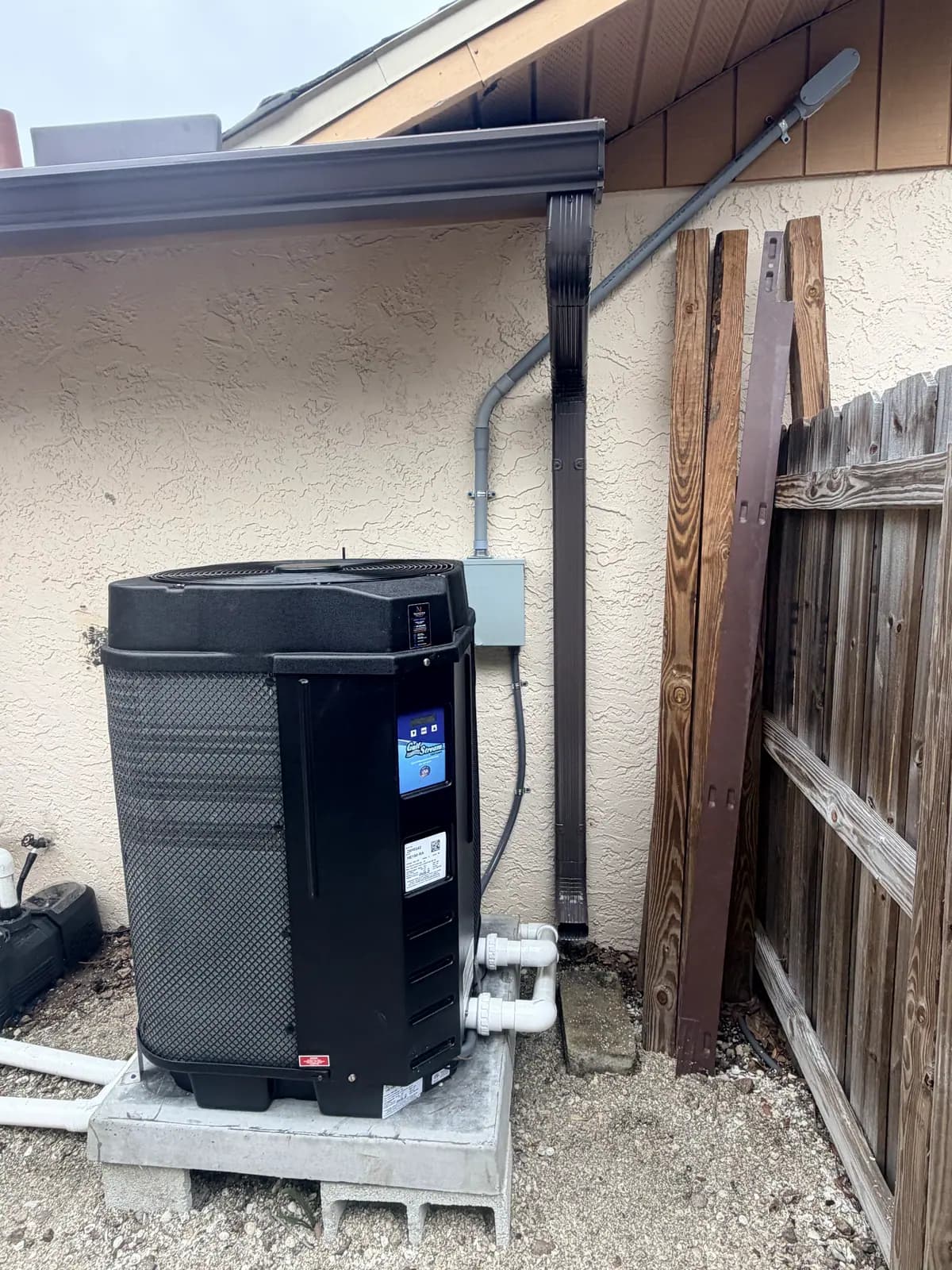
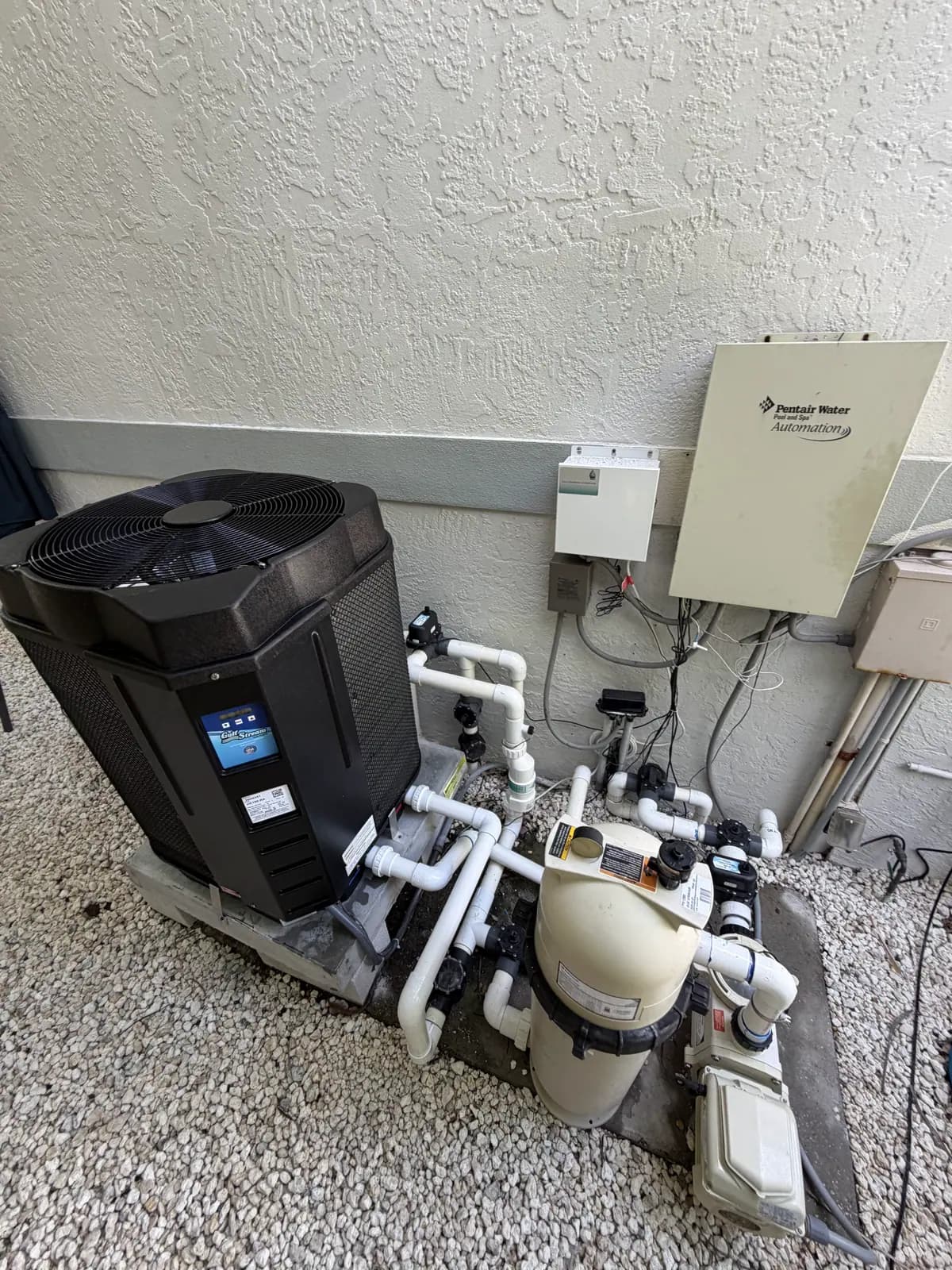
Our own jobs show what that looks like on real lots. In Dunedin the HE150-RA sits on its own pad off the house wall with open air around it, plumbed back in PVC to the existing filter and valve manifold. In Tampa the side yard between the house and a wood fence is narrow, but the unit still has open air above and on its open sides. Hayward also suggests direct sunlight, keeping growing shrubs away from the airflow areas, and keeping ground-level spray, including sprinklers, off the unit.
Condensate drainage and the pad
A running heat pump condenses water out of humid air, and in Florida that is a lot of water: GulfStream says up to 3 gallons an hour, and Hayward, Built Right and Jandy say typically 3 to 5. It drains out of the base, which is why the pad matters. GulfStream wants a flat concrete or fabricated pad with a slight grade so condensation drains away; Hayward wants a level surface, ideally at the same height as or slightly above the filter equipment pad, and accepts concrete-over-foam equipment pads.
On the Tampa job there was no pad where the heat pump needed to go, so the crew leveled concrete block on the gravel first; a unit that is not level drains unevenly and can rock on its feet. On Treasure Island the pad sits up out of a white rock bed so rain and irrigation drain away from the base. Hayward's manual also covers anchoring to the pad with clamps where local codes require it for wind load.
If you find water under the unit, GulfStream's test is simple: turn the heat pump off, leave the circulation pump running and check again in an hour. If the water has stopped, it was condensation. Pool water contains chlorine and condensation does not, so a chlorine test strip on the puddle settles it too. Water that keeps coming with the heat pump off can mean an internal leak and needs a service call.
How noisy is a pool heat pump?
Only a few manufacturers publish a sound figure, and they measure it differently, so the numbers cannot be lined up against each other. Moov's manual specifies 50 dB(A) or less at 10 feet for every Moov Inverter model, and Moov's technology page claims as low as 48 dB at 1 meter at half speed. Raypak publishes 64 dBA for the Crosswind V and as low as 34.9 dB for its smaller inverter Crosswind models, without stating the distance in what we have on record.
The others describe noise features without a number. GulfStream's manual credits a low-RPM fan motor, a deep-drawn venturi and an engineered fan blade for quiet operation; Hayward's HeatPro manual lists a compressor sound blanket; Jandy describes SoundShield, a swept-wing fan blade and an acoustic blanket, across the VersaTemp line. GulfStream also notes that a noise at start-up that stops after a few minutes can come from the compressor's starting position and does not need service, while noise that continues does.
Placement does as much as the specification. A unit isolated from the house wall, as GulfStream requires, does not send vibration into the structure, and on a zero-lot-line property it is worth thinking about which window the fan will face before the pad is poured.
Real installations
Recent jobs from our installation library that relate to this topic.