Modern Pool Heating · Owner/operator Henry Manna, Florida Certified Pool/Spa Contractor CPC1460367
Updated October 16, 2026
Short answer
Size a pool heater on the pool's surface area and the temperature rise you want over the coldest month you plan to swim, not on gallons alone; volume mainly decides how long a cold pool takes to warm back up. The Department of Energy's starting formula is surface area x temperature rise x 12 for the BTU per hour of heat output needed, which for a 15 by 30 foot Sarasota-area pool held at 80°F through January works out to roughly 95,000 BTU/hr. Size a heat pump against its capacity in cool air, size a gas heater for how fast you want heat (its rating is input, not output), and size solar by collector area, typically 50-100% of the pool's surface.
What we usually recommend
If the pool is screened and you hold one temperature most of the year, we'd usually choose a heat pump whose capacity in cool air, not just at the 80°F rating, still covers the January load. If you have an attached spa or heat on demand, we'd size the gas heater for the spa and the heat-up time you want, then confirm the gas line can actually feed it. If the pool is exposed to wind or sits on the water, we'd size up rather than down, and put a cover on the quote either way.
- Surface area sets how much heat a pool loses; gallons set how long it takes to warm from cold.
- DOE starting point: surface area (sq ft) x temperature rise (°F) x 12 = BTU/hr of output, assuming a 1-1.25°F per hour rise and a 3.5 mph wind.
- Sarasota-Bradenton's January average is 62.4°F (NWS 1991-2020 normals), so holding 80°F means planning for about an 18°F rise.
- Heat pumps: check the capacity at 50°F air, which can be about 40% below the 80°F rating. Gas: output is BTU input x thermal efficiency.
- Solar: collector area of 50-100% of the pool's surface; DOE says 100% for year-round use in Florida.
Surface area sets the size; volume sets the wait
A pool loses heat from its surface: to evaporation, to the air above it and to the wind moving across it. DOE's sizing guidance starts there, saying a heater is sized according to the pool's surface area and the difference between the pool and average air temperatures, with wind exposure, humidity and cool nights adding to the load. Two pools with the same footprint lose heat at nearly the same rate even if one is much deeper.
Volume still matters, but for a different question. It decides how much heat it takes to bring the pool up from cold, at 8.34 BTU per gallon per degree, so a deep pool takes longer to recover after a cold front even though it does not need a bigger heater to hold its temperature. A sensible sizing conversation covers both: how much heat the pool loses on a typical cold day, and how long you are willing to wait after it has dropped.
Our pool heat pump sizing guide works through the DOE formula and the cold-air derate in detail. This page covers the wider decision: how sizing works differently for heat pumps, gas heaters and solar, and what spas, screens and exposure do to the answer.
The starting formula, with Sarasota's own weather
DOE publishes the same approximate method for gas heaters and heat pumps: decide the pool temperature you want, find the average air temperature for the coldest month you plan to swim, subtract to get the temperature rise, measure the surface area, and multiply. Surface area x temperature rise x 12 = BTU per hour of heater output. DOE says the formula assumes a 1 to 1-1/4°F rise per hour and a 3-1/2 mph average wind at the pool surface; multiply by 1.5 for a 1-1/2°F per hour rise or by 2.0 for 2°F per hour. It also says a trained pool professional should do the actual sizing analysis.
For the coldest-month figure, the National Weather Service's 1991-2020 normals for Sarasota-Bradenton put January at an average of 62.4°F (average high 72.5°F, average low 52.3°F), with December at 65.2°F and February at 64.8°F. Holding a 15 by 30 foot pool (450 square feet) at 80°F through January means a rise of about 17.6°F: 450 x 17.6 x 12 = about 95,000 BTU/hr of output. Holding 84°F makes the rise about 21.6°F and the answer about 117,000 BTU/hr. Stop heating after November and the numbers shrink; swim through January at 85°F and they grow.
Treat those as starting points, not answers. The formula describes an uncovered pool in average wind. A cover, a screen enclosure or a sheltered yard lowers the real requirement, and a breezy waterfront lot raises it.
| Pool (surface area) | Hold 80°F (17.6°F rise) | Hold 84°F (21.6°F rise) |
|---|---|---|
| 12 x 24 ft (288 sq ft) | About 61,000 BTU/hr | About 75,000 BTU/hr |
| 15 x 30 ft (450 sq ft) | About 95,000 BTU/hr | About 117,000 BTU/hr |
| 16 x 32 ft (512 sq ft) | About 108,000 BTU/hr | About 133,000 BTU/hr |
| 18 x 36 ft (648 sq ft) | About 137,000 BTU/hr | About 168,000 BTU/hr |
Heat pumps: size for the cold-air number
A heat pump's headline capacity is measured at 80°F air, 80°F water and 80% humidity, and in cooler air it delivers less. Hayward publishes the HP21405T at 138,000 BTU/hr at that rating point, 128,000 BTU/hr at 80°F air and 63% humidity, and 82,000 BTU/hr at 50°F air. Raypak publishes its Crosswind V 8550 at 137,000, 129,000 and 85,000 BTU/hr across the same three conditions. Sarasota's January average of 62.4°F sits between those test points, so the capacity you actually get on a typical January day falls between the published numbers, and on the coldest mornings it is close to the 50°F figure.
So compare heat pumps on their 50°F capacity where the manufacturer publishes it, and treat the 80/80/80 number as a ceiling. GulfStream publishes COP at the low test point (at least 4.0 on every HE model) but not capacity there, so for GulfStream the practical comparison is the 80/80/80 rating: HE110-RA 110,000, HE125-RA 118,000 and HE150-RA 138,000 BTU/hr. Moving up a size mostly buys recovery time after a cold front.
Another published yardstick comes from California, where Title 24 sizes a pool heat pump on its ability to raise the pool 10°F within 17.5 hours at the 80°F air, 63% humidity condition. Raypak prints the resulting maximum pool size for each Crosswind V model, 27,101 gallons for the 129,000 BTU/hr heat-and-cool 8550. Florida does not use that rule, and Raypak notes the formula ignores wind and heat loss, but it is a quick check on whether a heat pump is in the right range for a pool's volume.
Gas heaters: size for the heat-up you want, then check the gas line
A gas heater's output does not fall when the air cools, so DOE's formula holds all year. What changes is the label: gas heaters are sold by BTU input, so a 250,000 BTU heater at 84 percent thermal efficiency delivers about 210,000 BTU/hr and a 400,000 BTU heater about 336,000 BTU/hr. Both cover a typical pool's January holding load by a wide margin; the real difference between them is speed, which matters most for spas and for heating on demand.
Manufacturer guidance reflects that. Hayward's own chart puts its 250,000 BTU heater at roughly 750 square feet of pool surface, based on a 30°F rise, a 3.5 mph average wind and an elevation up to 2,000 feet, and Hayward rates its 250 and 400 at the same 84 percent thermal efficiency. A bigger gas heater buys speed without costing efficiency, but it costs in other places.
Mostly it costs in the gas supply. Pentair's natural gas table allows a MasterTemp 250 to run 3/4-inch pipe for 20 equivalent feet and 1-inch for 70 feet, while a MasterTemp 400 needs 1-inch pipe just to reach 20 feet and 1-1/4-inch to reach 100, with 3 feet added for every elbow. Pentair's ETi 400 does not allow 3/4-inch pipe at all on natural gas. A larger heater can also mean larger venting, a bigger meter or propane tank, and a higher minimum flow for the pump to meet (25 GPM on the MasterTemp 250, 40 GPM on the 400). A heater the gas line cannot feed will never deliver its rating.
Solar: size by collector area
Solar is sized in square feet of collector rather than BTU. DOE's guideline is collector area equal to 50 to 100 percent of the pool's surface area, more in cooler or cloudier places, and it says a 15 by 30 foot pool in Florida typically needs collectors equal to 100 percent of its area, about 450 square feet, for year-round use. Adding collector area lengthens the swimming season, and DOE says a pool cover usually lets you install less.
The roof decides how much of that you can actually fit. DOE puts the best orientation at true south, with collectors facing up to 45 degrees east or west of south losing little performance, and says they can usually be mounted flat on the roof if the roof angle is accounted for in sizing. An array that only fits half the area a pool needs will underperform, which is why we size solar from the pool's surface area first and then see what the roof can take.
Solar also needs the right pump. DOE notes that a system replacing a conventional heater may need a larger pump, or a separate smaller pump, to move water up to and through the collectors. Our article on how many solar panels a pool needs covers panel counts and layouts.
Attached spas change the math
A spa is a small body of water you want very hot on short notice, which makes it a heat-up problem rather than a holding problem. Manufacturer figures show why gas usually ends up on the pad: Hayward's table puts its 400,000 BTU heater at about 18 minutes and its 250,000 BTU heater at about 29 minutes to raise a 400-gallon covered, insulated spa by 30°F, and Pentair estimates 27 minutes for a MasterTemp 400 to raise a 600-gallon spa by 30°F.
Heat pumps warm a swimming pool gradually over many hours. Actual heating speed depends on pool volume, heater output, starting water temperature, outdoor air temperature, humidity, wind conditions and whether the pool is covered. A spa is smaller, but the same physics applies, and a heat pump's output falls on the cool evenings when spas get used most: Hayward's HP21405T delivers 82,000 BTU/hr at 50°F air against 138,000 BTU/hr at its rating point. If you use the spa often and want it hot quickly, gas may make more sense than relying entirely on a heat pump, even if a heat pump carries the pool.
When a spa is in the picture, we size the gas heater for the spa's heat-up first and then check that it also covers the pool's January load, which at these sizes it nearly always does. The 400 is the usual answer for a pool and spa that both get used; the 250 for a pool with no spa or a spa that only gets used now and then.
Screened, sheltered or exposed
DOE says pools in places with higher wind speeds at the surface, lower humidity and cool nights need a larger heater, and that evaporation, the largest heat loss, rises with wind speed. A screen enclosure blocks much of that wind, and with it some of the evaporation. For windy sites DOE suggests a windbreak of trees, shrubs or a fence, high and close enough not to create turbulence over the water, and not so tall it shades the pool from the sun.
Screens and walls cut both ways for a heat pump. GulfStream asks for 12 inches on each side and 4 feet clear above, outdoors only, and its installation manual warns that enclosed spaces and low overhangs recirculate the cold discharge air and reduce capacity. A heat pump wedged into the corner of a lanai can behave like a smaller unit, which undoes the sizing work.
Exposed pools on canals, bays and the barrier islands are usually the windy ones, so we size those assuming the wind factor is real, and we push harder for a cover. A cover is the cheapest sizing tool there is: DOE says covering a pool when it is not in use can cut heating costs by 50 to 70 percent, because it shrinks the job the heater has to do.
What oversizing and undersizing actually cost
With heat pumps, undersizing is the mistake to avoid. An undersized heat pump holds temperature on mild days and falls behind on cold ones, and because its output drops in cool air, it falls behind exactly when you want the heat. Going up a size does not waste energy per BTU delivered, since efficiency comes from the COP at the conditions of the moment; it costs more up front and may need a larger circuit, though within the GulfStream HE line the 118,000 and 138,000 BTU/hr heat-only models share the same 50 amp maximum breaker.
Gas works the other way. An undersized gas heater still runs at full efficiency and simply takes longer. An oversized one brings real costs: a bigger gas line, venting, meter or tank, a higher minimum flow for the pump to meet, and more cycling. Our heater comparison notes put the 250 size where most residential pools sit: the Pentair MasterTemp 250 for an average-sized pool with no spa, and the Hayward H250FDN for an average-sized pool or one with a small spa.
Every heater also has a flow window that sizing has to respect: GulfStream's HE models want 30 to 70 GPM (45-50 optimal) and Hayward's HP21405T 30 to 75 GPM (60 recommended). A heater the existing pump cannot feed correctly is the wrong size for that pad, whatever the label says. We measure the pool, look at the enclosure, the pump and the electrical panel, and size from there, and we will tell you when the honest answer is a cover and the heater you already own.
Real installations
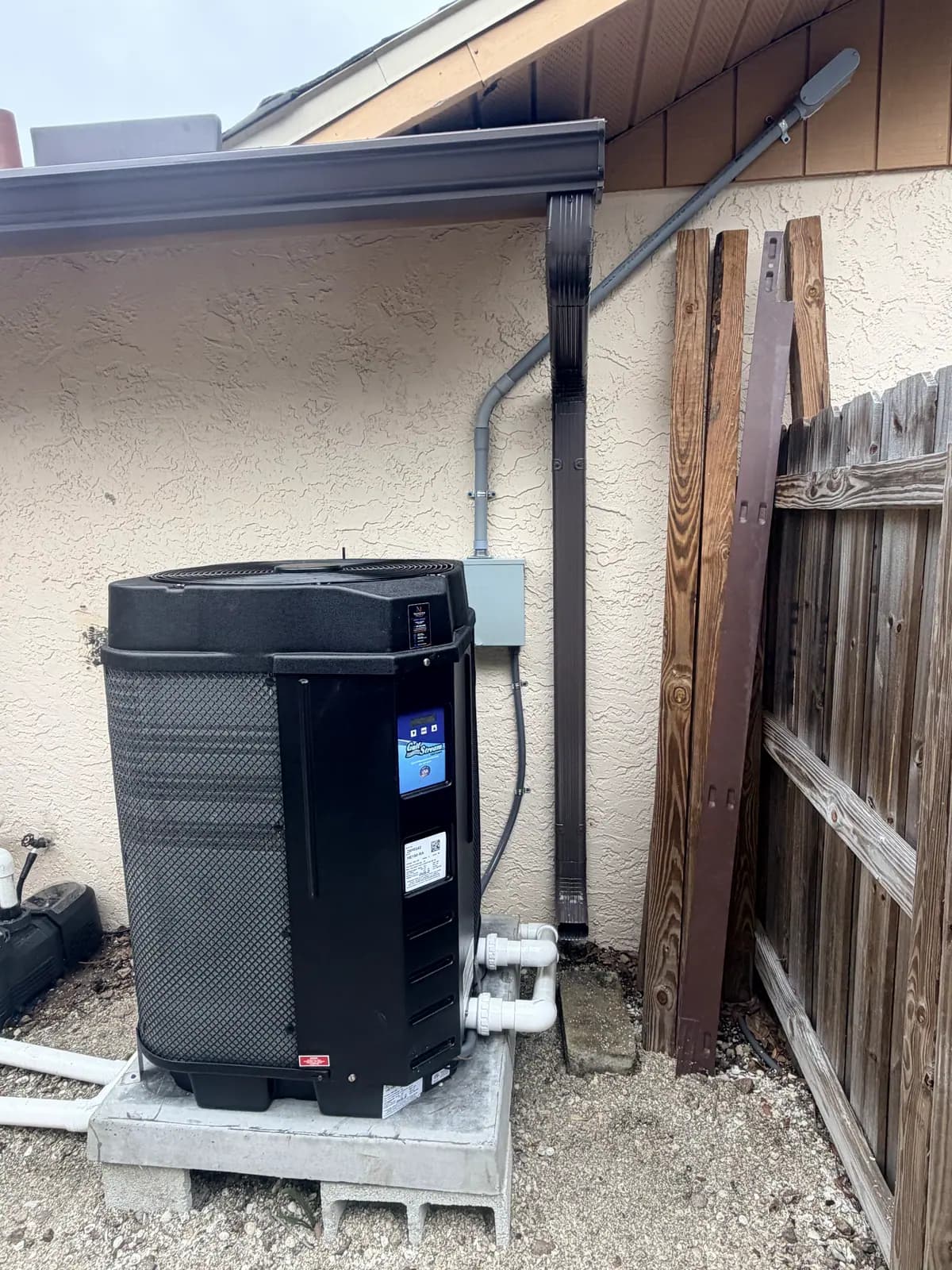
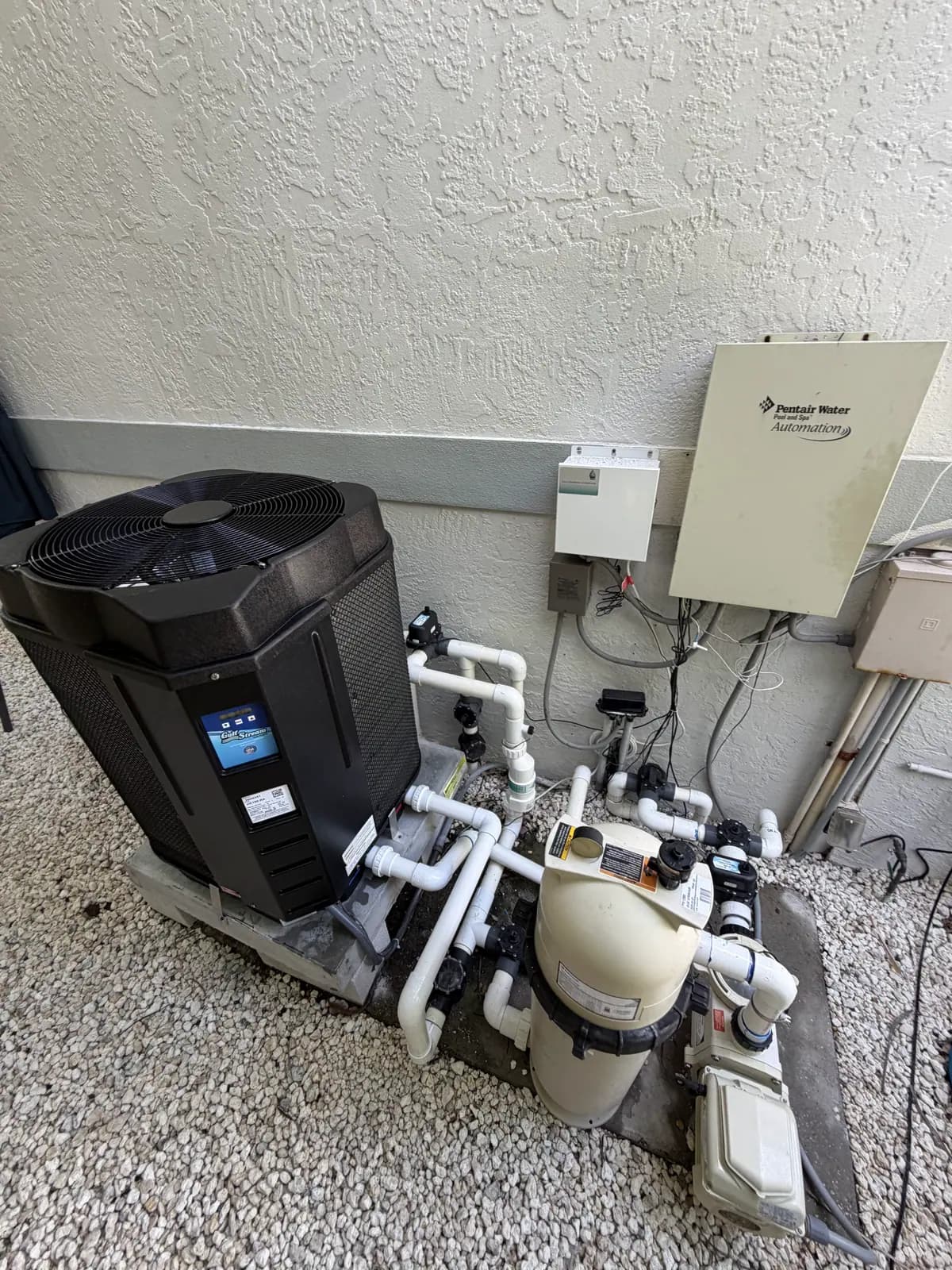
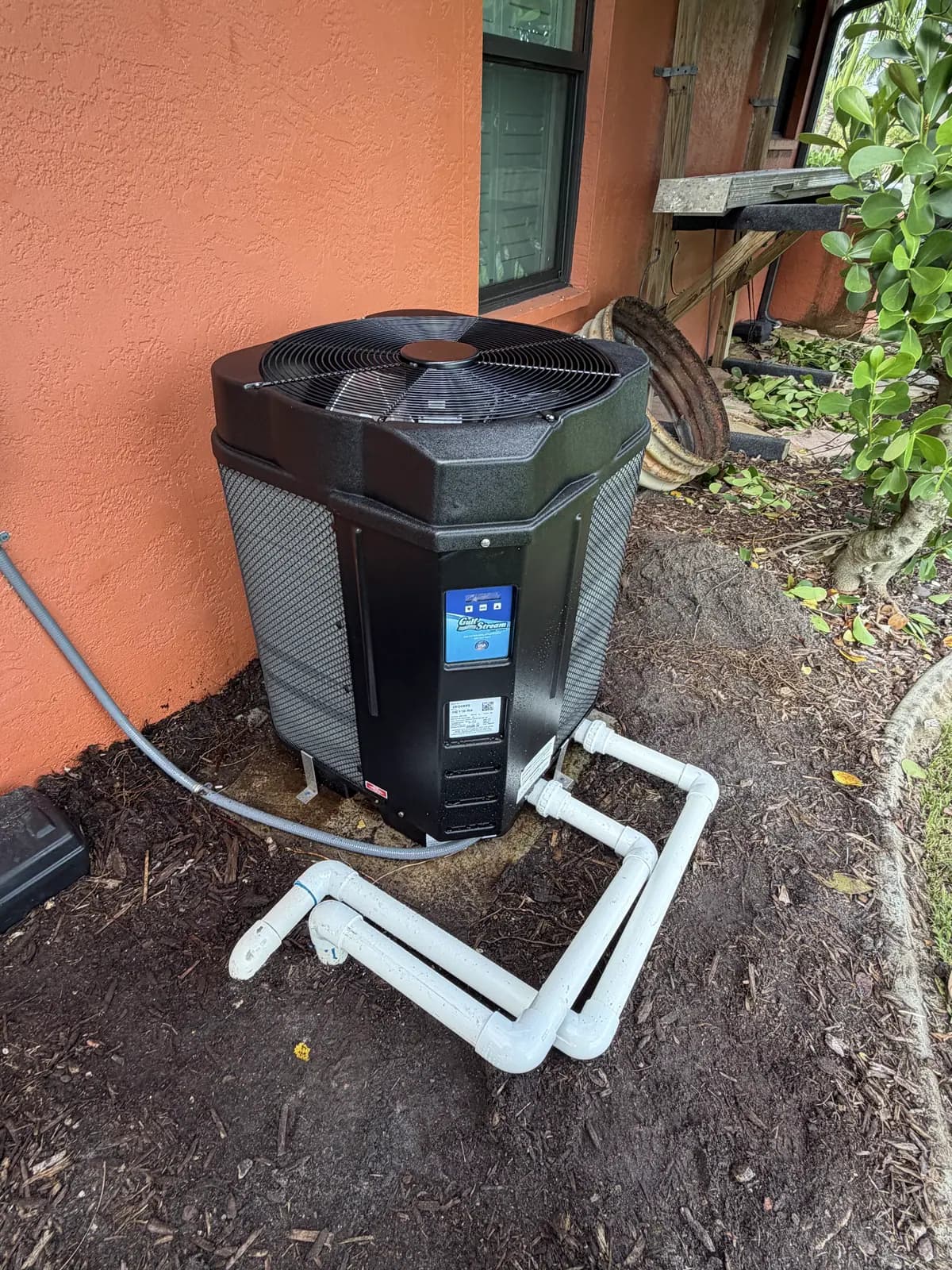
Recent jobs from our installation library that relate to this topic.