Modern Pool Heating · Owner/operator Henry Manna, Florida Certified Pool/Spa Contractor CPC1460367
Updated October 16, 2026
Short answer
For most Sarasota pools, an electric heat pump with a titanium heat exchanger is the best fit: Sarasota-Bradenton's January averages 62.4°F, mild enough that a correctly sized heat pump runs efficiently through most of the winter. On the barrier islands, Siesta Key, Longboat Key and Lido, the cabinet, coil and exchanger materials and where the unit sits matter as much as the BTU rating, and solar is a strong partner wherever the roof has the room and orientation. Gas makes sense for spas and occasional use, but natural gas reaches some Sarasota streets and not others, so confirm your fuel before choosing.
What we usually recommend
If you're inland with a screened pool you swim in most of the year, we'd usually recommend a heat pump sized for January plus a cover. If you're on Siesta Key, Longboat Key or Lido, we'd choose a heat pump with a titanium exchanger and a non-metallic cabinet, site it out of direct spray, and raise it if the lot floods. If you're in Lakewood Ranch or Palmer Ranch and want solar, we'd start the architectural review paperwork early. And if you have a spa you use often, we'd add gas for it once we've confirmed what fuel actually reaches your street.
- Sarasota-Bradenton in January: 62.4°F average, 52.3°F average low (National Weather Service, 1991-2020 normals).
- A heat pump fits most Sarasota pools; size it for January, not for the 80°F rating point.
- Barrier islands: titanium exchangers, non-metallic cabinets, siting out of spray, regular coil rinsing and, where needed, raised equipment.
- Natural gas varies street to street, and propane is the usual fallback.
- Florida law limits an HOA's power to prohibit solar collectors, though it can set their location within a south-facing orientation.
What 'best' means for a Sarasota pool
This page is the planning conversation; our Sarasota service-area page covers who we are, where we work and how to book. The short version of that conversation is that most Sarasota pools are best served by a heat pump, many by a heat pump plus solar, and a smaller number by gas, usually because of a spa or occasional use.
Which group your pool falls into depends less on Sarasota as a whole and more on where in Sarasota you are: on a barrier island or inland, in an HOA community or not, on a street with natural gas or without, under a screen enclosure or open to the wind. Our statewide article on the best pool heater for Florida covers the three heater types in general. Here we look at the local factors that change the answer, and at real jobs in the area.
Sarasota's winter, in numbers
The National Weather Service's 1991-2020 normals for Sarasota-Bradenton put January, the coldest month, at an average of 62.4°F, with an average high of 72.5°F and an average low of 52.3°F. December averages 65.2°F, February 64.8°F and March 68.1°F. DOE says pool heat pumps work efficiently as long as the air stays above the 45-50°F range, so most hours of a Sarasota winter fall inside it, with the coldest mornings dipping toward the edge.
That is why heat pumps suit Sarasota so well, and also why they have to be sized for January. Hayward rates its HeatPro HP21405T at 138,000 BTU/hr at 80°F air but 82,000 BTU/hr at 50°F air, and the mornings near that 50°F test point are when a pool loses heat fastest. Using DOE's sizing formula with the January average, a 15 by 30 foot pool held at 80°F needs about 95,000 BTU/hr of output before allowing for a cover or a screen. Our sizing article walks through the arithmetic.
Heat pumps warm a swimming pool gradually over many hours. Actual heating speed depends on pool volume, heater output, starting water temperature, outdoor air temperature, humidity, wind conditions and whether the pool is covered. In Sarasota that mostly means a heat pump left at a setpoint carries the pool through the season comfortably, while one switched on from cold the morning after a front has a long climb ahead of it.
Barrier islands: Siesta Key, Longboat Key and Lido
Pools on the barrier islands sit in salt air that pools a few miles inland rarely see, and salt works on cabinets, fasteners, coils and electrical connections as well as on the heat exchanger. The exchanger part of the decision is straightforward for heat pumps: every heat pump in our heater comparison uses titanium on the water side. The rest of the unit is where models differ. GulfStream's HE Series and Jandy's VersaTemp use ABS cabinets, Pentair describes the UltraTemp cabinet as a corrosion-resistant composite, and Built Right uses a polymer housing; Raypak's Crosswind V uses a powder-coated metal cabinet, which our heater comparison notes is less forgiving within reach of salt spray. Hayward coats the HP21405T's microchannel air coil with a Trivalent Chromium Process finish for corrosion protection.
Where the unit sits matters as much as what it is made of. Hayward's HeatPro manual says that in an oceanfront area the unit should be placed out of direct spray of sand and salt, and suggests a barrier against the prevailing beachfront wind, outside the minimum clearances. GulfStream's manual says a unit near salt water needs its coil cleaned regularly to remove salt and sand, with a low-pressure garden hose and a very soft brush, the power off and the control box kept dry. Irrigation counts too: both GulfStream and Hayward warn against sprinklers spraying or misting the unit.
For gas on the keys, the exchanger material is a live choice. Hayward fits cupro-nickel as standard on its Universal H-Series, Pentair offers it on the MasterTemp HD (82 percent thermal efficiency versus 84 percent for the copper version, natural gas only), and Raypak's AVIA HD uses its NiTek alloy. Our coastal article goes deeper on all of this.
Flooding is the other island issue. Florida's Office of Floodplain Management says the Florida Building Code generally requires equipment in flood hazard areas to sit at or above the base flood elevation plus one foot (some communities require more), and allows pool equipment lower only if it is elevated as far as practical, anchored against flotation and flood forces, and fed by GFCI-protected circuits. One of our gallery jobs is exactly this: on Siesta Key, a homeowner wanted his pool equipment elevated, and the heat pump now sits on a wall-mounted platform clear of the ground. That specific project cost $4,500-$6,500; it is a past job, not a quote.
Screened lanais and tight side yards
Screen enclosures are common across Sarasota, and they help any heater: DOE says evaporation, the largest source of heat loss, rises with wind speed, and a screen cuts the wind over the water. They also shade the pool somewhat, which reduces the sun's free contribution, so a screened pool is not automatically a cheaper pool to heat, just a less windy one.
The bigger issue is where the heat pump goes. A heat pump moves a lot of air, and if it is crowded against a screen wall, tucked into a corner or under a low overhang it breathes its own cold discharge air and loses capacity. GulfStream asks for 12 inches on each side and 4 feet clear above; Hayward asks for 12 inches around the perimeter, 24 to 36 inches at the front, an unobstructed top and 60 inches from the pool or spa wall; Pentair asks for 5 feet from the pool or spa wall on the UltraTemp unless a 5-foot barrier separates them. If the unit sits under a roof edge, GulfStream wants a gutter so roof water does not pour onto it, and Raypak's Crosswind V manual says damage from roof runoff landing on the unit is not covered under warranty.
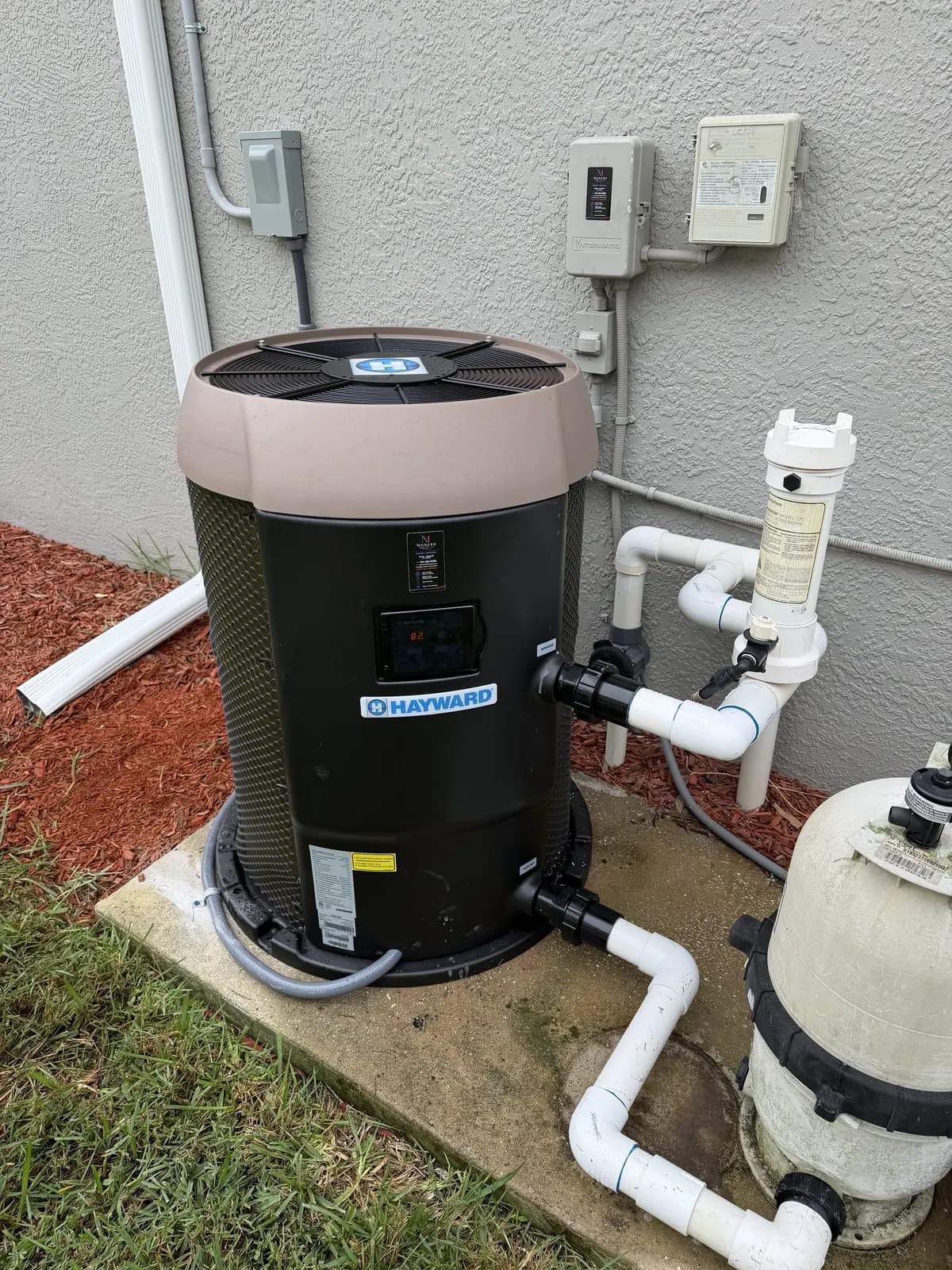
Shared pads need room for everyone. Pentair asks for 36 inches between a MasterTemp gas heater and an air conditioner or heat pump. On our Sarasota Hayward heat pump job, the unit went on the existing concrete slab beside the filter, which kept the plumbing between them short and direct, and before leaving we walked the homeowner through the controls.
HOA communities: Lakewood Ranch and Palmer Ranch
Lakewood Ranch, Palmer Ranch and the newer communities around them typically run an architectural review process, and roof-mounted solar or equipment visible from the street or a neighbor's lot usually needs approval before work starts. It pays to start that paperwork early.
Florida law sets the outer limits on solar. Section 163.04 of the Florida Statutes says a deed restriction, covenant or similar agreement may not prohibit solar collectors, and that an association may not deny a homeowner permission to install them. The association may decide where on the roof the collectors go, within an orientation to the south or within 45 degrees east or west of due south, as long as that does not impair their effective operation. That is not legal advice, but it is useful context when a review board is involved.
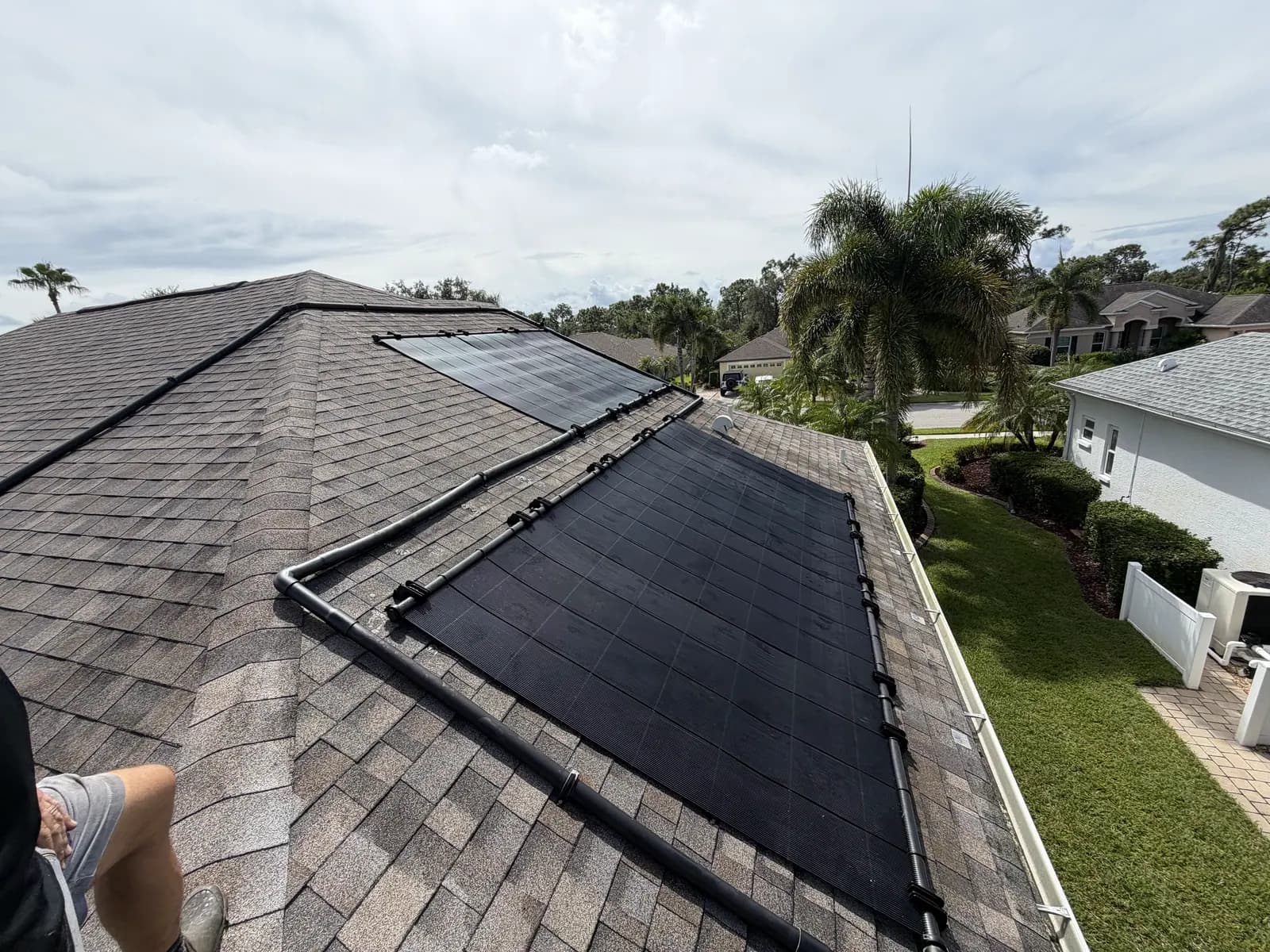
Appearance is part of the job in these communities. On our Lakewood Ranch solar installation, the collectors sit on two adjoining shingle roof planes and the supply and return lines are dark rather than white, so the plumbing reads as part of the roof from the street. If an HOA wants a heat pump screened from view, the screen has to respect the unit's airflow clearances, or the heat pump will perform like a smaller one.
Natural gas is street by street
Some Sarasota streets have natural gas at the curb and some do not, even close together. Where there is no gas main, propane is the normal answer, and it changes the tank siting, the gas line and the heater itself: most gas heaters are built for one fuel or the other (Hayward's H400FDN is natural gas and the H400FDP propane), and Pentair's cupro-nickel MasterTemp HD models are natural gas only.
Fuel also changes the running cost. Using the EIA prices in our cost guide, a million BTU of delivered pool heat costs roughly $29 on Florida natural gas and about $46 on propane at East Coast prices, both at 84 percent thermal efficiency, against about $9 on a heat pump at a COP of 5.0. For a spa used on weekends that is manageable; as the everyday winter heater for the pool, it adds up quickly.
Before falling for a gas heater, check what fuel the address actually has and how far the meter or tank is from the pad. Pentair's table for a natural gas MasterTemp 400 allows 1-inch pipe for only 20 equivalent feet, so a long run can mean upsizing the line. Our natural gas versus propane guide covers the rest.
Real jobs in and around Sarasota
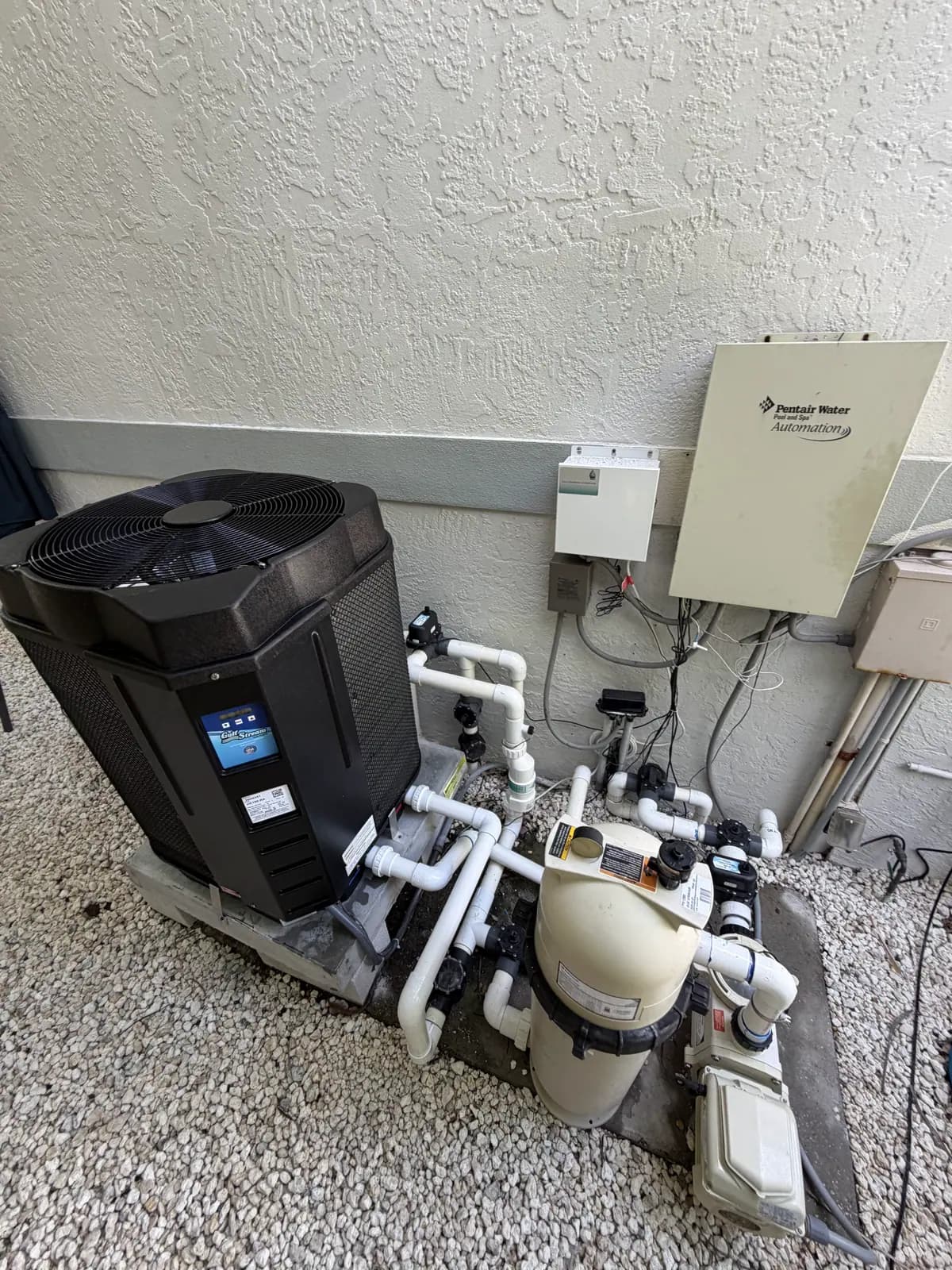
On Siesta Key we installed a heat-only GulfStream HE150-RA on a barrier-island pad it shares with a Pentair automation panel, a cartridge filter and a pump, so the plumbing had to thread between them. The HE150-RA ties into automation through dry-contact remote thermostat terminals rather than a Pentair data connection. Also on Siesta Key is the equipment-elevation job described above.
In Sarasota our projects include a Hayward heat pump set on an existing slab beside the filter, and our gallery includes a new Hayward gas heater plumbed into the equipment pad with clean, serviceable PVC runs. In Lakewood Ranch there is the solar installation with dark roof plumbing. Each one appears on our projects and gallery pages with photos, and our community pages for Siesta Key, Longboat Key, Lakewood Ranch and Palmer Ranch cover what is specific to each place.
Pros and cons
Heat pump in Sarasota
Pros
- January averages 62.4°F, so it runs in its efficient range most of the winter.
- Titanium exchangers suit salt pools and the keys.
- Works on any street, with or without natural gas.
Cons
- Output drops on the coldest mornings, so size for January.
- Needs airflow clearance, which can be tight in a lanai corner or side yard.
- Often needs a 40-50 amp, 240-volt circuit, which some older panels cannot take without work.
Solar in Sarasota
Pros
- No fuel cost, and strong sun most of the year.
- Pairs well with a heat pump for year-round swimming.
- State law limits an HOA's ability to prohibit it.
Cons
- Needs enough unshaded roof facing within about 45 degrees of south.
- HOA review of placement in communities like Lakewood Ranch and Palmer Ranch.
- Little help on cloudy winter days.
Gas or propane in Sarasota
Pros
- Fastest heat, best for spas and occasional use.
- Holds temperature on the coldest nights.
Cons
- Natural gas is not available on every street; propane costs more per degree.
- Highest running cost as an everyday winter pool heater.
- Copper exchangers are a poor match for salt air and salt pools; choose cupro-nickel, NiTek or titanium on the keys.
Real installations
Recent jobs from our installation library that relate to this topic.