Modern Pool Heating · Owner/operator Henry Manna, Florida Certified Pool/Spa Contractor CPC1460367
Updated October 16, 2026
Short answer
There is no single best pool heater for Florida; the right one depends on how often you swim, whether you have a spa, and what your roof, electrical panel and gas service allow. For a typical screened Southwest Florida pool used most of the year, an electric heat pump is usually the best fit, because it is one of the lowest-cost powered ways to heat a pool and our mild winters keep it in its efficient range. Solar is one of Florida's lowest-operating-cost methods when the home has suitable roof orientation and sun exposure, and gas is the fastest way to heat a pool or spa on demand, at the highest cost per degree.
What we usually recommend
If you swim most weeks of the year and the pool is screened, we'd usually install a heat pump with a titanium heat exchanger, sized for January rather than for the spec-sheet rating, plus a solar blanket. If you have good unshaded roof area, adding solar lets that heat pump run far fewer hours. If you use an attached spa often and want it hot quickly, gas makes more sense than relying entirely on a heat pump. And if the pool only gets used a few weekends a year, gas on demand usually costs less overall than a heat pump that sits idle between visits.
- Heat pump: the usual choice for a screened pool used most of the year. It heats gradually and is built to hold a setpoint.
- Solar: one of Florida's lowest-operating-cost methods where the roof has the orientation, sun and room for collectors equal to roughly 50-100% of the pool's surface area.
- Gas or propane: the fastest heat and the highest cost per degree. Best for spas and occasional use.
- On current EIA Florida prices, a million BTU of delivered pool heat costs roughly $9 on a heat pump at COP 5.0, about $29 on natural gas and about $46 on East Coast propane.
- A cover can cut pool heating costs by 50-70% according to the Department of Energy, whichever heater you choose.
Three questions decide it before any brand does
Every pool heater sold in Florida belongs to one of three families: solar collectors that use the sun, electric heat pumps that move heat out of the air, and gas heaters that burn natural gas or propane. Each one is the right answer for somebody. The common mistake is picking the family first, often from a neighbor's experience, and finding out later that it does not suit how the pool is actually used.
So start with three questions. How often do you swim, and do you want the water at a steady temperature or warm on a particular day? Is there an attached spa you want hot on short notice? And what does the house give you to work with: unshaded roof area facing roughly south, an electrical panel with room for a 240-volt circuit, and natural gas at the street or space for a propane tank? The answers usually narrow the choice to one family, sometimes two working together.
The Department of Energy frames the trade-off the same way. It describes gas heaters as ideal for heating pools quickly and a good choice for pools used only periodically, says heat pumps cost more to buy than gas heaters but have much lower annual operating costs, and calls solar cost competitive with both at very low annual operating cost. The rest of this page puts Gulf Coast numbers and specific equipment behind those statements.
Electric heat pumps: the everyday Florida answer
A heat pump does not burn anything. A fan pulls outdoor air across a coil, a refrigerant circuit concentrates the heat in that air, and a heat exchanger hands it to the pool water. Because it moves heat rather than making it, a heat pump delivers several units of heat for each unit of electricity, which is what its COP (coefficient of performance) measures. DOE puts typical COPs between 3.0 and 7.0 and says pool heat pumps work efficiently as long as the outside air stays above the 45-50°F range.
That range is why heat pumps suit Southwest Florida. The National Weather Service's 1991-2020 normals for Sarasota-Bradenton put January, our coldest month, at an average of 62.4°F with an average low of 52.3°F, so a heat pump spends nearly the whole year in conditions it was designed for. On the coldest mornings its output drops: Hayward rates the HeatPro HP21405T at 138,000 BTU/hr at 80°F air and 82,000 BTU/hr at 50°F air. That derate is the main reason we size a heat pump for January rather than for the headline number.
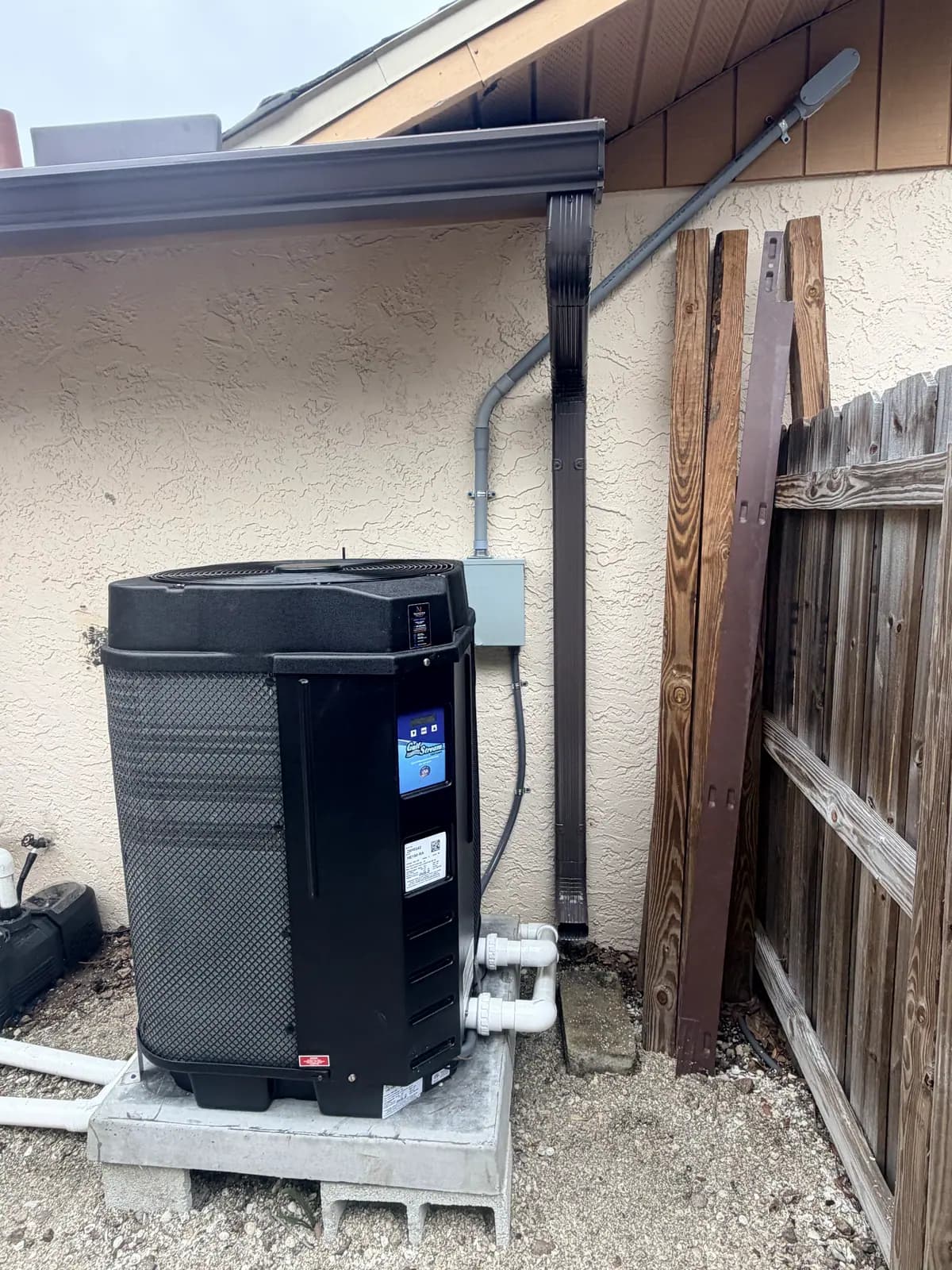
Equipment examples from the heater comparison on this site: the GulfStream HE Series, built in North Fort Myers, runs from the HE110-RA (110,000 BTU/hr, COP 6.1) to the HE150-RA (138,000 BTU/hr, COP 6.0), with TA versions that also cool. Hayward's HeatPro HP21405T is rated 138,000 BTU/hr at COP 5.7, and its Heat+Chill twin, the HP31405T, 135,000 BTU/hr. Pentair's UltraTemp 140 H/C is rated 140,000 BTU/hr heating at COP 5.6. Those capacity and COP figures are all at the 80°F air, 80°F water, 80% humidity rating point, and every one of these units uses titanium on the water side.
Heat pumps warm a swimming pool gradually over many hours. Actual heating speed depends on pool volume, heater output, starting water temperature, outdoor air temperature, humidity, wind conditions and whether the pool is covered. That is the trade you make: low running cost and a steady temperature in exchange for patience. GulfStream's own manual says heat pumps are best used to maintain a set water temperature and are not intended to provide fast heating the way a gas heater does.
- Skip a heat pump if you want a spa hot within the hour on a cool evening. That is a job for gas.
- Skip it if the pool is used a few weekends a year and the heater would sit off in between. Starting from cold every time is where heat pump owners get disappointed.
- Skip it if the only possible spot is boxed in. GulfStream asks for 12 inches of clearance on each side and 4 feet clear above, outdoors only.
- Budget for the electrical. GulfStream specifies a 40 amp maximum breaker for the HE110-RA and a 50 amp maximum breaker for the HE150-RA, and older panels sometimes need work first.
Solar: very low running cost, if the roof cooperates
Solar pool heating pumps pool water up through collectors on the roof and back down to the pool. There is no fuel bill, only the extra pump time needed to move water through the panels. DOE calls solar cost competitive with gas and heat pump heaters, with very low annual operating costs, and says solar systems typically last longer than either. With suitable roof orientation and sun exposure, it is one of Florida's lowest-operating-cost ways to heat a pool.
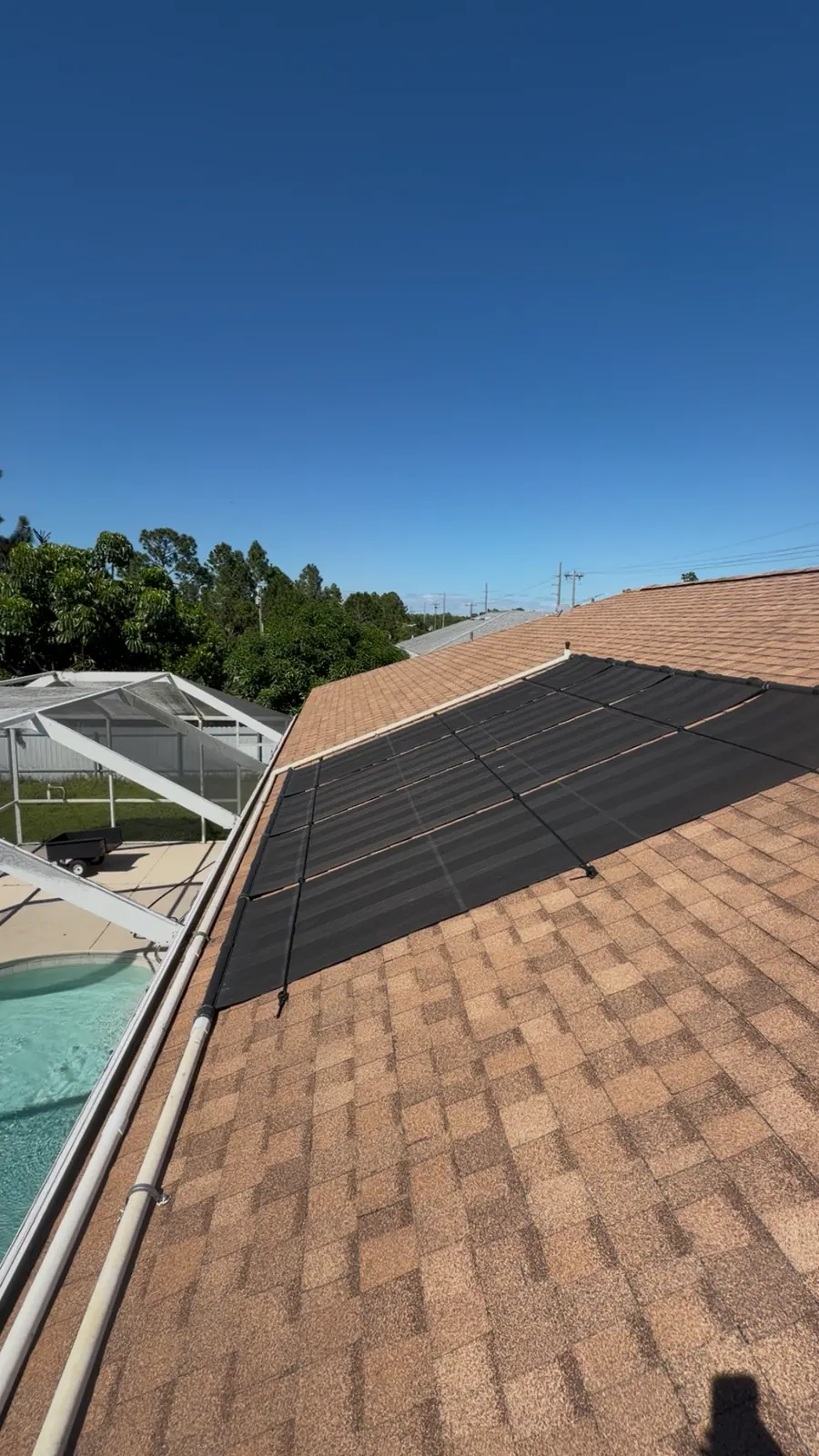
The roof is the whole question. DOE's rule of thumb is that collector area should equal 50 to 100 percent of the pool's surface area, and that a 15 by 30 foot pool in Florida typically needs collectors equal to 100 percent of its area, about 450 square feet, for year-round use. True south is the ideal orientation, but DOE says collectors can face up to 45 degrees east or west of south without a significant loss. Shade from oaks, small roof planes on newer homes, and tile or metal roofing all change what is possible, which is why we measure the roof before we quote a system.
Solar also works on the sun's schedule, not yours. It raises the pool's baseline temperature on sunny days and contributes little during a cloudy cold front, so it cannot promise a temperature on a specific morning. It suits owners who accept that and who swim mostly from spring through fall. DOE also notes that in hot climates the collectors can be run at night during peak summer to take heat out of the pool.
- Skip solar if the roof is heavily shaded, or if there is not enough unshaded area facing within about 45 degrees of south.
- Skip it as your only heater if you need a set temperature on demand, or a hot spa.
- In an HOA, plan for review of where the panels go. Section 163.04 of the Florida Statutes says an association may not prohibit solar collectors, but it may choose their location on the roof within a south-facing orientation, as long as that does not impair how they work.
Gas and propane: the fastest heat at the highest cost per degree
A gas heater burns natural gas or propane and pushes the heat straight into the water. DOE notes that gas heaters can maintain any desired temperature regardless of the weather, which neither solar nor a heat pump can promise. Gas heaters are rated by BTU input, the fuel they burn, and by thermal efficiency, the share of that fuel that ends up in the water. A 400,000 BTU input heater at 84 percent thermal efficiency puts about 336,000 BTU/hr into the pool.
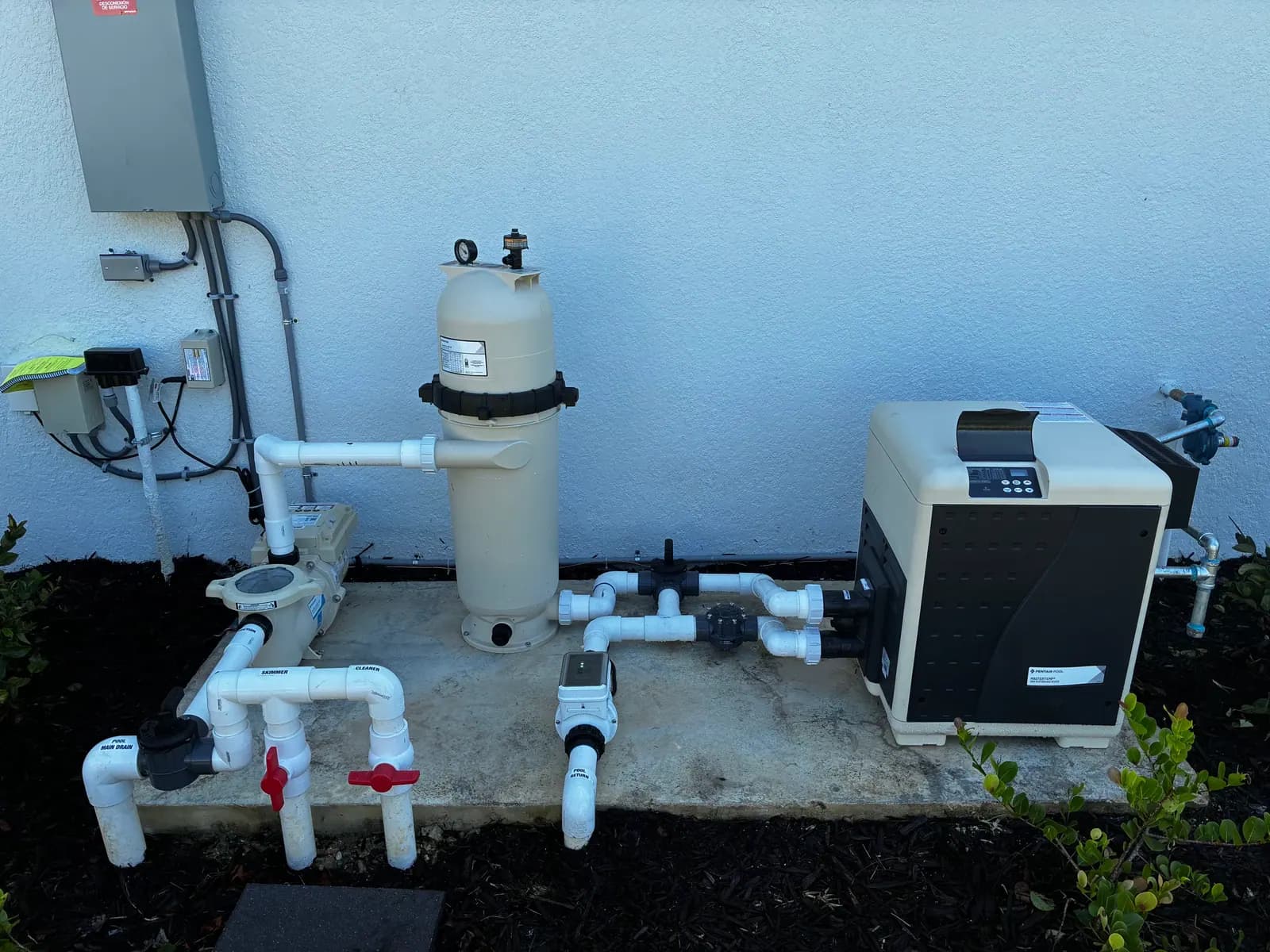
Catalog examples: Pentair's MasterTemp 250 and 400 are rated 84 percent thermal efficiency with a copper exchanger, and the HD versions use cupro-nickel at 82 percent. Hayward's Universal H-Series H250FDN and H400FDN are rated 84 percent with cupro-nickel standard. Raypak's AVIA 264A and 404A are rated 84 percent, with a NiTek exchanger on the AVIA HD. Jandy's JXi260N and JXi400N carry an 84 percent EnergyGuide rating, and Pentair's condensing ETi 400 uses a direct-fire titanium exchanger at 96 percent. Warranty terms differ more than efficiency does: Pentair publishes 2-Year Parts / 2-Year Labor on MasterTemp, Hayward 3-Year Parts / 1-Year Field Labor (3 years of labor through a Hayward Rewards dealer), Raypak 3-Year Parts / 3-Year Labor on AVIA, and Jandy 1 year on JXi with no labor coverage.
Fuel availability decides a lot of gas quotes around Sarasota and Manatee County, where some streets have natural gas at the curb and others do not. Without a gas main, propane is the normal answer, with a tank, a delivery contract and the highest cost per degree of anything on this page. The gas line also has to be sized for the heater's full input: Pentair's table for a natural gas MasterTemp 400 allows 1-inch pipe for only 20 equivalent feet.
- Skip gas as your everyday winter heater if running cost matters. For the same heat it costs about three times what a heat pump does on natural gas, and more on propane.
- Skip it if there is no natural gas at the street and you do not want a propane tank on the property.
- Do not use it as freeze protection. Pentair warns that running a MasterTemp continuously with water below 68°F causes condensation damage and voids the warranty.
The cheapest way to heat a pool in Florida
Running cost comes down to the price of the energy and how efficiently the heater turns it into pool heat. Our cost guide works this out from U.S. Energy Information Administration prices checked in September 2026: Florida residential electricity at 15.36 cents per kWh, natural gas at $25.48 per thousand cubic feet (the 2025 annual figure), and residential propane at $3.572 per gallon on the East Coast (March 2026). A million BTU is a handy yardstick, roughly the heat it takes to raise a 15,000-gallon pool by 8°F before any losses.
On that basis solar is one of Florida's lowest-operating-cost methods when the home has suitable roof orientation and sun exposure, because its only energy cost is pump time: two extra hours a day on a 1 kW pump is about 60 kWh a month, roughly $9. Among powered heaters, a heat pump is one of the lowest-cost methods, and natural gas costs roughly three times as much per BTU delivered. Florida's average residential gas price is pushed up by low household use, so ask your utility for its actual rates; a pool-heating household often pays less per therm, but the order does not change.
Whatever you choose, the cheapest upgrade is a cover. DOE says covering a pool when it is not in use is the single most effective way to reduce pool heating costs, with savings of 50 to 70 percent possible, because evaporation is by far the largest source of heat loss.
| Method | Efficiency used | Approximate energy cost |
|---|---|---|
| Solar | No fuel; extra pump time only | About $9 a month for 2 extra pump hours a day (1 kW pump) |
| Heat pump | COP 6.0 | About $7.50 per million BTU |
| Heat pump | COP 5.0 | About $9.00 per million BTU |
| Heat pump | COP 4.0 (around 50°F air) | About $11.25 per million BTU |
| Natural gas | 84% thermal efficiency | About $29 per million BTU |
| Propane | 84% thermal efficiency | About $46 (East Coast price) or $35 (U.S. average) per million BTU |
| Electric resistance | 100% | About $45 per million BTU |
The fastest way to heat a pool
Gas, without much argument. A gas heater's output does not depend on the air temperature, and residential sizes put a lot of heat into the water. As idealized arithmetic for a 15,000-gallon pool with no heat loss: a 400,000 BTU input heater at 84 percent thermal efficiency (about 336,000 BTU/hr delivered) supplies the heat for a 1°F rise in about 22 minutes, and a 250,000 BTU input heater at 84 percent (about 210,000 BTU/hr delivered) in about 36 minutes. A real pool keeps losing heat while it warms, so actual times run longer.
Spas are where speed matters most. Hayward's published table puts its 400,000 BTU heater at about 18 minutes to raise a 400-gallon covered, insulated spa by 30°F, and Pentair estimates 27 minutes for a MasterTemp 400 to raise a 600-gallon spa by 30°F, both under controlled conditions. If you want the spa hot when you decide to use it, gas is the tool. Our heat-up article works through the same arithmetic for heat pumps and explains why real-world times are longer.
Combinations that work on the Gulf Coast
Many Gulf Coast pools are better served by two heat sources than by one, and the right pairing follows how the pool is used. Solar plus a heat pump suits an owner who swims all year and wants a low running cost: solar carries the pool on sunny days and the heat pump covers cold fronts and cloudy weeks, so it runs far fewer hours than it would alone. Solar plus gas suits an owner with a spa or an unpredictable schedule, with solar handling the pool and gas handling the spa and the occasional cold weekend.
A heat pump for the pool and gas for the spa is the third common answer, and it covers the one thing a heat pump does poorly. One project in our gallery shows the solar-plus-electric approach: a full rebuild of the pool's plumbing with new valves, a new electric heater and automation, plus pool solar to help hold the heat and lower the electric heater's operating cost. That specific job, completed in 2024, cost $11,500-$12,500. It is a past project, not a quote.
When two heaters share a pad, the plumbing order matters. GulfStream's manual gives the sequence as pool pump, filter, heat pump, solar, then any chlorinator or salt cell, then back to the pool.
What we usually recommend for a screened Southwest Florida pool
For a typical Southwest Florida pool, an in-ground pool under a screen enclosure that gets used most weeks of the year, our usual recommendation is a heat pump with a titanium heat exchanger, sized for January rather than for the 80°F rating point, on its own correctly sized circuit, with a solar blanket. The screen cuts wind, which cuts evaporation, which is the biggest heat loss, and Sarasota's winter averages keep a heat pump in its efficient range for most of the season. It is not the fastest heater, so the right way to run it is at a steady setpoint.
We change that answer for specific reasons: gas when there is a spa used often or the pool is used only occasionally; solar first when the roof has the room and the orientation; and a cupro-nickel, NiTek or titanium exchanger in any gas heater going onto a salt pool or a coastal lot. We install all three across Sarasota, Manatee, Charlotte & Pinellas County, and before recommending anything we look at the pool, the screen, the equipment pad, the electrical panel and what fuel is actually available at the address.
Pros and cons
Electric heat pump
Pros
- One of the lowest-cost powered ways to heat a pool: roughly $9 per million BTU at COP 5.0 on Florida's average electric rate.
- Holds a steady temperature through most of a Gulf Coast winter.
- Titanium heat exchangers are standard on the models we compare, which suits salt pools and coastal lots.
- Heat-and-cool models can also take heat out of the pool in late summer.
Cons
- Heats gradually, so it is a poor fit for heating a spa on short notice.
- Output falls in cold air: Hayward's HP21405T is rated 138,000 BTU/hr at 80°F air and 82,000 BTU/hr at 50°F air.
- Needs a 240-volt circuit, often 40-50 amps, and clear airflow around the cabinet.
- Produces condensate, so the pad has to drain.
Solar
Pros
- No fuel cost; the only running cost is extra pump time.
- DOE says solar pool heaters typically last longer than gas and heat pump heaters.
- Florida law limits an association's ability to prohibit solar collectors.
Cons
- Needs unshaded roof area equal to roughly 50-100% of the pool's surface area.
- Cannot deliver a set temperature on demand, or much heat on cloudy, cold days.
- Roof type, roof layout and pump capacity all affect the install.
Gas or propane heater
Pros
- The fastest heat for pools and spas.
- Output does not depend on the air temperature.
- Modest electrical needs: a 15 amp circuit on the MasterTemp and Universal H-Series.
Cons
- Highest cost per degree: about $29 per million BTU on natural gas and about $46 on East Coast propane at 84% efficiency.
- Needs natural gas at the street, or a propane tank and deliveries.
- The gas line must be sized for the full BTU input, and venting and clearances apply.
- Copper heat exchangers are less tolerant of salt and drifting water chemistry.
Real installations
Recent jobs from our installation library that relate to this topic.