Modern Pool Heating · Owner/operator Henry Manna, Florida Certified Pool/Spa Contractor CPC1460367
Updated October 16, 2026
Short answer
On the coast, the best pool heater is one built and installed for salt air: a heat pump with a titanium heat exchanger and a non-metallic cabinet, or a gas heater with a cupro-nickel, NiTek or titanium exchanger, placed out of direct salt spray and sprinkler mist. Rinsing the coil regularly, as manufacturers recommend near salt water, and raising equipment where the lot floods do as much for a heater's life as the brand on the cabinet. Our own barrier-island examples include GulfStream HE150-RA heat pumps on Treasure Island and Siesta Key.
What we usually recommend
If you're on a barrier island or the open water, we'd usually choose a heat pump with titanium on the water side and an ABS, composite or polymer cabinet, place it out of direct spray (behind a barrier from the prevailing beach wind if needed, with full clearances kept), keep the sprinklers off it, and show you how to rinse the coil. If you want gas on the coast, we'd specify cupro-nickel, NiTek or titanium rather than plain copper. If the lot is in a flood zone, we'd settle the equipment elevation before deciding where anything goes.
- Heat pumps: titanium on the water side is standard across our heater comparison. The cabinet and air coil are where models differ.
- Gas: cupro-nickel (standard on Hayward's Universal H-Series), NiTek (Raypak AVIA HD) or titanium (Pentair ETi 400) rather than plain copper.
- Siting: out of direct spray of sand and salt, away from sprinkler mist, with a gutter if the unit sits under a roof edge.
- Maintenance: GulfStream says a heat pump near salt water needs its coil cleaned regularly, with a low-pressure hose, a soft brush and the power off.
- Flood zones: Florida guidance puts equipment at base flood elevation plus one foot, or elevated as far as practical, anchored and GFCI-protected.
What salt air actually does to a pool heater
On a barrier island or a waterfront lot, a pool heater faces two corrosion paths. One is inside: pool water, and on a salt pool a chlorine generator, working on the heat exchanger. The other is outside: salt carried on the wind settling on the cabinet, the fasteners, the electrical connections and, on a heat pump, the fins of the air coil, which sees a great deal of air (Jandy rates its VersaTemp at 3,600 cubic feet a minute). Our saltwater pool article and our heat exchanger guide cover the inside path; this page is mostly about the outside one.
Manufacturers write about this plainly. Pentair's MasterTemp manual warns against prolonged exposure to driving water from sprinklers, roof runoff and hoses, and against operation in persistent, extreme, moist or salty environments. GulfStream says sprinklers spraying near or onto a heat pump will speed corrosion of the unit. And two heat pump warranties in our heater comparison carry exclusions that matter on the coast: AquaCal's excludes installation in a corrosive environment, and Built Right's excludes corrosion caused by or related to weather, climate or equipment placement. Both are worth asking about in writing before a unit goes onto a beachfront pad.
None of this means coastal pools cannot be heated well. It means the specification and the installation carry more weight than they do inland, and most of what follows costs little or nothing extra if it is decided before the unit goes in.
Heat pumps on the coast: exchanger, cabinet and coil
Titanium on the water side is the easy part, because every heat pump in our heater comparison uses it: GulfStream's HE Series (a 2-inch full-flow titanium exchanger), Hayward's HeatPro (a titanium condenser), Pentair's UltraTemp (which Pentair describes as 100% titanium), Jandy's VersaTemp (a titanium twisted coil), Raypak's Crosswind V (a titanium tube rated to 600 psig), AquaCal's ThermoLink pure titanium, and Built Right's XW. The exchanger warranty terms differ: Hayward covers the titanium tube for 10 years on in-ground units, Raypak the titanium tube for 10 years parts and 2 years labor, Pentair the UltraTemp exchanger for a lifetime, AquaCal the titanium tubing for a lifetime on a part-only basis, Jandy the exchanger for 5 years, and GulfStream includes it under its published 7-Year Parts / 2-Year Labor warranty.
Cabinets are where models really differ, and on the keys a cabinet that cannot rust is worth having. As our heater comparison records them, GulfStream's HE Series uses a UV-stabilized ABS cabinet, Jandy's VersaTemp an ABS cabinet, Pentair's UltraTemp a long-life corrosion-resistant composite, Built Right's XW a corrosion-free, UV-resistant polymer housing, and AquaCal describes its HeatWave cabinet as corrosion-proof. Raypak's Crosswind V uses a powder-coated metal cabinet; it is well finished, but our heater comparison notes that within reach of salt spray a non-metallic cabinet is the more forgiving choice.
The air coil matters too, because salt-laden air is pulled straight across it. Hayward builds the HeatPro with a microchannel coil finished in a Trivalent Chromium Process coating that it positions as corrosion protection, and cites an 85 percent reduction in braze joints compared with a conventional coil. Fasteners, disconnects and conduit never appear on a spec sheet but corrode just the same, so on a coastal pad we look at the condition of what is already there when a new unit goes in.
Siting and rinsing: the low-cost part of a coastal install
Where the unit sits decides how much salt it sees. Hayward's HeatPro manual says that in an oceanfront area the heat pump should be placed out of direct spray of sand and salt, which will clog, damage and corrode it, and suggests a physical barrier against the prevailing beachfront wind, outside the minimum clearances. It also asks for sprinkler heads to be far enough away that normal wind will not carry mist into the cabinet, because irrigation water is often high in minerals, sulfur and salt. GulfStream wants a gutter if the unit sits under a roof edge, and Raypak's Crosswind V manual says damage from roof runoff falling directly on the unit is not covered under warranty.
Barriers and screens still have to respect clearances. GulfStream asks for 12 inches on each side and 4 feet clear above; Hayward asks for 12 inches around the perimeter, 24 to 36 inches at the front and 72 inches of clear height under any overhang. A barrier built too close turns into an enclosure, and an enclosed heat pump recirculates its own cold air.
Near salt water, rinsing becomes routine maintenance. GulfStream's manual says airflow and drainage are the two main maintenance tasks, that a garden hose on low pressure can be used to clean the evaporator coil, and that a unit near salt water needs regular cleaning to remove salt and sand, using a very soft brush and soapy water so the fins don't bend. It also says to disconnect all power before washing, never to spray the control box, and to keep the drain holes in the base clear. Built Right's manual likewise tells owners near the ocean or the Gulf to rinse the evaporator coil. Neither publishes a fixed schedule, so the right interval depends on how exposed your pad is.
Gas heaters on the coast
Gas heaters face the same salt air, and on them the exchanger material is a real decision. Plain copper is the category baseline and the least tolerant of salt and drifting chemistry. Hayward fits cupro-nickel as standard across the Universal H-Series and describes it as offering excellent salt water and chemical corrosion resistance. Pentair sells cupro-nickel as the MasterTemp HD, rated 82 percent thermal efficiency against 84 percent for the copper version and offered for natural gas only, and Jandy's cupro-nickel JXI400NN carries an 83 percent EnergyGuide rating against 84 for the copper model. Raypak's AVIA HD uses its NiTek alloy, which Raypak says is 300 percent more erosion resistant than copper and 200 percent more than cupro-nickel, at the same 84 percent efficiency. Pentair's ETi 400 uses a direct-fire titanium exchanger at 96 percent.
Above the water line, Raypak builds the AVIA with a stainless steel combustion chamber rather than galvanized steel and fits a replaceable ProTek Shield anode in the inlet header. The anode is a consumable: Raypak expects it to be replaced in routine service, and its warranty does not cover damage caused by a depleted anode left in place. Pentair's manual also lists corrosive vapors, pool chemicals and muriatic acid among them, that can damage a heater through its combustion air, so storing chemicals beside a gas heater is a bad idea anywhere and a worse one on the coast.
Coastal pads are windy pads, so anchoring matters. Pentair states that anchor clamps are required for the MasterTemp in Florida and sells a bolt-down bracket kit for the purpose, and Hayward's heat pump manual details its own anchoring method. Our copper, cupro-nickel and titanium guide compares the exchanger materials in depth.
Flood zones and raising equipment
If your lot is in a flood hazard area, that changes where equipment can go. Florida's Office of Floodplain Management explains that the Florida Building Code generally requires mechanical and electrical equipment in a flood hazard area to be at or above the required elevation, which for buildings is the base flood elevation plus one foot of freeboard, with some communities requiring more. Pool equipment is permitted lower only if it is elevated to the extent practical (the guidance notes even partial elevation protects against low-level flooding), anchored to prevent flotation and resist flood forces, and supplied by circuits with ground-fault circuit interrupter protection. The guidance points to FEMA P-348 for methods, and adds that chemical feeders count as pool equipment and pool chemicals should be stored above the same elevation.
The practical first step is to find out your flood zone and base flood elevation, from an elevation certificate or the local floodplain office, and what the building department requires for your lot. Raising equipment has to keep it serviceable: the guidance lists safe functioning and access for service among the factors, and a heat pump on a platform still needs its full clearances.
We have done this on the keys. One of our gallery projects is on Siesta Key, where the homeowner wanted his pool equipment elevated; the heat pump now sits on a wall-mounted platform clear of the ground. That specific job cost $4,500-$6,500, a past project rather than a quote. Even off a flood zone, manufacturers want a pad that drains: Hayward asks for a level slab at the same height as, or slightly higher than, the filter pad so condensation and rainwater run away from the base.
Real coastal jobs: Treasure Island and Siesta Key
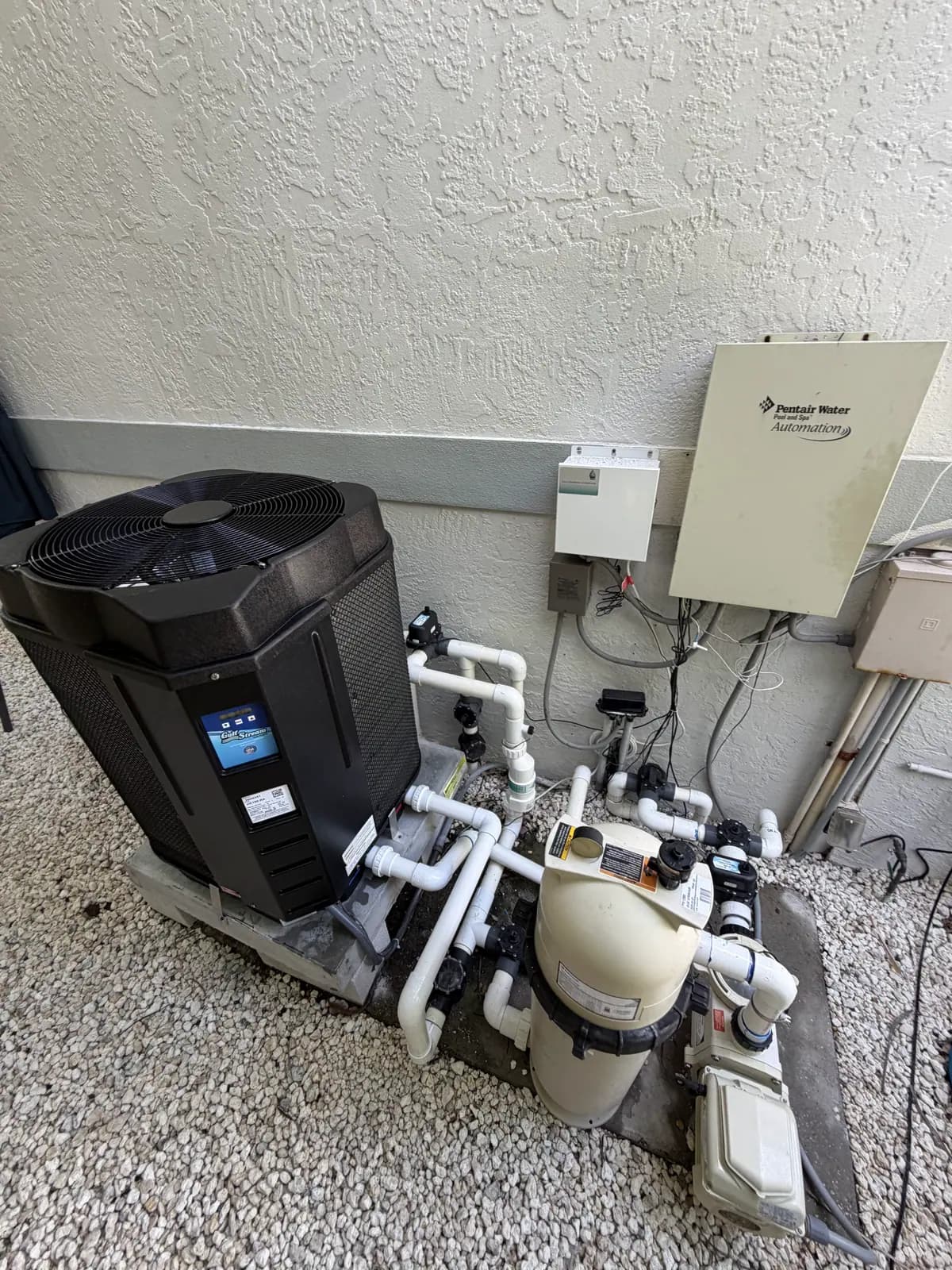
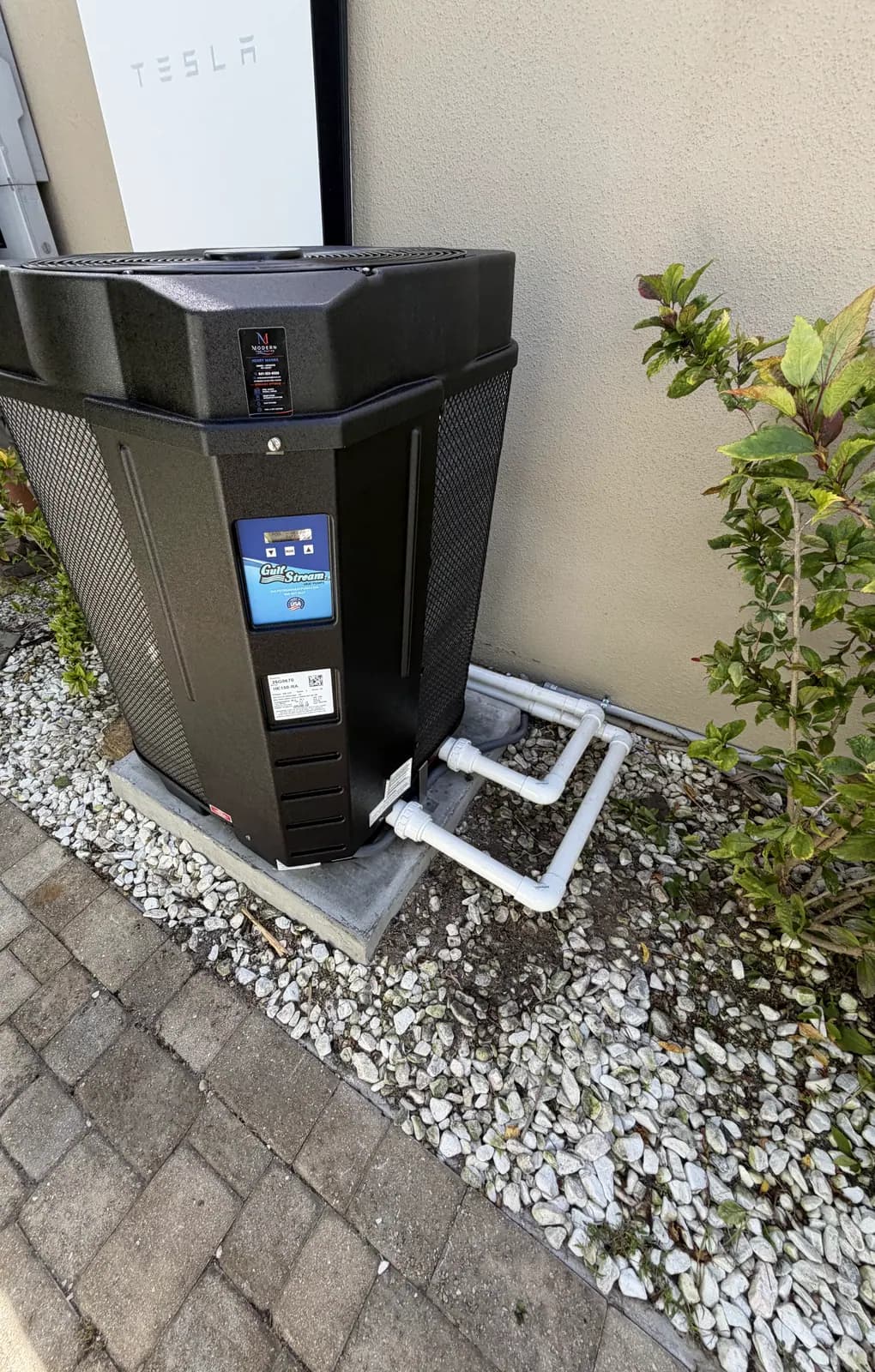
Treasure Island sits on the Gulf in Pinellas County. There we set a GulfStream HE150-RA on a concrete pad in a white rock bed beside a paver walk, plumbed with short, square PVC runs, and with the pad up out of the rock bed so rain and irrigation drain away from the base. On Siesta Key we installed a heat-only HE150-RA on a barrier-island pad it shares with a Pentair automation panel, a cartridge filter and a pump; the HE150-RA connects to automation through dry-contact remote thermostat terminals.
The HE150-RA's titanium heat exchanger and UV-stabilized ABS cabinet are the materials we want on the keys. GulfStream's spec sheet rates it at 138,000 BTU/hr and COP 6.0 at 80°F air, 80°F water and 80% humidity, and GulfStream publishes 7-Year Parts / 2-Year Labor (Pentair's cross-brand warranty table lists shorter terms, so get the current terms in writing). It is not the only good coastal heat pump; it is the one these two projects used, and both are on our projects page with photos.
Questions to ask before a coastal install
Whoever quotes your heater, these are the questions that separate a coastal installation from an inland one dropped onto a beach lot. Most of them cost nothing to answer, and every answer should be in writing on the quote or the warranty paperwork.
If a quote names a heater by BTU and price alone, ask for the model number and look it up in our heater comparison or the manufacturer's literature before signing. The exchanger, the cabinet and the warranty conditions are printed there, and on the coast they matter as much as the capacity.
- Is the heat exchanger titanium (heat pump) or cupro-nickel, NiTek or titanium (gas)?
- What is the cabinet made of, and how is the air coil protected?
- Does the warranty exclude installation in a corrosive environment, as AquaCal's does, or corrosion related to weather, climate or equipment placement, as Built Right's does, and has the manufacturer said how that applies to your location?
- Where will the unit sit relative to spray, sprinklers, roof edges and the prevailing wind, with full clearances kept?
- Is the lot in a flood hazard area, and what elevation does the building department require for the equipment?
- How will the heater be anchored?
- What coil-rinsing routine does the manufacturer's manual call for, and who will show you how to do it?
Pros and cons
Heat pump with titanium and a non-metallic cabinet
Pros
- No copper in the water path and no steel shell to rust.
- Low running cost, and it works whether or not natural gas reaches the island.
- Exchanger warranties of 5 years to lifetime depending on the brand.
Cons
- The air coil is exposed to salt air and needs regular rinsing.
- Needs a location out of direct spray that still keeps full airflow clearances.
- Some warranties exclude corrosive environments or corrosion tied to placement; ask how that applies.
Gas heater with cupro-nickel, NiTek or titanium
Pros
- Fast heat that does not depend on the weather, useful for spas.
- Cupro-nickel is standard on Hayward's Universal H-Series; NiTek and titanium options exist from Raypak and Pentair.
Cons
- Cupro-nickel costs a point or two of efficiency on some models (MasterTemp HD 82% vs 84%).
- Highest running cost, and natural gas is not available everywhere on the islands.
- Needs anchoring, venting and care with chemical storage nearby.
Real installations
Recent jobs from our installation library that relate to this topic.