

Updated September 17, 2026 · Affordable Solar & Pool Heating, LLC · Owner/operator Henry Manna
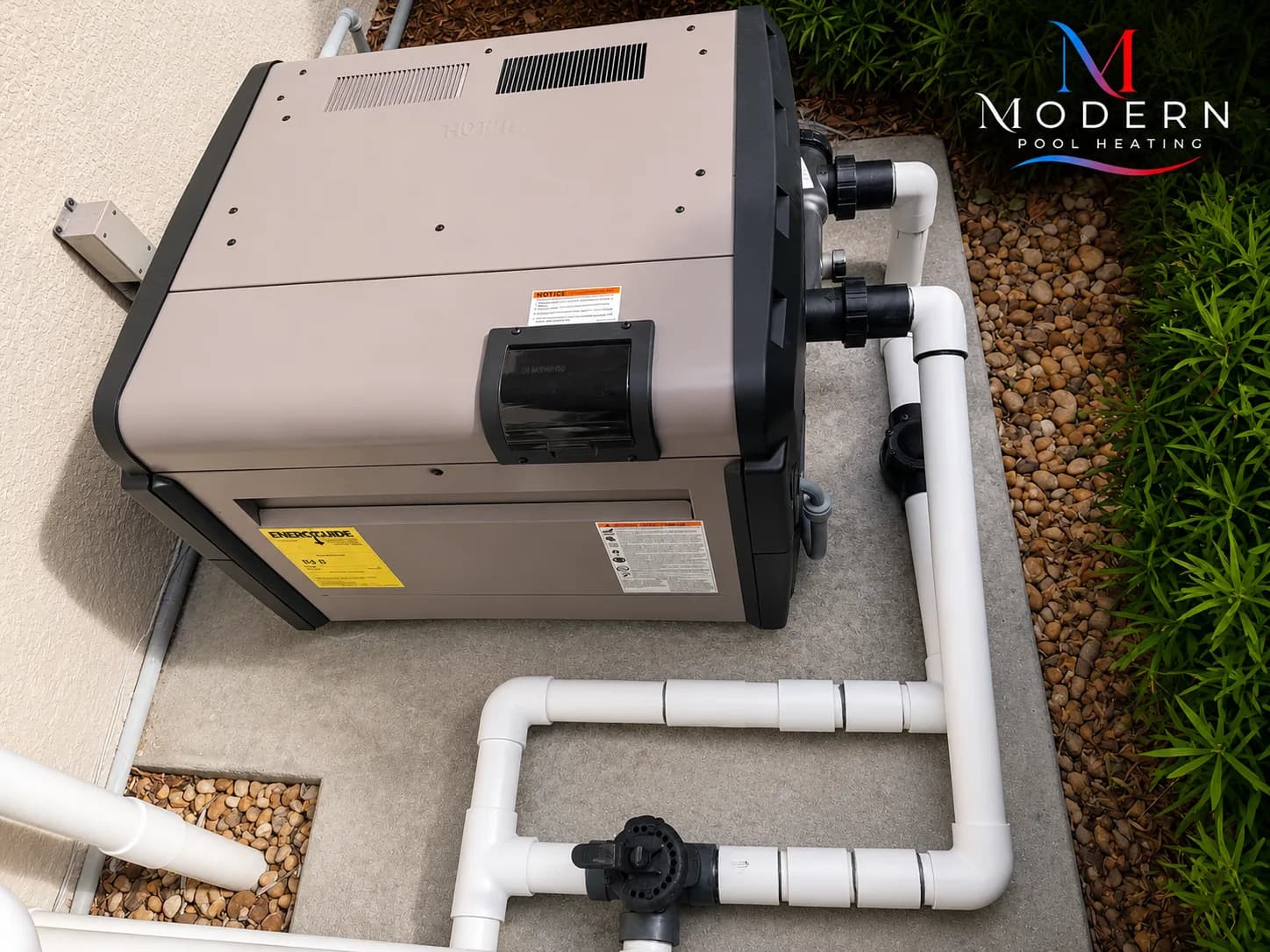
Two projects, both in Sarasota
Most pool heater content argues about brands. In practice the brand is the easy part of a Sarasota installation, and the hard parts are the ones nobody photographs: whether gas is at the street, whether the pad has room for the manufacturer's clearances, whether the equipment sits low enough to take on water, and how hard the salt air is.
These two projects are ours and both are in Sarasota. The first is a new Hayward gas heater plumbed into an equipment pad with clean, easy-to-service PVC runs. The second is a Siesta Key job where the homeowner wanted his pool equipment elevated and we made it happen affordably — the published range for that project is $4,500 to $6,500, and it is the only figure we put a number on here, because installed heater pricing moves too much with gas line sizing, electrical work, pad work and permits to quote from a page.
Project one: a Hayward gas heater on a Sarasota equipment pad
The photograph is worth reading slowly. The heater sits with the water inlet and outlet landing in a pair of unions, a valve in the run below, and the PVC squared up rather than threaded around whatever was there. That is not styling. Hayward fits the Universal H-Series with 2 inch by 2-1/2 inch CPVC union connections precisely so the heater can be isolated and lifted out without cutting pipe, and building the manifold this way means the next person who touches this pad does a one-day job instead of a re-plumb.
The same logic governs where it sits. Hayward requires 6 inches of clearance at the rear and 12 inches at the sides, and the line is built for front-panel-only service access, so a technician reaches the board, igniter and sensors from the front rather than pulling the unit away from a wall. On the tight side-yard pads normal on Sarasota builds, that often decides where the heater can go — and sometimes which size fits, since a 400,000 BTU cabinet is 34 inches wide against 25 inches for the 250,000 BTU version.
We have not confirmed which model is in this photo and we are not going to guess. What we can say is that every Universal H-Series heater, in every size and both fuels, ships with a cupro-nickel heat exchanger as standard — the specification that matters most here, and the reason we install a lot of them.
Why gas is a real question in Sarasota, not a given
Before a gas heater is a brand decision it is an infrastructure decision. Large parts of Sarasota and Manatee County have no natural gas main at the street, which turns the choice into propane plus a tank, a tank location and a delivery contract — or no gas at all. Checking what is available at the address takes five minutes and should happen before anyone falls in love with a heater.
Where gas is available, the next question is whether the existing line can feed the heater you want. A Universal H-Series heater connects at 3/4 inch NPT, and Hayward specifies a minimum inlet pressure of 4.5 inches w.c. and a maximum of 10.5 on natural gas, or 10.0 to 13.0 inches w.c. on propane. A line sized years ago for a smaller heater will hold pressure at idle and fall below the minimum under full fire, and the symptom is an IF ignition-failure code in January when demand on the system is highest. Undersized gas piping is the most common reason a straightforward-looking swap turns into a larger quote.
The third question is flow, and it has grown more common since variable-speed pumps took over. The Universal H-Series needs 25 GPM through the exchanger on the 250,000 BTU model and 30 GPM on the 400,000, inside a 125 GPM system maximum. A pump set to a quiet filtration speed will not satisfy that, so a heating speed has to exist in the schedule. Skip it and the heater shows LO and never lights.
Project two: elevating pool equipment on Siesta Key
The Siesta Key project started somewhere else entirely. The homeowner wanted his pool equipment elevated, and we made it happen affordably. Nothing about that job is exotic, and it is one of the most useful things you can do to equipment on a barrier island.
Equipment that sits low collects water. Rain runs to it, irrigation drains toward it, and on a low-lying island a storm pushes water further inland than anybody's site plan expected. Pumps, control boards, heater cabinets and disconnects are the parts that do not survive being submerged, and they are far cheaper to raise than to replace.
Manufacturers ask for a level, draining pad even without the flooding argument. Hayward's heat pump manual calls for a level slab so condensation and rainwater drain away from the base, and says the pad should sit at the same level as, or slightly higher than, the filter system's pad. It also details anchoring — eight clamps with stainless concrete screws and fender washers — and points the installer at wind-load requirements, which in coastal Florida are not a formality. It is also the cheapest moment to fix everything else: the plumbing gets re-run properly, valves land where a person can reach them, unions go in for future service, and the pad gets laid out for the clearances the next piece of equipment will need.
What barrier-island salt air changes about the specification
Siesta Key, Longboat, Casey Key and the rest of the Sarasota barrier islands are hard on pool equipment in a way that inland Lakewood Ranch is not, and the manufacturers know it. Hayward's heat pump manual says directly that in an oceanfront area the unit should be placed out of direct spray of sand and salt that will clog, damage and corrode it, and suggests a physical barrier outside the minimum clearances against the prevailing beachfront wind. The same manual warns that sprinkler heads must sit far enough away that normal wind will not carry mist into the cabinet, because irrigation water is often high in minerals, sulfur and salt.
That is the environmental argument for caring about the heat exchanger. On a gas heater, plain copper is the first thing to go on a coastal or salt-chlorinated pool, which is why Hayward making cupro-nickel standard matters more here than it does in Ohio. On a heat pump the equivalent is a titanium condenser — the HeatPro MCHX units use one, and Hayward's 2026 warranty covers the titanium tube for 10 years on in-ground models. None of it replaces chemistry: Hayward excludes exchanger damage from improper flow, unbalanced water or sanitizer added improperly, and the salt cell belongs downstream of the heater.
Service clearances people only regret later
Clearances read like fine print on a quote and then become a real constraint. They are worth knowing before you design a pad around a heater.
- Universal H-Series gas heaters: 6 inches at the rear, 12 inches at the sides, front-panel-only service access, 40°F minimum operating temperature.
- Gas heater plumbing: 2 inch by 2-1/2 inch CPVC unions, a 3/4 inch NPT gas connection, 25 to 30 GPM minimum flow depending on size, 125 GPM system maximum.
- HeatPro heat pumps: 12 inches around the perimeter, 24 to 36 inches at the front for service, an unobstructed top with 72 inches under any overhang, and 60 inches from the inside wall of the pool, spa or a solid barrier.
- Heat pumps are outdoor-only. Hayward's manual prohibits a fully enclosed space such as a garage or shed, and a boxed-in unit recirculates its own cold air and short-cycles.
- Heat pumps make water — roughly three to five gallons an hour of condensate in humid conditions — so the pad has to drain somewhere that is not a wall or a walkway.
- Screen enclosures cut both ways: a lanai reduces wind and evaporation, which helps every heater, but it restricts airflow, so clearances still have to be respected inside it.
What we actually look at before quoting a Sarasota heater
Both projects started with a site visit, and the same handful of things decide almost every quote we write here. What is at the street — natural gas, or nothing. What the existing gas line and meter deliver under load. What the electrical panel has left, because a 140,000 BTU class heat pump wants 230V single phase with a 50 amp breaker and a 42.5 amp minimum circuit. How much room the pad really has once the clearances are drawn on it. How the site drains. How exposed the lot is to salt. And how you actually use the pool.
That last one changes the answer most often. Gas heats fast and only costs money while it runs, which suits a spa, a rental or an occasional swimmer. A heat pump costs a fraction as much per degree and holds a temperature rather than chasing one, which suits a pool that gets used. Plenty of Sarasota homes end up with both, or with solar carrying the pool and a heat pump filling the gaps.
If you are in Sarasota — downtown, Siesta Key, Palmer Ranch, Lakewood Ranch or anywhere in between — our Sarasota pool heater installation and repair page covers what we do locally, and we are happy to look at the pad before you buy anything. We install and service pool heating throughout Sarasota, Manatee, Charlotte & Pinellas County, Florida. The comparison content here is written for pool owners anywhere; the installation offer is local.
Heaters mentioned in this guide
Hayward · Universal H-Series
Hayward Universal H-Series H400FDN Gas Pool Heater
Model H400FDN
- BTU input
- 399,900 BTU/hr
- Thermal efficiency
- 84%
- Heat exchanger
- Cupro-nickel
- Warranty
- 3-Year Parts / 1-Year Labor
- Wi-Fi / automation
- App Control via AutomationAutomation Compatible (Relay)
A large Florida pool, or a pool and spa combination, that needs to reach temperature on demand rather than hold it all season.
Hayward · Universal H-Series
Hayward Universal H-Series H250FDN Gas Pool Heater
Model H250FDN
- BTU input
- 250,000 BTU/hr
- Thermal efficiency
- 84%
- Heat exchanger
- Cupro-nickel
- Warranty
- 3-Year Parts / 1-Year Labor
- Wi-Fi / automation
- App Control via AutomationAutomation Compatible (Relay)
An average-sized Florida pool, or a pool with a small spa, where you want gas-speed heat without paying for 400,000 BTU you will never use.
Hayward · Universal H-Series
Hayward Universal H-Series H400FDP Propane Pool Heater
Model H400FDP
- BTU input
- 399,900 BTU/hr
- Thermal efficiency
- 84%
- Heat exchanger
- Cupro-nickel
- Warranty
- 3-Year Parts / 1-Year Labor
- Wi-Fi / automation
- App Control via AutomationAutomation Compatible (Relay)
A large pool or a pool-and-spa combination on a lot with no gas main, where fast heat matters more than the cost of the propane it burns.
Hayward · HeatPro MCHX Series
Hayward HeatPro MCHX HP21405T Heat-Only Pool Heat Pump
Model HP21405T
- Heating capacity
- 138,000 BTU/hr
- Efficiency (COP)
- COP 5.7
- Heat exchanger
- Titanium
- Warranty
- 5-Year Parts / 2-Year Labor10-Year Heat Exchanger
- Wi-Fi / automation
- Automation Compatible (Relay)
A Gulf Coast pool that gets swum in most of the year and an owner who wants the lowest running cost from a mainstream brand their service company already stocks parts for.
Last verified September 17, 2026
Specifications and warranty terms are taken from the manufacturer documents below. Manufacturers revise these without notice, so confirm the current terms before you buy. If you spot something out of date, email us and we will fix it.
Sources
- Hayward — Universal H-Series brochure (cupro-nickel standard, front-panel access, cabinet dimensions)
- Hayward — Universal H-Series Quick Reference Guide (minimum flow by model, natural gas and propane inlet pressure)
- Hayward — H400FDN product page (clearances, water and gas connections, minimum operating temperature)
- Hayward — HeatPro heat pump Installation and Operation Manual 51300122601 Rev C (equipment pad and drainage, anchoring, clearances, oceanfront and sprinkler guidance, condensation)
- Hayward — 2026 Expert Line residential warranty terms (heat pump titanium tube coverage)
Ratings on this site are the editorial opinion of Affordable Solar & Pool Heating, LLC, trading as Modern Pool Heating. How we rate heaters. Corrections: modernpoolheating@icloud.com.