

Updated September 17, 2026 · Affordable Solar & Pool Heating, LLC · Owner/operator Henry Manna
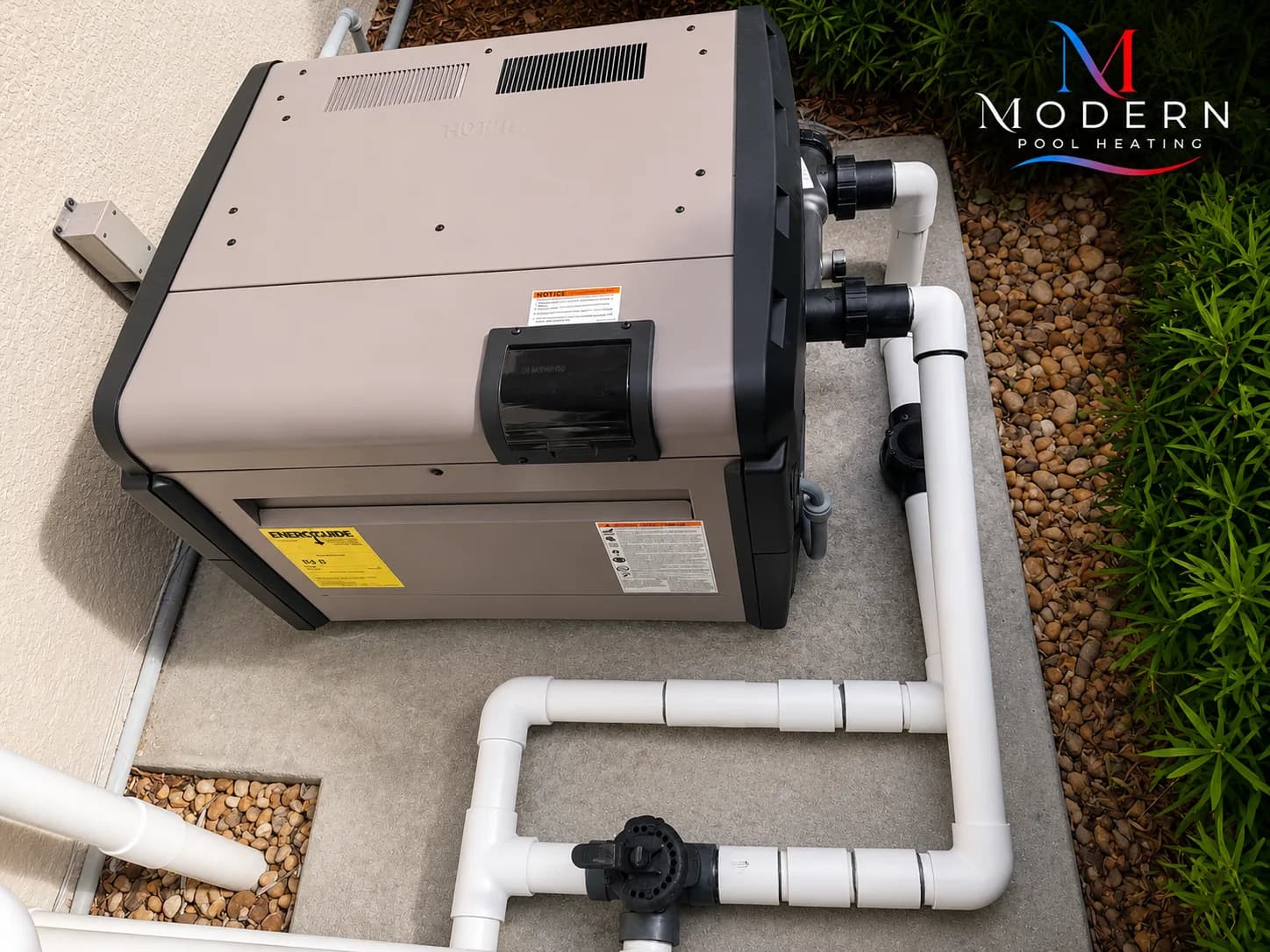
What the display is actually telling you
A Hayward heater does not have a check-engine light with one meaning. The two-digit code on the display is the control board naming the safety it could not satisfy, and most of the time the heater is doing exactly what it is designed to do: refusing to fire when a condition is not right.
That changes what you do next. A code meaning "I could not confirm water is moving" is a pump problem. A code meaning "flame was present when the gas valve was closed" is a gas safety lockout, and nobody without a license and a manometer belongs inside that cabinet. The code meanings below are Hayward's; the plain-English notes are ours.
Universal H-Series gas heater: the full code list
These are all of the diagnostic codes Hayward publishes for the Universal H-Series (H150FD through H500FD, natural gas and propane, plus the ASME variants). The heater's SERVICE LED lights with the code.
- LO — Water pressure switch, vent pressure switch or temperature limit switch fault. Hayward notes LO means Limit Open and is normal when the pump is off.
- IF — Ignition failure. The control retries three times, locks out, waits 60 minutes and retries until the call for heat stops.
- IO — Ignitor circuit open.
- HF — Flame present with the gas valve not energized. The control locks out and the blower runs continuously until corrected.
- HS — Maximum return water temperature exceeded, or rapid temperature rise. Hayward says HS means High Sense and appears above 105°F or on a rise of more than 6°F in 60 seconds.
- SF — Temperature sensor (thermistor) input failure: the sensor is reading out of range.
- PF — Voltage polarity reversed or low voltage detected. Hayward calls this Polarity Failure; reset is immediate once corrected.
- AC — Blower vacuum switch closed when the control expected it open.
- AO — Blower vacuum switch open. Hayward adds: check the voltage selector plug on a new installation.
- CE — Communication error between the control module and the display interface assembly.
- EE — Bad board.
- bd — Bad board or secondary high voltage fault.
- SB — Keypad failure, normally a stuck button.
- bo — Not a fault. bo is bypass operation, which hands temperature control to a two-wire remote or automation system.
LO is the code you will see most, and it usually is not the heater
LO means one of three safeties opened — the water pressure switch, the vent pressure switch or a temperature limit switch — and on an outdoor residential heater it is almost always the water pressure switch reacting to flow. Hayward's consumer guide leads with the obvious check: verify the pump is running and adequate water is flowing through the heater. It also states plainly that LO is normal when the pump is off, which is why a heater on a schedule shows LO half the day and is perfectly healthy.
The variable-speed pump is the modern culprit. A pump set to a quiet 1,400 RPM for filtration will not move the 25 GPM an H250 needs or the 30 GPM an H400 needs, so the switch never closes and the heater never lights. The fix is a heating speed in the pump's schedule, not a new heater. A dirty filter, a partly closed valve, a clogged skimmer basket, a low water level or a fountain stealing flow all do the same thing.
- Safe to check yourself: is the pump running, is the filter clean, is the water above the skimmer mouth, are the valves open, is the pump on a high enough speed while the heater is calling for heat.
- Call a technician if: flow is clearly good and LO persists, the code appears the moment the burner lights, or the heater is installed indoors — indoor units add a vent pressure switch and flue to the same code.
Ignition and flame codes: IF, IO, HF, AC and AO
IF means the heater tried to light and did not sense flame. Hayward's technician guide starts at the gas supply — is the main supply on, is the gas valve inside the heater ON — then moves to static, load and manifold pressure with a manometer attached. Those first two checks are reasonable for a homeowner. Nothing after them is.
Gas pressure is why we see repeat IF codes on otherwise healthy heaters. Hayward specifies a minimum inlet of 4.5 inches w.c. and a maximum of 10.5 on natural gas, and 10.0 to 13.0 inches w.c. on propane. A line sized for a smaller heater holds pressure at idle and drops under load, so the heater lights in spring and fails in January when the spa, the heater and the house all pull at once.
HF is different: flame was sensed while the gas valve was not energized, so the control locks out and runs the blower to clear the cabinet. Hayward's sequence begins with a power cycle at the breaker to rule out an erroneous code, then tests 24VAC at the gas valve. If HF returns after a power cycle, stop and call someone. AC and AO are both the blower vacuum switch — closed when it should be open, or open when it should be closed — and on a new install AO often just means the wrong voltage selector plug is fitted, since the heater ships set to 240 VAC.
Sensor, power and board codes: HS, SF, PF, CE, EE and bd
HS means the water sensor is reading above 105°F or has seen a rise of more than 6°F in 60 seconds. The cause worth knowing is plumbing: Hayward notes that reversing the water inlet and outlet often causes frequent HS codes, so if a heater started throwing HS right after a pad re-plumb, look there before anyone orders a board. SF is the sensor itself reading out of range — a real failure, but the thermistor is cheap and commonly stocked.
PF, or Polarity Failure, is about the power feeding the heater rather than the heater itself. Hayward's sequence is to confirm incoming voltage is within 10% of what the heater requires, then inspect ground and neutral connections for dirt or loose terminals — on older Florida homes this is often a genuine supply-side problem. CE, EE and bd all point at the electronics. Those are not homeowner repairs, but they are not automatically expensive: the control board, the display and bezel assembly and the fuse board are separate parts, and a good technician works out which one actually failed.
HeatPro heat pump display codes
Heat pumps use a completely different code set. These are the codes in Table 5, the Display Code Index, of Hayward's HeatPro MCHX installation and operation manual, covering the HP21105T, HP21205T and HP21405T heat-only units, the HP31105T, HP31205T and HP31405T Heat+Chill units, the HCB cold-plunge models and their W3 equivalents.
- Blank display — No power, or the unit will not turn on. Hayward lists a tripped breaker, a faulty electrical component, the master power switch being off, the five-minute delay, or normal operation for remote on/off — a unit switched off by a remote shows nothing on the display. Wait five minutes and check the breaker first.
- FLo — Water pressure or flow switch circuit open: low or no water flow. Hayward's checks are homeowner-friendly — pump on, filter clean, all valves open and the bypass closed, fountains off.
- LP — Low pressure switch circuit open: an air flow obstruction (clear debris off the coil), a low ambient cutoff (wait for outside air to reach 60°F), or low refrigerant (service call).
- HP — High pressure switch circuit open, from low water flow — same checks as FLo — or high water temperature, where the answer is to wait until the pool needs heat.
- FS — Defrost mode, not a fault. Frost has built up on the evaporator coil; Hayward is explicit that no action is required.
- SO — Water temperature sensor open: not connected to the control board. Call for service.
- SS — Water temperature sensor short circuit. Call for service.
- dSO — Coil temperature sensor not connected to the control board. Call for service.
- dSS — Coil sensor short circuit. Call for service.
Why the same code keeps coming back on a Florida pool
A code that clears and returns means the underlying condition never changed, and flow is usually it. HeatPro heat pumps want 30 to 75 GPM, with 60 recommended on the 140,000 BTU class, and Hayward states damage from flow outside the rated range is not covered — so a flow switch tripping is the heater protecting itself and your warranty at once.
Water chemistry is the other repeat offender, and the one that turns a nuisance code into a replacement quote. Hayward's literature illustrates what low pH, high sanitizer, high calcium hardness and low flow each do to an exchanger, and excludes damage from improper flow, unbalanced water or sanitizer added improperly. On a salt pool the rule is simple: the salt cell belongs downstream of the heater. Installation environment is third. Heat pumps need air — 12 inches around the perimeter, 24 to 36 inches at the front, an unobstructed top, 60 inches from the pool wall — and Hayward prohibits a fully enclosed space and warns to keep oceanfront units out of direct salt and sand spray.
When to repair and when to replace
Most Hayward codes are worth repairing. Igniters, flame sensors, thermistors, pressure switches and control boards are all stocked parts with published part numbers, and Hayward's documentation is good enough that a competent technician diagnoses rather than guesses. On a heater under about ten years old with a sound exchanger, repair is almost always the right call.
The calculation changes when the exchanger itself is the problem — water where it should not be, or the tube inspection Hayward describes coming back with corroded tubes. A replacement exchanger bought as a part carries only 1 year parts and no labor, and on an older unit the labor to fit one approaches the cost of a new heater with a fresh warranty. It also changes when the part was never the cause: a heater that has eaten two exchangers on a salt pool with the chlorinator plumbed upstream will eat a third. Fixing the plumbing order, the flow rate and the chemistry is the repair; the heater is just the receipt.
If you are on the Gulf Coast and a Hayward heater is showing a code you do not like the look of, call us. We work on Universal H-Series gas heaters and HeatPro heat pumps every week across Sarasota, Manatee, Charlotte & Pinellas County, Florida, and we will say when the honest answer is a pump speed change rather than a service ticket.
Real installations
Recent jobs from our installation library that involve the equipment in this guide.
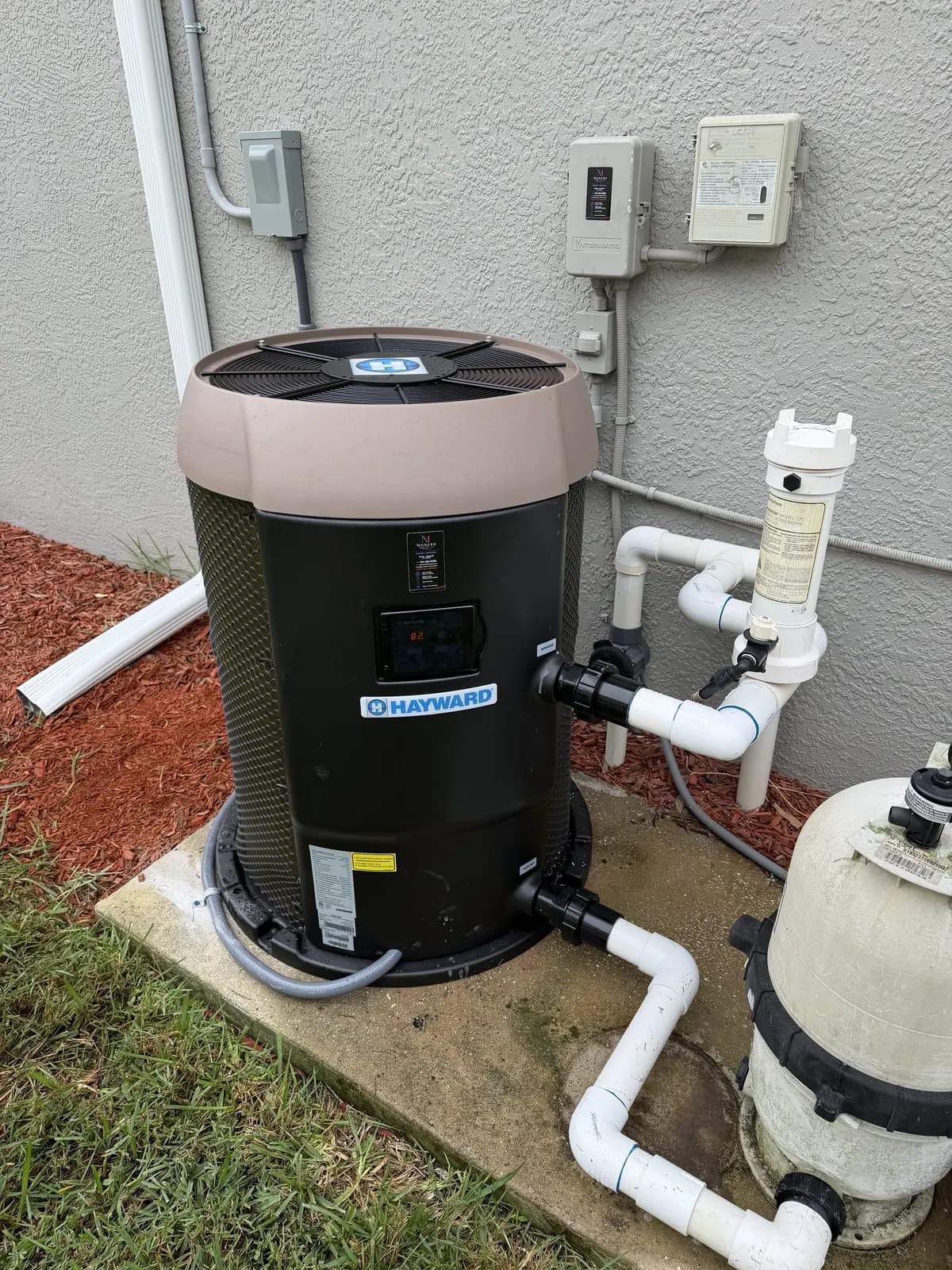
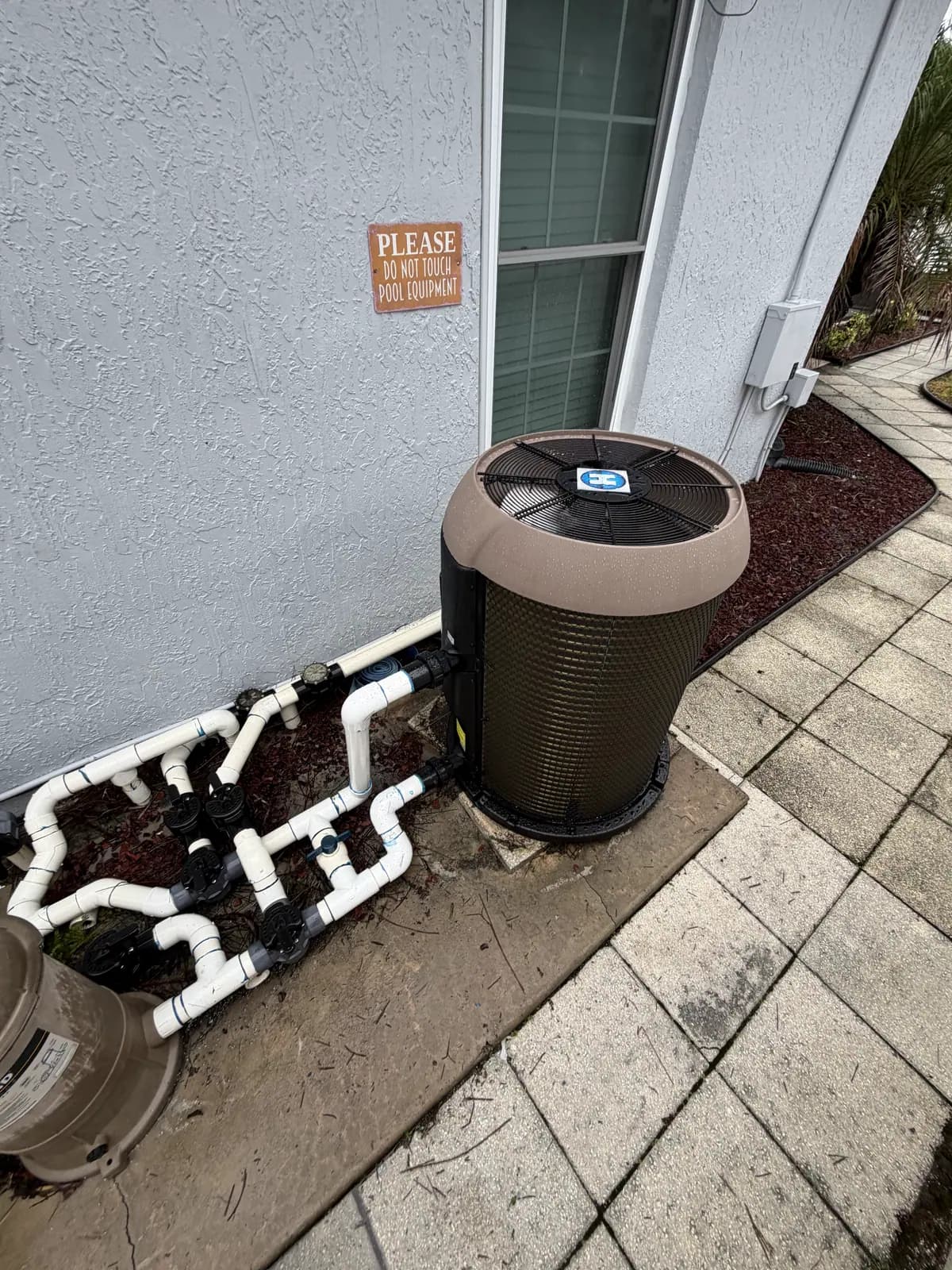
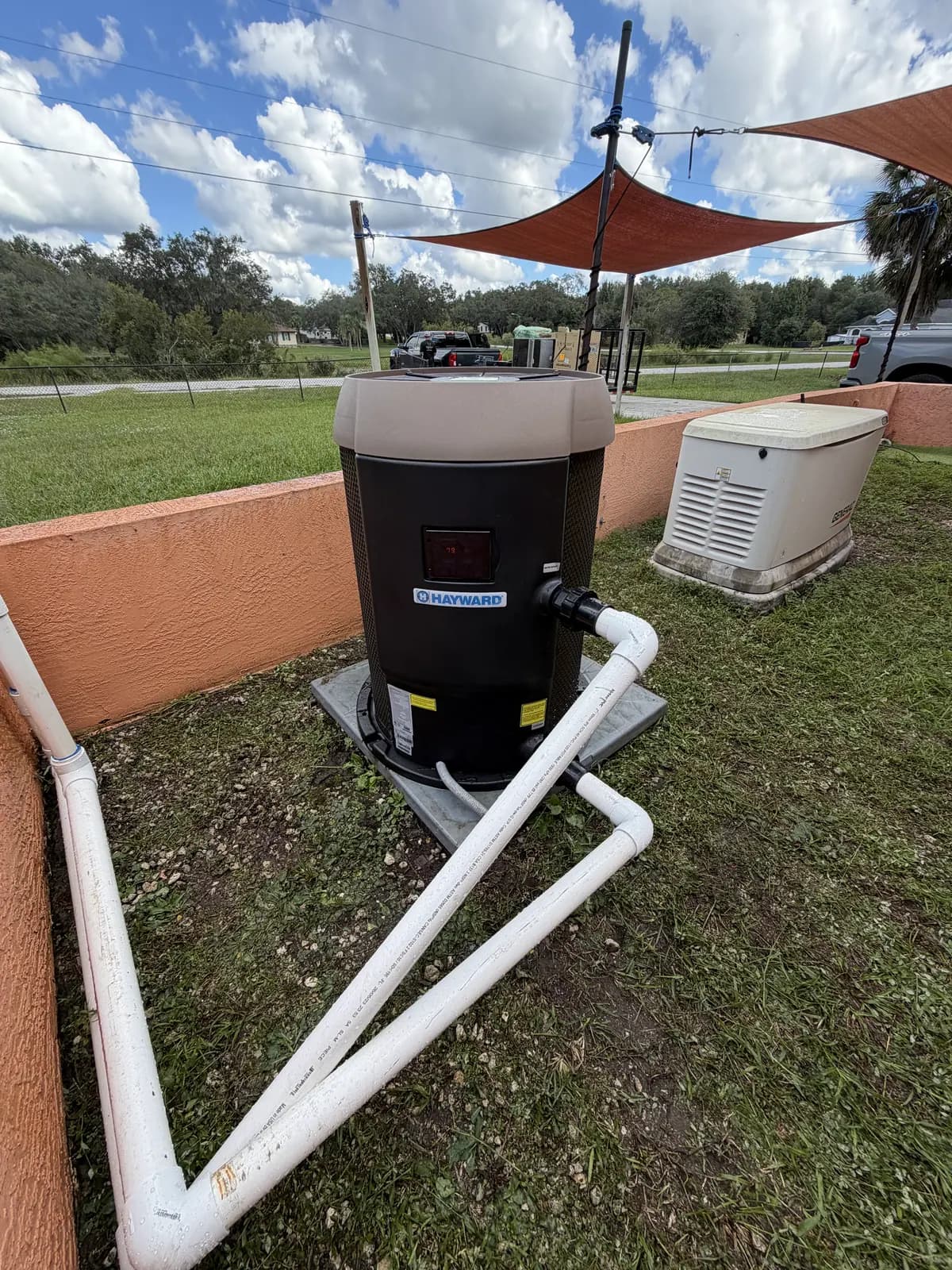
Heaters mentioned in this guide
Hayward · Universal H-Series
Hayward Universal H-Series H400FDN Gas Pool Heater
Model H400FDN
- BTU input
- 399,900 BTU/hr
- Thermal efficiency
- 84%
- Heat exchanger
- Cupro-nickel
- Warranty
- 3-Year Parts / 1-Year Labor
- Wi-Fi / automation
- App Control via AutomationAutomation Compatible (Relay)
A large Florida pool, or a pool and spa combination, that needs to reach temperature on demand rather than hold it all season.
Hayward · Universal H-Series
Hayward Universal H-Series H250FDN Gas Pool Heater
Model H250FDN
- BTU input
- 250,000 BTU/hr
- Thermal efficiency
- 84%
- Heat exchanger
- Cupro-nickel
- Warranty
- 3-Year Parts / 1-Year Labor
- Wi-Fi / automation
- App Control via AutomationAutomation Compatible (Relay)
An average-sized Florida pool, or a pool with a small spa, where you want gas-speed heat without paying for 400,000 BTU you will never use.
Hayward · HeatPro MCHX Series
Hayward HeatPro MCHX HP21405T Heat-Only Pool Heat Pump
Model HP21405T
- Heating capacity
- 138,000 BTU/hr
- Efficiency (COP)
- COP 5.7
- Heat exchanger
- Titanium
- Warranty
- 5-Year Parts / 2-Year Labor10-Year Heat Exchanger
- Wi-Fi / automation
- Automation Compatible (Relay)
A Gulf Coast pool that gets swum in most of the year and an owner who wants the lowest running cost from a mainstream brand their service company already stocks parts for.
Hayward · HeatPro MCHX Series
Hayward HeatPro MCHX HP31405T Heat+Chill Pool Heat Pump
Model HP31405T
- Heating capacity
- 135,000 BTU/hr
- Efficiency (COP)
- COP 5.7
- Heat exchanger
- Titanium
- Warranty
- 5-Year Parts / 2-Year Labor10-Year Heat Exchanger
- Wi-Fi / automation
- Automation Compatible (Relay)
A Florida pool that is too cold in February and too warm in August, where one unit doing both jobs is worth more than the cheapest way to heat.
Last verified September 17, 2026
Specifications and warranty terms are taken from the manufacturer documents below. Manufacturers revise these without notice, so confirm the current terms before you buy. If you spot something out of date, email us and we will fix it.
Sources
- Hayward — Universal H-Series Quick Reference Guide (diagnostic codes, flow requirements, gas pressure, power selection)
- Hayward — Universal H-Series Consumer Troubleshooting Guide CTSG-UHS16b (code list, sequence of operation, heat exchanger failure causes)
- Hayward — Universal H-Series Troubleshooting Guide UHS16b (per-code troubleshooting steps and part numbers)
- Hayward — HeatPro heat pump Installation and Operation Manual 51300122601 Rev C (Table 5 Display Code Index, flow, clearances, oceanfront guidance)
- Hayward — 2026 Expert Line residential warranty terms
Ratings on this site are the editorial opinion of Affordable Solar & Pool Heating, LLC, trading as Modern Pool Heating. How we rate heaters. Corrections: modernpoolheating@icloud.com.