Modern Pool Heating · Owner/operator Henry Manna, Florida Certified Pool/Spa Contractor CPC1460367
Updated October 16, 2026
Short answer
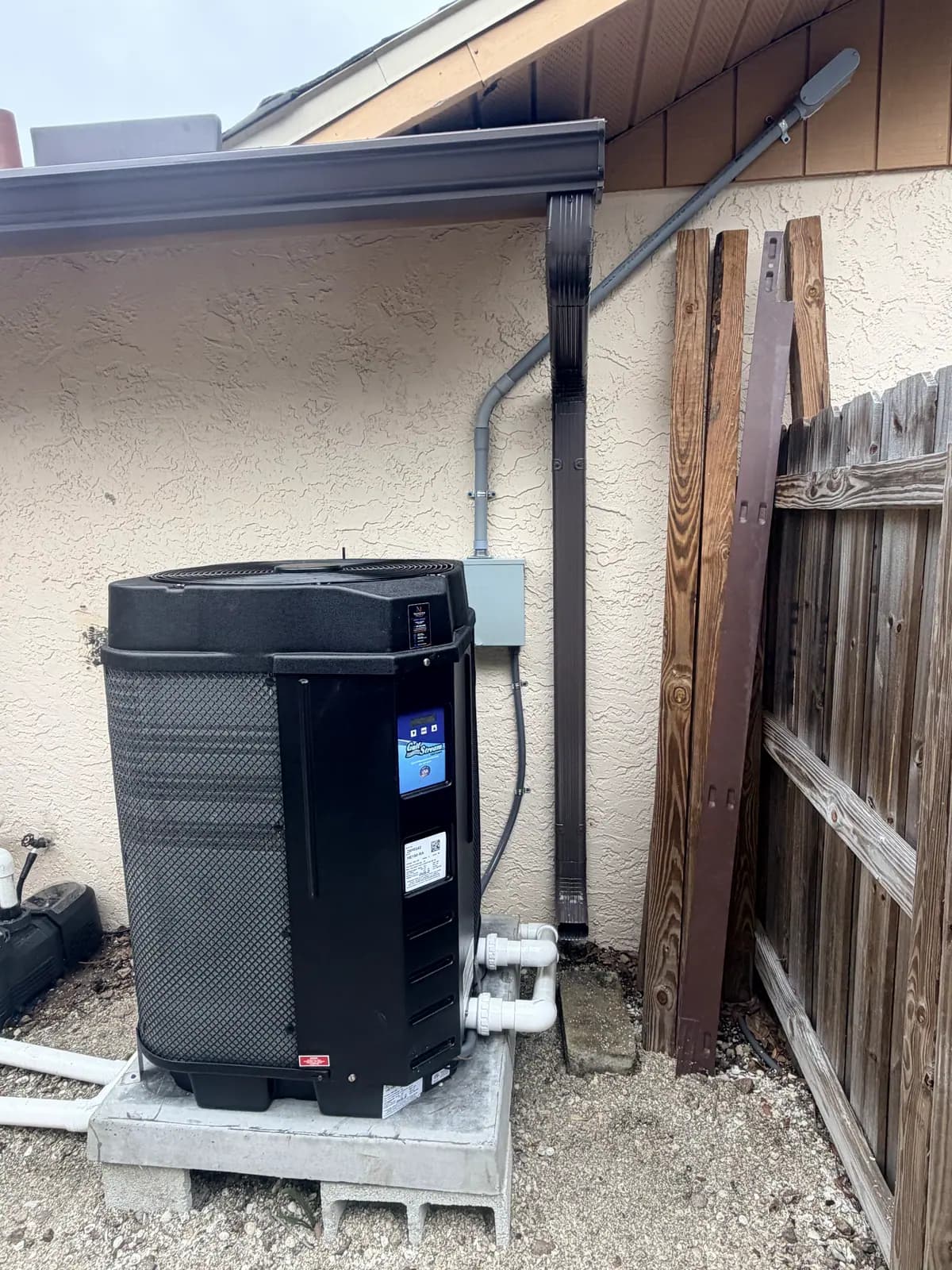
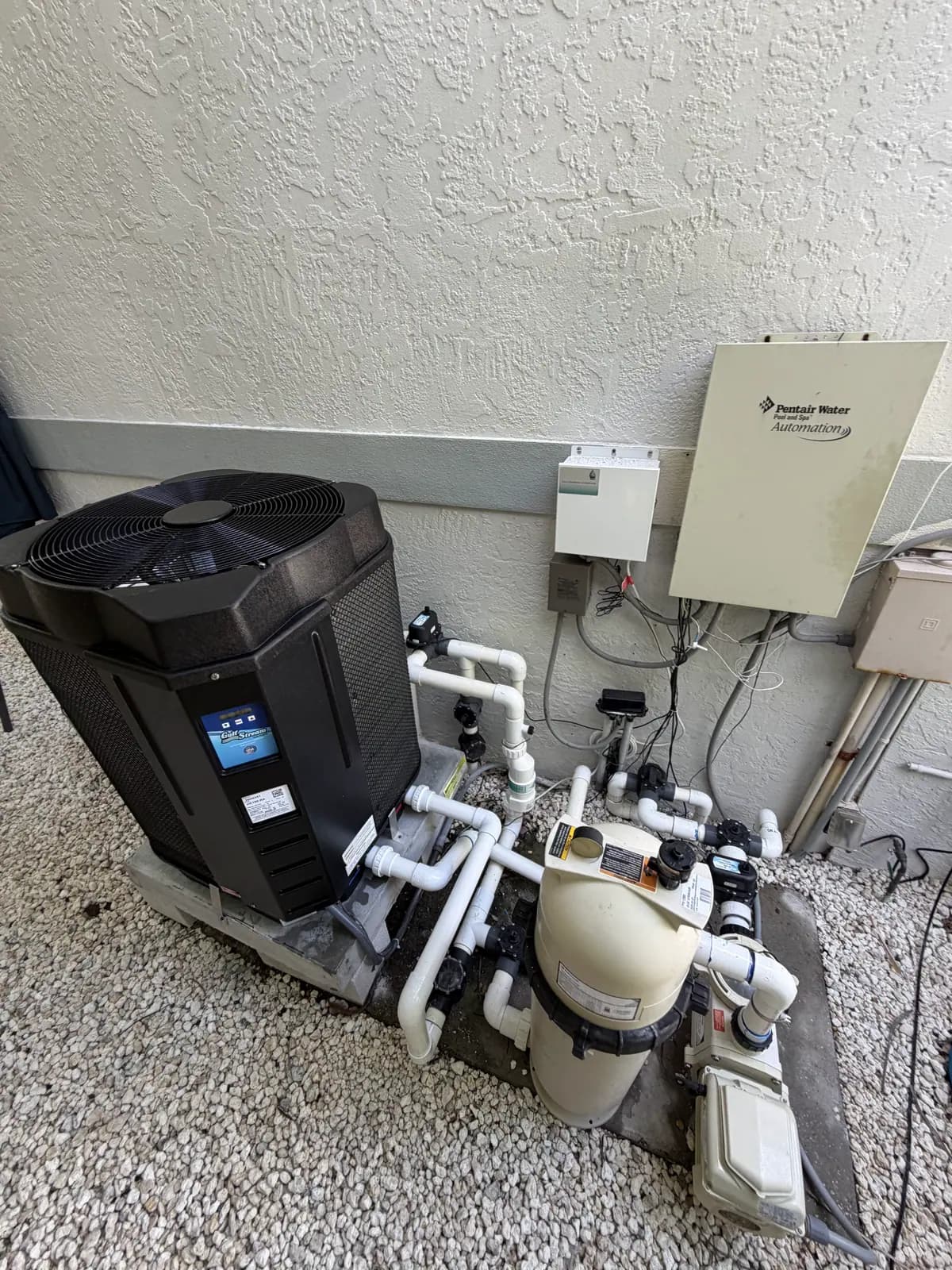
A like-for-like replacement, meaning the same type of heater on the same fuel in the same spot, is usually the least expensive way to replace a pool heater, because the new unit reuses the existing gas line or electrical circuit, the pad and most of the plumbing. Switching types costs more because the infrastructure changes: going from gas to a heat pump needs a new dedicated 240-volt circuit, and going from a heat pump to gas needs a gas supply and venting clearances. For reference, the two GulfStream heat pump installs in our gallery, both tied into the existing filter and pump, came in at $3,500–$4,500 and $3,995–$4,995. For a firm number on your replacement, send us a photo of the old heater's data plate and the pad, or call (941) 323-6559.
What we usually recommend
If the heater type you have suits how you use the pool and the old unit has failed in a way that isn't worth fixing, a like-for-like swap is usually the quickest and simplest replacement. If you're replacing an old gas heater on a pool you heat most of the winter, we'd usually price a heat pump alongside it, because the running-cost difference in Florida is large; check the electrical panel first, since the new circuit is the item that moves the price. And before you replace anything, have it diagnosed: plenty of heaters that seem dead need a part, not a new unit.
- Like-for-like replacements reuse the gas line or circuit, the pad and most of the plumbing; switching types changes all three.
- Gas to heat pump: the gas heater's 15 A control circuit can't run a heat pump, which needs its own 40 to 50 A breaker.
- Heat pump to gas: you need gas at the pad, a line sized for the heater, and vent and equipment clearances.
- Removal is real work, and an old heat pump's refrigerant has to be recovered before the unit is scrapped.
- Pool heater work generally needs a permit; we handle the permitting a job calls for.
Like-for-like vs switching type: why it matters to the price
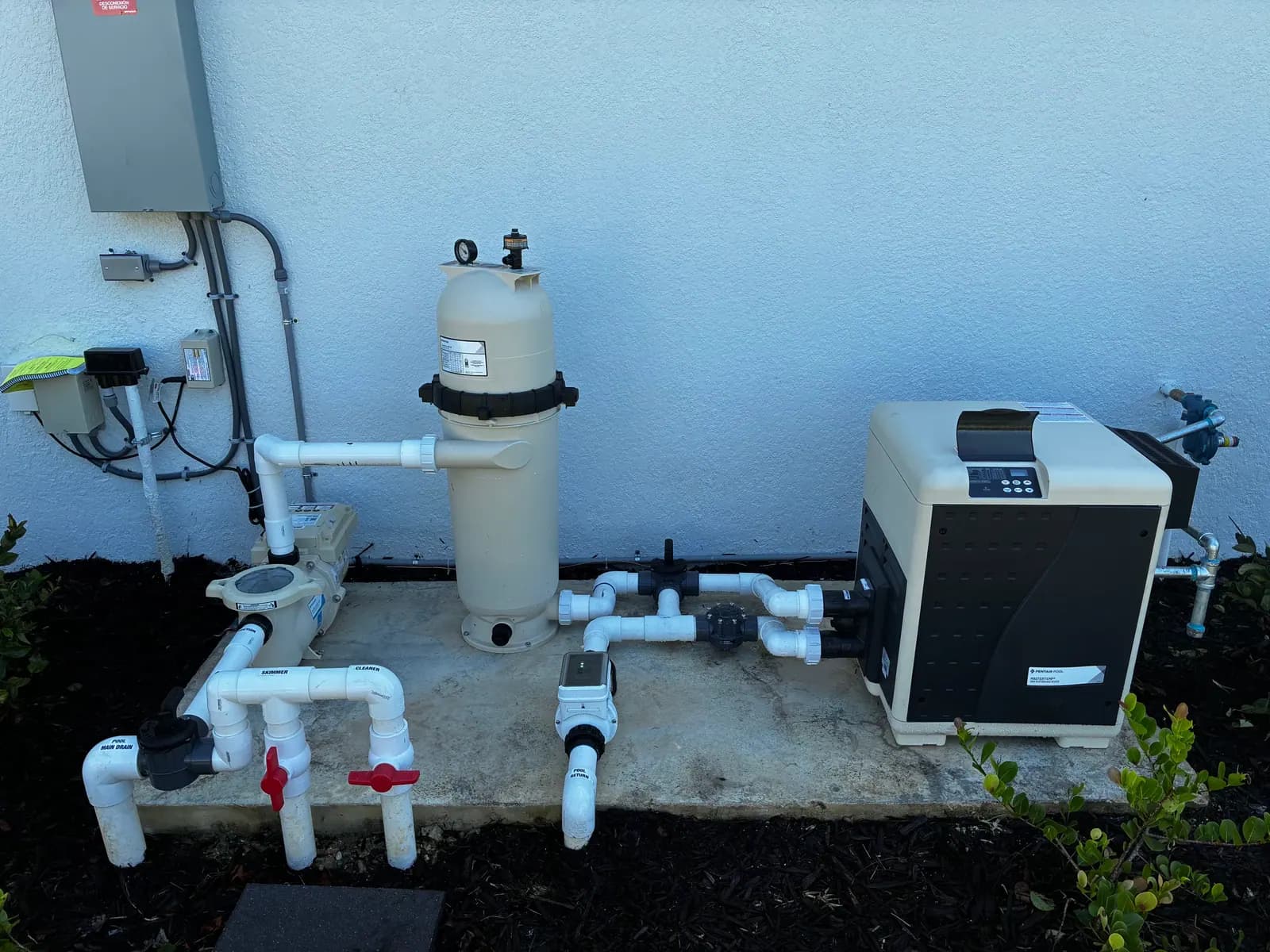
Much of what separates one replacement quote from another isn't the heater; it's what the new heater needs from the pad. When the new unit is the same type on the same fuel, it can usually reuse the gas line or the electrical circuit, sit on the same pad and connect to the same plumbing with a few adjustments. One of our gallery photos shows exactly that kind of job: a new Pentair MasterTemp set on the existing pad, where the rust stains from the old unit still show, and plumbed into the existing PVC manifold.
Even like for like, brands don't line up perfectly. MasterTemp heaters ship with 2-inch PVC slip unions, Hayward's Universal H-Series uses 2-inch by 2-1/2-inch CPVC unions, and heat pumps differ again: GulfStream uses 2-inch unions, and Hayward's HeatPro spaces its 2-inch connections 10.25 inches apart. Changing brands usually means re-plumbing the last few feet to meet the new connections, which is a small line on a quote but shouldn't be a surprise.
For a sense of scale, here's what heat pump jobs in our gallery with a published price included. Two GulfStream heat pumps, each tied into the customer's existing filter and pump, came in at $3,500–$4,500 and $3,995–$4,995. A Hayward heat pump installed in 2025 with new, clean equipment plumbing came in at $8,500–$9,500, and a 2024 rebuild that added a new electric heater, new plumbing and valves, automation and solar came in at $11,500–$12,500. The gallery doesn't record whether an old heater came out on each job, so treat them as what those installs cost, not as replacement prices. For current pricing on your replacement, call (941) 323-6559.
Switching from gas to a heat pump: what changes
The electrical circuit is the big one. A gas heater only needs power for its controls: Pentair calls for a 15 A circuit for the MasterTemp, and Hayward lists a 15 A maximum breaker for the H250FDN. A heat pump runs a compressor and needs far more. GulfStream's HE150-RA lists 37 minimum circuit amps and a 50 A maximum breaker; Hayward's HP21405T lists 42.5 A minimum circuit ampacity with a 50 A breaker recommended. The old circuit can't be reused, so a new one runs from the panel, and if the panel is full, that's where the cost grows.
Placement often changes too. Gas heaters are compact and can be tucked into a corner, like one of the Hayward gas heaters in our gallery; a MasterTemp is about 23 by 21 inches. A GulfStream HE unit is 31 by 31 inches and needs 12 inches of clearance on each side and four feet clear above, outdoors only, because it breathes the air around it. Heat pumps also produce condensate, up to three gallons an hour per GulfStream's manual, which has to drain away from the pad. The gas line to the old heater has to be shut off and capped safely.
Flow is the detail people miss. Pentair rates the MasterTemp for up to 120 GPM, while GulfStream lists a 70 GPM maximum for its heat pumps. A pump that suited the gas heater may push more water than the heat pump wants, in which case a bypass valve goes in.
The reason to make the switch is running cost. At current EIA prices, a million BTU of pool heat costs about $29 from natural gas at 84% efficiency and about $9.00 from a heat pump at COP 5. The trade-off is speed. Heat pumps warm a swimming pool gradually over many hours. Actual heating speed depends on pool volume, heater output, starting water temperature, outdoor air temperature, humidity, wind conditions and whether the pool is covered. If you use an attached spa often and want it hot quickly, keeping gas for the spa may make more sense than relying entirely on a heat pump.
Switching from a heat pump to gas: what changes
Going the other way, the cost depends almost entirely on gas. If natural gas already reaches the property, the job is a line from the meter to the pad sized for the heater's input; if it doesn't, it's a propane tank and line. Our gas installation cost article walks through line sizing, but the short version is that a 400,000 BTU heater needs considerably bigger pipe than a 250,000 BTU heater over the same run.
Clearances change as well. Pentair asks for 3 feet between the top of the MasterTemp's exhaust vent and any roof overhang and 36 inches from an air conditioner or heat pump, and it states that anchor clamps are required in Florida. A spot that suited a heat pump may not suit a gas heater. The heat pump's 40 to 50 A circuit is no longer needed for the heater; the gas heater's controls only need a 15 A circuit.
Removal, haul-away and the pad
Taking the old heater out is real work: shutting off and disconnecting the power and gas, draining it, cutting it out of the plumbing, carrying it out of the side yard and disposing of it. On a heat pump there's one more step. A heat pump holds refrigerant, and EPA rules make the final person in the disposal chain responsible for ensuring refrigerant is recovered before the equipment is disposed of. Your quote should say that removal and disposal are included, not leave it implied.
The pad is the next question. A pad poured for a compact gas heater may be too small for a heat pump, and an old pad may have cracked or settled. When there's no usable pad, a new base gets built; on our Tampa heat pump job the crew leveled a concrete-block base on the gravel before the unit went in. On waterfront and barrier-island lots, a replacement can also be the moment to raise the equipment. On Siesta Key, a homeowner had his pool equipment elevated, and that project came in at $4,500–$6,500. That was an equipment elevation, not a heater price, but it shows what pad work on its own can involve.
Re-plumbing, bypass and fixing what killed the old heater
A replacement is the right time to correct the plumbing. Heater manufacturers specify the order: GulfStream's manual lists pool pump, filter, heat pump, solar, then the chlorinator or salt cell, then the pool, and says a check valve can be installed between the chlorinator and the heat pump to prevent backflow. If the old heater's exchanger failed because a salt cell or chlorinator sat upstream of it, or because the water chemistry ran low for months, the same thing will happen to the new one unless the cause is fixed at the same time.
Other plumbing items that commonly come up on a replacement are a bypass valve when the pump moves more water than the new heater's maximum, unions so the new unit can be isolated and removed without cutting pipe, and re-wiring to the pool automation if you have it. Heaters connect to automation differently: GulfStream's HE line uses dry-contact remote thermostat terminals only, while Hayward's H-Series gas heaters provide two-wire and three-wire remote terminals and work with Hayward's Omni system. Ask whether the new heater will work with your controller the way the old one did.
Permits, warranty and buying the heater yourself
Pool heater work generally needs a permit, and the exact requirements differ between the City of Sarasota, unincorporated Sarasota County and the surrounding municipalities. We're a Florida Certified Pool/Spa Contractor (License #CPC1460367), and we handle the permitting a job calls for rather than leaving it with you. A replacement that adds a new electrical circuit or a new gas line involves more than a straight swap, and the quote should say who covers that part of the permitting.
Some homeowners look at buying the heater online and paying only for installation. Check the warranty first. Pentair's warranty page, which covers MasterTemp heaters and GulfStream heat pumps among others, says its published terms apply when the equipment is bought from a brick-and-mortar retailer, pool builder or pool service company and installed by a qualified professional who charges for the work; a unit bought from an internet retailer gets a one-year parts-only warranty with no labor coverage. Saving a little on the box can cost you much of the warranty.
Repair or replace first?
Before pricing a replacement, make sure the heater actually needs one. A board, an igniter, a pressure switch or a fan motor is an ordinary repair on most heaters. A leaking heat exchanger on a gas heater, a failed compressor on an older heat pump, repeated failures across seasons, or parts that are no longer made usually tip the decision toward replacement. Water reaching the burner tray, scorching inside the control box or a suspected gas leak end the discussion on safety grounds.
A common contractor rule of thumb, borrowed from HVAC, is that when a repair approaches half the price of a comparable new unit, replacing is usually the better move, especially on older equipment. It's a rule of thumb, not a standard. Our repair-or-replace guide goes through the decision in detail, including how to check whether the old heater is still under warranty from its data plate. If you're not sure what's wrong, a diagnostic visit is the place to start.
What to send for a fast replacement quote
Replacements are the easiest jobs to price from photos, because the old heater tells us most of what we need. Attach them to the quote form on our contact page (it takes up to four photos), email them to modernpoolheating@icloud.com, or call (941) 323-6559 and let us know they're coming. The most useful photo is the old heater's data plate, which shows the make, model, serial number, BTU rating and fuel or voltage. Add a wide shot of the equipment pad, any error code on the heater's display, and, if you're thinking of switching types, your electrical panel with the door open or your gas meter or propane tank.
Tell us how old the heater is if you know, and what it's doing or not doing. We repair and replace most makes of heat pump, gas heater and solar system regardless of who installed them, across Sarasota, Manatee, Charlotte & Pinellas County.
Pros and cons
Like-for-like replacement
Pros
- Reuses the gas line or electrical circuit, the pad and most of the plumbing.
- Usually the quickest replacement to schedule and install.
- No change to how you use the pool or spa.
Cons
- Keeps the running cost of the heater type you already have.
- Brand changes still need some re-plumbing to meet new connections.
Switching gas to heat pump
Pros
- About $9 per million BTU at COP 5 against about $29 on natural gas, at current EIA Florida prices.
- No gas line, meter or propane deliveries to maintain for the heater.
Cons
- Needs a new 240-volt circuit (a 40 to 50 A breaker on GulfStream's HE line) and possibly panel work.
- Heats gradually, so an attached spa won't come up as quickly as on gas.
- May need a new spot or pad for airflow clearances and condensate drainage.
Switching heat pump to gas
Pros
- Heats quickly and on demand, which suits an attached spa and occasional use.
- Output doesn't fall in cold air the way a heat pump's does.
Cons
- Needs gas at the pad: a natural gas line sized for the heater, or a propane tank and line.
- Costs roughly three times as much per unit of heat as a heat pump on natural gas, more on propane.
What this costs
We give a written, itemized price after we have seen your equipment pad. The pad, the plumbing, the electrical service and the gas supply decide most of the cost, so a number given before anyone has looked at them is a guess.
What moves the price
- Existing heater removal: disconnecting, hauling and disposing of the old unit.
- Existing plumbing: whether the current lines can be reused or need re-piping to reach the new equipment.
- Electrical service: whether the panel has room and capacity for a new 240-volt circuit.
- Breaker and disconnect: a correctly sized dedicated breaker, wire run and outdoor disconnect.
- Gas supply: natural gas at the street, an existing propane tank, or a new tank and line.
- Equipment pad: whether there is a level pad in the right spot or one has to be poured or built.
- Equipment access: tight side yards, long carries and anything that slows the install.
- Installation complexity: permits, multi-story roofs, long pipe runs and anything unusual about the site.
What recent jobs cost
These are the actual price ranges for specific past jobs shown in our gallery, not quotes or averages. Your price depends on your pad, plumbing and electrical.
GulfStream Heat Pump
$3,500-$4,500The customer wanted a locally manufactured heater, and GulfStream is made right in North Fort Myers, Florida. We installed it alongside the existing filter and pump for efficient, thermostatically controlled pool heating.
See it in the gallery: GulfStream Heat PumpPool Equipment Rebuild
$11,500-$12,500A full rebuild of the pool's plumbing with new valves, a new electric heater and automation, plus pool solar to help hold the heat and lower the operating cost of the electric heater. Completed in 2024.
See it in the gallery: Pool Equipment RebuildHeater & Pool Equipment
$8,500-$9,500Completed in 2025, this customer wanted a Hayward heater and pool equipment plumbing that is clean and aesthetically pleasing.
See it in the gallery: Heater & Pool EquipmentGulfStream Pool Heat Pump Installation
$3,995-$4,995A GulfStream pool heat pump, manufactured in North Fort Myers, Florida, set on the equipment pad and plumbed into the existing filter and pump.
See it in the gallery: GulfStream Pool Heat Pump InstallationReal installations
Recent jobs from our installation library that relate to this topic.